
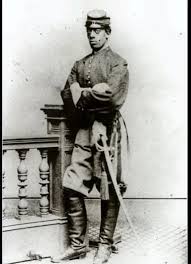
 I was looking for information about my great-great-grandfather, James Archer, who fought in the Civil War in the 26th New York (colored). Or perhaps his brother-in-law, Henry Bell, who fought in the 54th Massachusetts (colored).
But I came across this document from the 5th Massachusetts (Colored) Cavalry:
“THE Fifth Cavalry Regiment, composed of colored men, was organized during the autumn of 1863 and the following winter; but the first company, A, was not ready for muster until the 9th of January, 1864; three other companies were mustered on the 29th, E on the 10th of February, F on the 23d; three companies were filled during March, and two in April, but it was not till the 5th of May that Company M was ready for the mustering officer.
“On that day, the First Battalion of four companies under Major Weld left camp en route to Washington; the Second Battalion followed next day under the command of Major Adams, and the Third Battalion, under Major Bowditch, on the 8th. The organization at this time numbered 930 officers and men, the commissions issued being as follows:”
Officers
There’s a recitation of the colonel, Henry S. Russell of Boston; three majors; a surgeon and two assistant surgeons; an adjutant; a quartermaster, a sergeant major, Alfred Froman, all of Boston; quartermaster sergeant; commissary sergeant; a hospital steward; and, to my joy, a principal musician. Most of them were from the Boston area.
Then there was a listing of the captains, first lieutenants, and second lieutenants for Companies A-I and K-M. Most were from the Boston metro, though one captain and three lieutenants were from San Francisco.
“The various battalions as they reached Washington reported at Camp Casey, near Fort Albany, on the Virginia side of the Potomac, some two miles from Long Bridge, Colonel Russell being placed in command of a provisional brigade of colored troops assembling there for instruction and discipline.” I’ve read elsewhere that black soldiers captured in Confederate territory were more likely to be executed than captured.
“The Third Battalion had been in camp only two days, however, when the regiment was ordered to report to General Butler at Fortress Monroe, reaching City Point on the 16th of May, where the regiment formed part of the Third Division, Eighteenth Corps. Being armed as infantry, the command was industriously drilled in that branch of tactics, performing guard and picket duty meanwhile, and taking part in various expeditions.
Casualities
“These were without serious engagement or loss till the 15th of June, when the division, under the command of General E. W. Hincks, moved toward Petersburg and the battle of Baylor’s Farm was fought. This was the only conflict in which the Fifth took an active part, and its loss was not severe: three killed and 19 wounded. Among the latter were Colonel Russell and Major Adams, leaving the regiment under the command of Major Bowditch.
“During the latter portion of the 15th, the command was in support of a battery, and the following day was held in reserve… Most of the remainder of the month was passed in picket duty on the north side of the Appomattox, where Hincks’s Division relieved troops of the Tenth Corps, but toward the close of the month, the regiment was assigned to duty at Point Lookout, Md., as garrison for the camp of Confederate prisoners of war at that place. Arriving there on the 1st of July, the regiment remained during the balance of the year, being at first under the command of Major Weld…
After a realignment of officers, “the regiment took the field for the closing campaign of the war, and was on duty in front of Petersburg till the fall of that stronghold.”From here: ” One of the most significant contributions of the Regiment… was its participation in the Appomattox Campaign in Virginia. The regiment played a vital role in the final days of the Civil War, engaging Confederate forces and contributing to the ultimate victory of the Union Army. The bravery and skill of the regiment’s soldiers were instrumental in securing this crucial triumph.”
Richmond
From here:” The Fifth participated in the occupation of Richmond after the surrender of Lee. The all-white electorate chose former Mayor Joseph Mayo as the new mayor. Incredibly, Mayo reinstated the pass system that had been used under slavery, under which blacks on the streets had to have passes signed by their white employers. When the men of the 5th demanded that whites also produce passes, they provoked outrage among the city’s white residents! Col. Charles F. Adams was placed under arrest for allowing his men to straggle and ‘maraud.’ The charges were dismissed after two weeks.”
[They were] subsequently encamped in the vicinity till sometime in June, when they were ordered to Texas. [Recently promoted] “Colonel Chamberlain at once joined his new command, which had been heavily taxed in the construction of fortifications, and like work, and was suffering severely in health. He warmly interested himself in the welfare of his men, and an improvement in their sanitary condition was soon apparent.
“The prospect of complications with the French troops in Mexico having disappeared, the regiment was finally mustered out of the United States service on the 31st of October, 1865, and set out for Massachusetts, making most of the journey by steamer; on reaching Boston it went into camp at Gallop’s Island where it remained till late in November, when the men were paid and discharged.”
Here’s a book on the topic.

Great too know your history.