
The Blind Person Rule

Another source of irritation occurs when one of my neighbors parks his car so that it totally blocks the sidewalk, forcing one to either walk in the street or squeeze between this car and the other car in the driveway.

One of the rules I try to enforce in our household is to not have anything on the floor where someone – mostly likely, me – might trip over it at night when the lights are out. Makes sense, right? I have tried to apply that idea to my sidewalk and walkways. No unnecessary debris, such as branches. It is obvious, however, that not everyone shares my zeal.

I may have told this story before, but, years later, it still irritates me. Sometime in the past decade, a blind man was walking across Madison Avenue in Albany from the corner nearest the police station to the corner where the Bruegger’s bagel shop was/is located. He was doing fine until he almost walked into a car that had totally blocked the crosswalk. The driver of the car, as you might guess, was inside the Bruegger’s picking up some food. I’m sure he was thinking, “I’ll only be a minute.” But it was disruptive to the pedestrian, who felt his way around the car and finally made his way to the sidewalk. And it was frustrating to me, who was far enough up North Allen that I could not help him, or even yell to him coherently.

I was also roiled because there was a real parking spot about three car lengths away. Moving there was obviously too onerous for the driver to do. Unfortunately, he drove away before either seeing the disruption he caused or before I could reach him to (probably unkindly) inform him of his bête noire.

Another source of irritation occurs when one of my neighbors parks his car so that it totally blocks the sidewalk, forcing one to either walk in the street or squeeze between this car and the other car in the driveway. This has happened more than once. This situation could have avoided if the first car in the driveway had pulled in farther. The problem is amplified when there are snowbanks on the grass, especially when trying to use a shopping cart. This is frustrating for a sighted person; imagine how much more frustrating it would be to one who is not.

So keep your walkways free of debris, ice, snow, and vehicles. That includes bicycles, such as the one I saw lying in the middle of the sidewalk in front of a food establishment on Lark Street a while back. Think about how you would fare there if you could not see.
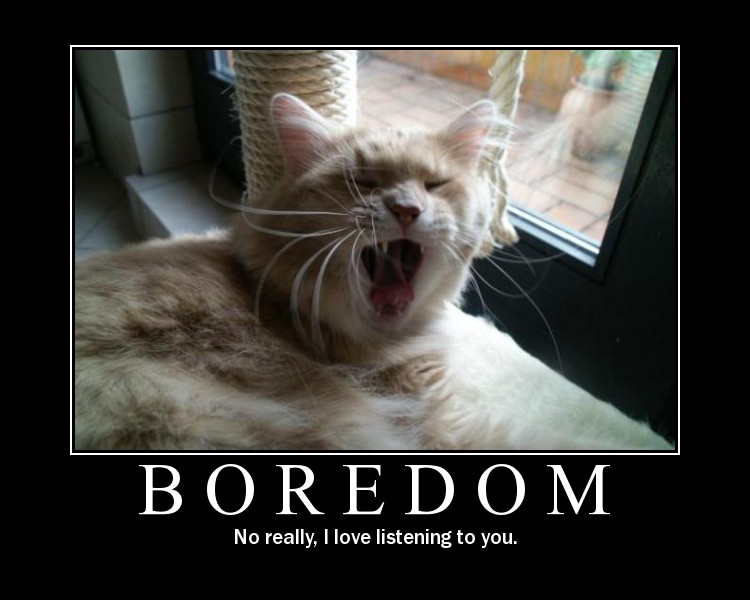
I do not usually understand “I’m bored”

This is not to say that I’m never bored. Trapped in someone else’s time frame WILL bore me silly. In a long meeting that is top down?

I was reading on Facebook about some actual acquaintance of mine whose family was out of town for the weekend. He was expressing how lonely and bored he was, as he didn’t know what to do with himself. I thought it was rather sweet and endearing, actually.

Still, I also found it odd. On those rare occasions that my wife takes The Daughter to visit the grandparents, I miss them. But I always have a litany of things to read, watch and/or listen to, and other projects. I am never bored by my own company, probably a function of living alone more than half my adult life.

This is not to say that I’m never bored. Trapped in someone else’s time frame WILL bore me silly. In a long meeting that is top-down? A yawn; Presbyterians have LOTS of meetings, which I avoid as much as possible. Stuck three hours in Wal-Mart (and it HAS happened)? REALLY boring – it’s shopping, which I dislike, and it’s Wal-Mart, which I’m not fond of. The only way that situation would have been salvageable is if I had had something to read and a place to sit down and read it. IF there’s something to read, AND I have the opportunity to do so, I am NEVER bored.

When, if ever, are you bored?

U is for Unions

There definitely has been hostility towards unions in recent years.

Here is the state of unionized United States.

In 2011, the union membership rate–the percent of wage and salary workers who were members of a union–was 11.8 percent, essentially unchanged from 11.9 percent in 2010. The number of wage and salary workers belonging to unions [was] at 14.8 million… In 1983, the first year for which comparable union data are available, the union membership rate was 20.1 percent and there were 17.7 million union workers.

In 2011, 7.6 million employees in the public sector belonged to a union, compared with 7.2 million union workers in the private sector.

The union membership rate for public-sector workers (37.0 percent) was substantially higher than the rate for private-sector workers (6.9 percent)…Among full-time wage and salary workers, union members had median usual weekly earnings of $938, while those who were not union members had median weekly earnings of $729.

The role of unions has been a source of much debate. Some find unions not so important to the modern economy, with such a relatively small percentage of workers currently unionized. Others note that this declining union membership parallels the sharp decline in the share of the country’s income going to the middle class; I count myself in the latter group.

This generates the question, Why did labor unions start in the first place? “Labor unions are associations of workers who are banded together for the purpose of improving their employment conditions and protecting themselves and their coworkers from economic and legal exploitation.” Unions are almost always formed as a reaction to a situation.

There definitely has been hostility towards unions in recent years. A Kenneth Cole fashion ad managed to dis teachers and their unions. A local newspaper writer got into a bit of a kerfuffle over her anti-union remarks.

I have been watching events in the state of Wisconsin with fascination. First, the people elected an anti-union governor, Scott Walker in 2010. Then, as he attempted to make draconian cuts to the budget, and paint union members less than favorably (an understatement), a massive and sustained protest of workers – teachers, firefighters, and many others – literally rocked the statehouse. Now, over a million Wisconsinites signed on to try to recall the governor, in an election, coincidentally being held today.

The librarians at the Albany Public Library have had a union for less than two decades, and it was initiated by the weather. On Saturday, March 13, 1993, there was a warning for a severe snowstorm in Albany, from a storm that already had pelted locations as far south as Alabama and Florida with severe weather. The city had told people to get off the roads. The library director, who I’ll call Bill, could not be reached. The librarians made a collective decision to close the facilities early, and it was a good thing: the airport received over 26 inches (over 2/3 of a meter) of snow in what has been dubbed The Storm of the Century. The autocratic director was furious that the staff had acted without his say-so, and took disciplinary action against some employees. Though the punishment was later rescinded (I believe) because of negative publicity, this became the impetus for a union at APL.

No doubt there have been excesses in unions over the years – my first image of the union involved tough guy Jimmy Hoffa – but unions also can advocate for a fair shake in a manner that individual workers simply cannot.

Last cartoon:

ABC Wednesday – Round 10

‘Cause like a good neighbor…

At the beginning of the school year, we were coming home and this college student was waiting for us so he could introduce himself, and his mother, to us.

We have been in our house for 12 years as of May 8. Since that time, neither of our immediate neighbors live there anymore. On the one side, there were a couple of sisters and their kids and their husbands or boyfriends. They were a tad uncouth, especially in the summer when I could hear the occasional profanity-laden tirades. But we got along well enough to negotiate the building of a fence between us, sharing the cost; the old fence was falling apart. (See MENDING WALL by Robert Frost.)

The guy now is a lot quieter, and responsible. He seems to have a LOT of tenants, though, and I don’t know if they are relatives or borders; if the latter, that’d be in violation of the city code.

On the other side was a great family. But the patriarch died. One family member bought a second house a few houses down but then moved out of the original house. This guy who does not live there purchased the building, renting it out to three distinct groups of college students a couple of years ago. The young women who lived there the first year were terrible. They might sit on the second-floor porch and pour their half-drunk beer out onto the ground, which would inevitably spray in our direction.

But the guys this year were great. At the beginning of the school year, we were coming home and this college student was waiting for us so he could introduce himself, and his mother, to us. Two hours later, he brought one of his roommates over to introduce him to us. We were in shock. Another guy engaged us while we were doing yard work. I actually knew them by name (Daniel, Andrew, Sam, among others), whereas the women last year, save one grad student who was living alone, wouldn’t even acknowledge our presence with a nod of the head. When we’ve had issues with the guys (cigarette butts on our lawn, a bit of noise), we were able to talk to them and the situation would be rectified.

So when they had a graduation party, they invited us over. We got to meet (or meet again) their parents, and other folks in their lives, including a writer from the local newspaper, Steve Barnes; one of the guys had an internship at the paper. I’m going to actually miss those fellows, and hope their replacements will be as civil.

Oh, and the former next-door neighbor let us use the electric lawnmower. I try to use the reel mower, but busyness plus rain can preclude that.
***
Richard Dawson died. I watched him on Family Feud – but his successors not so much – and also enjoyed him on Match Game and the comedy Hogan’s Heroes. Here’s a Hogan’s Heroes tunnel gag, and Dawson discussing meeting his wife on Family Feud.

Example #74 of why the Internet is weird: Samantha Brick

nt Laura Logan, assuming – ASSUMING – that she was merely hired for her looks.

Shortly before I went on vacation, or holiday, if you prefer, last month, there was this great Internet kerfuffle about this 41-year-old writer named Samantha Brick, who graced the Daily Mail [UK] with a long article about, according to this assessment, “the advantages of her great pulchritude (lots of attention from men, who only have to drive past her in their cars to be overcome with the need to purchase a gift for her) and the disadvantages (unerring hatred from all women, who are jealous of the threat Brick’s very existence poses to their own relationships with said men).”

She took a lot of heat for this from literally, all over the world, including some people who suggested she wasn’t “all that” physically, in that nasty way the Internet can be. I probably would ignore it except for this subsequent article from Salon, which noted that “the backlash to the backlash kicked in.” Too much piling on; enough is enough. She was compared with performer Rebecca Black, noted for the oft-watched, oft-loathed song Friday.

I’m less interested in Samantha Brick (or Rebecca Black, for that matter) than with the notion that women, particularly attractive ones in the workplace, may not be taken seriously, with the assumption that they are gliding by on their physical features. I still recall a prominent newspaper editor make a disparaging remark about CBS News correspondent Laura Logan, assuming – ASSUMING – that she was merely hired for her looks when she in fact had been working in war zones. Brick’s point, if better presented, might have actually been a teachable moment.

Instead, as we’ve seen so often before, we recognize that there seem to be no boundaries as to what people seem to have been given permission online. 

Ramblin' with Roger
Social media & sharing icons powered by UltimatelySocial