QUESTION: What is your Third Place?

For budgetary reasons, the main library now closes at 6 p.m. on Thursday nights, and none of the branches are open either.

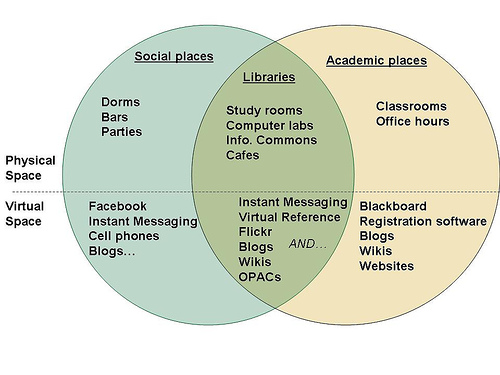
Since this is 3/3, no matter whether you’re a 3 March person or a March 3 individual, I thought I’d ask what your third place is. The third place is a term used in the concept of community building to refer to social surroundings separate from the two usual social environments of home and the workplace.

My third place – shockingly! -is the Albany Public Library. That’s where I tend to go when I’m waiting. If I’m finished with my dentist appointment downtown, but the next bus out to Corporate Woods doesn’t come for a half-hour, I’ll go to the library, e.g.

But my third place schedule has been severely disrupted. My favorite time to go to the library was on Thursday nights, after work and before 7:30 choir rehearsal; I would get quite a bit of blogging done there on the computers, maybe a couple of pieces. But, for budgetary reasons, the main library now closes at 6 p.m. on Thursday nights, and none of the branches are open that evening either. I’ve stolenborrowed my daughter’s little pink laptop and gone to a Starbucks one Thursday evening and another coffee shop on Lark Street in Albany another, but it’s just not the same.

Do you have a third place?

Graphic from MCHABIB.com.

The cat in the hat came back, wrecked a lot of havoc

“Half of the song is about somebody trying to get in touch with someone who can sleep on his floor. The other half – you’re on your own.”

The lyrics to The sidewinder sleeps tonight by R.E.M. from the Automatic for the People album:

Baby, instant soup doesn’t really grab me.
Today I need something more sub-sub-sub-substantial.
A can of beans or blackeyed peas, some Nescafe and ice,
a candy bar, a falling star, or a reading of Doctor Seuss;

Call me when you try to wake her up. Call me when you try to wake her…

The cat in the hat came back, wrecked a lot of havoc on the way,
always had a smile and a reason to pretend.
But their world has flat backgrounds and little need to sleep but to dream.
The sidewinder sleeps on his back.

But What does it MEAN? That is if you can even make out the lyrics; the word “Jamaica” appears nowhere in this song, one of the most misunderstood pop texts ever. Making an effort to interpret Michael Stipe’s lyrics in this song, R.E.M. bass player Mike Mills said, “Half of the song is about somebody trying to get in touch with someone who can sleep on his floor. The other half – you’re on your own.”

Here’s The sidewinder sleeps tonight by R.E.M.


Not incidentally, Dr. Seuss was born 108 years ago today. He died on September 24, 1991, about a year before the Automatic for the People album was released.

From MAD: The Idiotical: Dr. Seuss for the Digital Age

The movie Dr. Seuss’ The Lorax opens today.

Shelly Goldstein reads a story about marriage equality, in the style of the day.

Harry Belafonte is 85

Harry Belafonte was an artist who used his celebrity for good.

Harry Belafonte, who turns 85 today, is a hero to me. Based on his record collection, my late father was likewise taken; moreover, I think Belafonte was a model for my father’s life.

If you’re not familiar with him, here’s an apt description from the Charlie Rose website:
Harold Belafonte, Jr. is an African-American musician, actor and radical social activist of Jamaican ancestry. One of the most successful Jamaican musicians in history, he was dubbed the “King of Calypso” for popularizing the Caribbean musical style in the 1950s. Belafonte is perhaps best known for singing the “Banana Boat Song”, with its signature lyric “Day-O”. Throughout his career, he has been an advocate for civil rights and humanitarian causes. In recent years he has been a vocal critic of the policies of the Bush Administration.

My father used to sing in the Binghamton, NY area when I was growing up. He was a “singer of folk songs,” which he found to be an important distinction from being a “folk singer,” a term he found too confining. And like Belafonte, he sang in a variety of styles.

My father’s musical repertoire, I understood far later, came from a variety of sources: Woody Guthrie, Pete Seeger, Odetta, Leadbelly, Jimmie Rogers and very definitely, Belafonte. In fact, here’s one song called There’s A Hole in My Bucket by Belafonte and Odetta, which my father used to sing, until my sister Leslie and I joined his act and stole it from him.

Harry Belafonte was an artist who used his celebrity for good. He was not one to shut up and sing, or act, as though he had forfeited his rights as a citizen, something we in my household admired greatly. He was quite active, for instance, working with Martin Luther King, Jr. Read The amazing American journey of Harry Belafonte -Day-O! How the singer-activist blended Caribbean shtick and fierce political passion. Also, watch this segment of CBS News Sunday Morning.

And if sleeps through an occasional interview, he’s entitled!
***
Davy Jones of the Monkees died this week. I was not a big Monkees fan, but I distinctly remember wanting a Monkees Greatest Hits album and getting it one Christmas. Mark Evanier tells a lovely story about Davy Jones from just a few weeks ago; seemed like a great guy. Here’s the Monkees doing It’s Nice To Be With You.


February Rambling: Military Draft, Muppets and Graceland

“’Soul Train’ was the first and only television show to showcase and put a spotlight on black artists at a time when there were few African-Americans on television at all, and that was the great vision of Don.”


When I mentioned the military draft earlier in the month, I may not have been very clear. Think of a large goldfish bowl with 365 or 366 balls with every date for the year represented. The first date for a particular year pulled would be the first selected for military service, the second date pulled the second selected, etc. There would be a cutoff number, based on the need for the war effort. Check out this article and then this one.

The food stamp President; note that Arthur had this BEFORE MoveOn.com helped propel it viral. He also remembers the first anniversary of the Christchurch, New Zealand earthquake, the 50th anniversary of John Glenn’s flight aboard Friendship 7, and the 200th anniversary of the birth of Charles Dickens.

Rosa Parks Did Much More than Sit on a Bus

The Stories I Tell: “Like most of us I was raised to tell the truth and be honest. This can present a minor dilemma for resellers.”

How a mom used Star Wars to answer life’s questions

Marvel/Disney wages petty, vicious war against Ghost Rider creator. Yeah, there are two sides to this story, but Disney’s treatment of writer Gary Friedrich is still most unfortunate. Here’s a more nuanced piece that links to a donate to Gary site. Incidentally, in the comments to the former piece, someone was complaining that Friedrich was selling the art of Mike Ploog, penciler of Ghost Rider. I don’t know about the specifics of this case, but as former Marvel editor-in-chief Jim Shooter explained here and here, art pages, which previous to the 1970s were rarely returned at all by comic book companies, were distributed to various participants of the story; this included the writer, though they usually got last dibs. Shooter does explain Marvel’s likely point of view, and here’s a Marvel rebuttal.

I swear I had the same problem as Mitch O’Connell.

I read in Entertainment Weekly about this website that has the feature If 2012’s Oscar-nominated movie posters told the truth. This one riffing on The Help is funny, but so are several others.

I was saddened by the death of “Soul Train” host Don Cornelius of a self-inflicted gunshot wound. From the LA Times: “Don Cornelius’ legacy to music, especially black music, will be forever cemented in history,” said Clarence Avant, former chairman of Motown Records. “’Soul Train’ was the first and only television show to showcase and put a spotlight on black artists at a time when there were few African-Americans on television at all, and that was the great vision of Don.”
But I also remember tuning in when unlikely guests would show up, such as David Bowie performing Fame and Golden Years.

Read about comic book legend John Severin, who died at the age of 90, here and here and here.

The Wicker Muppet and A Muppet phenomenon and REALLY early Muppets.

The film trailer for “Under African Skies,” “the documentary from award-winning filmmaker Joe Berlinger. Paul Simon travels back to South Africa 25 years after his first visit, chronicling the creation and lasting influence of his groundbreaking album, Graceland. Simon revisits the making of the record, surveying from the vantage of history the turbulence and controversy surrounding the album’s genesis.”

HOW TO mix a grody-looking Alien Brain Hemorrhage cocktail
***
ROGER AT OTHER BLOGS

Interestingly, on most of these, I don’t get many comments. But I DO get an occasional LIKE on Facebook or retweet on Twitter, so it’s all good. Oh, and speaking of Facebook, I now have but one Facebook account. So if you want to “friend” me, it needs to be this account, the one with the duck logo.

Obviously, we’re still working on that “change the world” thing – also noting Graham Nash’s 70th birthday.

The GIANTS WIN THE PENNANT! The GIANTS WIN THE PENNANT!

Secrets of the public bathroom

Caring about Multiple Things Simultaneously, which is less about Whitney Houston, and more about people who think other folks shouldn’t care about Whitney Houston’s death

Alan Moore’s Twilight Proposal. Flashmob Fridays’ final outing.

Even a Megaphone Might Have Helped: Albany’s Black History Month bit

Scott Ritter is…complicated

In the spirit of Woody Guthrie. Well, maybe funnier.

The City of Albany didn’t even know the sign was missing until someone – OK, I – pointed it out.

G is for Gerrymander

The US Supreme Court ruled that Congressional and state legislative districts had to be roughly equal in population, consistent with the “one man (later, one person), one vote” doctrine.

Gerrymandering is a word that means “a practice that attempts to establish [in the process of setting electoral districts] a political advantage for a particular party or group by manipulating geographic boundaries to create partisan, incumbent-protected districts. Gerrymandering may be used to achieve desired electoral results for a particular party, or may be used to help or hinder a particular demographic, such as a political, racial, linguistic, religious or class group.”

The term was created way back in the early 19th century concerning the redrawing of the “Massachusetts state senate election districts under the then-governor Elbridge Gerry…to benefit his Democratic-Republican Party. When mapped, one of the contorted districts in the Boston area was said to resemble the shape of a salamander.”

Thus GERRY+SALAMANDER=GERYYMANDER. Oddly, though, the first syllable in gerrymander sounds like JERRY, Gerry’s name sounds like Gary. Gerry, incidentally was the second Vice President of the US to die in office, after George Clinton, both under James Madison.

The US Supreme Court ruled, in Baker v. Carr (1962) and Reynolds v. Sims (1964), that Congressional and state legislative districts had to be roughly equal in population, consistent with the “one man (later, one person), one vote” doctrine. This was a good thing: some districts had 10 or 14 times as many people as other districts. Invariably, though, the lines drawn shortly after each decennial Census become fraught with controversy.

The 2012 tentative New York State Senate redistricting was described as being in its gerrymandered glory. The Los Angeles Redistricting Commission released its proposed boundary lines for 15 City Council seats in 2012, which led one councilman to call it an “outrageous case of gerrymandering” against his coastal district.

Not all gerrymandering is done with nefarious intent, to keep a political party safe. Some was done to try to create fairness. For decades, concentrations of black voters were parceled into various predominately white districts to minimize the possibility of a “majority-minority district”. That behavior too has been deemed unconstitutional as well.

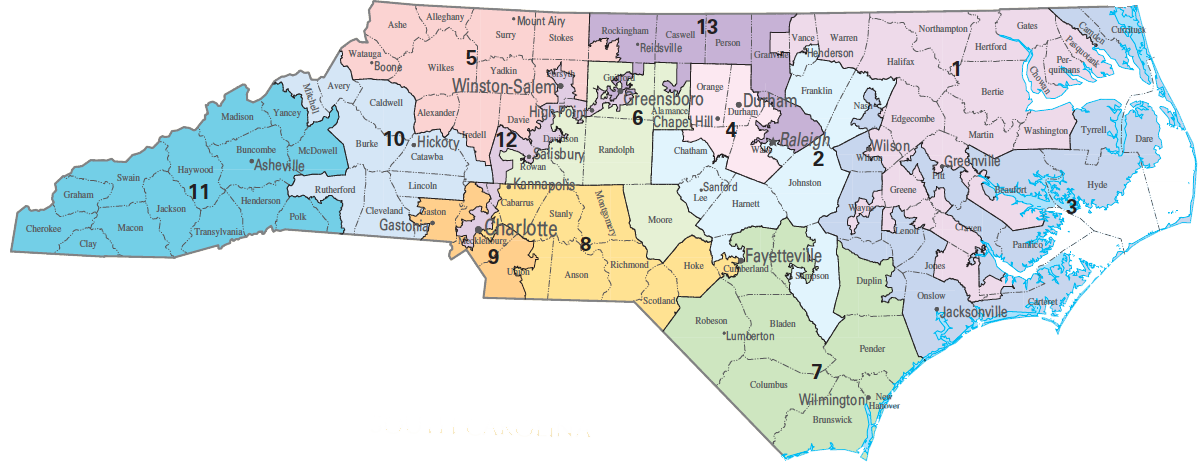
But sometimes the solution is as bad as the disease. Look at North Carolina congressional district 12 (in purple), which is long and narrow and practically bisects the state. I’m sure that it was designed to give a better chance for a black candidate to win. But it runs along the interstate without any sort of community cohesiveness. Similar maps have been struck down for that very reason.

Another big issue in New York is so-called prison-based gerrymandering. Most prisons are in upstate New York; many prisoners are from downstate New York. Critics say the census should count prisoners in the district where they lived BEFORE they were incarcerated, which would lessen the power of the most rural districts where prisons tend to be situated.

There has been a move toward “non-partisan” reapportionment. For most places, though, that is easier said than done.

ABC Wednesday – Round 10

Ramblin' with Roger
Social media & sharing icons powered by UltimatelySocial