The Toothache

Four days after the procedure, and the pain is STILL tremendous in the mouth

There is a great bit by Bill Cosby on the Why Is There Air? album from the mid-1960s called The Toothache. It’s only about 4 minutes long, but it is full of great wisdom. Without having heard it for possibly decades, I remember some great lines such as:
“Here’s the difference between novocaine and pain. Novocaine doesn’t deaden pain. It postpones it. It allows all its pain buddies to get together and say, ‘We’re going to hit that hole at five o’clock.'”
But the best line, and it’s the delivery, not the words:
“And the pain…was tremendous…”

Well, I went to the dentist on Wednesday. A filling came out, and it needed to be replaced. The first filling I had since 2007, I was told by the person who does the billing, who looked it up and saw that I paid right away the balance not covered by my insurance. Some people she makes pay right away, but others with a good payment record she’ll wait until the insurance has paid, and then bill me for the balance. It’s always good to be on good terms with the person processing the bills at your medical offices.

I had done this after having gone to my primary care doctor’s office for getting a flu shot. Then I gave blood, which, I understand, is OK.
The bloodletting was probably the least painful of the three, after the fact.

Anyway, four days after the procedure, and the pain is STILL tremendous in the mouth, despite the suggested treatments, so I’m going to shut up.

I was going to leave you with The Toothache, but I couldn’t find it. Instead, here’s Bill Cosby at the Dentist, which is pretty funny, too.

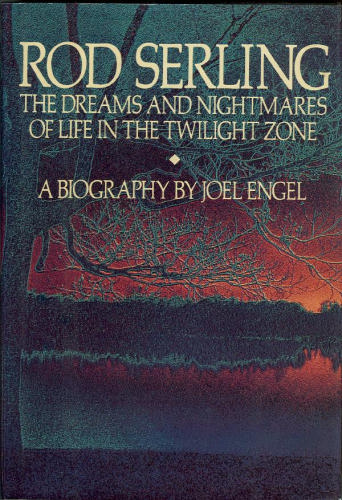
Rod Serling biography by Joel Engel

One of the things I was able to do in the Adirondacks a couple of months ago was to read the bulk of the book Rod Serling: The Dreams and Nightmares of Life in the Twilight Zone – a biography by Joel Engel. I wanted to finish it because I had borrowed the book from my father-in-law and I wanted to return it; that was my internal message, not his external one.
In the Methodology and Sources section of the book, author Joel Engel expressed surprise that in 1985, a full decade after the death of the celebrated television writer Rod Serling, there had not yet been a Serling biography. So Engel made inquiries and ended up writing a book about a man whose fans adored him, but who, despite his considerable success, was riddled with self-doubt. As Engel notes in the Prologue re Serling in 1967: “Submitted for your examination: a man who’s dying inside. Not so many years ago, he rode the crest of a golden wave he thought would never end…But that was before giving birth to the Creation…Each day, he hears fewer whispers of his greatness, and those still heard cannot be believed from inside the private hell to which the Creation has doomed him.”

The Creation, of course, was the seminal series The Twilight Zone, whose writing and hosting made him both successful as a writer but also a celebrity; yet he doubted his writing abilities, and scorned his own celebrity.

Chapter 1 was about Rod Serling’s dad Sam, who was too poor to go to college and become the engineer his skill set would suggest he could have become. He ended up enrolling in secretarial school and took his bride Esther to Panama, where she almost died of yellow fever. When the Serlings returned to Auburn, NY, they discovered Esther was pregnant. The pregnancy was difficult, and the doctors assured the family that Robert, born in 1918, would be their only child. Sam then felt that he was doomed to work for his father-in-law’s grocery business, in Cortland, then Syracuse.

But the doctors were wrong. Rodman Edward Serling was born on Christmas Day, 1924. Sam moved south to Binghamton to buy his own grocery store and when it proved successful, the family moved to Bennett Avenue on the city’s middle-class West Side. He was attracted to the place that became a relatively worker-friendly town for the vast immigrant population. More importantly, Binghamton became, for Rod “a kind of geographic womb to crawl back into – and that’s your hometown,” a feeling not shared by Bob, BTW.

“Rod attracted people to him by sheer force of personality. He received constant praise, even adoration, and soon found it difficult to live without them.” At some level, this would continue to be the case for most of his life.

Chapter 2 involved Rod Serling as a paratrooper in World War II, a function he had to plead for because of his diminutive stature. Engel tells about the campaign in the Philippines in 1945, and how the absurdity of war – one friend was killed by the food supply dropped from the air to save them – that colored Rod’s eventual writing career.

Subsequent chapters addressed his evolution as a writer from radio station intern to some encouraging radio drama submissions to some success with this new medium called television. Despite some great volume of work, when the focus of TV production moved from live stagelike NYC shows to the filmed Hollywood product, it was a bit like starting over.

Nevertheless, despite his eventual success with The Twilight Zone, Rod’s “need to please,” and his disdain for, yet attraction to, fame and success made him not quite satisfied.

Due in large part to his four-pack-a-day cigarette habit – he even smoked during a classroom appearance at his alma mater, Binghamton Central High School in 1970, I can testify personally – Rod Serling died on June 28, 1975.

The Engel book is quite interesting, especially the first two chapters. But it is all well researched. If the latter chapters are somehow less enjoyable, maybe it’s because the subject of the book was unable to be content with his life, believe his success, be happy with his first writing critic, his wife Carol. Like his father, he wanted more than he achieved and like Sam, he died young pursuing it.

NOT SHY question

The title song of Simon and Garfunkel’s Parsley, Sage, Rosemary and Thyme is Scarborough Fair/Canticle.

I happen to catch the song Magnet and Steel by Walter Egan at my bank, which is also a Starbucks You can LISTEN to it HERE. The backstory: Stevie Nicks sang on this track, and provided inspiration for the lyrics.

I’m a sucker for albums that have a title song but isn’t the title of the album. The album title is Not Shy, a reference in the song. “With you, I’m not shy.”

In Kill to Get Crimson by Mark Knopfler, the lyrics of Let It All Go include “I’d kill to get crimson on this palette knife.”

The title song of Simon and Garfunkel’s Parsley, Sage, Rosemary and Thyme is Scarborough Fair/Canticle. Negotiations and Love Songs, and Shining Like A National Guitar are collections of Paul Simon’s songs. The titles are taken from lines in the songs Train in the Distance and Graceland, respectively.

And of course, Nevermind by Nirvana is in reference to a word/words? in Smells Like Teen Spirit. (Oh, speaking of that song, a cover by 2 Cellos.)

Got any other examples of lines of songs that provide the title of an album?

Back in the USA

The trip to Canton included a much smaller gathering of my father-in-law’s close relatives.

When we were leaving Peterborough, ON, we figured we ought to at least LOOK at the Peterborough Lift Lock. While we didn’t have time to take the cruise, we did investigate the location, including watching a 17-minute film about it. The lift lock looks like THIS.

Then we drove to the border. We had several choices, actually. We opted for the Ogdensburg crossing, based on the rumors that it was a place that was less of a hassle than, say the Thousand Islands Bridge. Of course, if we heard that, I suspect smugglers probably have, too. In any case, the crossing was problem-free.

We stayed at a B&B for a couple of nights in Canton, NY. The only full day there, we went on a tour of the campus of St. Lawrence University, my wife’s alma mater. It was an impressive place, both physically and academically. My daughter has decided she wants to go there.

Our trip to Peterborough had included seeing my mother-in-law’s extended relatives; the trip to Canton included a much smaller gathering of my father-in-law’s close relatives – his brother, with his wife, who I’d seen a couple times; and his sister, with her daughter, neither of whom I had met before. The sister, who was 84, had just bought a new car.

Then, we trekked – through some driving rain at times – to some cabin in the Adirondack Mountains of Warren County for four days, meeting up with my parents-in-law, and, eventually, one of my brothers-in-law, his wife, and their two daughters. Let’s just say I didn’t love this part of the vacation; however, the trips to town, a village called North Creek, were charming. Moreover, it had Internet access at the public library, which was available to anyone coming in. And the grandparents watched the granddaughters, while the other couples got to go out to eat one lunchtime in the village.

Finally, the Wife and I went home. Oops, did we forget the Daughter? No, she stayed with the cousins a couple of days, while her parents had some alone time. THAT was the highlight of the latter portion of the trip.

And the “Wichita Lineman” is stuck in my mind

“‘And I need you more than want you/and I want you for all time’ is simply a genius couplet, no doubt about it.”

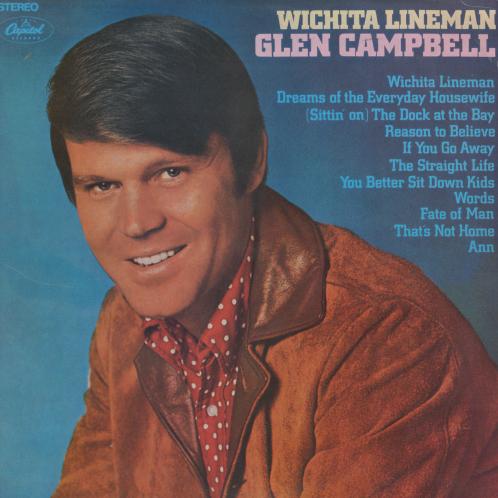
The song Wichita Lineman, written by Jimmy Webb and performed by Glen Campbell, keeps popping up in my life.

First I was watching a segment of CBS Sunday Morning (aired on July 31, but I watched later), where Webb was interviewed. He indicated that, after he’d given Campbell “By the Time I Get to Phoenix”, Campbell wanted “another ‘Phoenix'”. Webb replied that he didn’t have ANOTHER ‘Phoenix’. He wrote most of “Wichita Lineman”, but he wasn’t finished; nevertheless, Campbell recorded it, using a guitar solo where Webb thought the song was incomplete.

Then Campbell, who had announced that he had Alzheimer’s in June was interviewed by ABC News in August. He shared the fact that the favorite of his songs was Wichita Lineman, as he noted his favorite lyrics. As Johnny Bacardi noted here: “‘And I need you more than want you/and I want you for all time’ is simply a genius couplet, no doubt about it.”

Here’s the studio version and here’s a live version.

What songs are currently stuck in your mind?

Ramblin' with Roger
Social media & sharing icons powered by UltimatelySocial