Woman’s Rights: Declaration of Sentiments

He has usurped the prerogative of Jehovah himself, claiming it as his right to assign for her a sphere of action, when that belongs to her conscience and her God.

Vacation: Monday, July 18, 2016, Seneca Falls, NY

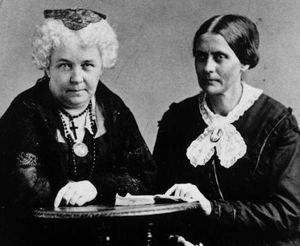
The family came to Seneca Falls specifically to go to the Women’s Hall of Fame, which should have been open, according to the website and the AAA book. It was disappointingly closed, but it was a nice day, and we went by this nearby fountain/wall, which contained the Declaration of Sentiments – clearly modeled on The Declaration of Independence – read at the Woman’s Rights Convention, 19-20 July 1848. It was shepherded by Elizabeth Cady Stanton and Susan B. Anthony.

There was a M/F couple, probably in their thirties there, and also two college-aged women, all, as it turned out, from Cleveland, where they were escaping the Republican National Convention. The young women seemed particularly pleased that The Daughter had an opportunity to be at this important place.

Incidentally, women won the right to vote in New York State in November 1917, three years before the 19th Amendment was ratified.
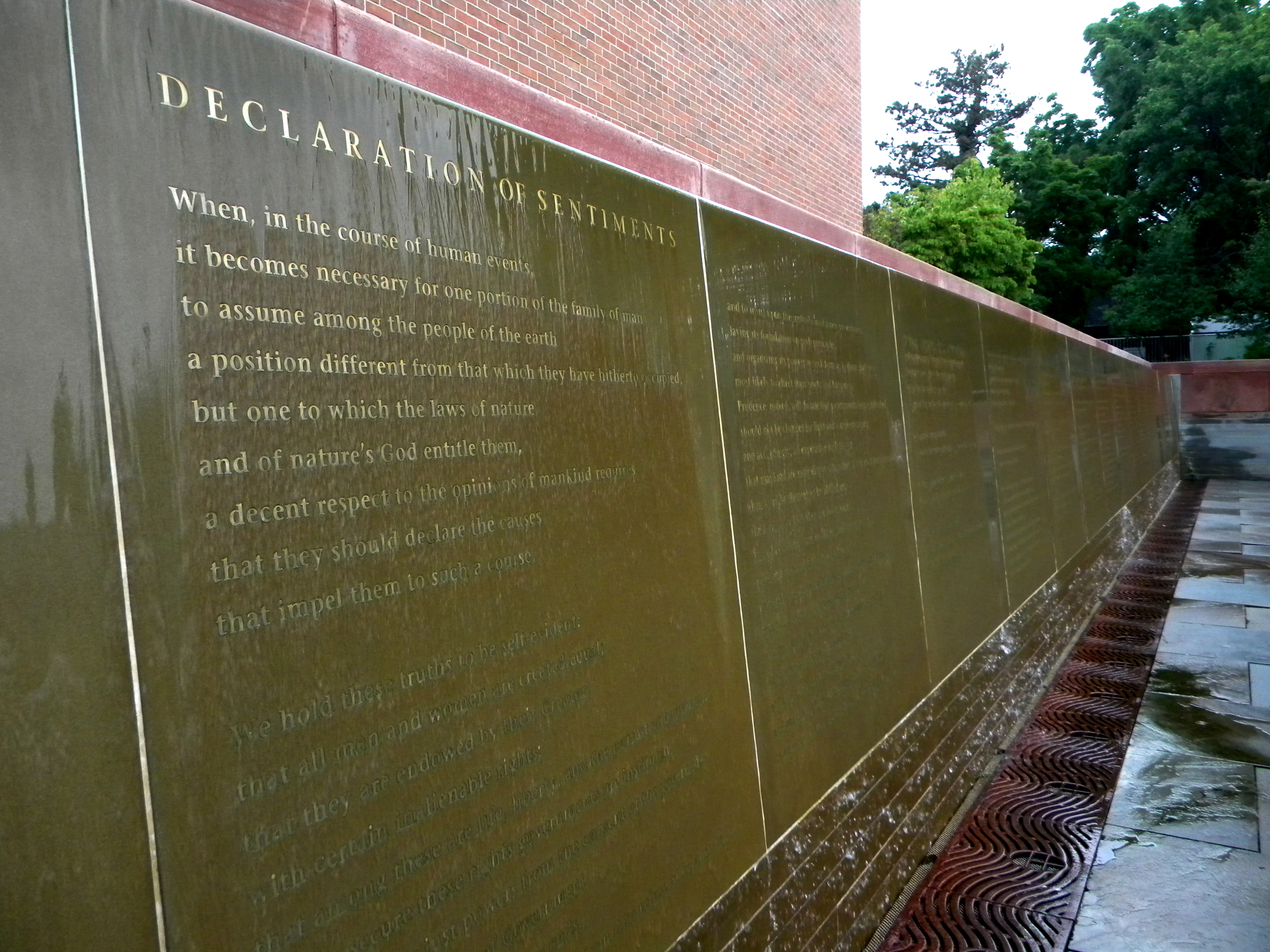

When, in the course of human events, it becomes necessary for one portion of the family of man to assume among the people of the earth a position different from that which they have hitherto occupied, but one to which the laws of nature and of nature’s God entitle them, a decent respect to the opinions of mankind requires that they should declare the causes that impel them to such a course.

We hold these truths to be self-evident: that all men and women are created equal; that they are endowed by their Creator with certain inalienable rights; that among these are life, liberty, and the pursuit of happiness; that to secure these rights governments are instituted, deriving their just powers from the consent of the governed.

Whenever any form of Government becomes destructive of these ends, it is the right of those who suffer from it to refuse allegiance to it, and to insist upon the institution of a new government, laying its foundation on such principles, and organizing its powers in such form as to them shall seem most likely to effect their safety and happiness.

Prudence, indeed, will dictate that governments long established should not be changed for light and transient causes; and accordingly, all experience hath shown that mankind are more disposed to suffer, while evils are sufferable, than to right themselves by abolishing the forms to which they are accustomed.

But when a long train of abuses and usurpations, pursuing invariably the same object, evinces a design to reduce them under absolute despotism, it is their duty to throw off such government, and to provide new guards for their future security. Such has been the patient sufferance of the women under this government, and such is now the necessity which constrains them to demand the equal station to which they are entitled.

The history of mankind is a history of repeated injuries and usurpations on the part of man toward woman, having in direct object the establishment of an absolute tyranny over her. To prove this, let facts be submitted to a candid world.

He has never permitted her to exercise her inalienable right to the elective franchise.

He has compelled her to submit to laws, in the formation of which she had no voice.

He has withheld from her rights which are given to the most ignorant and degraded men—both natives and foreigners.

Having deprived her of this first right of a citizen, the elective franchise, thereby leaving her without representation in the halls of legislation, he has oppressed her on all sides.

He has made her, if married, in the eye of the law, civilly dead.

He has taken from her all right in property, even to the wages she earns.

He has made her, morally, an irresponsible being, as she can commit many crimes with impunity, provided they be done in the presence of her husband. In the covenant of marriage, she is compelled to promise obedience to her husband, he becoming, to all intents and purposes, her master—the law giving him power to deprive her of her liberty, and to administer chastisement.

He has so framed the laws of divorce, as to what shall be the proper causes of divorce; in case of separation, to whom the guardianship of the children shall be given; as to be wholly regardless of the happiness of women—the law, in all cases, going upon the false supposition of the supremacy of man, and giving all power into his hands.
After depriving her of all rights as a married woman, if single and the owner of property, he has taxed her to support a government which recognizes her only when her property can be made profitable to it.

He has monopolized nearly all the profitable employments, and from those she is permitted to follow, she receives but a scanty remuneration.

He closes against her all the avenues to wealth and distinction, which he considers most honorable to himself. As a teacher of theology, medicine, or law, she is not known.

He has denied her the facilities for obtaining a thorough education—all colleges being closed against her.

He allows her in Church as well as State, but a subordinate position, claiming Apostolic authority for her exclusion from the ministry, and, with some exceptions, from any public participation in the affairs of the Church.

He has created a false public sentiment, by giving to the world a different code of morals for men and women, by which moral delinquencies which exclude women from society, are not only tolerated but deemed of little account in man.

He has usurped the prerogative of Jehovah himself, claiming it as his right to assign for her a sphere of action, when that belongs to her conscience and her God.

He has endeavored, in every way that he could to destroy her confidence in her own powers, to lessen her self-respect, and to make her willing to lead a dependent and abject life.

Now, in view of this entire disfranchisement of one-half the people of this country, their social and religious degradation,—in view of the unjust laws above mentioned, and because women do feel themselves aggrieved, oppressed, and fraudulently deprived of their most sacred rights, we insist that they have immediate admission to all the rights and privileges which belong to them as citizens of these United States.

In entering upon the great work before us, we anticipate no small amount of misconception, misrepresentation, and ridicule; but we shall use every instrumentality within our power to effect our object. We shall employ agents, circulate tracts, petition the State and national Legislatures, and endeavor to enlist the pulpit and the press in our behalf.We hope this Convention will be followed by a series of Conventions, embracing every part of the country.
Roger is 64

“Misery depresses you. Ignorance depresses you. Persecution depresses you. Violence depresses you. Corruption depresses you.”

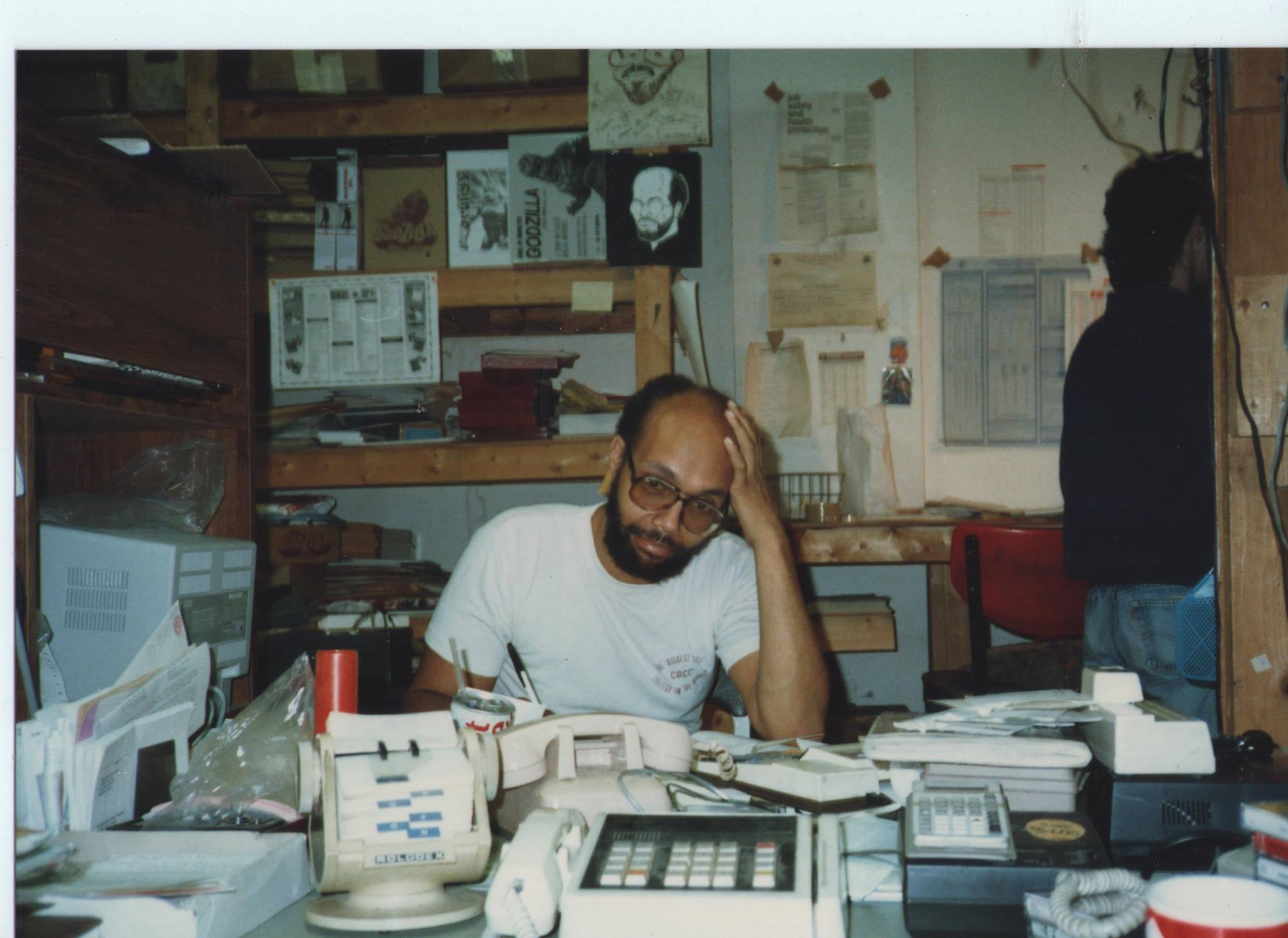
FantaCo. Photo by Tom Skulan.

A picture from the 1980s, when I was working at a certain comic book company in Albany.

Anyway, it’s my birthday, when I don’t blog. But I rather liked this quote a friend of mine posted on her Facebook page several months ago, from a book I read and movie I saw (1.5 times – long story.) You can muse how much of it is actually applicable to me.

“You have deep-seated survival anxieties. And you don’t like bigots, bullies, snobs or hypocrites. Subconsciously there are many people you hate.”

“Consciously, sir, consciously,” Yossarian corrected in an effort to help. “I hate them consciously.”

“You’re antagonistic to the idea of being robbed, exploited, degraded, humiliated, or deceived. Misery depresses you. Ignorance depresses you. Persecution depresses you. Violence depresses you. Corruption depresses you. You know, it wouldn’t surprise me if you’re a manic-depressive!”

“Yes, sir. Perhaps I am.”

“Don’t try to deny it.”

“I’m not denying it, sir,” said Yossarian, pleased with the miraculous rapport that finally existed between them. “I agree with all you’ve said.”

― Joseph Heller, Catch 22

I is for the idiosyncrasy of inches

Mary is every inch the schoolteacher.

While the metric system is very logical there’s something wonderfully daft about the United States customary systems of measurement:

1 inch = 254 millimeters, exactly
12 inches = 1 foot
36 inches = 3 feet = 1 yard
63,360 inches = 5,280 feet = 1,760 yards = 1 mile

Except for inches in a mile, I KNEW all of those by heart.

I love the etymology. “The English word inch comes from Latin uncia meaning “one-twelfth part” (in this case, one twelfth of a foot); the word ounce (one twelfth of a troy pound) has the same origin.”

Of course, I know it’s now 16 ounces = 1 pound = approximately 453.59237 grams.
And, confusingly, 16 fluid ounces = 2 cups = 1 pint = 0.5 quart = 0.125 gallon = approximately 0.473176 liter

“The vowel change from u to i is umlaut; the consonant change from c (pronounced as k) to ch is palatalisation.” But you knew that.

“In many other European languages, the word for ‘inch’ is the same as or derived from the word for ‘thumb’, as a man’s thumb is about an inch wide (and this was even sometimes used to define the inch); for example, Catalan: polzada inch, polze thumb; French: pouce inch/thumb; Italian: pollice inch/thumb; Spanish: pulgada inch, pulgar thumb; Portuguese: polegada inch, polegar thumb; Dutch: duim inch/thumb; Afrikaans: duim inch/thumb; Swedish: tum inch, tumme thumb, Danish and Norwegian: tomme / tommer inch/inches and tommel thumb; Czech: palec inch/thumb; Slovak: palec inch/thumb; Hungarian: hüvelyk inch/thumb.”

There are lots of sayings based on the US system. On one’s birthday, a child gets a “pinch for an inch,” to grow. A noted saying is “give someone an inch and they’ll take a mile”, which means that if you agree to part of what someone wants they will get, or take, ALL of what they want.

Then “every inch a” something means completely; in every way. “Mary is every inch the schoolteacher. Her father is every inch a gentleman.”

The great thing about the metric system is that you can always deduce the relationships – 1000 milliliters is a liter, 1000 grams is a kilogram, and the same is true for meters. But there’s something quaint about the measurement scale that was initially not only defined, but named, for people’s feet and fingers.

Oscar-nominated live action short films 2017

“Enemies Within,” feels like it’s based on current events, though it was set in the 1990s.

Sometimes, you just need to leave work early to see the Oscar-nominated live action short films

“Mindenki,” Hungary (25 minutes)

This was the Oscar winner, and certainly worthy. The title translates to “Sing,” but it oughtn’t to be confused with another, full-length, animated recent film of the same name.

Reportedly based on a true story, young Zsofi (Dóra Gáspárvalvi) enrolls in a new school best known for its lauded children’s choir, which is great, because Zsofi loves singing. Her mother, the principal and her new friend Liza (Dorka Hais) encourage her to join the troupe. But Zsofi runs into a snag.

I love the music, and the world of competitive choir, and it has a nifty ending. But the most engaging part of the film is the friendship between the shy Zsofi and the cool Liza.

“Silent Nights,” Denmark (30 minutes)

Aske Bang’s third short starts off strong. Malene Beltoft (Inger) is a kindhearted worker for the Salvation Army homeless shelter worker. One of her clients is a Ghanaian immigrant named Kwame (Prince Yaw Appiah). They strike up a romance.

The film’s first half addresses the difficulty many immigrants, including Kwame, have in wanting a better life. But there may be way too much story at the back end to be credible. Still, I found the couple intriguing.

“Timecode” (Spain, 15 minutes)

Juanjo Giménez Peña won the Palme d’Or for this. Luna (Lali Ayguadé) and Diego (Nicolas Ricchini) work in a parking garage in 12-hour shifts. Pretty boring, with polite but minimal interaction between the two only at the shift change.

Then Luna discovers that Diego has a hobby. Eventually, the two soon start using the expansive video surveillance system to swap videos. It was a minor piece but with some charm, especially if you appreciate the moves.

“Ennemis Interieurs,” France (28 minutes)

Sélim Azzazi’s film, translated “Enemies Within,” feels like it’s based on current events, though it was set in the 1990s. It takes almost entirely inside a dim immigration office. Hassam Ghancy is an unnamed Algerian-born Frenchman hoping to procure official citizenship. Najib Oudghiri is the likewise unnamed official who essentially plays the good cop AND the bad cop at different points.

For a movie mostly confined to one location, it was quite affecting. Ghancy’s character showed fear and indignation from the interrogator’s questions. Probably the best of the five.

“La Femme et la TGV,” Switzerland (30 minutes)

Timo von Guten’s film is the most quirky of the features. Jane Birkin, who’s been in quite a few movies you may have seen, is the femme, a melancholy baker in a tiny French town. Her only joy is to wave at the TGV train when it goes by twice a day at 185 mph.

A train conductor sends her a note, tossed off the speeding train and landing in her yard, thanking her for her daily greetings. A correspondence is struck up between the pair, but not on “the Internets,” which she actively avoids.

There is a relationship based on more tossed packages, stuffed with cheese, and carefully written letters which eventually forces her to take action unusual from her predictable life. The solution was there but she couldn’t see it before. I liked it, though it may be a tad long. It’s based on a true story.

Here are trailers for Oscar-nominated live action short films. Most of the movies are in subtitles. I did not find them out there for free, only for a fee.

Music, March 1971: Humble Pie

He saw himself as a budding black militant, but he thought of me as a hippy-dippy, flower-power type.

More random music recollections based on the book Never A Dull Moment.

It was Woodstock, the March 1970 movie, that was the greater watershed than the August 1969 concert, the author posits, and I tend to agree. If a third of a million people actually went to Max Yasgar’s farm in Bethel, NY, after seeing the Academy Award-winning documentary, millions would say they were there.

I recall going to the film with a bunch of my anti-war, socially activist friends – Holiday Unlimited: “a splendid time is guaranteed for all”- shortly after the film was released. We sat through it TWICE, back in the days when you could actually do that sort of thing, and it was LONG, about three hours.

My most specific recollection was looking back at the light stream that was projected image that was showing during Sly and the Family Stone’s performance and noticing how purple it was. And, seriously, I had never taken any drugs at the time.

The Woodstock soundtrack propelled my listening for at least the next half-decade, really introducing me, and much of the country, to Joe Cocker and Santana, and solidified my listening to Arlo Guthrie, CSN(&Y) and The Who, among others.

Unlike earlier live albums, such as The Who’s Live at Leeds, which captured the performance and nothing more, producers in 1971 realized the “sound of the crowd was a key element” in transferring the excitement to the listener who had not been present. I always had mixed feelings about live albums for that reason.

Bill Graham closed both Fillmore East in New York City and Fillmore West in San Francisco in 1971. Agents such as Frank Basalona realized that some bands, such as Led Zeppelin, would sell out the venues based on their names, and weren’t willing for the flat rate someone such as Graham would offer.

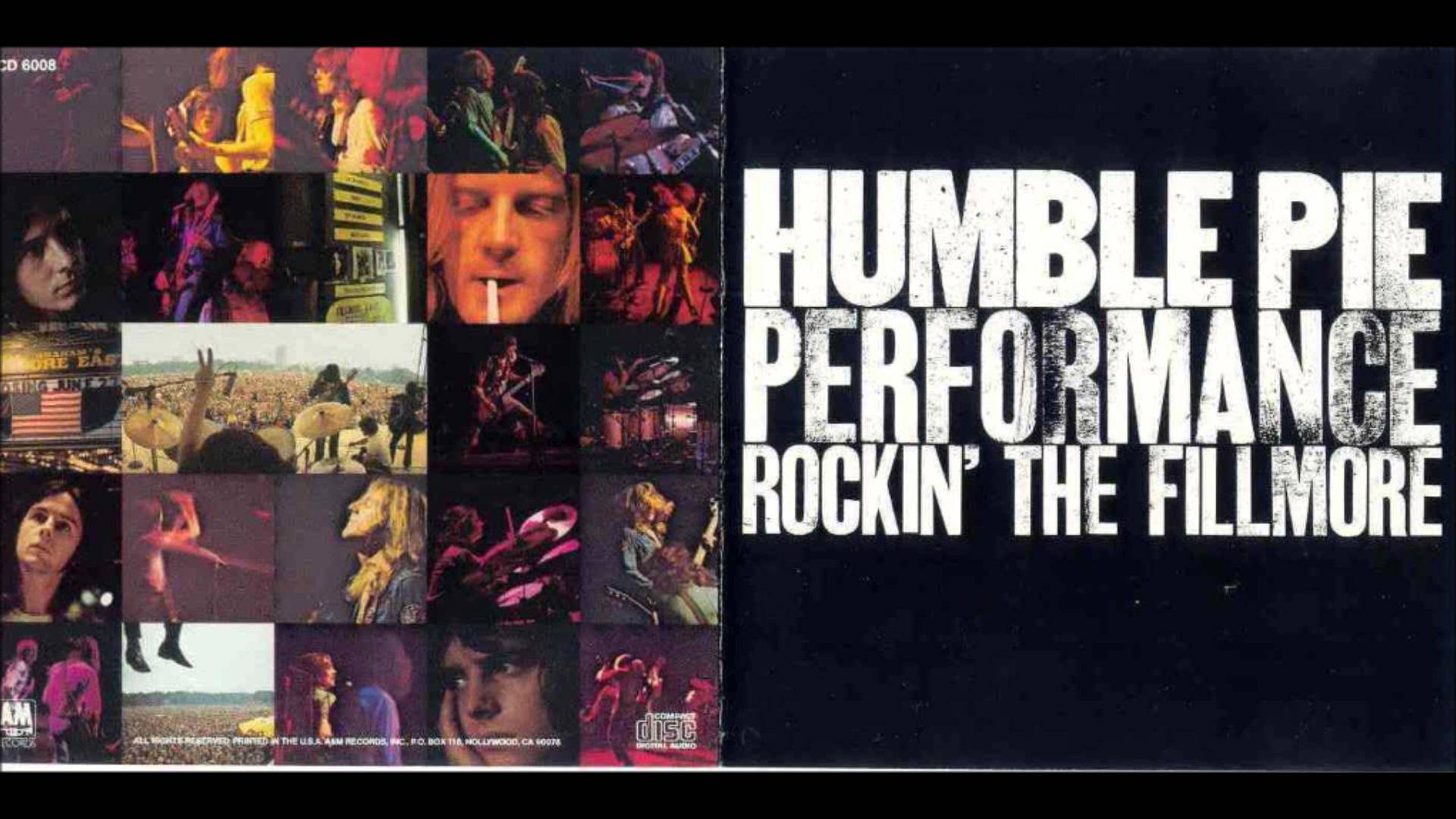
Basalona signed groups such as Humble Pie from London and J. Geils from Boston. I listened quite a bit to cuts from the live Humble Pie album Rocking the Fillmore on the radio, featuring Peter Frampton, who would go on to have even greater live album success.

The groups’ common manager was Dee Anthony, who, in addition to worrying about the money, instilled in the band a sense of showmanship. Producer Tom Dowd got the Allman Brothers to dump their out-of-tune horn section and made them a much better band.

The other live music album I recall from this period was the one by Grand Funk Railroad, which came out in November 1970. I received it for my birthday in March 1971 from my sister’s boyfriend George. He saw himself as a budding black militant, but he thought of me as a hippy-dippy, flower-power type, and thought, incorrectly, that this would have been “my” type of music. But I did listen to it a few times, and it’s probably still in the attic.

Listen to:
Black Dog – Led Zeppelin. It was first played live at Belfast’s Ulster Hall on 5 March 1971.
I Don’t Need No Doctor – Humble Pie
Aqualung – Jethro Tull
Rock and Roll, Hootchie Koo – Johnny Winter
Mean Mistreater – Grand Funk Railroad

Ramblin' with Roger
Social media & sharing icons powered by UltimatelySocial