First Presbyterian Church is located at the corner of State and Willett Streets. Please enter on the Willett Street side, across from Washington Park.
Roger Green: a librarian's life, deconstructed.

Art and music at First Presbyterian Church Albany May 6.
First Presbyterian Church is located at the corner of State and Willett Streets. Please enter on the Willett Street side, across from Washington Park.
I use the term “enrolled”, rather than the term “independent” because there is actually an Independence Party in the state of New York.
Someone in my office building asked me to explain what had taken place in the New York primaries on April 13. I said it was complicated and was willing to let it go.
But then the 2political podcast, featuring Arthur in Auckland, New Zealand, and Jason, in Washington, DC, gave it a go, and I thought I would do the same. For their benefit, I should note that the Republicans in this state only list the candidates, four in my Congressional District: Cruz, Kasich, Trump, and Ben Carson, who had dropped out of the race.
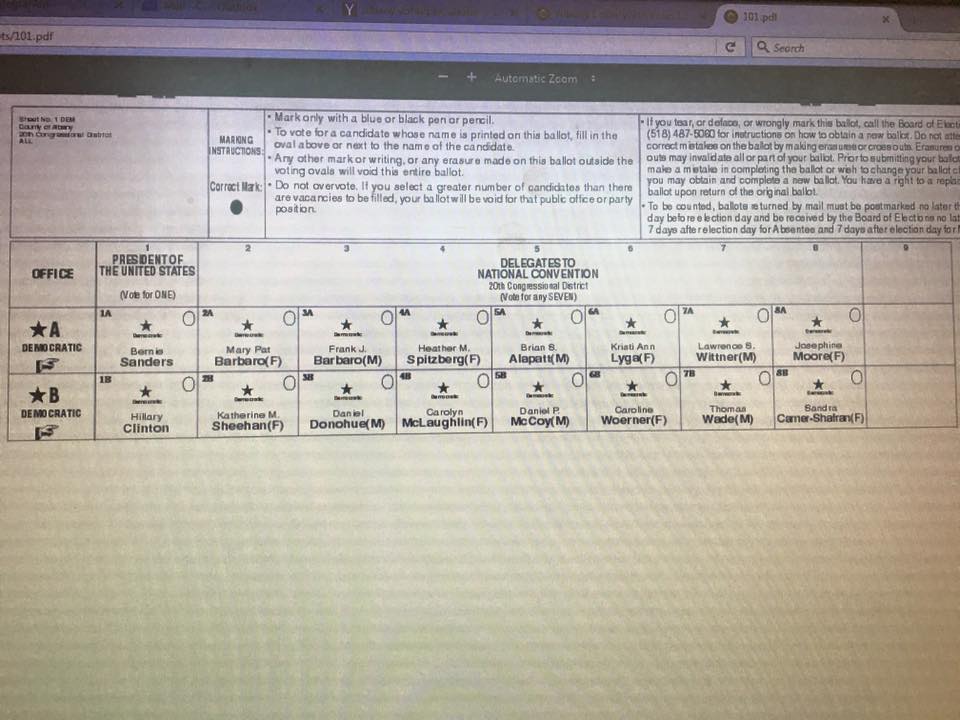
Democrats list the two candidates, Clinton and Sanders, and then the 4 to 7 delegates per Congressional district. (The districts may be of a similar population, but the number of Democrats vary). This article suggested voting for your candidate, but then voting for a mix of Bernie and Hillary delegates, since it’s unlikely that all of the delegates would go to either candidate. This argument made perfect sense to me, but to almost no one else.
There were several layers of voter issues/complaints I heard about, primarily from the Bernie Sanders supporters, because he was the insurgent candidate, who ended up losing by about 13 percentage points.
* New York is a closed primary state. This means that only people registered to vote and enrolled in a party can vote in that party’s primary can vote. I use the term “enrolled”, rather than the term “independent” because 1) it’s more precise and 2) there is actually an Independence Party in the state of New York that received enough votes in the last gubernatorial general election for someone to enroll in that party, or as a Conservative, Green, Working Families, Women’s Equality (essentially a creation of Governor Andrew Cuomo), Reform, and of course the Big Two.
In some primary states voting earlier, non-enrolled voters could vote in the Democratic primary OR the Republican primary (but not both). This is NOT the case in New York. The Democratic and Republican parties don’t want people not enrolled to select their candidates, rightly or not. Their concern that these nonenrolled voters might cause mischief. Those who lean toward the Republican party might pick the Democrat least likely to win in the general election, or vice versa.
There is legislation introduced in the state legislature to allow nonenrolled people to be able to vote in a party primary, but I don’t know what chances it has.
* For already registered voters, any change to party enrollment was to have been requested by October 9th, 2015 in order for it to have gone into effect and be applicable for ANY primary election occurring in 2016. This is, BY MONTHS, the earliest deadline of ANY state. The cutoff to enroll in earlier voting primary states, such as New Hampshire, was MUCH later. I wrote about this in the Times Union blog on August 30, 2015, after analyzing the information offered at VoteForBernie.org.
And this October 9, 2015 enrollment deadline for existing voters is applicable for the LATER primaries in the state of New York, including the state and local primary races in September 2016. The deadline for new voter registrations and enrollment was March 25th. I DO think there was some confusion on this point, from people who thought they had until March 25 of this year to enroll in a party, whether or not they were new voters.
* In primary elections, voters in New York City and the counties of Nassau and Suffolk (Long Island), Westchester, Rockland, Orange, Putnam (just north of New York City) and Erie (Buffalo), POLLS OPEN AT 6 AM and CLOSE AT 9 PM. At 15 hours, this is the LONGEST period of any primary in the country.
In all other counties, POLLS OPEN AT 12 NOON and CLOSE AT 9 PM, which, at a mere 9 hours, is the SHORTEST period of any primary state in the nation. And not being able to vote before work is rather annoying.
Anecdotally, I was reading on Facebook about people who had been voting regularly but were suddenly unregistered. A plurality of these in my area were in Rensselaer County (Troy). Periodically, the local board of Elections sends out a postcard to ascertain whether someone is still at that address. The postcard is not to be forwarded. If the BOE gets the card back, voters are usually stricken from the rolls.
More substantially, 120,000 voters were stricken from the rolls in Kings County (Brooklyn), and other irregularities were cited. Moreover, many people across the country, including New York and California, are reporting problems with their voter registrations being changed without their permission. In New York, at least, an investigation has been launched.
Unfortunately, some folks have conflated the three areas, making understanding the process even more muddled. The long deadline to vote in the primary is a form of voter suppression, I suppose, even more so in the later primaries in the year.
***
Here’s how Albany County voted in the GOP presidential primary.
Chris Wallace calls the “bathroom bills” a “solution in search of a problem.”
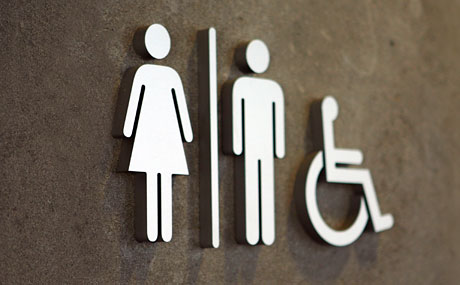 In the United States, we’ve been reading about all sorts of laws passed by state legislatures, in North Carolina and Mississippi, and elsewhere that discriminate against LGBT citizens. Entertainers such as Bruce Springsteen and Bryan Adams have canceled concerts there, which I find a good and proper thing to do, as Arthur can explain.
I’m against laws that discriminate, of course. But I believe an element of these bills is based on some callow, unsubstantiated fear of transgender people molesting others in bathrooms. Someone commented, cheekily, that more Republican politicians than trans people have been arrested for sex acts in bathrooms.
For me, I would like to suggest a much more prosaic reason to oppose these particular ordinances: they cannot work.
The North Carolina governor has set up a hotline to report anyone not using the correct bathroom. And how is this supposed to work, exactly? Will they borrow some of those discredited TSA screening devices and hire bathroom monitors to check out who has what body parts?
Transgender people are already using the restrooms that correspond to their gender appearance and almost no one even knows the difference. The idea that, suddenly, one has to go by the gender on one’s birth certificate is impractical. Will we require that somebody check IDs before they go into the loo?
Some customers may boycott Target over its transgender-friendly bathroom policy. They have the right to do this, but I have to wonder how many of these people KNOW any transgender folks. Chris Wallace, Fox News host, calls the “bathroom bills” a “solution in search of a problem.”
One of the oddly transformative moments in my life was taking a charter bus from New Paltz, NY to Washington, DC to attend an antiwar rally c. 1972. At some stop very near our destination (Delaware?), we made a pit stop.
We had a finite amount of time, so, as the line to the women’s bathroom started to get long, several of the women started using the men’s room. This was an obviously logical thing to do.
Such simple logic should be brought to the current debate.
I swear I saw Joe Bruno.
 On Monday, April 11, not one but THREE Presidential candidates were going to be in the Capital District of New York State: John Kasich (R), Bernie Sanders (D), and Donald Drumpf (R). A day or two before, The Daughter started wheedling me – why didn’t she bug her mother? – to see one of them, the one alphabetically last.
I said no. I said no because I was afraid she might get hurt. She said that no one was going to hurt a little girl, but I noted that she is taller than most adult women. She should watch him on television. (I was also afraid I might get hurt, but I didn’t bring that up.)
Her counter-proposal was to see Bernie Sanders. I noted that he too would be on TV, and he was speaking during the school day.
“But it would be educational!”
She wanted ME to contact her teacher to ask if she could go, but I said she could go if SHE asked her teacher and she said yes; she can be shy in these matters.
Monday morning, I had to get a blood test, which I ended up going to TWICE because I forgot my insurance card the first time. I kept checking my email to see if her teacher contacted me. The Wife came home early – she had an eye test in the early afternoon – and she checked HER email, where she received a positive response from the teacher to MY inquiry.
By this time, it was already noon. The Washington Armory opened at 11 a.m., and the rally was at 2 p.m. I got the Daughter out of school. The Wife dropped us a block from the Armory, because I figure the traffic at Washington and Lark would be crazy, and so it was.
We went to the end of the line, which was down Washington Avenue, across Dove Street, up Elk Street to behind the armory; had we realized, we would have gone the shorter route.
I engaged a young man, 33, behind us in conversation. We decided that this was very educational for the Daughter, because it addressed sociology (the nature of the crowd), history, political science, meteorology (it was very windy, raining briefly; his girlfriend was freezing), and undoubtedly other disciplines.
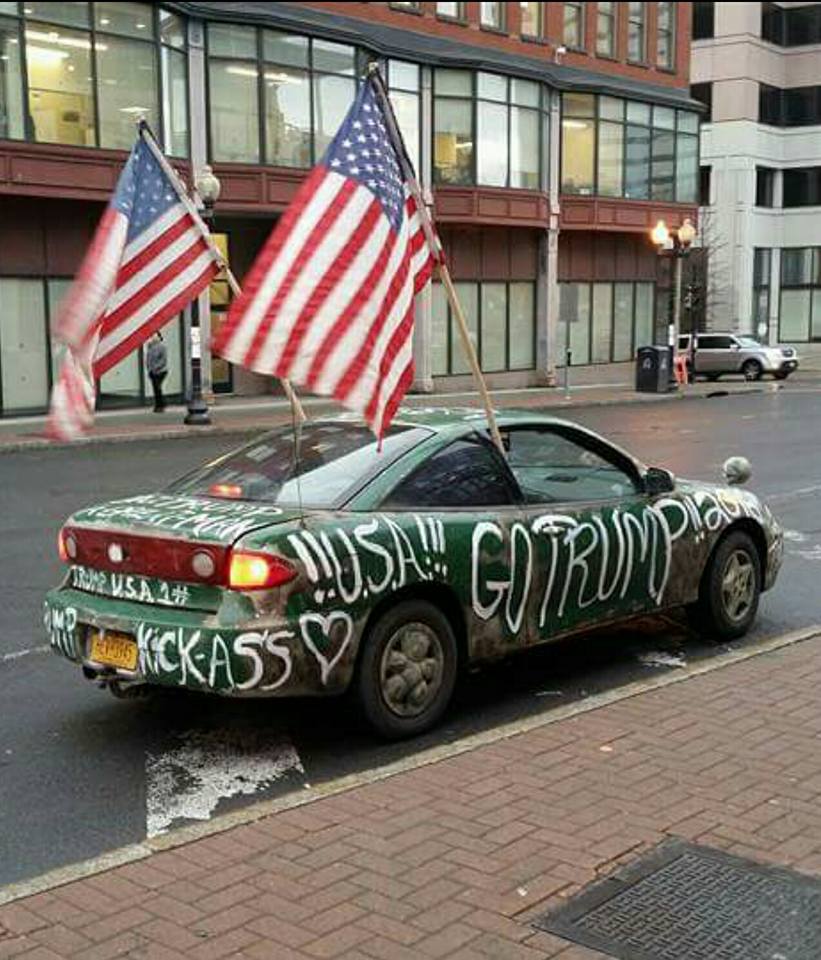
A green car drove by a couple times, with Drumpf USA, etc. painted in splotchy white, as though he’d used a huge bottle of Wite-Out. It had two huge American flags.
Even as the Armory was in sight, I knew the capacity of the Washington Armory was 3000 for basketball games, maybe 1000 more for something like this, and that we probably wouldn’t get in. This turned out to be the case.
Still, we stuck around. I ran into my friends Dan and Lynne. I bought The Daughter a Feel the Bern T-shirt and a couple buttons.
She started taking notes, as we listened to the activities inside via a couple speakers that kept cutting out. The audio in front stopped playing music, and we heard, “I’m sorry the venue wasn’t big enough.”
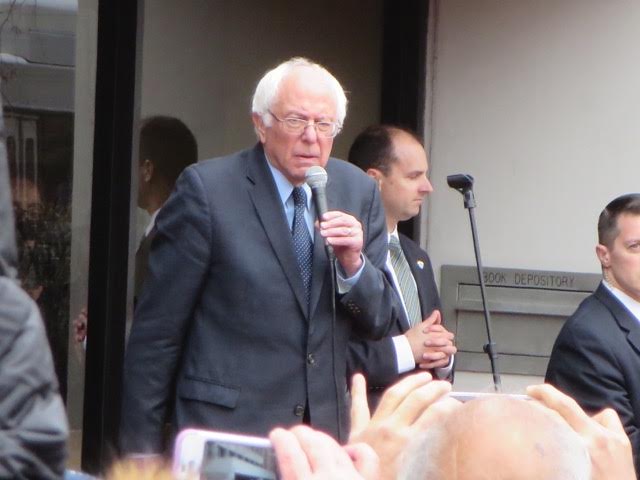
BERNIE CAME OUT!
He gave a seven-minute speech on his main topics: end fracking, Medicare for all, free college, climate change is real. “We can’t spend trillions in Iraq while we leave our cities at home.” Some families are spending 50-60% on housing each month. There’s too much police violence. We need a $15 per hour minimum wage.
He noted that movements develop from the bottom up: trade unions, civil rights, women’s rights, gay rights.
After that, we caught a bus and went home, and watched the last 50 minutes of the speech on TV. We also saw Kasich speak in Troy.
The Wife took us out to dinner; it was quite good. In another room, I swear I saw Joe Bruno, the former state Senate Majority Leader, surrounded by a dozen others.
The Daughter was trying to rush The Wife home, because she (and I) wanted to watch The Donald. He didn’t say anything in that way he generally does: read some reviews. All in all, an excellent day.
The next day, The Daughter confessed that she didn’t REALLY wanted to see Donald, she wanted to see Bernie, but used the DJT request as an opening salvo in what she REALLY wanted. Well played, Daughter, but I would have said yes to Bernie, eventually, even without the chicanery.
Photo credits: car (c) 2016 Kate Intelisano. Bernie (c) Daniel Van Riper
Civil War photography changed war from something remote to something with visceral impact.
 Photography of the Civil War has fascinated me for many years. Wikipedia says: “The American Civil War was the fifth war in history to be photographed [without specifying the first four], and was the most widely covered conflict of the 19th century.” The most famous photographer of the conflict was Mathew Brady, but there were several other men behind the camera.
From the Metropolitan Museum of Art: President Abraham Lincoln “called up 75,000 militiamen to put down an insurrection of Southern states,” in what proved to be a painfully optimistic assessment of the length of the struggle. “
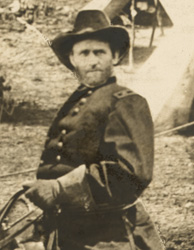
“Brady secured permission from Lincoln to follow the troops in what was expected to be a short and glorious war.” Ultimately, Brady instead financed a corps of field photographers who, together with those employed by the Union military command and by Alexander Gardner, made the first extended photographic coverage of a war.
“The terrible contest proceeded erratically; just as the soldiers learned to fight this war in the field, so the photographers improvised their reports. Because the battlefields were too chaotic and dangerous for the painstaking wet-plate procedures to be carried out, photographers could depict only strategic sites camp scenes, preparations for or retreat from action, and, on rare occasions, the grisly aftermath of battle.”
Yes, this picture is likely who you think it is. Check out how to replicate the wet-plate process today.
It is clear that photography of the Civil War changed war from something remote to something with visceral impact.
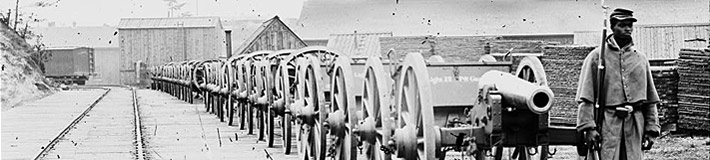
The Library of Congress has an online collection [which] “provides access to about 7,000 different views and portraits made during the American Civil War (1861-1865) and its immediate aftermath.” Some of them are much more gruesome than what you see here.