O is for Oscar the cat

Oscar the cat’s sense of smell may be just one explanation.

oscarthecat Oscar the cat lives in the Steere House Nursing and Rehabilitation Center in Providence, Rhode Island, United States. He is, by all accounts, “notoriously anti-social.”

That is, until, he cuddles up with residents in their final dying days. “After about six months, the staff noticed that Oscar, just like the doctors and nurses, would make his own rounds. Oscar would sniff and observe patients, then curl up to sleep with certain ones. The patients he would sleep with often died within several hours of his arrival.”

The story was even written up in the prestigious New England Journal of Medicine back in 2007, A Day in the Life of Oscar the Cat by David M. Dosa, M.D., M.P.H. Dr. Dosa believes that Oscar “might be picking up on specific odors surrounding death.”

Some animal behavior experts say the explanation about Oscar sensing a smell associated with dying is a plausible one. “I suspect he is smelling some chemical released just before dying,” says Margie Scherk, a veterinarian in Vancouver, British Columbia and president of the American Association of Feline Practitioners…

“And cats can certainly detect illness.” Dr. Jill Goldman, a certified applied animal behaviorist in Laguna Beach, California says that “Cats have a superb sense of smell,” adding that keeping a dying patient company may also be learned behavior. “There has been ample opportunity for him to make an association between ‘that’ smell [and death]”…

The sense of smell may, however, be just one explanation. Dr. Daniel Estep, a certified applied animal behaviorist in Littleton, Colorado suggests that “One of the things that happens with people who are dying is that they are not moving around much. Maybe the cat is picking up on the fact that the person on the bed is very quiet. It may not be smell or sounds, but just the lack of movement.”

The story of Oscar the cat was not without controversy, as in this review of Dr. Dosa’s 2010 book, Making Rounds with Oscar: The Extraordinary Gift of an Ordinary Cat would indicate. “The NEJM piece was an essay and in no sense a scientific article, which raises questions about why it was published. If we expected the book to provide something resembling scientific evidence, we are again disappointed.”

In any case, Oscar was still at work, as of this March 2015 Redbook article. Here’s a short video, and Oscar’s Facebook page.

abc18
ABC Wednesday – Round 18

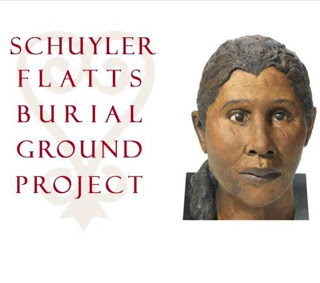
Schuyler Flatts: reburying enslaved people in Albany County, NY

“The bones [of the 14] rested on a shelf at the State Museum for the past 10 years while researchers pieced together what limited information they could using DNA analysis.”

schuylerflattsprojectBack on June 5th, 2005, the remains of more than a dozen 18th Century African slaves were found buried at the former Capital Region estate of the Schuyler Family, which was known as Schuyler Flatts. They were discovered during construction work in the Town of Colonie, Albany County, NY off Route 32 near Menands/Watervliet.

Archaeologists studying this unmarked burial ground “discovered 13 sets of remains plus another set of remains was found in 1998.”

In 2010, bioarchaeological analysis was completed by the NYS Museum. The analyses determined that the remains are about 200 years old and represent 6 women, 1 man, 2 children, and five infants.

DNA analysis concluded that four of the individuals are of African descent. (West/East and Central Africa) Two sets of remains are descendants of women from Madagascar (off the coast of Southeast Africa). One individual, who may have been of mixed ancestry, was descendant from a Native American woman (possibly Micmac Tribe: Eastern Canada and the Northeastern corner of the United States).

The burial ground was dated between the 1700s and early 1800s. Historical research indicates that the burial ground was part of a large estate owned by the colonial Schuyler family who owned a number of slaves in the 18th and 19th centuries.

Yes, this would be the same Schuyler family that Alexander Hamilton married into.

From a Times Union story by Paul Grondahl, which contains lots of details about the Schuylers: “In 1790, there were 217 households in Albany County that owned five or more slaves of African descent, a portion of the county’s 3,722 slaves, the most of any county among New York state’s 21,193 slaves counted in that year’s census.”

The graphic below is actually of the enslaved people in ALL of New York State.

“The bones [of the 14] rested on a shelf at the State Museum for the past 10 years while researchers pieced together what limited information they could using DNA analysis. Their names were never recorded and virtually nothing is known about their history.”

The Schuyler Flatts Burial Ground Project is organizing an official interment of the remains of the fourteen, in order for these people to be buried with dignity and respect, even as work is being done to try to find other remains.

Upcoming Events

san
Public Meeting and Artist Presentation
April 30, 2016 1pm-3pm
New York State Museum (Huxley theatre), 222 Madison Ave, Albany

The Remains Will Lie in State
June 17, 2016 12pm-8pm
Schuyler Mansion State Historic Site, 32 Catherine St, Albany

Burial Ceremony
June 18, 2016 11am-12pm
St Agnes Cemetery, 48 Cemetery Ave (off Broadway), Menands

For more information concerning the Schuyler Flatts Burial Ground Project, please contact:
Evelyn (Kamili) King (Peace Out Productions)
Paul Stewart (The Underground Railroad History Project)

About the symbol: Sankofa is a word in the Akan language of Ghana that translates as “reach back and get it” (san – to return; ko – to go; fa – to fetch, to seek and take) and also refers to the Asante Adinkra symbol. Sankofa is often associated with the proverb, “Se wo were fi na wosankofa a yenkyi,” which translates as: “It is not wrong to go back for that which you have forgotten.”

April rambling #1: music for tax day

librarians_shout out

Silence or Violence: Logan, Suicide, and the Culture of Masculine Silence.

Preventing Bullying and Cyber-Bullying.

Last Week Tonight with John Oliver: Border Wall and Congressional Fundraising.

The Unabomber takes on the Internet.

The Tip That Led to Terrorist Abdelhamid Abaaoud’s Downfall Came From a Muslim Woman.

Ken Screven: And then I tossed a bourbon Manhattan in his face.

The Real Story Behind HBO’s ‘Confirmation’ From The NPR Reporter Who Broke The Story. Clarence Thomas, Anita Hill,and NPR’s Nina Totenberg.

Chip, Implanted in Brain, Helps Paralyzed Man Regain Control of Hand.

Facing life unarmed. “When I was born, everyone was expecting me to have arms.”

Within Our Gates (1920) – Oscar Micheaux Silent Film.

Arthur’s Outaversary.

Dustbury has been blogging 20 years, which, at 11 years, makes me a piker.

Sharp Little Pencil: Lost Word.

Now I Know: Voltaire’s Wager and The Revolt of the Dancing Grannies and They Blue It and The Birds that Sing for Their Supper.

You may have to be from upstate New York to appreciate this: This is a Halfmoon; This is a Black and White Cookie.

The Mystery of the Phantom Page Turner.

Can anything good come from an experiment involving whipped cream?

The funnies

Cartoon: The NYC pandering primary.

Frank Welker, will be honored with the Lifetime Achievement Award at the 43rd Annual Daytime Creative Arts Emmy(R) Awards on Friday, April 29th, 2016. He is the legendary performer of the voices of Scooby-Doo and many others.

Guinness Book of World Records certified famed Mad artist Al Jaffee’s run as a world record for “Longest Career as a Comics Artist.”

How Mickey Mouse Evades the Public Domain.

An Audience With the King. That would be Jack Kirby. Bob Kane does not fare so well.

Book review: A Spanish Comic Book Exposes Franco’s Orphanages.

Music

R.I.P, Merle Haggard and Steve Earle: The Other Side of Merle Haggard and Coverville 1121: A cover tribute to Merle Haggard and some A Cappellaville!

10 Priceless Songs About Taxes and Coverville 1120: A Tribute to Tax Day.

New Paul Simon Album ‘Stranger to Stranger’ Coming June 3rd. Simon & Garfunkel – Bridge Over Troubled Water – Madison Square Garden, NYC – 2009/10 29 or 30.

18 Ripping 1960S ROCK & ROLL Bands That Performed On TV Sitcoms And Dramas.

The History of John Lennon and Paul McCartney’s Only Post-Beatles Session.

The Muppets on the Ed Sullivan Show.

This is a REALLY annoying K-Chuck Radio, especially the Oz piece, which I gave up on. They made a disco song out of THAT?!?

Led Zeppelin’s Stairway to Heaven may be partly stolen, judge says.

The lawyers who beat​ the ‘Happy Birthday’ copyright are taking on ‘We Shall Overcome’.

The Black Keys Say They Regret Inducting Steve Miller Into Rock Hall of Fame.

David Kalish: My ode to how music has shaped me.

SamuraiFrog’s 12 albums.

Music Throwback Saturday: In the Mood

Under copyright laws, a tune that had not been written down and registered with the copyright office could be appropriated by any musician with a good ear.

Wingy-ManoneAll I wanted to do was post a link to a familiar version of In the Mood, then add one you might not have heard.

But the facts got in the way:


“In the Mood” was an arrangement by Joe Garland based on a pre-existing melody… The main theme, featuring repeated arpeggios rhythmically displaced, previously appeared under the title of “Tar Paper Stomp” credited to jazz trumpeter and bandleader Wingy Manone. Manone recorded “Tar Paper Stomp” on August 28, 1930…

Horace Henderson used the same riff in “Hot and Anxious”, recorded by his brother’s band, Fletcher Henderson and his Orchestra, on March 19, 1931…

Under copyright laws [at the time], a tune that had not been written down and registered with the copyright office could be appropriated by any musician with a good ear. Wingy Manone had brought up the issue of the similarity between “Tar Paper Stomp” and “In the Mood” to Joe Garland and to the publishing company of the song, Shapiro, Bernstein, and Company of New York… “Tar Paper Stomp” was copyrighted on November 6, 1941…

Glenn Miller’s “In the Mood” [1939] became the best selling swing instrumental.


But what I REALLY wanted to tell you about is my favorite version of In the Mood. I have it on the 1977 Warner/Reprise Loss Leader album Limo, compiled, as many were, by Doctor Demento. The song is credited to Henhouse Five Plus Too, the nom de poulet of Ray Stevens, who had hits as diverse as Gittarzan, The Streak, Everything Is Beautiful, Turn Your Radio On, and Mr. Businessman. This song went to #40 early in 1977 and proved to me that almost ANY song could be done in Chicken.

Listen to

Wingy Manone – Tar Paper Stomp HERE or HERE

Hot and Anxious – Fletcher Henderson HERE or HERE

In The Mood from The Glenn Miller Story – Glen Gray & The Casa Loma Orchestra HERE or HERE

In the Mood – Henhouse Five Plus Too HERE or HERE

How God wants us to vote

“Any talk of using the Bible should start with a few acknowledgments, the first of which is that the Bible is not a book, rather it is a collection of books.”

KenScreven.plus
A little over a year ago, a few of the bloggers of the Times Union newspaper met at the home of retired television news reporter Ken Screven, in the foreground of this picture. All the other bloggers I knew: historian/environmental activist Don Rittner; photographer Chuck Miller, and Unitarian minister Sam Trumbore.

The person I did not know was Liz Lemery Joy. She was a very charming and articulate woman. Her blog focus is “A Biblical stance on political/legislative issues.”

In March, she first promised to write about Christians and voting. “We’re going to go to the Word of God, and I’m going to show you what God says about the political and legislative issues we’re facing as a state and a nation.”

Later that month, she declared that It’s the Christians fault our country is in such a mess, because they do not vote in sufficient numbers.

Finally, she described Ted Cruz, a breath of fresh air in Upstate! He is, she describes, a “level headed candidate, who actually respects the Constitution, come and address voters in our area. People in upstate are hurting economically and the power-hungry Albany machine has done nothing to help.”

Her chief issue, though, is his opposition to abortion: “How a person values other people’s lives absolutely determines how they will govern in office. Why? Because how they regard the worth of another human life, determines where their moral compass is and how they will carry out everything they do in political office… If a leader doesn’t value life, they will also disregard and be callous to other matters of governing and legislating that require principle and virtue.”

This, unsurprisingly, generated lots of comments, many of them unrepeatable. TU blogger Heather Fazio, who disagrees with Liz, solicited, then summarized some comments about Liz’s posts here and here.

A TU blogger named Michael Rivest declared The Bible does not tell us how to vote, pointing to the scriptural inconsistencies in the arguments of people from both sides of the political fence.

While I certainly would not come to the same conclusion as Ms. Joy did, I tend to agree with her premise, so I don’t think Mr. Rivest is correct either. Cherry-picking Scripture, one can “prove” anything, or nothing, about how God wants us to vote, or anything else.

Walter Ayres addresses this point quite well.

Any talk of using the Bible should start with a few acknowledgments, the first of which is that the Bible is not a book, rather it is a collection of books. It is more like a library and, just as libraries do not all contain the same books, neither do Bibles… These books vary in nature; e.g., some are historical, some are legalistic, some are poetry.

Many times, when people claim that the Bible says something, what they really mean is that a particular book of the Bible says something. Another book of the Bible may say something else.

This brings us to the issue of proof-texting, a method of claiming Biblical support for a position by choosing selected texts, often out of context, to support a particular position. One example is using select verses to support or oppose to the death penalty without regard to the original intent of the author. Proof-texting does not lead to good theology.

Bernie in ALB
And it gets more complicated…

In other words, interpreting the Bible in not always as easy as it might seem. People of good will can reach different conclusions. And we all should be very careful before we claim to speak for God.

What he said.

In a follow-up post, Ayres, who is a self-described Roman Catholic, quotes Pope Francis when he wrote: “An authentic faith… always involves a deep desire to change the world, to transmit values, to leave this earth somehow better than we found it.” He also writes about four principles of Catholic social teaching in the document Forming Consciences for Faithful Citizenship.

In the New York Times magazine article Donald Drumpf, American Preacher, Dartmouth professor Jeff Sharlet writes:

Drumpf…returns [faith] to the roots of Christian business conservatism, which is where he has been all along: Norman Vincent Peale’s 1952 best seller, “The Power of Positive Thinking”…

“Positive Thinking” isn’t about serving God; it’s about “applied Christianity,” using God to achieve “a perfected and amazing method of successful living.” The method is like a closed loop, a winners’ circle of the soul. “The man who assumes success tends already to have success,” Peale writes, a tautological spiritual­ity as instantly recognizable in Trumpism as the drumbeat of his words: “success,” “amazing.” Peale’s message resonated most with the upper middle class — those, like Drumpf himself, who saw themselves as winners. The prosperity gospel recasts the same promise to those, like Drumpf’s followers, who feel lost.

On the surface, the prosperity gospel is a simple transaction. The preacher is blessed, and you can be, too. All you have to do is invest. How? The usual way: You give him your money. Only, your money is just a metaphor. The good news is that faith will be repaid in kind. The deal — belief in return for relief, belief as a form of relief — is as old as religion, too fundamental to human consciousness to dismiss simply as a con. Pray for rain, sacrifice to the gods, keep kosher — you needn’t believe to recognize the power of trading devotion for the hope of well-being.

My fortnightly church group has been slowly reading Jesus for President: Politics for Ordinary Radicals by Shane Claiborne and Chris Haw. They write: “Christianity is at its best when it is peculiar, marginalized, suffering, and it is at its worst when it is popular, credible, triumphal and powerful.”

It’s no secret that on Tuesday, I’ll be supporting Bernie Sanders in the Democratic Presidential primary, who is the gold standard in presidential politics “on matters of economic equality, social justice, combatting poverty and human rights that Pope Francis has placed before the world and at the center of his papacy.” For ME – no, I’m NOT telling you how to vote – he is my clear theological choice.

Or maybe the “Ted Cruz” in this parody article is right, that Jesus IS too liberal to follow:

The most disturbing thing about Jesus, said Cruz, “is his obsession with caring for and hanging out with a bunch of losers, like poor people and homeless beggars, sick and unemployed people, strangers and immigrants (some of them undocumented!), and even prisoners.”

“I’m not making this up,” Cruz continued. “He — the real Jesus — is as radical as any longhaired punk camping out with street people in Boston or Philadelphia. If you don’t believe me, you can go read it for yourself, in the Gospel of Matthew, 25:31-46. Check it out. And don’t miss the part where Jesus says that showing kindness and generosity toward the least fortunate is the same as showing kindness and generosity toward Jesus himself. Now that’s just dangerous left-wing nonsense, worse than Obamacare.”

 

Ramblin' with Roger
Social media & sharing icons powered by UltimatelySocial