Mom was too nice

We thought people would act honorably, and say what they mean, rather than behave with a level of subterfuge.

roger.mom.1971If I have told this story before, I’ll tell it again anyway.

My late mother, at some point during the last decade of her life, received a telephone call at her home for a product or service – it little matters what – that she was not interested in receiving. She tells the young man this, and yet he remains on the phone with her another ten minutes or more before the call is finally terminated.

She complains bitterly – well, as resentful as she was capable of getting – that she TOLD him she wasn’t interested. Why didn’t he listen? Why didn’t he hang up? To which I said, “Why didn’t YOU just hang up?” I have nearly perfected the “Thanks but no thanks, bye” thing, upon which I disconnect the call.

But she was expecting that the unknown individual on the other end of the line would do the honorable thing, hear what she has to say, and act accordingly.

I believe that at least two of my mother’s three children, and I’ll acknowledge being one of them, have been hurt and surprised by people who we thought would act honorably, and say what they mean, rather than behave with a level of subterfuge. In retrospect, we should have seen it coming, but because we trusted their words, were not only surprised but hurt. I shan’t get into the details, but my sister’s situation was much worse than mine.

Because my late father was such a strong persona, people often compare us with him. Mom’s influence was there too, and often it is manifest in compassion and fairness. But sometimes, people take niceness for weakness, and this continues to be part of our learning curve.

Today would have been our mother’s 88th birthday. I think of her all the time, mostly with good thoughts.

S is for a story about the South in the ’60s -Booker Wright

What was the mystery surrounding Booker Wright’s courageous life and untimely death?

bookerwrightBack in 1966, NBC News aired an hour-long documentary called Mississippi: A Self Portrait, hosted by Frank McGee and filmed by Frank De Felitta the previous year, which you can see here or here, and a transcript here.

The documentary showed a relatively short piece about a black waiter named Booker Wright which you can watch here. After extolling the menu of the food at Lusco’s from memory, Wright noted:

Now that’s what my customers, I say my customers, be expecting of me. When I come in this is how they want me to be dressed. “Booker, tell my people what to do with that.” Some people are nice, some is not. Some call me Booker, some call me John, some call me Jim. Some call me [expletive]. All that hurts, but you have to smile. If you don’t, “What’s wrong with you? Why are you not smiling? Get over there and get me so and so and so and so.” …

Then I got some old people who come in real nice. “How you do, waiter? What’s your name?” Then I take care of some not so good, and I keep that smile. Always learn to smile. The meaner the man be, the more you smile, although you’re crying on the inside. Are you wondering what else can I do? Sometimes he’ll tip you, sometimes he’ll say, “I’m not going to tip that [expletive], he don’t look for no tip.” “Yes, sir, thank you.” “What did you say?” Come back, “Glad I could take care of you.”…

I’m trying to make a living. Why? I got three children. I want to give them an education. A lot of us never get the education. But I want them to get it. And they are doing good. Night after night, I lay down and I dream about what I had to go through with. I don’t want my children to have to go through with this. I want them to be able to get the job that they would be qualified. That’s what I’m struggling for.

…”Hey, tell that [expletive] to hurry up with that coffee.” “I’m on my way.” Now that’s what you have to go through with. But remember, you have to keep that smile.
SearchingForBooker_Cover_FINAL
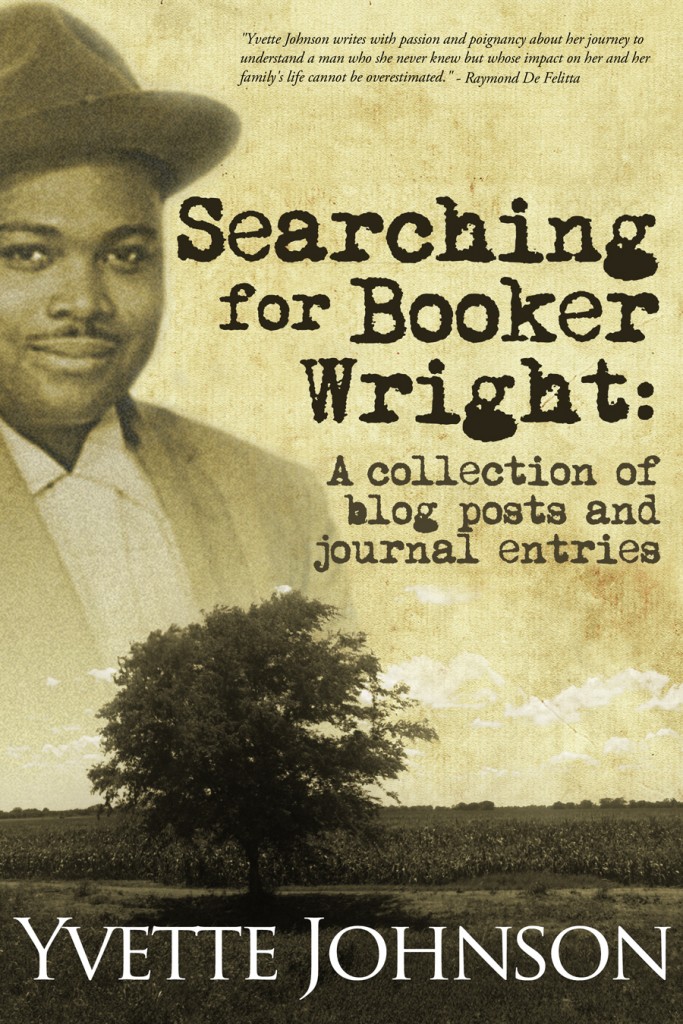
From the Grio: “The repercussions for Booker Wright’s courageous candidness were extreme. He lost his job and was beaten and ostracized by those who considered him ‘one of their own.’ Almost fifty years after Booker Wright’s television appearance, his granddaughter Yvette Johnson, and Frank De Felitta’s son, director Raymond De Felitta, journey into the Mississippi Delta in search of answers: Who exactly was Booker Wright? What was the mystery surrounding his courageous life and untimely murder?”

Watch the Democracy Now interview about the 2012 documentary Booker’s Place, which tells the story of that black Mississippi waiter who lost his life by speaking out. Also, see the 2012 NBC News Dateline story about both documentaries, made nearly a half-century apart.

Yvette Johnson has created The Booker Wright Project. It was designed “to help move the conversation along. By conversation, I mean discussion on race, class, gender, sexuality, age, religion, and more. The topics that tend to divide us. These issues are like fault lines running through our nation, threatening not only to further divide us but to destroy us. In spite of all we have in common, in light of all we’ve overcome, there are several areas in which Americans are consistently, undeniably divided.

“We don’t have to agree on everything. But we have to respect one another enough to not let our individual preferences lead to violence, hate, a lack of empathy, or turning our backs to the challenges of others.”
abc 17 (1)
ABC Wednesday – Round 17

November rambling #1: Rebecca Jade’s new video, and Confessions Of An Idiom

What happens if the Elephant in the Room decides to make the Skeleton in the Closet bring the truth to light?

Librarian_need
What Evanier said about Paris. Ditto. This is the second time this year my cousin Anne, currently working there, has had to report that she is safe.

Samaritan Lives Matter.

Fall of the House of Bush.

Marilynne Robinson warns against utilitarian trends in higher education.

Middle-Aged White Americans Are Dying of Despair.

Last Week Tonight with John Oliver: Prisoner Re-entry.

The First County Clerk in the US to Approve a Same-Sex Marriage License. In 1975.

Egypt’s women-only taxi service promises protection from male drivers.

A New Alcott Emerges From The ‘Annotated Little Women’.

Now I Know: How Matthew Broderick Helped Shape American Computer Law and The World’s Most Prolific Author.

Berowne’s participation in the French Revolution. No, not that one.

A tumor stole every memory I had. This is what happened when it all came back.

Renaissance Geek: Eddie is 51, which is divisible by three.

Simply Red: The Con-Man Behind the Rightwing’s Starbucks Cup Freak-Out.

Wondermark: Throw Back the Dead Man’s Coin.

Binghamton, Now & Then.

Stop expecting artists to work for free — or worse, for “exposure”.

God, on Lawns.

Tosy has 10 opening sentences to short stories that do not exist, yet. But one of them could.

David Kalish: My imagined contract with cockroaches.

The new music video Weather the Storm by Rebecca Jade, the eldest niece.

Allen Toussaint – seven of his greatest songs. Plus Top 10 Allen Toussaint Classic Rock Covers, and finding a big hit in Toussaint’s trash can.

K-Chuck Radio: The WABC Sonic Experience!

Dustbury’s Feel Bad songs. Plus Connie Stevens (!) sang the original of a soul classic.

The Beatles: A 5 Minute Drum Chronology – Kye Smith.

“Love and Theft” – The Veiled but Tangled Roots of Jimmie Rodgers and Tommy Johnson.

Confessions Of An Idiom. What happens if the Elephant in the Room decides to make the Skeleton in the Closet bring the truth to light?

Mad magazine: Overheard at the New Amazon Bookstore.

The Absolute Best Way to Reheat Pizza.

Mark Evanier continues to list the twenty top voice actors in American animated cartoons between 1928 and 1968, including Jackson Beck (Bluto, King Leonardo) and Dick Beals (Speedy Alka-Seltzer, Davey of Davey and Goliath) and Clarence Nash (Donald Duck, Huey, Dewey, and Louie) and Bill Scott (Bullwinkle J. Moose, Mr. Peabody).

Oswald the Lucky Rabbit, the first-ever Disney character and a long-eared precursor to Mickey Mouse, features in this long-lost animated film. Another, obscure, Disney film, John Henry.

The finale of a recent episode of Best Time Ever with Neil Patrick Harris, a program I forget was even on the air.

GOOGLE ALERT (me)

What comics creator has most changed the way people think about comics?


Music Throwback Saturday: Crescent City Blues

johnny cash.folsom

Eurreal Wilford “Little Brother” Montgomery (April 18, 1906 – September 6, 1985) was an American jazz, boogie-woogie and blues pianist and singer from Louisiana.

From his 2013 Blues Hall of Fame induction: “Montgomery first recorded in Chicago in 1930 but spent most of his early professional years in south Mississippi, where he played lumber camps, cafes and nightclubs, sometimes in a blues mode, other times leading a more jazz-oriented dance band. Among the bluesmen influenced by his music in Mississippi were Skip James, Sunnyland Slim, Arthur ‘Big Boy’ Crudup, and especially Willie Dixon.” Among his songs was an instrumental called Crescent City Blues.

Gordon Jenkins (May 12, 1910 – May 1, 1984) I associate as a producer and/or arranger for Billie Holiday, Ella Fitzgerald, The Weavers, Frank Sinatra, and Nat King Cole. “He also began recording and performing under his own name… His ‘Seven Dreams’ released in 1953 included ‘Crescent City Blues’,” featuring singer Beverly Mahr, Jenkins’ wife, borrowed liberally from Montgomery’s version. Jenkins is now in the Songwriter’s Hall of Fame.

Johnny Cash (February 26, 1932 – September 12, 2003) was inspired by a movie Inside the Walls of Folsom Prison (1951), written and directed by an actor, screenwriter and director named Crane Wilbur. Cash stole even more heavily from the Jenkins version to create Folsom Prison Blues, which he wrote and first recorded in 1955.

The lyrics are nearly identical, except for the points where Cash changes the perspective of the narrator. For example, both begin “I hear the train a comin’/It’s rollin’ ’round the bend.” The Jenkins song follows that with “And I ain’t been kissed lord/Since I don’t know when,” but Cash follows it with the darker “And I ain’t seen the sunshine/Since I don’t know when.” All of the verses have this dichotomy, with an identical narrative path and stark differences in tone. Where Jenkins’ narrator says “But I’m stuck in Crescent City/Just watching life mosey by,” Cash has his protagonist sing the far darker “But I shot a man in Reno/Just to watch him die.”

Nonetheless, Jenkins was not credited on the original record from Sun Records. According to Cash’s manager Lou Robin, Cash acknowledged the debt to Jenkins’s song, but was reassured by Sun founder Sam Phillips that he had no reason to fear a plagiarism suit. Fifteen years later, Jenkins sued for royalties. In the early 1970s, after the song became popular, Cash paid Jenkins a settlement of approximately $75,000.

The original Cash studio version hit #4 on the country charts in 1956, but the live version from 1968 spent four weeks at the top of the country charts in 1968. It was also #32 on the pop charts and #39 on the adult contemporary charts. The live album from which it came, At Folsom Prison, went to #13 pop, and #1 country.

Johnny Cash received the Kennedy Center Honors in 1996, and has been inducted into the Country Music Hall of Fame (1980) and the Rock and Roll Hall of Fame (1992), among many other honors.

LISTEN to:
Crescent City Blues – Little Brother Montgomery
Crescent City Blues – Gordon Jenkins, featuring Beverly Mahr (or Maher)
Folson Prison Blues – Johnny Cash
Johnny Cash’s Folsom Prison Blues vs Jenkins’s Crescent City Blues

Bathroom archeology

If that design were in the whole room, it would have been like showering in an aquarium.

pinksink

When we first bought into our house in 2000, one of the things The Wife and I knew we needed to get fixed, sooner rather than later was the bathroom. It was so bad, I actually entered some contest called “America’s ugliest bathroom.” Alas, we did not win. But it was UGLY, SO ugly… I must have those pictures somewhere.

bathroom wall -start
Unfortunately, other home improvements, including, but not limited to, a new kitchen floor, a new roof built by a Trusted and Recommended Roofing Repair Company near me, and having someone dig a big hole in our front lawn to stop sewage from coming to our basement, and replacing our deteriorating above ground pool patio with grass all took precedence. In the summer of 2014, we contracted work to begin on our bathroom starting with a glass shower enclosure.

bathroom wall-2

These pictures do not do their ugliness justice. The pink toilet, pink sink, terrible wallpaper. Worse, a shower where the tile was falling down. Well, the shower was replaced, and the bathroom expanded. The new vanity was purchased in August 2014. But then, for reasons I cannot explain, the work stopped. The vanity was moved from the living room to the room adjacent to the bathroom just before Thanksgiving. In July 2015, after looking at the panel above for nearly 11 months, work commenced again.
bathroom2

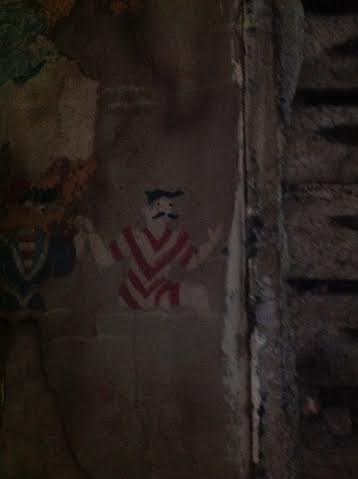
The white, pink and light blue wallpaper was taken off, and somewhere below was this:
seashells

If that design were in the whole room, it would have been like showering in an aquarium. Then, the very next level down, we discovered this:
swimsuit
It made us laugh heartily.

The house is around 100 years old, so it’s quite believable that someone would have used this design.

Sorry that the pics are so dark. they were taken on the Wife’s iPad, before the dim lighting of the bathroom was enhanced.

EDIT: My friend Arthur lightened the top pic and especially the lower three. GRACIAS!

All pictures (C)2015 by Lydia P. Green.

bathroom

fish

swimmer

Ramblin' with Roger
Social media & sharing icons powered by UltimatelySocial