
W is for Watergate

The key lesson of Watergate seems to have been “it’s not the crime, it’s the coverup.”


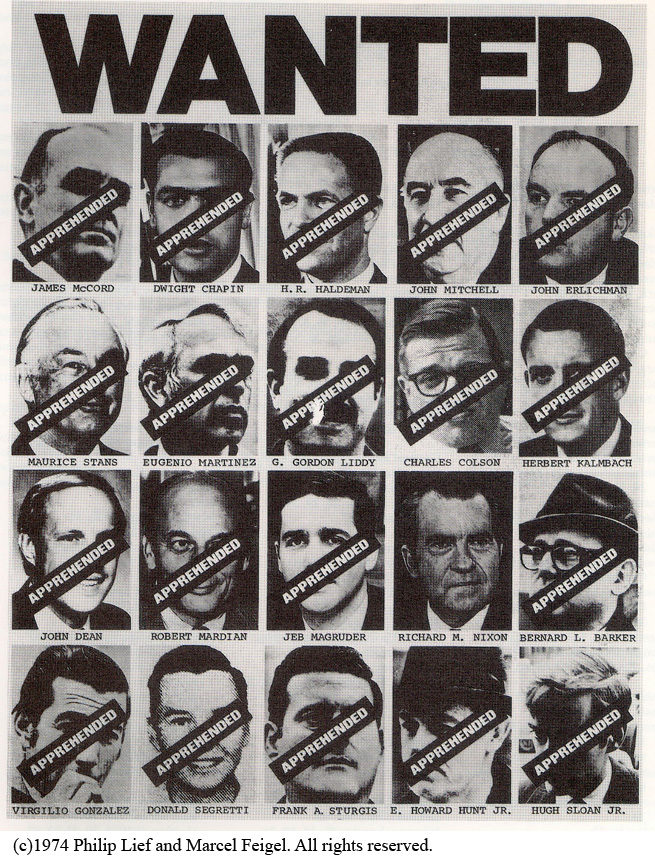
Five burglars involved with the break-in of the Democratic Party headquarters at the Watergate Hotel on June 17, 1972, were arrested; a couple more, involved in the operation, were also detained. The term used by President Richard Nixon’s Press Secretary, Ron Ziegler, to describe the event was “a third rate burglary attempt.” The seven were tried and convicted, President Richard Nixon was reelected in a landslide, and that was that. Except for the fact that two years later, the President was forced to resign in order to avoid almost certain impeachment.

I could not do justice to the story in such limited space – I recommend this Washington Post retrospective – but I do want to convey how important this story was to me personally, and how it played out provided an optimism about “the process” that I have seldom had since.

The burglars had a relationship with the Committee to Re-Elect the President, which many delighted in calling CREEP. Washington Post reporters Bob Woodward and Carl Bernstein uncovered information suggesting knowledge of the break-in and attempts to cover it up, with help of secret informant Deep Throat to fill in the blanks, led deep into the Justice Department, the FBI, the CIA, and the White House. Various men close to the President were forced to resign.

The US Senate had a select committee operate from May 17 to August 7, 1973, and shown in rotation by the three major networks. Riveting story and I watched it as often as possible, as did most of the country, though some soap opera fans were furious; this was better than the made-up stuff.
It got REALLY interesting when White House assistant Alexander Butterfield revealed that there were listening devices in the Oval Office of the President. Special Prosecutor Archibald Cox subpoenaed the tapes, as did the Senate, but Nixon refused to release them, citing executive privilege and ordered Cox to drop his subpoena, which Cox refused. On October 20, 1973, Nixon demanded the resignations of Attorney General Richardson and his deputy William Ruckelshaus for refusing to fire the special prosecutor, finally getting the reluctant Solicitor General Robert Bork to do so; this was referred to as the “Saturday night massacre.” It was pretty much downhill from there, with each new revelation pointing closer to RMN himself.

I remember SO many of the characters in this drama. Chair of the Senate select committee Sam Ervin of North Carolina had a folksy demeanor, yet stayed on task. During the House committee hearings on impeachment, Republican House member William Cohen of Maine’s looked pained as he recognized his President’s failings. Charles Colson was convicted of obstruction of justice; he became involved in prison ministry, and he died only a couple of months ago (Arthur had a take on him).

It reminded me how checks and balances used to work, with even Republicans communicating to a GOP chief executive that an abuse of power had taken place. And it was also a time when a vigorous press was a true fourth estate, holding government accountable, but in turn, holding itself responsible for what is published in return. I do miss those days. Oh, here’s the trailer to the film All The President’s Men, which addresses the latter aspect.

The key lesson of Watergate seems to have been “it’s not the crime, it’s the coverup,” a message politicians seem to have missed over and over. And over and over. One terrible outcome is the attachment of the suffix -gate to almost every subsequent scandal, no matter how trivial. Here’s an undoubtedly incomplete list.
***
Legendary reporter Bob Woodward gets defensive about mild accusations that he sexed up his Watergate stories

Woodward and Bernstein: 40 years after Watergate, Nixon was far worse than we thought

Will Robert Redford’s new documentary explain whether Nixon ordered the Watergate break-in?

ABC Wednesday – Round 10

Book review: JOURNALISM by Joe Sacco

Many black Africans travel across the Mediterranean Sea, attempting to get to Europe, but end up in the tiny island nation of Malta.


Cartoonist/war correspondent Joe Sacco’s new book, JOURNALISM (Metropolitan Books; on sale June 22, 2012) is doing an interesting thing, addressing wars and other conflicts in recent human experience in a graphic form, while attempting to operate in the discipline suggested by the book title. Moreover, he generally succeeds in his mission, though it must be said that the writer himself may be his harshest critic.

Most, but not all, of the work had been published before, in a variety of venues. “The War Crimes Trials,” for instance, was commissioned by Details “during the short stint when Art Spiegelman [creator of the historic graphic novel Maus] was the magazine’s comic editor. Sacco’s access was limited by Detail’s reputation for “glossy photos of spoiled young men and saucily clad women,” so that the last page was compromised. I thought it nevertheless worked well.

There were three pieces in The Palestinian Territories chapter, including getting to “look inside” Hebron, seeing both sides of the struggle between the residents and the Israeli neighbors. The Caucasus section is dominated by a 40-page explanation of “Chechen War, Chechen Women,” which explains the history of the conflict and literally illustrates the fate of the victims of war.

In the Iraq section, Sacco complains that his “Complacency Kills” piece could have reflected any war; to me, that was a strength, the universality of conflict. “Down! Up!” may remind you of the gym teachers or coaches you hated most.

The India section addressed Kunsinagar, a section in northern India in the Uttar Pradesh province where the notion of “untouchables” has been abolished legally but not actually, corruption runs rampant, and a certain sense of hopelessness rules.

The best-realized section, though, has to be the Migration tale, “The Unwanted.” Many black Africans travel across the Mediterranean Sea, attempting to get to Europe, but end up in the tiny island nation of Malta. Almost everything you’ve heard in the debate in the United States over illegal immigration shows up here: mutual distrust of the natives and the newcomers and neo-Nazi resistance to the Africans, who also fight among each other. This piece works so well, I suspect because Sacco is Maltese and still knows a bit of the language, though his family had emigrated to Australia a number of years ago.

In some ways, though, the most interesting part of the book is the Preface, “A Manifesto, Anyone?” Critics, Sacco notes, “question the notion that drawings can aspire to objective truth? Isn’t that — objective truth — what journalism is all about? Aren’t drawings by their very nature subjective?” While the answer to “this last question is yes…this does not let the cartoonist who aspires to journalism off the hook. The journalist’s standard obligations—to report accurately, to get quotes right, and to check claims—still pertain. But a comics journalist has obligations that go deeper than that.” Fascinating stuff.

“Another trap promoted in American journalism schools is the slavish adherence to ‘balance.’ But if one side says one thing and the other side says another, does the truth necessarily reside ‘somewhere in the middle’? A journalist who says, ‘Well, I pissed off both sides—I must be doing something right,’ is probably fooling himself and, worse, he may be fooling the reader.” I have frequently heard this very observation from some newspeople and it pains me greatly. It’s like saying that some claim that six million died in the Holocaust, while others deny it happened at all, so we’ll compromise and decide that three million died. This obviously pleases no one.

“Balance should not be a smokescreen for laziness. If there are two or more versions of events, a journalist needs to explore and consider each claim, but ultimately the journalist must get to the bottom of a contested account independently of those making their claims.”

I highly recommend this book. According to the press release, “Sacco received the Eisner Award for Safe Area Gorazde, which was also named a New York Times Notable Book and Time Magazine’s best comic book of 2000; his most recent book, Footsteps in Gaza, won the Eisner award in 2010 and was also the first graphic novel to win the Ridenhour Book Prize.”

[I received a review copy of JOURNALISM, but no other compensation.]

Let’s party like it’s 1812!

Interestingly, both Canada and the United States “emerged from the War of 1812 with a heightened sense of national feeling and solidarity, having repelled multiple…invasions.”


In 1976, there was this big bicentennial celebration of the United States Declaration of Independence from Great Britain. Currently, the country is in the midst of the sesquicentennial of various events during the American Civil War.

But what is being planned for the bicentennial of the War of 1812, which started on June 18? I’ve heard nothing, quite possibly because almost no American understands exactly what the heck it was all about.

The Americans declared war in 1812 for several reasons, including “trade restrictions brought about by Britain’s ongoing war with France, the impressment of American merchant sailors into the Royal Navy, British support of American Indian tribes against American expansion, outrage over insults to national honour after humiliations on the high seas and possible American desire to annex Canada.” The British first engaged in military rope-a-dope, which allowed the US to gain “control over Lake Erie in 1813, seize parts of western Ontario, and end the prospect of an Indian confederacy and an independent Indian state in the Midwest under British sponsorship.”

But once the British dealt with Napoleon in 1814, the British adopted a more aggressive strategy, sending in three large invasion armies.” And if Americans know ANYTHING about the war, it is from this latter period. “The British victory at the Battle of Bladensburg in August 1814 allowed them to capture and burn Washington, D.C.” The image we have is of First Lady Dolley Madison saving the picture of George Washington from a burning White House.

“American victories in September 1814 and January 1815 repulsed all three British invasions in New York, Baltimore, and New Orleans.” Baltimore, of course, is where Francis Scott Key wrote the words to the Star-Spangled Banner, inspired by seeing the flag shown above. And New Orleans was codified in an old Johnny Horton song called The Battle of New Orleans [LISTEN!].

Interestingly, both Canada and the United States “emerged from the war with a heightened sense of national feeling and solidarity, having repelled multiple…invasions,” Canada from the US, and the US from Britain. This led, in the US, “a sense of euphoria over a ‘second war of independence’ against Britain. It ushered in an ‘Era of Good Feelings’ in which partisan animosity nearly vanished.” It also seemed to codify the “manifest destiny” drive to go “from sea to shining sea,” to quote a different American anthem.

At some level, it is this war that made a squawking bunch of states into a nation, back in the days when Congress actually declared war.
***
The Year 1812, Festival Overture in E flat major, Op. 49, popularly known as the 1812 Overture…[was] written by Russian composer Pyotr Ilyich Tchaikovsky in 1880 to commemorate Russia’s defense of Moscow against Napoleon’s advancing Grande Armée at the Battle of Borodino in 1812. Interesting that music [LISTEN!] associated with the defeat of the erstwhile ally of the US has become a staple of US 4th of July celebrations.

40 Years Ago – June 14, 1972: Purgatory

For several seconds, I believe that I have died, and that the people around me are part of the Judgment.

After I was arrested and convicted of trespassing at the IBM Poughkeepsie (NY) plant, one or both of the Okie’s parents decided that it was either them or me; the fact was that the Okie’s dad worked at the nearby IBM Kingston plant. The particulars are now fuzzy, but somehow, my parents agreed to have my girlfriend stay at their house in Johnson City, NY that summer, where they had just moved from neighboring Binghamton. she was staying in the room of one of my sisters. (More on that eventually.)

The thing was that the only job I could find was at IBM Endicott, and while I don’t believe it was involved in the same war program as IBM Poughkeepsie, it was the same multinational. Nagged by one of my father’s friends, and perhaps the Okie, I went to work there about June 5. Unlike the previous summer, where I had three different tasks to do, I had this one job ALL night involving putting clips on circuit boards – boring doesn’t begin to describe it.

I don’t recall how I got to work every day, but at least on Wednesday, June 14, I hitchhiked. I got picked up by a guy named Charlie. I didn’t know him but he knew my father and recognized me in him. He drops me off at a corner, and I open the door then…

As I learned later, this woman who had some arthritic condition in her leg, and had high-risk insurance, as a result, plowed into the rear of Charlie’s car at 35 mph because her leg could not reach the brake. Charlie’s car was pushed forward into the car in front of his, but since the car in front was much heavier than Charlie’s, it threw us back. Charlie was of course in the driver’s seat, but I was halfway out of the car and was knocked unconscious.

Some period later, I am lying on the sidewalk and there are a bunch of people standing around me in a circle. For several seconds, I believe that I have died and that the people around me are part of the Judgment. But is it heaven or hell? Then I hear an ambulance in the background, and I realize that I am still in Endicott, which is more like purgatory.

We get transported to a nearby hospital. At some point, one or both of my parents arrive, as does the Okie, who burst into tears. She’s crying because she is glad I’m OK. I THINK she’s crying because my face was a ghastly, swollen mess, which, IMO, it was.

I was in the hospital a day and a half. I remember one night, my pillow fell off the bed, and I had to ring a nurse because my shoulder was too sore to pick it up.

Friday, my father picked me up and took us home. What I remember most was the Union-Endicott High School football field filling up because of all the rain we had received from Hurricane Agnes. I spent a week home, and then a week at work.

Friday, June 30, my mom, the Okie, and my sisters picked me up from work. Usually, I worked from 5:12 p.m. until 4 a.m. – 10 hour-days were the norm – but we were getting a long weekend, so I got out at 2 a.m. We went grocery shopping. I was carrying a fairly light bag with my left arm when suddenly, it just gave out. Fortunately, I was able to catch it with my right arm.

For the next six weeks, I ended up doing physical therapy and probably worked a couple more weeks in the end.

The thing is: it was wrong, FOR ME, to have worked at IBM that summer. I don’t want to say I was punished by God in the accident, but metaphysically/spiritually/whatever, it was just bad karma. And it only would get worse.

V is for a Virginia Slave Law

Based on the age of Blair Underwood’s ancestor, and the age of the slaves, it was believed that the slaves were likely his parents or other relatives.

The one television program the Daughter and I watch together is an NBC show called Who Do You Think You Are? It involves stars looking back at their genealogy. An episode we saw recently featured actor Blair Underwood, which I hope you can find here or here or here at the third notch 21 minutes in, with him walking down the steps.

What Underwood discovers is that one of his ancestors at the end of the 18th century, Samuel Scott, actually owns property in Virginia. He is distressed, though, to discover that Scott also owns two slaves! Well, until the researcher he is with explains to him the Virginia Slave Law of 1806 [Shepherd, Statutes at Large, III, 252; passed January 25, 1806]: “The General Assembly moved to remove the free Negro population from Virginia with a law that stated that all emancipated slaves, freed after May 1, 1806, who remained in the Commonwealth more than a year, would forfeit his right to freedom and be sold by the Overseers of the Poor for the benefit of the parish. Families wishing to stay were to petition the legislature through the local county court.”

This was known as a manumission law by which someone who was a free black could be enslaved, or re-enslaved. Based on the age of Scott, the ancestor, and the age of the slaves, it was believed that the slaves were likely his parents or other relatives, protected by the “peculiar institution” rather than being forced to leave the state, or worse.
***
It appears that modern-day Virginia is now involved with a new Jim Crow attitude:

Virginia knows it has DNA evidence that may prove the innocence of dozens of men convicted of crimes they didn’t commit. Men just like [Bennett] Barbour. So why won’t the state say who they are?

“Bennett Barbour was convicted in 1978 of a rape he didn’t commit…The Commonwealth of Virginia learned that Bennett Barbour was innocent nearly two years ago when DNA testing cleared him of the crime. Virginia authorities, however, never informed Barbour of his innocence.” An irritating story.

ABC Wednesday – Round 10

Ramblin' with Roger
Social media & sharing icons powered by UltimatelySocial