Storage media creep, dismal future, and what if Lincoln had lived

Would Lincoln have run for a third term?

Jaquandor, Buffalo’s favorite blogger, who answered so many of my questions that you’d think I was from New Jersey, writes:
(Sorry to be so late in the game with these!)

You’re not late. One can ask me questions anytime, though I specifically request them periodically. Hey, if anyone else has questions, ask away.

To what degree are you tired of “storage media creep” — meaning, the progression from LPs to CDs to MP3s or from VHS to DVD to Blu-ray to streaming?

I am EXHAUSTED by it. I rant about it periodically, especially when it leads to what I like to call W.W.C.T.G.Y.T.B.N.C.O.S.Y.A.O. (the World Wide Conspiracy To Get You To Buy New Copies Of Stuff You Already Own). This is why I 1) still have an LP player, a CD player, a VHS player, DVD player, and 2) don’t jump on the next technology bandwagon very quickly. I’m not going to get all of those newfangled things, because of cost and some incompatibility with each other. I do have music in the cloud – I have no idea what that means – but it’s mostly stuff I got from Amazon for free or cheap (Lady Gaga’s last album for 99 cents.)

And what do you think of the increasing sense in which when we buy something, we’re not getting ownership of anything for our money, but merely permission to use it?

It angers me. One library vendor decided, after the fact, that library patrons can only take out an e-book, I believe, 28 times, because that’s some average book circulation number. Then the “book” would cease to operate. It’s also true of library databases, where what’s available seems to change from year to year, not to mention soaring prices.

To this day, I get peeved around Neil Diamond’s birthday. I bought his CD, 12 Songs. Then I discovered that SONY had placed essentially malware on its own disc which prevents me from copying an album that I own onto my iTunes or other devices; indeed, I believe that even playing the album on my computer could damage the computer. So I must play it on a CD player. I read, well after the fact, that there was a recall, but I keep the disc as a reminder of corporate copyright overreach.

When you think of the long-term problems we face, which one(s) bother you the most from the perspective of your daughter having to be part of the generation that deals with them?

The environment, clearly. I think that the melting ice caps will mean catastrophic weather. Corporations will dupe people into thinking that hydrofracking is a good thing until some disaster that will make the BP oil spill look like lint on a new pair of pants. I also expect that there will be major wars in the 21st century over potable water, more so than fuel.

We may have already passed the tipping points on global warming, say scientists at the Planet Under Pressure conference. Worse. on March 19, Tennessee became “the fourth state with a legal mandate to incorporate climate change denial as part of the science education curriculum when discussing climate change… The ALEC bill passed as H.B. 368 and S.B. 893, with 70-23 and 24-8 roll call votes, respectively.”

How different do you think the post-Civil War era would have been had Lincoln not been assassinated?

Wow, this is SUCH a good question, because it’s so TOTALLY UNANSWERABLE. Which won’t keep me from trying.

Like an assassinated President a century later, I believe that Lincoln was evolving on civil rights issues. I can only wonder how he would have dealt with the Radical Republicans that drove much of Reconstruction in his absence. Would there have been compensation to slave owners that remained loyal to the Union? Would blacks ex-slaves have gotten their 40 acres and a mule, which Lincoln supported but which Andrew Johnson rescinded? If these two things had taken place, might some of the racial animosity that exists in America today have been better ameliorated?

And here’s yet another question: would Lincoln have run for a third term? I always thought he felt his destiny to serve. It was only tradition, not the Constitution, which barred it at the time. And he may have proved more tolerable terms for Southern states to re-enter the union, without the seceding states feeling totally demoralized. I think it was the quick end to Reconstruction that helped allow for the rise of the Ku Klux Klan, lynchings, and the like.

And I just had a debate with someone online about this, so I’ll ask your opinion: how much does the common usage of the phrase ‘begging the question’ bother you? This to me leads to a lot of interesting issues regarding how languages evolve. Thoughts?

It doesn’t annoy me. It has an ancient construction that most people don’t understand. Maybe because it involves “proof” and “logic”, and those are not elements of modern discourse. Politicians beg the question, in the classic sense, all the time.

Its more modern meaning, “raising the question,” the more pedantic complain about, and I can be rather that way, but not on this. Language changes.

I remember that my good Internet friend Arthur was complaining about those folks in the Guy Fawkes masks not knowing who Fawkes really was, or what he stood for. Didn’t bother me.

Whereas I’m still bugged by it’s/its, et al. And the word among no longer seems to be in use at all. I learned that it was between two, but among three or more, yet between is now being used to the exclusion of among. I’ve pretty much given up that fight.

Jaquandor, this begs the question (modern sense): what was the nature of the debate you were having?

The Beginning of the Fall of the Roman Republic

As the gap between rich and poor widened, angry mobs began to riot.

The Wife was perusing a textbook entitled World History by Elisabeth Gaynor Ellis and Anthony Esler (2008, Prentice Hall), when she came across this piece about Rome, in a chapter called From Republic to Empire (p.157):

Conquests and control of busy trade routes brought incredible riches into Rome. Generals, officials, and traders amassed fortune from loot, taxes and commerce. A new class of wealthy Romans emerged. They built lavish mansions and filled them with luxuries imported from the east.

Wealthy families bought up huge estates, called latifundia. as the Romans conquered more and more lands, they forced people captured in war to work as slaves on the latifundia.

The widespread use of slave labor hurt small farmers, who were unable to produce food as cheaply as the latifundia could. The farmers’ problems were compounded when huge quantities of grain pouring in from the conquered lands drove down grain prices. Many farmers fell into debt and had to sell their land.

In despair, landless farmers flocked to Rome and other cities looking for jobs. There, they joined an already restless class of unemployed people. As the gap between rich and poor widened, angry mobs began to riot. In addition, the new wealth led to increased corruption. Greed and self-interest replaced virtues such as simplicity, hard work and duty, which had been so prized in the time of the early republic.

Thus endeth the reading.

Requiem of the week- Mozart

The last time I sang the Mozart Requiem was on September 11, 2002.

The Requiem Mass in D minor (K. 626) by Wolfgang Amadeus Mozart is almost certainly the best known requiem, since its creation (and non-completion) was presented in the 1984 movie Amadeus. Here’s a segment in which Salieri helps Mozart write his Confutatis. Parts of the Requiem show up in some three dozen TV shows and movies, such as The Big Lebowski and Watchmen.

As noted in Wikipedia, it was “composed in Vienna in 1791 and left unfinished at the composer’s death on December 5. A completion by Franz Xaver Süssmayr was delivered to Count Franz von Walsegg, who had anonymously commissioned the piece for a requiem Mass to commemorate the February 14 anniversary of his wife’s death. It is one of the most enigmatic pieces of music ever composed, mostly because of the myths and controversies surrounding it, especially around how much of the piece was completed by Mozart before his death.

“The Sussmayr completion of the Requiem is divided into fourteen movements, with the following structure:
I. Introitus: Requiem aeternam (choir and soprano solo)
II. Kyrie Eleison (choir) {used in commercials, too]
III. Sequentia (text based on sections of the Dies Irae):
Dies irae (choir)
Tuba mirum (soprano, contralto, tenor and bass solo)
Rex tremendae majestatis (choir)
Recordare, Jesu pie (soprano, contralto, tenor and bass solo)
Confutatis maledictis (choir)
Lacrimosa dies illa (choir) [which almost always make me cry]
IV. Offertorium:
Domine Jesu Christe (choir with solo quartet)
Versus: Hostias et preces (choir)
V. Sanctus:
Sanctus Dominus Deus Sabaoth (choir)
Benedictus (solo quartet, then choir)
VI. Agnus Dei (choir)
VII. Communio:
Lux aeterna (soprano solo and choir)”

It is clearly my favorite requiem, as it is one of the two scores I ever purchased so that I can sing along, the other being Messiah by Handel. I have sung this in performance at least thrice. Once was in the spring of 1985 for which I had a now long-long cassette recording. Another time was sometime in the mid-1990s. The last time was on September 11, 2002, when my friends Tim and Gladys, and I crashed the Albany Pro Musica performance to honor the first anniversary of 9/11. (Wasn’t REALLY “crashing” as such.)

Here’s the Wiener Philharmoniker performance, with those nice section breaks. And here are scores and more performances.

L is for Lost Books of the Bible

There are stories in these “lost books ” about the gaps in Jesus’ life; the standard Biblical narrative skips from infancy to the story at the temple when he was about 12, then skips again to being baptized by John the Baptiser.


From one of our locally owned-and-operated bookstores, I bought this deeply discounted tome called Lost Books of the Bible, compiled by William Hone, and published in 1926, though my copy was considerably newer than that. One reviewer says the work “marked the beginning of a new era in Biblical scholarship. They are of inestimable value to an understanding of Christianity past and present.” In the preface, Hone writes: “This collection…is published, without prejudice or motive, save that the reader…may be free to enjoy and hold his own opinion of these ancient and beautiful writings.” For instance, in the First Gospel of the Infancy of Jesus, Joseph had sought a midwife, but this proved to be unnecessary.

One current position about these books notes: Are there lost books of the Bible? No there aren’t. “But that hasn’t stopped people from saying there are. The Christian church didn’t establish the Word of God. Instead, the Christian church recognized it.
“My sheep hear My voice, and I know them, and they follow Me,” (John 10:27).
Interesting to me, the books that are part of the Roman Catholic, or Douay–Rheims, Bible are considered apocryphal. I find this to be too bad. The inclusion of the warriors in the Maccabees books makes a better contrast to the non-warrior Savior.

Whereas others claim: Most followers of churches using the King James Bible feel they have the complete book with all the writings used by the first church and the nation of Israel before it. This work presents evidence that this is not true.


My suggestion has always been to read for oneself. There are interesting stories in these “lost books “about the gaps in Jesus’ life; the standard Biblical narrative skips from infancy to the story at the temple when He was about 12, then skips again to being baptized by John the Baptiser. I must say that The Childhood of the Saviour (Infancy Gospel of Thomas) suggests a less than Prince of Peace-like fellow.

But what also interests me is how the Bible that is extant, with the 66 books, was also not always as it now presented. Origen (215) omits the epistles of James and Jude. The inclusion of Hebrews is doubted by a few writers. Cyril (340), the Bishops of the Council of Laodices (364), and Gregory (375) all omit Revelation, though by 390, the Bible “perfectly agrees with ours.” Revelation, it is safe to say, is the most perplexing book of the Bible.

Here’s one video to check out (note the music) and this beginning of a lengthy series. But there’s a lot more out there.


ABC Wednesday – Round 10

Me as fictional characters, plus Obama, Serling, Cosby

I’ll vote for Obama, in large part because the other guy will be far worse.

Chris from NYADP asks:
Which book/ movie/ TV/ comic book character best represents how you actually are right now?
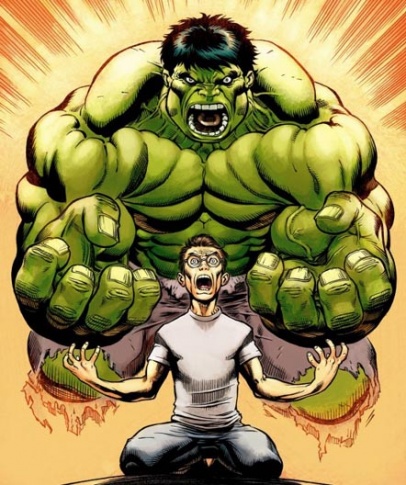
That would be Bruce Banner. He is the guy who has anger management issues. Fortunately, I was raised well enough that I don’t act on my pent-up rage so I don’t Hulk out. But sometimes, things just infuriate me.

One example is the story of Kenneth Chamberlain, a 68-year-old veteran of the U.S. Marines, was killed in his home by the police in White Plains, NY, on November 19, 2011, after his medical alert device was accidentally set off. According to his son, the audio device installed in his father’s home as part of his medical alert system captured racial slurs – Chamberlain was black – and after the door was knocked down, being Tased before being shot dead.

You’ve probably heard about shooting death of unarmed 17-year-old Trayvon Martin at the hands of “neighborhood watch” vigilante George Zimmerman on February 26. There may be disagreement over just what happened that night, but there’s little doubt that incompetent police work after the fact was involved.

From here: “Zimmerman, who is white, called police from his SUV and told them he was following a ‘suspicious’ character. The dispatcher promised to send a prowl car and told Zimmerman to stay in his vehicle. He didn’t. When police arrived, they found him with a bloody nose and Martin face down on the grass not far from his father’s door, a gunshot wound in his chest.”

The more overriding issue, though, is Florida’s controversial law, which protects from prosecution someone who uses deadly force if that person “reasonably believes it is necessary to do so to prevent death or great bodily harm to himself or another or to prevent the commission of a forcible felony.”

I was SO enraged for a couple of days that my stomach was in knots. And there have been others who have been victims of the “shoot first, ask questions later” laws in about two dozen US states. The Sunshine State’s version is clearly the worst. I thought President Obama addressed the issue quite well.

On the other hand, I’ve been disappointed in some of President Obama’s policies…which leads to-

Tom the Mayor, my old FantaCo buddy, asks:

Has Barack Obama disappointed you in any way, I feel that he has missed some great opportunities to enact more changes, especially after the election when he had majorities in both houses? I will still vote for him, but it is kind of sad.

I really think that the failure in the first two years of office was tied to his evidently false notion that he was dealing with rational people. In fact, given the vitriol he had to deal with by day 100, it became clear to me that the folks he was working with across the aisle were not playing the same game. He thought he’d have a honeymoon, which, in very many ways, did not occur. I believe he didn’t want to come off as the “angry black guy,” even though some painted him that way anyhow.

He was working harder in the interregnum than I’ve EVER seen a guy not yet President work. But he, like most, underestimated the depth of the recession. So, by saying that the unemployment rate wouldn’t get under 8%, he clearly miscalculated.

Still, there were things I liked (gay rights, e.g.), and a few I don’t like at all. A couple of recent examples of the latter:

H.R. 347 expands the power of the Secret Service and police to arrest protesters near a ‘protected person’ or at special public events like nominating conventions… [It] passed the House of Representatives by a 388 to 3 margin and was signed, shortly thereafter, by President Obama, on Friday, March 9, 2012.

The Obama DOJ’s decision to charge more national security whistleblowers under the Espionage Act than all other administrations combined.

When I probably end up voting for him, it’s only because the guy who will run against him would likely have championed the same things, and far worse.

Chris also asked:
Which book/ movie/ TV/ comic book character represents the person you’d most like to be?

Kwai Chang Caine from the TV show Kung Fu: “The demands of his training as a priest in addition to the sense of social responsibility which was instilled within him during his childhood, forced Caine to repeatedly come into the open to fight for justice. He would then leave his new surroundings in a further search for anonymity and security.” He had a certain calm, as well as skills to turn the fight back on the attacker.

I was so impressed with Democratic Ohio state Sen. Nina Turner, who, in response to those men wanting to legislate woman’s reproductive health, introduced legislation that would introduce new hurdles for men who want Viagra: proof that they have sought sex therapy, and a sexual partner’s notarized statement verifying their impotency. Very much turning the aggression back on itself. Brilliant; very Caine.

More from Amy at Sharp Little Pencil:

1. Do you think that when our hometown boy Rod Serling said, “Everybody has to have a hometown; mine is Binghamton,” he was being in any way sarcastic?

Absolutely NOT. I read his biography by Joel Engel last summer. Rod LOVED Binghamton, felt safe there. Here’s the fuller quote:
Everybody has to have a hometown. Binghamton’s mine. In the strangely brittle, terribly sensitive makeup of a human being, there is a need for a place to hang a hat or a kind of geographical womb to crawl back into, or maybe just a place that’s familiar because that’s where you grew up. When I dig back through memory cells I get one particularly distinctive feeling-and that’s one of warmth, comfort, and well-being. For whatever else I may have had, or lost or will find-I’ve still got a hometown. This nobody’s gonna take away from me.

BTW, did you see that story about Binghamton being the least hopeful city in America?

3. What is your favorite single cut of all time – 45 or album cut, and by whom?

Amy, you’re a cruel woman, you know that? I have so many tunes running in my head at any given time. Still, I’ll go with God Only Knows by the Beach Boys; incidentally, Brian Wilson turns 70 in June. Although there is a woman in my choir who’s having a baby in July; his code name is Rufus, and I’ve had Tell Me Something Good stuck in my head ever since.

4. Why is there air? (Haha, know you dig Cosby)

And I still have that Cosby LP, Why Is There Air? BTW, take this test to see how well you know that album. But going off from that, the air is there so politicians can make it hot; probably the REAL reason behind global warming.

Ramblin' with Roger
Social media & sharing icons powered by UltimatelySocial