Baseball’s coming, with some new rules

end of the designated hitter

minor league baseballBaseball’s coming, and I’m happy. Actually, it’s more the absence of the negative. I was less excited by the return of the “National Pastime” than annoyed by its potential suspension.

And there are experimental rules rolling out for the 2022 season in Minor League Baseball. Not for all leagues but usually the majority. “Many experimental rules were first tested on a limited basis in 2021.” Most I think are fine. But one I rather despise.

PITCH TIMER: “On-field timers will be used… to enforce regulations designed to create a crisp pace of play, with batters required to be ready to hit and pitchers required to deliver the pitch within allotted periods of time. With runners on base, pitchers will have additional allotted time for each pitch but will risk automatic baserunner advancement if a third pick-off attempt or step-off within the same plate appearance is made without recording an out.”

This is a really good idea. Pitchers and batters take too much time fussing. A half dozen throws by the pitcher to keep the runner close is BORING.

LARGER BASES: “The size of first, second, and third base will be increased from 15 inches square to 18 inches square… to reduce player injuries.”

This may minimize collisions at first between the fielder and the batter. And the change appears to modestly increase stolen bases, which is a fine thing.

AUTOMATED BALL-STRIKE (“ABS”): “In select games…, ABS technology will be used to call balls and strikes.”

While the purist in me is mildly unsettled, seeing so many umpires have their “own” strike zones, and worse, inconsistent ones, allows me not to hate this.

On the other hand

DEFENSIVE POSITIONING: “…the defensive team must have a minimum of four players on the infield, with at least two infielders completely on either side of second base. These restrictions on defensive positioning are intended to allow infielders to better showcase their athleticism, to increase batting average on balls in play, and to restore a more traditional set of aesthetics and outcomes on batted balls.”

Yeah, it’ll almost certainly increase batting averages. But the solution to the shift (three fielders on one side or the other of second base, is to “hit it where they ain’t.” I’m not happy with this.

On the Major League level, the new contract has finally brought the end to no designated hitter in the National League. I’m no fan of the DH. But when MLB ended up with 15 teams in each league, requiring at least one interleague game every day of the season, I knew that pitchers who bat would soon be gone. Unless they’re really good at both.

Meanwhile, see the ball attendants snag some foul balls. 
Albany Symphony: two Russian composers

Hannah Kendall

Sergei Prokofiev
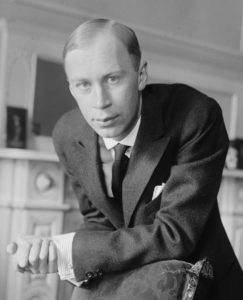
Sergei Prokofiev, c. 1918

The Albany Symphony held a concert at the Palace Theatre in the city on February 12, featuring two Russian composers. My friend Lee was supposed to go, but he and his spouse were out of town. He gave us their tickets, and my wife and I went in their stead. We attended the pre-concert talk with conductor David Alan Miller and piano soloist Wei Luo.

The first piece was the 10-minute piece The Spark Catchers by the non-Russian Hannah Kendall (b. 1984). It was inspired by Lemn Sissay’s poem of the same name. It concerned the Bow Matchwomen’s Strike in East London of the late 1880s. Kendall was struck by the linguistic parallel of striking a match and a worker cessation.

The Spark Catchers as performed by Chineke! Orchestra c. 2020

This was followed by the Concerto for Piano No. 3 by Sergei  (1891-1953) from 1921. In the notes, the initial section shows “everything a pianist is done: cross-handed work… crashing chords, reaches to both ends of the keyboard and staccato playing.” No wonder Wei Luo, dressed in a very shiny red outfit, presumably for Valentine’s Day weekend, got an ovation after only the first movement.

Prokofiev died the same day as Joseph Stalin, two days before I was born. Thus the news of the composer’s death was somewhat muted in the Soviet press. Or maybe it was that the Communist Party had censured his work in 1948, seeking a “new style,” whatever that means. Possibly they thought it was his beautiful melodies that had “become distorted, and conventional tonality gives way to harmonic dissonance.”

Piano Concerto No. 3. Martha Argerich at the Singapore International Piano Festival 2018

And tell Tchaikovsky the news

Pytor Ilyich Tchaikovsky (1840-1893) was one of the first composers whose work I could identify, first the 1812 overture, then the Nutcracker. I’m sure I have at least one recording of his Symphony No. 6, “Pathetique.” I did not know that he died nine days after the symphony’s debut, which the composer conducted.

His brother Modest blamed Pytor’s death on the composer drinking unboiled water during a cholera epidemic. But David Alan Miller doesn’t buy it. Was it suicide? The man was old before his time.

The second movement is in the unusual 5/4 meter. The theme of the third movement appears very early and it is very familiar to me. But doesn’t reach its full vigor until relatively near the end. It sounds like the end of the piece, and many patrons at ASO applauded. No, there is a fourth, slow movement that “fades away into nothingness.”

Pathetique, Symphony No. 6 in B Minor, Op. 74, Royal Philharmonic Orchestra with Yuri Temirkanov, conductor. Recorded in 1990

Colorblindness, I reckon

combination

colorblindI was reminded recently that I experience a degree of colorblindness. It surprises me because I can easily discern if an apple is red or green, e.g.
Or the broad category of book covers. In fact, there have been sections of my collection I’ve arranged by color, which is not a moral failure. When I was working as a librarian, we sometimes would refer to a book by broad function and color – “You know, that New York state directory with that maroon cover.”

But distinguishing between navy blue and black? I’m not so hot. I was living in an Albany apartment in the 1980s or 1990s when my mother visited from Charlotte, NC. I bought a rug, which I perceived to be black and a shade of brown. She said my indisputably blue chair would go well with the rug because they’re both blue. “Blue? Are you sure?” She thought I was kidding.

Back in librarian days, one of the librarians, with the assistance of a couple of colleagues, wrote a book called What’s Your Signage. Chapter 4, “Designing the Signage That’s Right for Your Business,” discussed the numerous factors that should be considered in creating an effective sign, including color contrast.

Yellow on white?

Recently, when I checked into my church – for contact tracing, if necessary – someone had marked the column for that date with a yellow line. My glasses were slightly foggy, and I couldn’t see the line. Someone insisted, “It’s right there!” Well, I could see the light green line from the previous week, and the pink line from the week before that, but not the yellow one.

Even as a child, I had a terrible time seeing yellow on white, or vice versa. Ditto certain purples and black. And since about 8% of the population is colorblind to some degree, those combinations should be avoided. Even the dull blue on the black background of the DVR display is not that easy for me to read. Whereas the red on the answering machine display is highly visible.

From AAO: “There are different degrees of color blindness. Some people with mild color deficiencies can see colors normally in good light but have difficulty in dim light.” I was taking down the artificial Christmas tree. Most of the bulbs I had removed; the one I missed, in that dim part of the living room, was a different shade of green.

If I were to place the black remote control to the television face down o the dark brown TV stand, I might never see it. Again, more light helps a LOT.

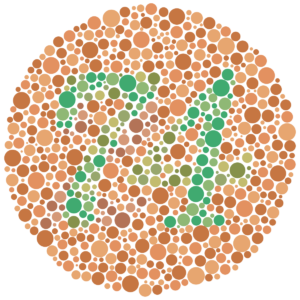
I got the graphic from Wikipedia. What number do YOU see? “Viewers with red-green color blindness” see it differently, and “those with total color blindness may not see any numbers” I see numbers, but not the correct ones, apparently.

27% Irish, from County Cork

World’s 1st St. Patrick’s Day parade was in 1762 in NYC

As I’ve noted, I’m 27% Irish, a plurality in my makeup. My daughter is 21% Irish. I don’t have access to my wife’s DNA test presently, but I surmise she’s 15% Irish, give or take. Moreover, at least some of my ancestry is rooted in Munster, County Cork.
So I was VERY tempted to go on the 2022  Dave Koz cruise. It has an impressive musical lineup, including the niece, Rebecca Jade, who must be part Irish as well.

Moreover, the Royal Caribbean cruise starts in Amsterdam, Netherlands, and is traveling to Cork (Cobh), Ireland as well as Holyhead, Wales; Glasgow (Greenock), Scotland; Dover (London), England; then back to Amsterdam. Two tours, May 13 to May 20, and May 20 to May 27. But at two grand for double occupancy, plus airfare, this is a bit dear, as my grandma Williams would say. Worth it, I imagine.

And I’m not sure I’d want to go that long without seeing my daughter in her senior year of high school, or my wife. Also, I suppose I’m wary of cruises; less about COVID, since RC “requires all guests and crew to be 100% vaccinated with no exceptions.” But perhaps more about other cruise debacles in recent years.

Also, while I’ve FINALLY requested a new passport, I haven’t received it yet.

Census stuff

The Census Bureau regularly issues out these seasonal packets in two series. “Profile America’s Facts for Features… provides statistics related to observances and holidays such as Asian/Pacific American Heritage Month (May), The Fourth of July (July 4), Hispanic Heritage Month (Sept. 15-Oct. 15), and Veterans Day (Nov. 11).”

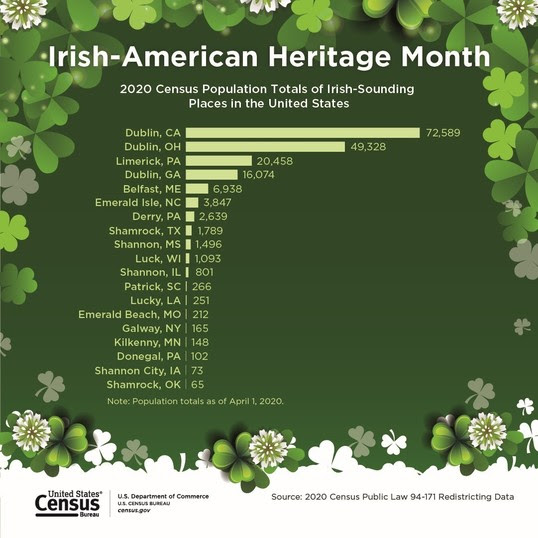
For Irish-American Heritage Month and St. Patrick’s Day:

“Originally a religious holiday to honor St. Patrick, who introduced Christianity to Ireland in the fifth century, St. Patrick’s Day has evolved into a celebration for all things Irish. The world’s first St. Patrick’s Day parade occurred on March 17, 1762, in New York City, featuring Irish soldiers serving in the English military. This parade became an annual event, with President Truman attending in 1948. Congress proclaimed March as Irish-American Heritage Month in 1995, and the President issues a proclamation commemorating the occasion each year.”

Check out stats at the link.

March snows can ruin plans in Albany

Remember “The Great” one of March 1888?

I know that March snows can ruin plans in Albany. My wife, my daughter, and I were going to do a college visit on March 12-13, but the forecasted snow and wind had us postpone the trip. The St. Patrick’s Day parade in the city, which had been canceled the last two years, was postponed a week.

The WORST two storms in Albany, at least as far back as the records go, were in March. The first one was The Blizzard of 1888 (March 11-14, 1888). “The blizzard by which all others are measured.” No, I don’t remember it. But it appeared in at least four JEOPARDY clues.

2001: AMERICAN HISTORIC EVENTS for $400: The “Great” one of these paralyzed New York City on March 12, 1888 (Triple stumper, with guesses of fire and a blackout)
2007: STORMY WEATHER for $400 (DJ): In March 1888 one of these blinding snowstorms struck the East Coast, creating 40-to-50-foot snowdrifts (correct answer)
2014: WEATHER REPORT for $2000 Remember “The Great” one of March 1888? (Triple stumper)
2018: “ZZ” MIDDLE for $600: Spring buds were blooming, but “The Great” one of these of March 1888 was one of the worst ever in American history (correct answer)

Storms I DO remember

Blizzard of 1978 (February 6-7, 1978). I was working at the Albany Savings Bank downtown while living in Schenectady. A chunk of ice hit the roof of a VW Beetle on the street where I was living.

April 6-7 1982: I saw Pete Seeger at Page Hall at the downtown SUNY campus on the 4th, when it was already uncommonly cold. Then the snow came.

January Snowstorm of 1983 (January 15-16, 1983). I didn’t remember this, maybe because it was on the weekend. But my girlfriend at the time and I DID go to a party Saturday night, despite 18″ of snow.

Unprecedented Early Season Snowstorm (October 4, 1987). I  wrote about this.

The Downslope Nor’easter (December 10-12, 1992) “This storm produced incredible snowfall totals across many mountainous locations, while barely having any effect on valley locations.” Chris Kapostasy of WNYT (later Chris Jansing of MSNBC) told this story at my church a couple of years later. She and her cameraman were trapped in the Berkshires. And no one was looking for them from Albany because it wasn’t a big deal in the city. But Chris and the cameraman recorded their final wishes.

The worst storm in my life

Superstorm of 1993 (March 13-14, 1993) This was the worst storm in Albany in my lifetime, which I wrote about here.

May 18, 2002 – Snowstorm. I remember because my wife was supposed to get her graduate degree from UAlbany outdoors. They had to find an inside venue.

Various storms in the early 2000s I recall vaguely. We went to visit my in-laws in Oneonta during the December 25-26, 2002, and again for the January 3-4, 2003 storms. When we came home, we had double-digit inches of snow to shovel.

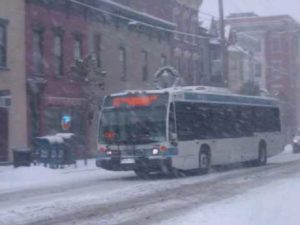
Valentine’s Day Storm: February 14, 2007. I was working at Corporate (frickin) Woods when we were told we could leave if we wanted to. If I hadn’t taken the 2:06 pm bus out of there, I would have had to sleep at my desk. Any westbound bus from Central Avenue and Henry Johnson Boulevard took 45 minutes to arrive, then took 20 minutes to ride a 10-minute stretch. The 6-minute walk home required nearly a half-hour. I took the next day off, helping my wife dig out her car as the temperature plummeted. Dig for 20 minutes, drink hot chocolate indoors, dig for 15 minutes, go back inside for 15 minutes…

Ramblin' with Roger
Social media & sharing icons powered by UltimatelySocial