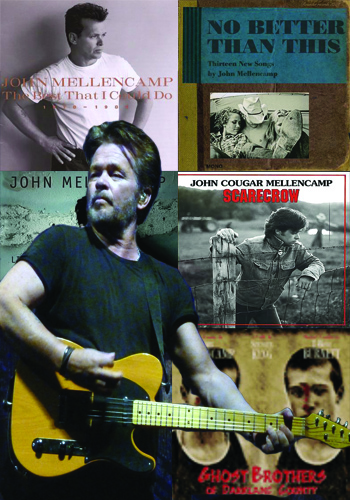
Musician John Mellencamp is 70

Blood on the plow

MellencampIn the late 1970s, I heard about a singer named Johnny Cougar. Without having heard a single note from the musician, I had immediately dismissed him. I later learned that a “suit” insisted that John Mellencamp change his name because the Germanic surname was too hard to market.

When he achieved some commercial success, he could get his record company to list him as John Cougar Mellencamp in 1983. But it wasn’t until 1991 that the Cougar went away.

Mellencamp claims to have invented alt-country, and perhaps he did. For sure, he helped organize the first Farm Aid benefit concert with Willie Nelson and Neil Young on September 22, 1985. It’s now an annual event that has raised over $60 million for family farmers who are struggling financially.

Big Daddy

I’ll admit I haven’t heard that much of Mellencamp’s music since the late ’80s. I did listen to some recommended cuts on his Wikipedia page and liked quite a lot of them. He doesn’t seem to have the rock star instinct, though. When he released Big Daddy in 1989, which he said at the time was his best album, he decided not to tour. He was heavily involved with painting at the time.

John Mellencamp has been lauded by folks such as John Fogarty, the late Johnny Cash, and Bruce Springsteen, who has played with him occasionally. He was inducted into the Rock and Roll Hall of Fame in 2008. A decade later, he got into the Songwriters Hall of Fame.

Rolling Stone contributor Anthony DeCurtis said: “Mellencamp has created an important body of work that has earned him both critical regard and an enormous audience. His songs document the joys and struggles of ordinary people seeking to make their way, and he has consistently brought the fresh air of common experience to the typically glamour-addled world of popular music.”

On CBS Sunday Morning, he told fellow Indianian Jane Pauley that smoking got him the voice he wanted. He’s riding her on this motorcycle but where are their helmets?

Some songs

Chart action per Billboard pop charts

Rumbleseat, #28 in 1986
Save Some Time To Dream. This is from his 2010’s lo-fi CD No Better Than This, the only album of his I actually own save for a greatest hits collection.
R.O.C.K. in the U.S.A. (A Salute to ’60s Rock), #2 in 1986 – if a little cheesy, I got what Mellencamp was going for. And I appreciate the ocarina, which I associate with “Wild Thing” by The Troggs
I Need A Lover, #28 in 1979. It’s a very long intro
Cherry Bomb, #8 in 1988

Paper’s In Fire, #9 in 1987. Lisa Germano’s fine violin
Authority Song, #15 in 1984. He says it’s his band’s version of “I Fought the Law”
Lonely Ol’ Night, #6 in 1985
Jack & Diane, #1 for four weeks in 1982. I’ve become a sucker for this song for the past quarter-century because my wife’s cousin Diane married a guy named Jack a while before I met them. I was really fond of Jack, as he, my late FIL Richard, and I talked about baseball at length, especially from the 1950s and 1960s, every family reunion. Jack was a Brooklyn Dodgers fan. When he died in 2021, dear Diane made sure some of Jack’s books were sent to me.
Rain On The Scarecrow, #21 in 1986. “Do you want to buy a farm?”

Optimism: is it always good?

optimismAfter I had written about my melancholy/depression, I allowed that my default position about events is not optimism, but pessimism. My friend Cee had heard the benefits of optimism.

And indeed, if you Google “Is optimism good?” the first thing one might find is this quote from Kids’ Health: ” Optimism Is Healthy. It turns out that an optimistic attitude helps us be happier, more successful, and healthier. Optimism can protect against depression — even for people who are at risk for it. An optimistic outlook makes people more resistant to stress. Optimism may even help people live longer.”

So it’s settled. Wait a minute. The next article is a 2015 piece from the Washington Post stating that “Researchers have found a really good reason not to be an optimist.” It references an NIH study.

That Wapo article: “Optimism isn’t merely unhelpful at times—it can be demonstrably counterproductive. Telling someone ‘you can do it’ when they actually can’t doesn’t change the outcome, and it makes them more likely to exert time and effort on a fruitless task. There might be no clearer example than the fact that optimists spend more time looking for Waldo, but are no more likely to find him.” But the piece allows that pessimism is not curative either.

Ben Franklin

I had mentioned to Cee that I had long been attracted by a portrayal of Ben Franklin, on, of all things Bwitched. His character [said]… that “he always going through life expecting negative outcomes so that when something positive happened, he would be pleasantly surprised. It was a punchline that was supposed to be funny – the canned laughter told me that – but, to me, it made SENSE… ‘Perhaps I’m an optimistic pessimist — prepare for the worst, but when the very worst doesn’t happen, I’m pleasantly surprised.’”

I’m more vulnerable when I’m optimistic. I’m thinking of someone in a particular position who despised the action of a perpetrator, and rightly so. When they were in the same situation as the previous villain, I was optimistic that they, remembering how crummy they felt, would act differently. Nope, they performed the same damn way. As bad as the mess was, it was my optimism that bit me in the butt.

This is why, for instance, I’m not disappointed in politicians anymore. If they end up being better than expected, I’m pleased. But if they have feet of clay, well, what did I expect? I suppose this sounds cynical, but it tends to regulate my highs and lows, which in the main, works for me.

So the fact that I was optimistic that we’d be out of this damn pandemic by now is why I crashed emotionally a bit. This commercial really spoke to me.

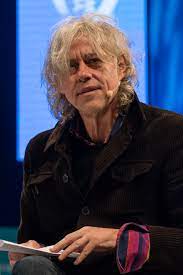
Musician Bob Geldof turns 70

Where the only water flowing Is the bitter sting of tears

Bob GeldofI was making a follow-up appointment at my podiatrist’s office. It was a Monday, and the receptionist and I started riffing on songs. Monday, Monday; Stormy Monday; Manic Monday; Rainy Days and Mondays – there have been lots of rainy days around Albany.
Then I said I Don’t Like Mondays. She thought I was making a reference to scheduling my next visit. No, I was talking about a song by the Boomtown Rats, led by Bob Geldof. I explained that it was a song about a mass shooting and the explanation of the act by the 16-year-old shooter.

The truth is that, though I actually have a couple of albums by the Boomtown Rats on vinyl that I haven’t played in years, I Don’t Like Mondays is the only song that I identify with Geldof.

Band Aid

Well, that and Do They Know It’s Christmas?, one of the best-selling singles of all time, which Geldof co-wrote with Midge Ure of Ultravox. It was created in response to the famine in Ethiopia in the early 1980s.

Geldof and Ure put together the group Band Aid, comprised of a large number of British and Irish musicians. The song was especially massive in the UK and generated remakes in 19892004, and 2014.

It also inspired the Lionel Ritchie/Michael Jackson-penned We Are the World from mostly American artists as USA for Africa in 1985.

When he promoted the original single, Bob Geldof got into a run-in with the British Government, which initially refused to waive the VAT on its sales. Ultimately, yielding to public sentiment, the government donated the tax back to the charity.

But he realized the problem in Ethiopia was much larger, in no small part because of what he discovered, according to his Wikipedia page. “One of the main reasons why African nations were in such dire peril was the obligation to make repayments on loans that their countries had taken from Western banks.”

Live Aid

The charity super-concert Live Aid took place in 1985 in London and Philadelphia. “On how Geldof got artists to agree to play, Live Aid production manager Andy Zweck states, ‘Bob had to play some tricks to get artists involved. He had to call Elton and say Queen are in and Bowie’s in, and of course, they weren’t. Then he’d call Bowie and say Elton and Queen are in. It was a game of bluff.'”

Geldof continues to be involved with charitable work. He is “a member of the Africa Progress Panel (APP), a group of ten distinguished individuals who advocate at the highest levels for equitable and sustainable development in Africa… [He] was granted an honorary knighthood (KBE) by Elizabeth II in 1986 for his charity work in Africa… In 2005, he received the Brit Award for Outstanding Contribution to Music.”

I’m way too busy to work

Art at APL

It is a cliche, but like a lot of retirees, I’m way too busy to work. Friday, 1 October was a perfect example.
I was attending the third of a three-day online state Data Center conference. The penultimate session was on The Quality of the 2020 Census Apportionment Counts: What Can Process Statistics Tell Us? by Joe Salvo, Research Fellow, Social Data and Decision Analytics.

What? No, this was fascinating stuff! Really! For instance, how many more records had partial responses, such as just numbers with no names, for instance, because of the Non-Response Follow-Up taking place during a pandemic? As an enumerator for the 2020 Census, I would have loved to have stayed for the whole talk, not to mention the question-and-answer period.

Underground Railroad

But I needed to catch a bus for a tea for the Underground Railroad Education Center. It was outdoors, and fortunately a nice day. The UREC is a tremendous asset to Albany and the history of the country. Paul and Mary Liz Stewart’s “work uncovered the voices and stories of people written out of this history.”

Discovering the home of Stephen and Harriet Myers, abolitionists who lived in the city, and then buying and renovating – especially renovating – 194 Livingston Ave – has been a boon to the process. But it’s hardly the endpoint.

I knew a few people there, including mayor Sheehan, and met several more. One of the interns interviewed me for a project about the history of the UREC.

I was trying to remember how I knew Paul and Mary Liz, which predated the project that started two decades ago. Paul theorizes that the late Donna George probably brought us together. She was always connecting people to others they didn’t know before.

After I went home with my wife, who had come to the event directly from work, we ate a quick dinner.

Art@APL

Then I walked less than a fifth of a mile to the Pine Hills branch of the Albany Public Library to see the new installation of Art at APL called Pieced Together. The artists include Fern Apfel, Paula Drysdale Frazell, Danny Goodwin, Chloe Harrison, Niki Haynes, Beth, Humphrey, Henry Klimowicz, Juan Hinojosa, Melinda McDaniel, Michael Oatman, and Kenneth Ragsdale. The exhibition guide is just a small fraction of the work.

I was immediately drawn to Michael Oatman’s work. Much of the created works are based on comic book covers, magazine logos, and the like. The installation will be at 517 Western Avenue until April 17, 2022, so check it out.

Expect that many of the next few posts will be of the “I’m way too busy to work” mode.

Baseball player Dave Winfield is 70

dead bird

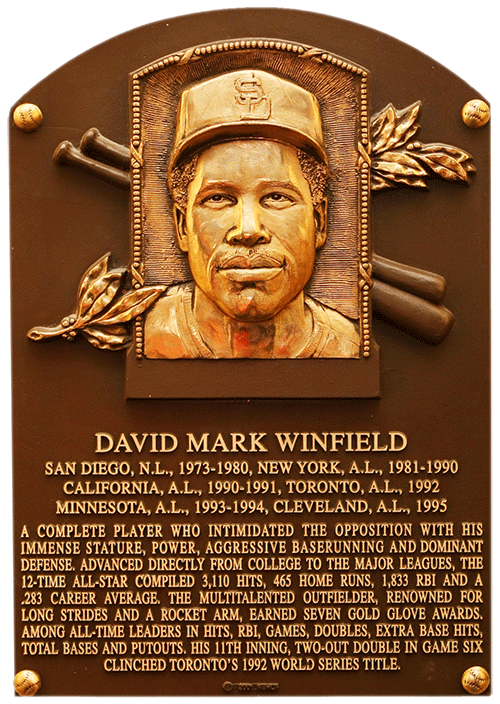
dave winfield.hall_of_fame_plaqueI always liked the outfielder Dave Winfield. He played for the San Diego Padres as the right fielder from 1973 to 1980, becoming an All-Star in the middle years there.

In 1981, he became a free agent. The sometimes volatile owner of the New York Yankees, George Steinbrenner signed Winfield to the most lucrative baseball contract at the time. But The Boss didn’t understand a cost-of-living provision and ended up agreeing to a ten-year, $23 million deal, rather than ONLY $16 million. This led to Steinbrenner’s feuding.

In 1985, Steinbrenner, in criticizing Winfield, said to The New York Times writer Murray Chass, “Where is Reggie Jackson? We need a Mr. October or a Mr. September. Winfield is Mr. May.” A few years later, the owner was banned from baseball for two years, in part for hiring a guy with Mafia ties to dig up dirt on Winfield.

This was weird: “On August 4, 1983, Winfield killed a seagull by throwing a ball while warming up before the fifth inning of a game at Toronto’s Exhibition Stadium. Fans responded by hurling obscenities and improvised missiles. After the game, he was brought to a nearby Toronto Police Service station and charged with cruelty to animals. He was released after posting a $500 bond… Charges were dropped the following day.”

Away from the Bronx Zoo

Dave Winfield was traded in 1990, and he was wearing a California Angels uniform the one time I saw him play in person, June 14, 1991. He went 3 for 4. Ten days later, he became the oldest player to hit for the cycle (single, double, triple, home run).

Finally, in 1992, with the Toronto Blue Jays, he got his first World Series ring. He retired in 1995, having accumulated 3110 hits, including 465 home runs, in his 22-year career. He was selected to the Baseball Hall of Fame in 2001, his first year of eligibility. Here’s his induction speech

He could do it all. Here’s why he wants kids to play multiple sports, as he did growing up. Dave Winfield – Field dedication ceremony, 2021.

Ramblin' with Roger
Social media & sharing icons powered by UltimatelySocial