Writing your own obituary

You matter

ObituariesWriting your own obituary? First of all, I should note that I’m not in imminent danger of dying. As far as I know. I suppose I could be mistaken. In any case, I’m betting against living another six decades.

The idea of writing my obit appeals to me. It’s mostly because I recognize that the task can be onerous. Writing it yourself alleviates the stress of your family and friends having to take on the task. Of course, you also have to face up to your accomplishments. You might say, as  Peggy Lee did, “Is that all there is?” Conversely, you might be forced to consolidate the bullet points. That racquetball trophy I won in 1989 won’t make MY list.

I love a good obituary. It’s like any compelling story. I remember leafing through The Last Word: The New York Times Book of Obituaries and Farewells: A Celebration of Unusual Lives by Marvin Siegel. Where this happened, I don’t remember, but it was several years ago. Thrift Books reviews speak to me.

“Rather than an ode to death, this book cherishes lives once lived by all kinds of people. Whether brilliant or simple, rich or poor, actions great or discreet, each of the people written about contributed to society in a meaningful (and often surprising) way.”

“You wouldn’t think a book of obituaries would be entertaining, but it is when the obits are well-written and celebrate the lives and characters of the 100+ people found in this collection. The subjects are most often unknown to the majority of us, but the various authors (including well-known NYT obituary author Robert McG. Thomas, Jr.) humanize each subject and inspire you to contemplate your own life.” Yeah, that.

The recent prompts

I started thinking about this – again – because of a May 14 New Yorker article, Telling the Stories of the Dead Is Essential Work. This was a COVID-19 -related tale.

Then there was an October 15 commentary in the Albany Times Union. “On the obituary pages, reflections of lives fully lived” was written by Karl Felsen, a local retired public relations executive. His daughter, in the time of COVID, had asked Karl and his wife to write their own obits. “If you have a favorite picture, include it.”

Felsen quotes poet Jim Harrison. “Death steals everything except our stories.” He started perusing the longest obituaries in the TU. Charles P. Rougle lived a fascinating life “that ran from Montana to Moscow, from Sweden to Slovenia. A translator and expert in my many languages, a woodworker sand cello player on the side.” Someone Felsen wished he had met.

Of the collection of obituaries that he read, “They were here. They lived. They mattered.” So Felsen’s going to write his own obit. “It’ll be long, celebratory, and mostly true.” He’s “come to the conclusion that crafting your own final story is one way to stay busy living.”

I’m inclined to do this. Maybe not next week, or next month, but probably in the next year. Have any of you done this? Any pointers? This could be an interesting posthumous “ego trip.”

“Blacklisting” the word blacklist

embargp

I came across the Antiracist Word Finder. It’s a useful, crowdsourced list. One can quibble with one or two of the suggestions, but it’s pretty solid. The attempt is “to surface how racism is embedded in everyday English-speaking life.

One of the words on the AVOID list is blacklist. The definition is “a list of people or things that are regarded as unacceptable or untrustworthy and should be excluded or avoided.” When I was growing up, it was a word that vaguely gave me discomfort.

But it wasn’t until the prevalence of whitelist in this more technological period that it really started to bug me. Whitelisting is a term for the “practice of explicitly allowing some identified entities access to a particular privilege, service, mobility, access or recognition.” Ha! “Privilege” right there in the definition!

The Word Finder suggests Blocklist / Allowlist for data security. Wikipedia mentions ‘allow list’ and ‘deny list’. “While the term ‘black’ is race-neutral, it is linked to European duality of evil vs good (or dark vs light). Google and other tech companies plan to phase them out.”

As a term for trade barrier, Word Finder chooses Exclude / Include over Blacklist / Whitelist. “In some cases, ‘embargo’ is appropriate. For a list, a business or country that is offsides with humanitarian issues might be better excluded from a roster of reputable groups.”

Synonyms for blackmail

The Word Finder also excises blackmail. It prefers coercion or extortion. I’m not that fond of the term coercion in this context, as there are lots of ways to coerce, such as a physical threat. Blackmail is a specific subset of extortion, I suppose, less precise but also less problematic.

Exaction? “The action of demanding and obtaining something from someone, especially a payment or service.” But it lacks the part about the potential embarrassment.

I’ll tell you the truth. As a black male, I have disliked the homophone blackmail for a very long time. So maybe we need a new term. Do you have one?

Movie- All In: The Fight for Democracy

Stacey Abrams

All InThe documentary All In: The Fight for Democracy is very good. And quite infuriating. As the New York Times  subtitle of the review notes, “with snapshots and stories of voter suppression yesterday and today, [it] carries an urgent message: Vote!”

But they don’t make it easy. “The broad strokes of the history in the film are likely to be familiar to viewers, but some of the details may not be… The recurring theme is that every major advancement for voting rights in the United States has been met with a counterreaction that hollows out those rights.”

Yet the Constitution points to a broadening of the right. Read amendments 14, 15, 19, 23, 24, and 26, and arguably others.

The movie describes the Florida debacle., where the citizens voted to allow ex-felons to vote, but the state essentially reneged. I wrote about that here.

Stacey Abrams

The Stacey Abrams experience is mentioned early. She was the Democratic candidate for governor of Georgia in 2018, running against Republican Brian Kemp. Tens of thousands of voters were disenfranchised by the state Secretary of State, who was Brian Kemp. It was like playing tennis with the chair umpire.

“Abrams’s sections of the film are also a memoir: She remembers her grandmother telling her about casting her first vote, after the Voting Rights Act passed, and how she still felt terrified to exercise her franchise. At another point, Abrams notes that chronic voter suppression has had a ‘pernicious’ effect: ‘It convinces you that maybe it’s not worth trying again,’ she says.

“In its shifting of topics and breadth of material, “All In” gives the impression of being a movie that the directors, Liz Garbus and Lisa Cortés, rushed to complete to meet the moment. (There is footage of Wisconsinites voting during the pandemic in April.) In a sense, it’s less a documentary for posterity than an urgent broadcast.”

Voter Suppression

The Times article refers to Carol Anderson, “a professor of African American studies at Emory, as “one of the most engaging interviewees.” She “relates the story of Maceo Snipes, a World War II veteran in Georgia who was the only African-American to vote in his area in 1946.” He was shot and killed for his effort.

She and “journalist Ari Berman…discuss… Chief Justice John G. Roberts, who wrote the majority opinion in [the evil] Shelby County v. Holder” case. That’s the “2013 decision that struck down a key provision of the Voting Rights Act,” from which a lot of new disenfranchisement stemmed. Roberts “had been a foe of the act as a young lawyer.”

Oh, check out this related website to find out how to register and vote.

Thumbs way up

The 62 critics who reviewed All In at Rotten Tomatoes were unanimous in their praise of the film. It addresses “barriers to voting that most people don’t even know is a threat to their basic rights as citizens.” “A thorough but accessible guide to the history of voting in the US and what that history means for the electorate today.”

This definitely rings true: “The dismaying ebb and flow of justice is a major point in the film, with multiple pundits noting that periods of swift progress are often followed by equally if not more stringent rollbacks.” And it “makes a very convincing argument that the right to vote needs to be protected, and that democracy itself is under siege.”

More yin and yang: Stacey Abrams, a producer of the film, has been nominated for the Nobel Peace Prize for her efforts to expand access to the right to vote. And Republicans have ALREADY introduced over 100 voter suppression bills in 2021.

GameStop, Robinhood: explain it to me

Bernie meme

Bernie SandersA smart, nearly 80-year-old man wears mittens suitable for a cold DC day. How does it become a meme? And when do we decide it’s over? At least Bernie seems amused if slightly bemused by it.

This pic, BTW, was forwarded to me by my daughter. I have no idea why.

GameStop? What’s a GameStop?

Explain it like I’m 5 years old: A desperate nation tries to understand the GameStop saga. “There better be a test about the GameStop saga. When it burst into the news, I dutifully dropped my other studies and applied myself to the stock market frenzy.

“The short. The short squeeze. Margin call. Payment for order flow. The CBOE Volatility Index. Go ahead, ask me anything.

“Wait, hold on a moment: I swear I understood it like a second ago.”

I think the Globe is correct, that “we’re dealing with a Category 3 story… That’s a story that’s simultaneously complicated and simple, compelling but somehow boring, and can only truly be explained by John Oliver or a kindergarten teacher.

“Category 1: These are stories that are so easy that any civilian could go on CNN with no notice and comment authoritatively. Meghan and Harry leaving the Royal family. Murder hornets…

“Category 2: Stories you will never understand, no matter how hard you try so you can skip right over them. Physicists finding a way to test superstring theory. The new AI tool that cracks the code of protein structures…

“But then there’s the third category, which is when facts you should be able to grasp — if the Wall Street bros can, why not you? We’re not talking Stephen Hawking here — briefly seem within reach, but then slip away.”

Hank Green spends four minutes explaining the “short squeeze.” Whatever that is.

Does it wear green tights?

And what the heck is Robinhood? I’d never of it. According to this two-star review of the app, its “claim to fame is that they do not charge commissions for stock, options, or cryptocurrency trading. Due to industry-wide changes, however, they’re no longer the only free game in town.

“The firm’s target customer base is young people new to investing, who are drawn to the app by advertising that leans heavily on words such as ‘free’ and ‘democratization.’ By and large, this tactic has succeeded, drawing in 10 million accounts held by an unknown number of customers. But what happens to them when they outgrow Robinhood’s meager research capabilities or get frustrated by outages during market surges?”

You know their control of the market is too strong when AOC and Ted Cruz both think so.

Too bad John Oliver is on hiatus. Here, read these pieces from Nation of Change and Business Insider. I think it means…

And

Why is clogging while eating spaghetti so fascinating to me?

We’re in this water, it’s in us, on us

Mahogany Mermaids

Wade in the waterIn this Now I Know piece about Fred Rogers, Dan Lewis quoted Greg Carr. “That’s the most intimate thing,” the chairman of Howard University’s Afro-American studies department noted. “I’m in this water, you’re in this water, it’s in me, on me.”

What are we talking about? Swimming together, wading in the water together, black and white. In a New York Times article – behind a paywall – there’s a relevant 2018 article. “Racism at American Pools Isn’t New: A Look at a Long History.”

And the issue isn’t limited to pools. There has been a contentious history even of public beach access. “Well into the 20th century, northern municipalities in the US treated beaches as spaces for enforcing the kind of Jim Crow segregation commonly associated with the post-Reconstruction South… Municipal shoreline policies were directed towards racial and class exclusion, yet often used ‘ostensibly race-neutral laws’ to achieve their aims.

“Sometimes, Black beachgoers were explicitly told they could not access a beach or were confined to an undesirable area. Other times, municipalities used elaborate means to enforce Jim Crow on the shoreline while obscuring their racist intentions.

“One New Jersey town, for example, required beachgoers to buy a ticket to access one of its four beaches. But when Black beachgoers bought tickets, they were given tickets to Beach 3 only. ‘Across America, this was how many black children first encountered the color line: during summer and at the beach.'”

Read about the St. Augustine, Florida wade-in, June 1964. The photo above is from that event.

Unspoken rules

The Windy City area provides a striking example. “Though never segregated by law, Chicago’s beaches were long segregated in practice. With the start of the Great Migration during World War I, Chicago’s growing African American population confronted sharp limits in access to beaches, enforced by violent responses from whites.

“In 1912, for example, a Black child was attacked after attempting to bathe at the white 39th Street Beach, nearly causing a riot. Into the 1950s and 60s, African Americans visiting white beaches met conflict and violence upon entering – and apathy from park police.”

The 2020 article notes that change is difficult and slow. “Today, methods of regulating beach access in metropolitan Chicago are subtler, but they continue to produce discriminatory outcomes and beaches largely segregated by class and race.”

The couplet within a song performed by Pete Seeger in 1963 called If You Miss Me at the Back of the Bus is relevant here: 

If you miss me at the Mississippi River, and you can’t find me nowhere.
Come on over to the swimmin’ pool, I’ll be swimmin’ over there.

Plays a cop on TV

Which brings us back to Mr. Rogers. He notes that François Clemmons, an actor and opera singer, played “Officer Clemmons, a recurring character on the television show… Every once in a while, Clemmons would visit his neighbor. There shouldn’t be anything even remotely noteworthy [about them wading in a small pool together in 1969], except maybe for how high they rolled up their pants relative to the water level.

“For the kids watching, there may not have appeared to be anything out of the ordinary… But for the adults, it was borderline scandalous — or perhaps would have been, had they been watching.

“The vestiges of such discrimination were still present… Just weeks before the Civil Rights Act of 1964 went into effect, for example, a motel manager infamously dumped cleaning supplies into a pool, intending to get swimmers — black and white together — to exit the pool.”

Clemmons notes in the documentary Won’t You Be My Neighbor?  xenophobes “didn’t want black people to come and swim in their swimming pools. My being on the program was a statement for Fred,” and one they both hoped kids would pick up on.

Don’t Go Near the Water

The result of the narrative is why, statistically speaking, black Americans don’t swim. Thus, black youth are at higher risk of drowning

In 2015, Jessica Williams reported for The Daily Show with Jon Stewart a satirical piece. “Assault Swim – Progress in Community Policing,” noting the risk of Swimming While Black.

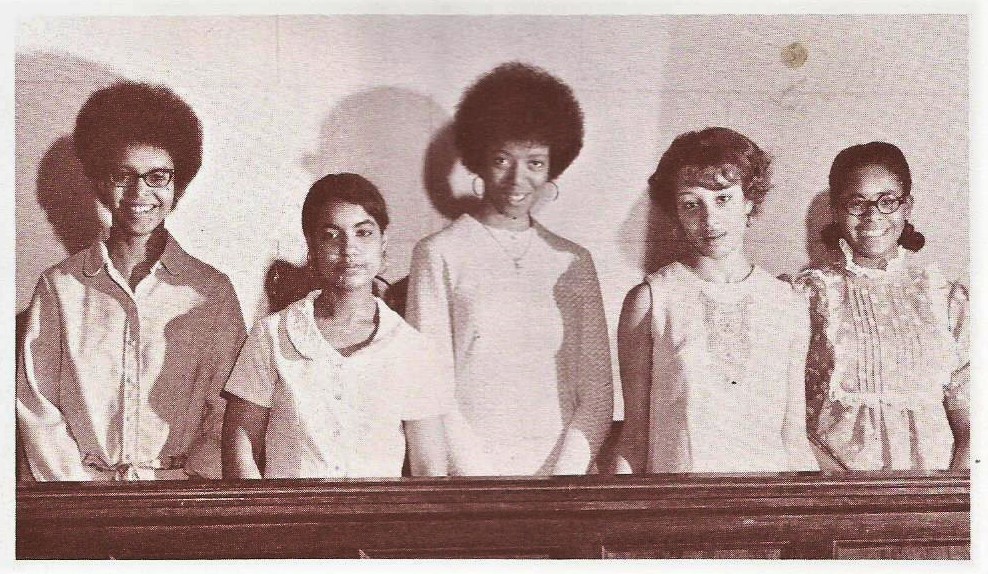
Thus, this recent story resonated very much with me.  N.C. swim team brings Black women to the pool for competition and camaraderie. “How often do you see this? You don’t ever see Black women swimming in a pool together,” said one member of the Mahogany Mermaids.

“I’m in this water, you’re in this water, it’s in me, on me.” Wade in the Water, children.

Ramblin' with Roger
Social media & sharing icons powered by UltimatelySocial