
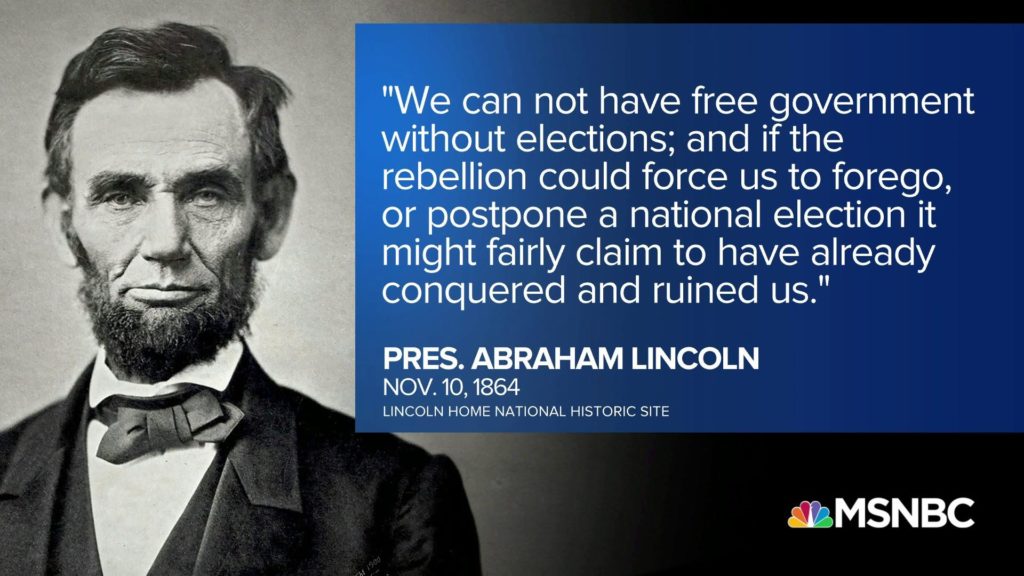
“Hey, Maybe We *Should* Postpone The Election”

A crony running USPS

postpone the election.Abe LincolnJust the other day, I was kvetching to my wife. I said, “You know, I’d rather NOT write about him. But then he keeps doing worse crap.” To wit, suggesting, on Twitter, naturally, that perhaps the United States should postpone the election of November 3 until we can get everyone to the polls safely.

This was so egregiously wrong that Steven Calabresi called for a second impeachment inquiry into him. He is the co-founder of the conservative Federalist Society, This was in a New York Times opinion piece in late July, “where he falsely characterized mail-in voting and proposed the delay of the 2020 presidential election in November, which the executive branch cannot enact.”

Please understand the weight of the complainant. Calabresi has “he’s voted Republican in the presidential election since 1980.” He also “opposed the investigation into Russian election interference by Robert Mueller and was against the impeachment into Trump regarding withholding aid to Ukraine.

As for the Federalist Society, it is “a right-wing organization with 60,000 lawyers, law students and scholars.” It has been “characterized as a ‘conservative pipeline to the Supreme Court'” by the Atlantic. Recently confirmed judge Brett Kavanaugh joined the group while at Yale.

Calabresi wrote, “Until recently, I had taken as political hyperbole the Democrats’ assertion that President Trump is a fascist. But this latest tweet is fascistic. And it is itself grounds for the president’s immediate impeachment again by the House of Representatives and his removal from office by the Senate.” Which won’t happen, mind you.

Preciscient?

Ed Morrissey in Red State: “Good grief. For months, Donald Trump’s allies and even a few of his critics have blasted Democrats and a handful of media figures for their baseless theories that the president would cancel or delay the national election. [Presumptive Democratic candidate Joe] Biden got ridiculed for saying that in April. ‘Mark my words: I think he is gonna try to kick back the election somehow, come up with some rationale why it can’t be held,’ even though the law and the constitution are clear that presidents can’t do that.

“And then…

“The best that could be said for this tweet is that Trump’s just spitballing, but even that’s an indictment of its own. No president should just be spitballing a suggestion like this, not in public and not even in private, where it would leak to the press quickly enough anyway. The US held an election in the middle of its Civil War in 1864. We can hold an election in the middle of a pandemic, especially when the president himself keeps insisting we can and should reopen for business.

“Rather than recognize those [Constitutional] impossibilities and leave it as a paranoid-conspiracy theory for the Left, he has essentially vindicated Biden and the paranoids. And for what purpose? Trump can’t do what he’s suggesting, Congress wouldn’t entertain the thought for one hot second… and it won’t work anyway. What could possibly be gained from tweeting out this absurd idea, other than perhaps distracting from the bad GDP report everyone was more or less expecting anyway?”

Of course, the tweet was sent the same day it was announced that the U.S. gross domestic product dropped at an annual rate of 32.9%. Reports of polling putting Biden far ahead of him in the November election.

Properly, securely and safely vote

The argument for delaying has to do with people being able to get to the polls without risking their lives. During this primary season, we’ve seen people standing in long lines during a pandemic. Of course, those were almost always DEMOCRATIC primaries, so it didn’t seem to matter to IMPOTUS.

A real problem, even prior to COVID-19, but certainly exacerbated by it, is a dearth of poll workers. There is a national effort to recruit more poll workers. These are healthy people “to ensure that those workers most susceptible to the coronavirus are given the space to take care of their health, while still keeping polling sites open and available for efficient in-person voting.”

“We can also demand change from our local officials, who in most cases can take needed steps without waiting for the federal government to help. New voting technologies, training standards, polling place opening and closing hours, and poll worker recruitment practices are all decided at the state or local levels.

“State legislatures and state secretaries can expand, rather than shrink, the number of polling places, reversing the harmful trend of polling-place closures in recent years. They can also invest in more early voting sites, and keep them open for longer, reducing the number of voters who cast ballots on Election Day itself.”

Undermining the Postal Service

Meanwhile, the US Postal Service is experiencing days-long backlogs of mail across the country. It is after a top djt donor running the agency put in place new procedures “described as cost-cutting efforts, alarming postal workers who warn that the policies could undermine their ability to deliver ballots on time for the November election…

“Postal employees and union officials say the changes implemented by the Trump fund-raiser-turned-postmaster general Louis DeJoy are contributing to a growing perception that mail delays are the result of a political effort to undermine absentee voting.”

One recent study found mail-in voting doesn’t benefit one party over another.

Still, since every state has its own deadline for when you need to request an absentee or mail-in ballot, start looking into the options now. Verify that you’re registered to vote and if you’re not, do so right away.

With more voting options this year, the US Postal Service is encouraging voters to plan ahead. If you wait until the last minute to decide how to vote, you could be cutting it close, or even become disenfranchised. We’re now less than 90 days away from the election – time to make a game plan.

Finally, since IMPOTUS’ bogus call for postponing the election took place on the same day as John Lewis’ funeral, tell your members of Congress to support The John Lewis Voting Rights Advancement Act. For it is voter suppression that is the real threat to democracy in the United States.
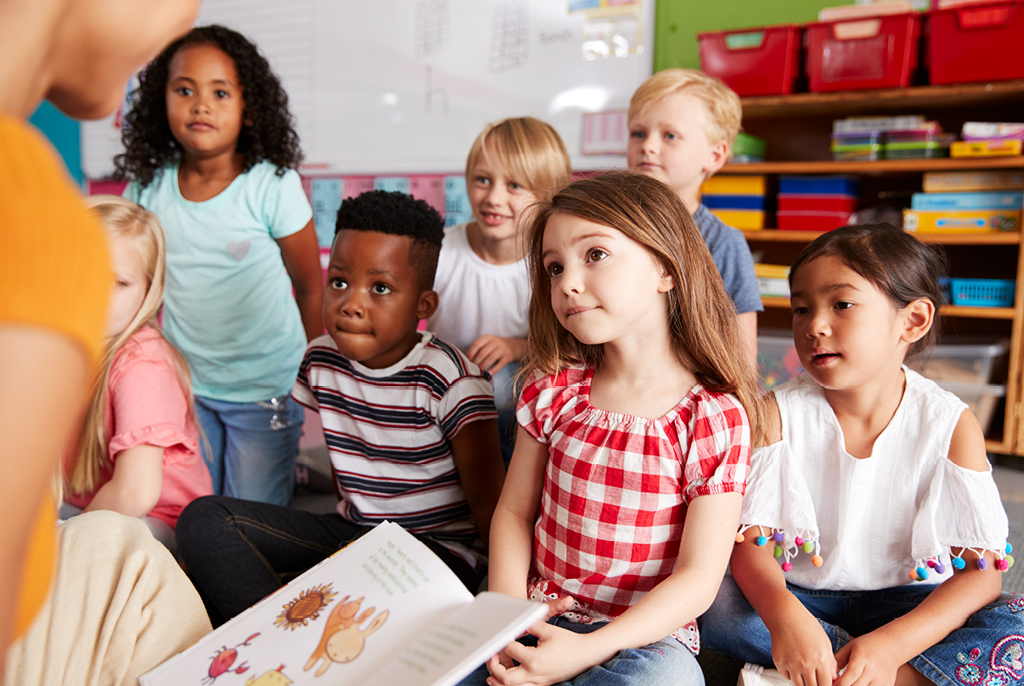
Not talking about race as a kid

Slavic neighborhood

Talk-to-Your-Kids-About-RaceSince June 1, a week after George Floyd, I have had lengthy conversations about race with three of my oldest friends. And by “oldest,” I mean I met two of them in 1958, and the other much later, in 1960. Yet I don’t remember talking about it when we were growing up. When I noted this with one of them, they said, “You ought to blog about that!” The problem is that I can’t really explain why.
For those unfamiliar, I should explain that I grew up in the First Ward of Binghamton, NY in the 1950s and 1960s. The city consisted of many Irish, Italians, and especially Eastern Europeans, second- and third-generation folks. There were black people in other parts of the city, but north of Clinton Street, which was a demarcation for “the Ward,” most folks were Slavic – Russian, Polish, Czech, Ukrainian, primarily.

At my school for K-9, Daniel S. Dickinson, I was often the only black kid in my class. There was a black young woman named Bernadette in 7th grade, coming from one of the feeder schools to our junior high. But she was gone by 8th grade to who knows where. Robert in 5th grade, who I’ve mentioned, was so academically challenged that he eventually ended up in my sister Leslie’s class, and she was three semesters behind me.

Also, in kindergarten, there was a “mixed-race” girl. She’s one of my current Facebook friends. By her account, I was very nice to her, even as most of the other kids were not. I have no recollection of any of this. Incidentally, I believe we have the same great-grandfather.

So NOW we talk

When I told one of my friends how traumatized when I saw photos of Emmett Till’s dead body in a magazine in 1960, I was asked, “Why didn’t you tell me?” I dunno. Why didn’t they tell me how their father put a stop to some racist taunts directed toward a man I knew at my church?

Another friend was pretty shocked that there were any racial problems in Binghamton at all. I’ve noted that back in 1964, over 200 black people complained in an open letter in the paper problems, jobs, and even “common courtesies.” Yes, I was pretty insulated in that geography triangulated by Dickinson school, my grandmother Williams’ house at 13 Maple Street, and my house on 5 Gaines Street. But I knew there was more to the story in the rest of the city.

I had long talks not only with the third friend but also with the spouse. Much of it has been generated by the contents of my blog over the last two months. “We didn’t know you were going through things like that.”

Theories

Maybe it was that I didn’t want to point myself out as different. Perhaps I didn’t think they’d understand. I talked with my sister Leslie about this. She had a similar situation, except that she did have one black classmate, Bonnie for a few years. They didn’t talk about race either. It was assumed that they were going through the same, or similar things and there was no need to verbalize it.

It’s like when I’ve seen a black person in a sea of white faces. Inevitably, one of us will give a nod to the other. It’s an acknowledgment of assumed common experience.

I suppose I should be grateful that my old friends and I are talking about race now.

August 6, 1945: Hiroshima plus 75

light a candle

I’ve mentioned before how the late Paul Peca, my sixth-grade teacher, was arguably the best one I ever had. As I noted here, he believed the conventional wisdom. The dropping of atomic bombs on Hiroshima and Nagasaki, Japan on August 6 and 9, 1945, respectively, was necessary in order to end World War II in the Pacific.
I pushed back against that. But hey, I was only a kid. It wasn’t until years later I discovered this 1963 quote by the first President in my lifetime, Dwight David Eisenhower. He was, of course, a five-star general in World War II, and served as Supreme Commander of the Allied Expeditionary Force in Europe.

Ike wrote: “Japan was already defeated and that dropping the bomb was completely unnecessary… Secondly, our country should avoid shocking world opinion by the use of a weapon whose employment was, I thought, no longer mandatory as a measure to save American lives.”

116 Days

FOX news guy Chris Wallace was on CBS This Morning this past June. He was discussing his new book, “Countdown 1945: The Extraordinary Story of the Atomic Bomb and the 116 Days That Changed the World.”

The review of the book in the New York Times makes the process of deciding quite riveting.

“In the end, the reader is forced to ask: Should Truman have dropped the bombs? Wallace points out that more than 100,000 people were part of the bomb-making effort, the program was approved by Roosevelt and over $2 billion was spent. ‘It is unrealistic,’ Wallace says, ‘to think Harry Truman would make any other choice.’ Truman himself exulted after the success of Little Boy, ‘This is the greatest thing in history.’

“Was it? Wallace’s superb, masterly book lets the reader decide.”

Peace response

Upper Hudson Peace Action notes: “Recognizing and remembering those who perished in the horror of the dropping of the atomic bomb at Hiroshima and Nagasaki while staying safe during the COVID-19 pandemic is a challenge.

“Throughout the day on August 6th,” on the UHPA Facebook page, there will be posts “featuring pieces of John Hersey’s novel Hiroshima, along with speeches related to the bombing, first account testimonials, videos of Hiroshima and photographs.”

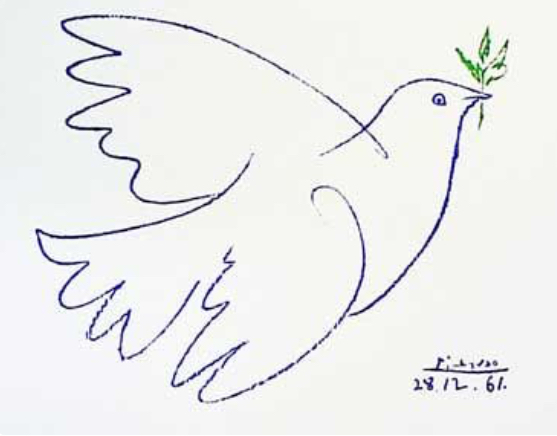
They are “asking people to put a candle in their window or porch (an electric candle in the home might be safer – use your judgment) at sundown, on the nights of August 6th and 7th.” Also please place either a peace crane – here is link with instructions for making one – or the Picasso peace dove,” pictured, “next to your candle along with a sign that says: WE MOURN THE 250,000 DEAD IN THE DROPPING OF THE ATOMIC BOMBS.”

Spider-Man, and other films, non-MCU

ANOTHER iteration?

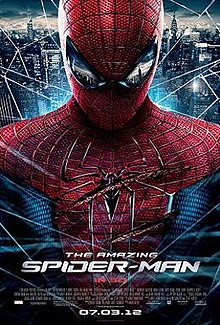
The_Amazing_Spider-Man_theatrical_posterI started watching the movies in what was eventually labeled the Marvel Cinematic Universe back when it started in in 2008. Now for those of you NOT seeped in these things, not every Marvel character that appeared in a movie this century is an MCU film.
For convoluted aesthetic and licensing reasons, the films with the X-Men, Fantastic Four, Blade, and Deadpool films, among others, are not part of the canon. The Spider-Man films in 2002/2004/2007 and 2012/2014 are not MCU. But the recent ones with Tom Holland, including Captain America: Civil War and the last two Avengers films, ARE MCU. Got that? There will be a test.

Despite having had collected comic books for over a quarter-century, primarily Marvel products – and I still own some Marvel Masterworks books – I hadn’t watched all that many of the films. Before I tackle the MCU, I thought I’d check to see which ones of the other Marvel films I’ve seen.

Howard the Duck (1986) – the movie was previewed in Albany in a movie theater, sponsored by FantaCo, the comic book store where I worked. I related to the “trapped in a world that he never made” description in the comic book, which also transferred to the film. It was roundly panned, and perhaps deservedly so. Yet I had an odd fondness for it.

Fantastic Four (1994 – unreleased) – at some point in the 2010s I saw this, possibly on YouTube. It was not very good. In fact, it was so awful, it was mildly enjoyable.

Friendly, neighborhood…

Spider-Man (2002) and Spider-Man 2 (2004) . These are the ones starring Tobey Maguire. I saw the first one in a cinema, the second at a resort in the Berkshires. Never saw the third one. I liked the first two enough to get them on DVD.

X2 (2003) – I watched in a hotel in Oneonta on New Year’s Eve many years back. Maybe because I didn’t see the first X-Men film, it didn’t make as much sense as I thought it should.

Fantastic Four (2005) – I thought Michael Chiklis was actually quite good in this. That is high praise since he was all but unrecognizable as The Thing. The rest of the story, as I recall, was pretty pedestrian. That’s necessary, I suppose for an introductory piece, but still… Never saw the follow-up.

The Amazing Spider-Man (2012) – for reasons I’ll explain soon, I have been watching a LOT of MCU movies this summer. So in early July 2020, I needed a palate cleanser before starting on Avengers: Infinity War.

Why did we need ANOTHER iteration of the web-slinger? I say that as someone whose favorite Marvel character is Peter Parker, the awkward young man with a secret.

Maybe we didn’t. But I felt Andrew Garfield was a credible Peter. And since the earlier Sam Raimi stories focused on his relationship with Mary Jane Watson (Kirsten Dunst), it seemed natural that the series deal with his first love, Gwen Stacy (Emma Stone). Her internship with Osgood Corp may have been a bit too coincidental for my taste.

Still, I appreciated their relationship. Her father, the cop (Denis Leary) felt like a real dad, as did Peter’s uncle Ben (Martin Sheen). Aunt May (Sally Field) fretted a lot. If the villain was more tortured soul than actually evil (Rhys Ifans as Curt Connor/the Lizard), that would be in keeping with the comic book narrative.

Ultimately, I didn’t enjoy it as much as the films I had seen a decade and a half earlier. Still, it was time well-spent. I’m still warming up to the new Spider-Man. But that’s a story for another time.

Steve Derrick; beautiful nurses’ eyes

portraits of healthcare workers

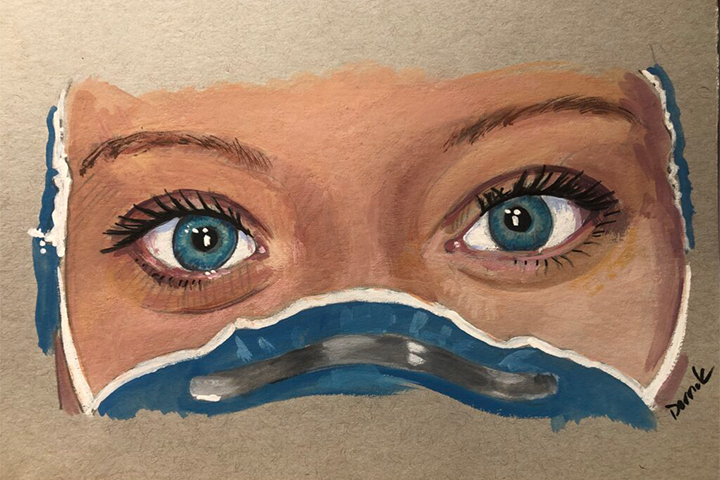
eyes.Steve derrickOn the Road with Steve Hartman introduced me to Steve Derrick, an artist from Clifton Park. He “has produced more than 100 portraits of healthcare workers as they ended their shifts, many of them nurses at Albany Medical Center.”

The artist paints portraits of medical workers and captures their exhaustion treating Covid-19 patients. The subjects are weary, tired, brave, bruised, and raw. “Steve Derrick’s paintings depict the spirit of healthcare heroes on the front lines.”

“To escape the overwhelm of the pandemic, he engaged in painting. He says, ‘there was so much negativity on the news. This gave me something positive to think about while sitting in quarantine.'”

I found the story so touching, so compelling that after seeing it on the CBS Evening News on a Friday, I watched it again on CBS Sunday Morning. “He presents the finished portrait, a moment in time that omits no detail, to each of his subjects, and refuses payment.” Herrick’s actions have become part of a movement.

The eyes have it

Beyond this story, I’ve discovered that I have spent a whole lot more time looking at the eyes of people wearing masks. I find almost all of them are beautiful. Without seeing the whole face, it’s been necessary to discern how another is feeling. I’m required to actually look at people in a new, and arguably, better way.

Googling “eyes,” I came across a poet and short story writer named Avijeet Das. He wrote: “Eyes speak. Eyes say the unsaid words. Eyes express feelings. Eyes convey emotions. Eyes are eloquent. Eyes are tender. Eyes are sensitive. Eyes are captivating. I can’t help looking into eyes. I am always fascinated by eyes. If I were a painter then I would love to paint the eyes of the people I meet and come across.”

CBS’s Steve Hartman asked painter Steve Derrick if he were painting the nurses at their worst. Derrick totally disagreed. It is his belief that he has captured them at their best. I believe he is correct.

Ramblin' with Roger
Social media & sharing icons powered by UltimatelySocial