
Oh, I tried a couple times. After all, adjusting for inflation, the 1939 film is the highest-grossing movie ever. Its appearance on commercial television, in two parts in 1976, were both in the Top 10 of the highest-rated broadcasts of all-time.
But nope. It was frankly boring to me. I just didn’t give a damn about watching it.
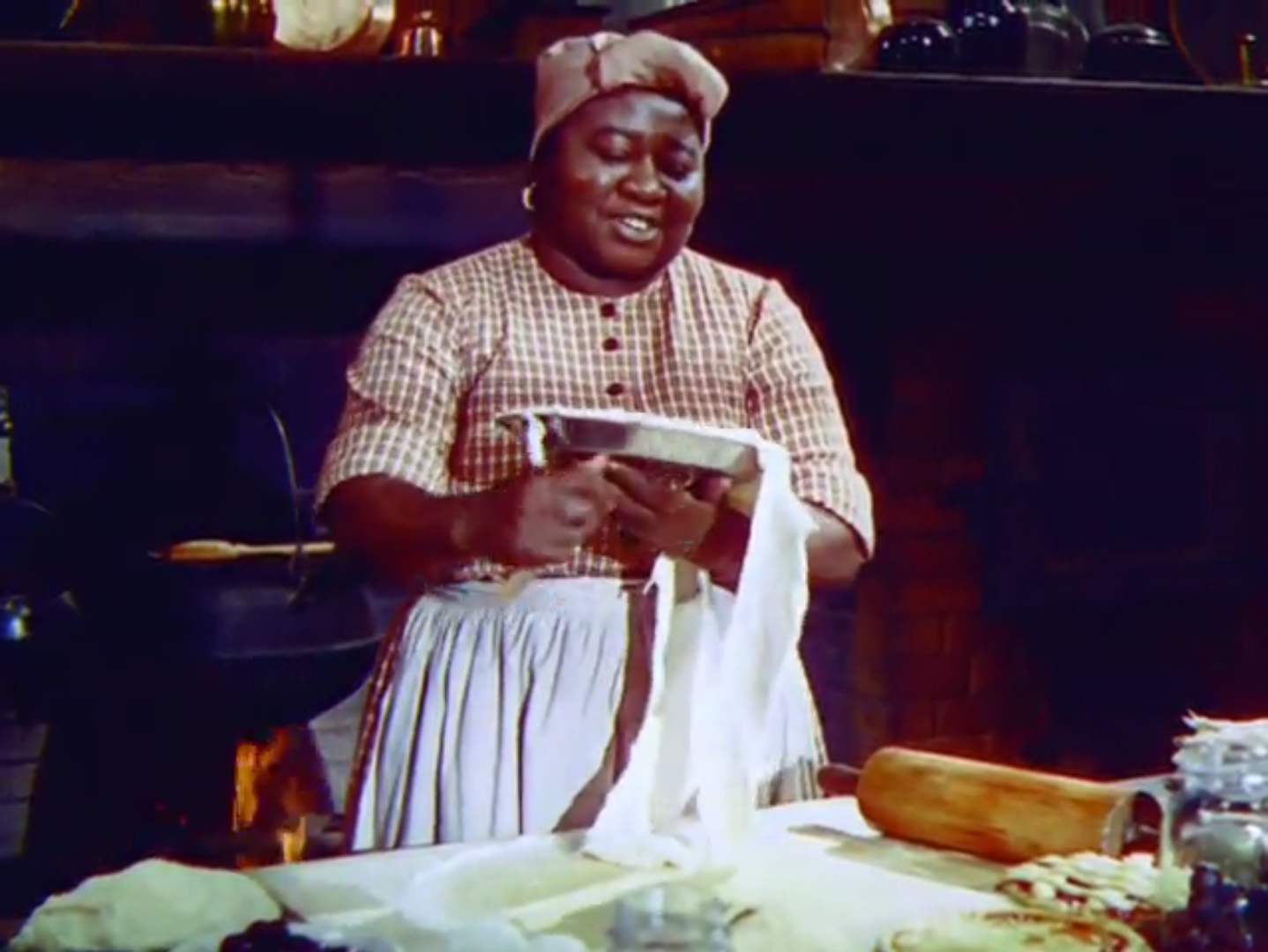
The GWTW news reminded some of us about the indignities faced by Hattie McDaniel. She played “Mammy” in the movie, for which she won the Academy Award for Best Supporting Actress. Know that she became the FIRST African American to win an Oscar. “She and her escort were required to sit at a segregated table for two… The discrimination continued after the award ceremony as well as her white costars went to a ‘no-blacks’ club, where McDaniel was denied entry.”
She was philosophical about her movie roles. “Why should I complain about making $700 a week playing a maid? If I didn’t, I’d be making $7 a week being one.”
Zip-a-Dee-Doo-Dah
Now, this very year, I DID finally see Hattie McDaniel in the movie Song of the South (1946), in which she played Aunt Tempy. “The kindhearted storyteller Uncle Remus tells [children] stories about trickster Br’er Rabbit, who outwits Br’er Fox and slow-witted Br’er Bear.”
Its controversial history is well known. Walter Francis White, the Executive Secretary, said in 1946 that the organization “recognizes in Song of the South remarkable artistic merit in the music and in the combination of living actors and the cartoon technique. It regrets, however, that in an effort neither to offend audiences in the north or south, the production helps to perpetuate a dangerously glorified picture of slavery. Making use of the beautiful Uncle Remus folklore, Song of the South, unfortunately, gives the impression of an idyllic master-slave relationship which is a distortion of the facts.”
A couple of clarifications. I never got the sense that the story took place during slavery, but rather during Reconstruction. Yes, Uncle Remus does the Magic Negro thing near the end, but it was the times. And the film itself was well done, as the NAACP chief noted, with the usual solid Disney animation and fine acting by James Baskett.
While the narrative of the Uncle Remus stories in cartoon form made me uncomfortable, I’ve seen so much worse. The Abraham scene in Holiday Inn (1942), which I wrote about seven years ago. Alas, the link no longer works. But A.O. Scott in his 2008 Critics’ Picks for the New York Times, provides a snippet.
Here’s something awful: Judy Garland in blackface in Everybody Sing (1938). Chuck Miller notes Warner Bros. cartoons that should stay out of circulation.
In that context, I didn’t find Song of the South nearly as offensive as I had built it up in my mind. Judge for yourself.



 I was working the front counter of the FantaCo comic book store in Albany on November 2, 1982. Joe Sinnott had driven the 45 miles from Saugerties to buy 10 copies of Life of the Pope, John Paul II, which he had inked. He wanted to have copies to give to family and friends.
 [Every year, on his birthday, I find a quote or two from Rev. Dr. Martin Luther King, Jr. to reflect upon. It’s because most people have no idea what Dr. King stood for that wasn’t enunciated in a five-minute portion of one speech.
 Here’s a continuation of a list of songs I found in my record collection after my last full readthrough of the Bible back in 1996/1997. I was in a Bible study at the home of my then-former girlfriend. Two years later, I lived at that home for a year.