Movie review: Ford v Ferrari

Wide World of Sports

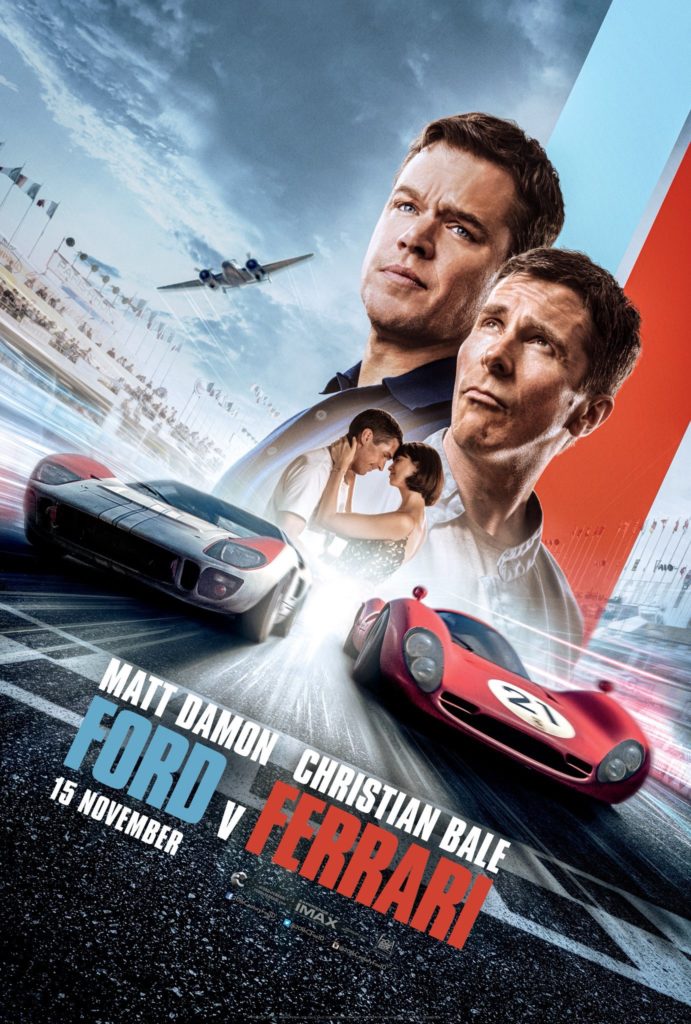
fordvferrariI read the description of Ford v Ferrari in IMBD. “American car designer Carroll Shelby and driver Ken Miles battle corporate interference, the laws of physics and their own personal demons to build a revolutionary race car for Ford and challenge Ferrari at the 24 Hours of Le Mans in 1966.”

Frankly, this doesn’t sound too compelling to me. I’m not a car guy by any stretch. But as a critic put it: “Ford v Ferrari reaches beyond a niche car-enthusiast audience. The screenwriting team has really made it accessible for anyone with or without car knowledge.”

It’s partly an unlikely buddy movie with the clever, smooth-talking Texas-born Shelby (Matt Damon) encouraging, protecting and occasionally fighting with Miles, the prickly and creative Englishman. Certainly, it was a love story without a lot of hearts and flowers between Ken and wife Mollie (Caitriona Balfe). Their kid Peter (Noah Jupe) is nice without being movie-kid annoying.

Shelby exploits the corporate ego of the Ford Motor Company in getting them to let him and Miles build the car they wanted to create. Ford loses yet again to their Italian rival at the 24 hours at Le Mans. The jousting between Shelby and Ford executives such as the Henry Ford II himself (Tracy Betts) was quite delicious.

NOW I remember

Finally, it’s a sports story of speed, endurance, and technology which I ended finding fascinating.

These were real-life guys I had never heard of. But I suddenly remembered that I had seen television coverage of Le Mans when I was a kid. I was probably watching it with my grandfather McKinley Green in the second-floor apartment he shared with my grandma.

I’m guessing it was on ABC’s Wide World of Sports and that the late Keith Jackson was the announcer. The TV anchor certainly was a ringer for Jackson.

At two hours, 32 minutes, it is probably too long by a quarter-hour. But Ford v Ferrari was a film both my wife and I enjoyed when we saw it at the Spectrum Theatre in Albany in December 2019.

Albany has fine cultural offerings

the walk signals

Albany culturalThe blogger Jaquandor has more questions for Ask Roger Anything.
Do you like the cultural offerings in your area?

I LOVE the cultural offerings in the Capital District of New York State. The Albany Symphony Orchestra received two more Grammy nominations this year. They often perform contemporary, challenging pieces, not just the old warhorses. Although they do those very well.

Proctors Theatre in Schenectady offers a panoply of performances. I have season tickets to see the shows that were on Broadway and are now touring. But there are a lot of other things going on in the former vaudeville venue with 2700 seats.

Capital Rep does very fine theater with mostly Actors’ Equity performers. In the past, I’ve had season tickets. There are many fine other theatrical venues in the area, such as Mac-Haydn Theatre.

Free shows in the good weather include Alive at Five, performances on the Empire State Plaza, the Tulip festival, Larkfest, and many more.

The New York State Writers Institute offers name authors and challenging films throughout the year. The Underground Railroad history project always has informational and educational events.

APL

I can’t forget the Albany Institute of History and Art, since we are members. The New York State Museum is another of the many museums and galleries in the region. I must mention that the Albany Public Library, which offers over a thousand events each year, including a weekly book review at the Washington Avenue branch.

My friend David Brickman writes about a lot of these. Check out Nippertown for more events than I could possibly attend. My theory: if you’re bored here, you’re not trying very hard.

What’s something completely mundane that bugs you or freaks you out? For me, it’s the fact that the buttons on the drive-thru ATM have braille on them. It’s clear why (they probably don’t bother making multiple sets of buttons for those machines), but it still always strikes me as really odd.

It’s the walk signals in Albany. Some of them do nothing except mirror the street lights, so what’s the point? Some of them you press and you get extra time to cross the street – important crossing Madison at West Lawrence. Without, it’s about five seconds, and you’ll probably die.

There’s an intersection a block from there. It has five spurs. The walk sign lights up only if you hit the button crossing Madison at South Allen,. If you cross Western at North Allen, the walk sign lights up regardless of whether you hit the button. But the sequence of when you can cross and when you can not is unchanged.

The saga of the two refrigerators

an offer that we couldn’t refuse

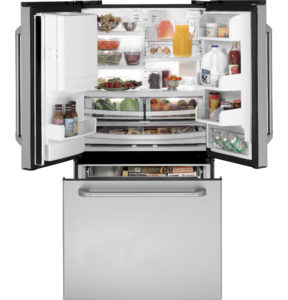
refrigeratorFor five days, we had two refrigerators. The incumbent we purchased c 2003, maybe. It was your standard fare, freezer on the top, fridge beneath. I was fond of it until 2007 when the accident happened.

I bent over looking for something in the lower section. Unbeknownst to me, someone had opened the freezer door above me. I stood up and the freezer door hit me in the back of my head, neck, and shoulders. The freezer door never was quite right after that. Neither was the fridge door, which didn’t always close entirely.

Moreover, in the summers, there would be puddles on the floor, which we had to mop up almost daily. Items on the back of the top shelf of the fridge section would freeze. We’d been thinking about getting a new refrigerator for about three years.

Then National Grid made us an offer that we couldn’t refuse. They were offering their customers $100 to recycle their refrigerators and freezers. The appliances had to be between 10 to 30 cubic feet to be eligible for pickup. The units need to be plugged in and working on the day of the pickup. We scheduled the no-cost pickup for November 4.

OK, time to shop for the new refrigerator. Ultimately, we got a stainless steel model with the freezer on the bottom. The problem is that it’d be delivered on October 30. The evening before, the appliance dealer called and said they’d be delivering between 2:30 and 4:30.

Musical fridges

Where to put the old fridge? We made a path from the kitchen to the front of the living room. The day of delivery, we emptied the stuff from the incumbent into some coolers. The oddest find: an ice-encrusted disposable camera.

Promptly at 3 p.m., the delivery came. They brought the new appliance in the back door. Then these three guys, who were hardly burly, moved the old one to the living room with amazing ease.

Two of the three guys left, with the third one hooking up the water and some other tasks. I gave the third guy tips for all three of them. I’m trusting that he shared them.

I like the new refrigerator. The food is at eye level, so it won’t get “lost.” We threw out – actually composted – some veggies that had gone bad. Also, after being open for about three minutes,
according to this important source, it makes an irritating beep.

But I liked having two refrigerators, one in the living room, in the short term. I felt as though we should have had a keg party, even though none of us drink beer. I put the milk delivery in the living room fridge so it wouldn’t feel lonely. But I emptied it on Sunday night.

Then on Monday morning, as promised, we bid the old refrigerator adieu. I was afraid the two guys carrying it down our four steps were going to smash one of our railings, but they steadied the appliance. The $100 check arrived three weeks later.

Century of Pop Music: 1900-1999

When You Were Sweet Sixteen

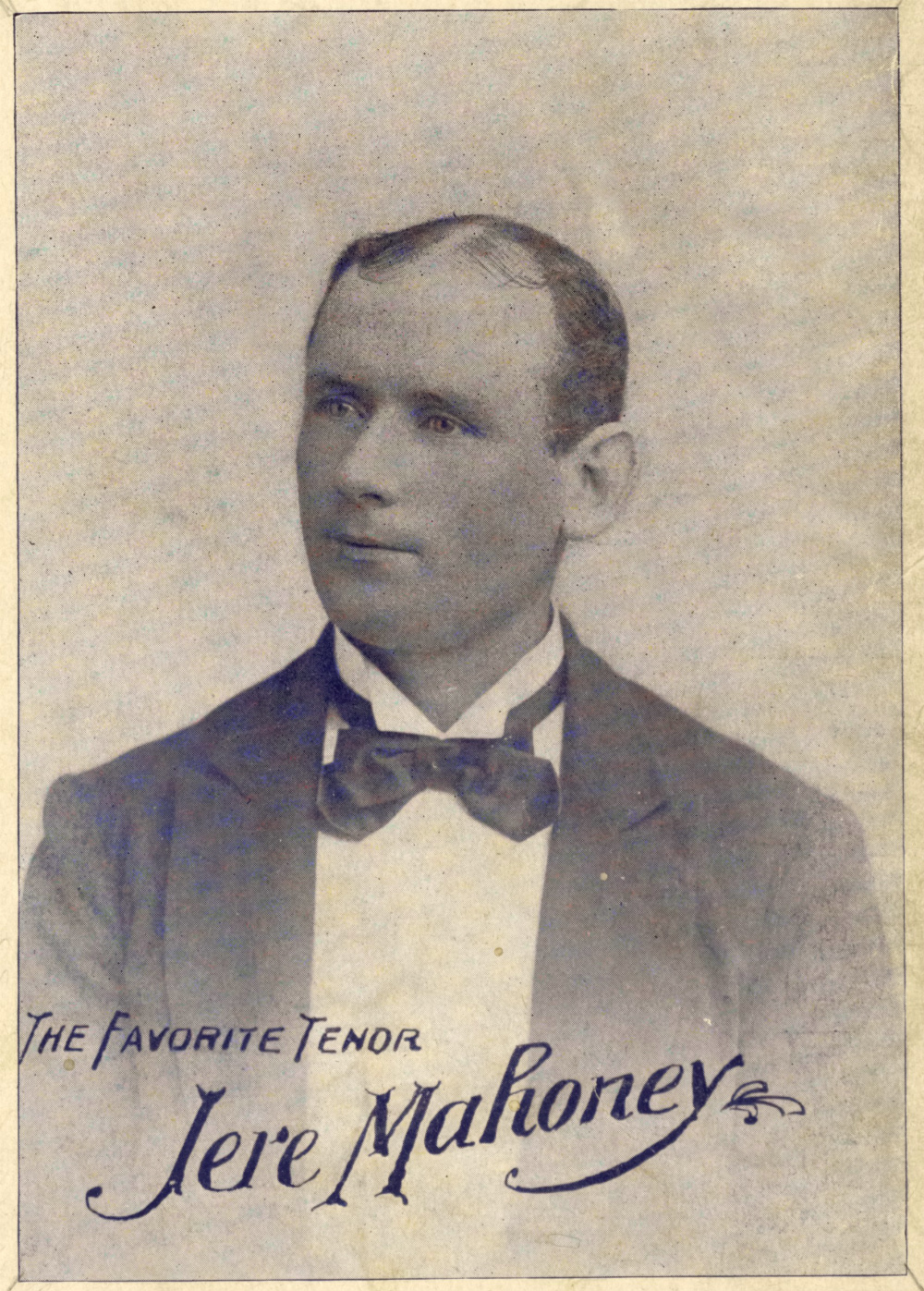
Jere Mahoney
Jere Mahoney
When I left my job in June 2019, I packed up some books I owned that I had kept in my office. One was Joel Whitburn Presents A Century of Pop Music. It is a “Year-by-Year Top 40 Rankings of the Songs & Artists that Shaped a Century.”

The book was “compiled from America’s Popular Music Charts, Surveys and Records Listings 1900-1939 and Billboard’s Top Pop Singles Charts, 1940-1999.” For each year except 1900, it lists the forty top-ranked songs. There were only thirty that first year.

Those early rankings were complicated, drawing data from The Talking Machine World periodical, record label publications, and books by David Ewen, Jim Walsh, Roger Kinkle, and Joseph Murrells.

The hits of 1900-1909 included male quartets, parlor ballads, minstrels songs, ragtime, comedy, and brass bands. George M. Cohen and Billy Murray were particularly popular.

The next section lists all of the artists. What I like is that it combines information I had in other books covering shorter time spans. For instance, Frank Sinatra had 17 Top Ten records from 1943’s You’ll Never Know (#2) to Something Stupid, with his daughter Nancy, #1 for four weeks in 1967.

The list of songs includes every version to hit the Top 10. For instance, for Alexander’s Ragtime Band, the version by Arthur Collins and Byron Harlan hit #1 in 1911. Billy Murray’s version’s got to #2 the same year. That sort of thing happened a lot in the first half-century.

The Prince’s Orchestra version went to #3 (1912) and the Victory Military Band to #4 (1912). Bing Crosby and Connie Boswell returned the song to #1 for two weeks (1938).

As far as I can tell, the book is out of print. You can find a used copy on Amazon for as little as $12.74 from a vendor.

The #1 hits of 1900

When You Were Sweet Sixteen – George J. Gaskin. I couldn’t find Gaskin’s version, but here’s a take by Harry Macdonough (1901). Listen to Gaskin singing After the Ball (1893), The Irish tenor was “one of the first vocalists to make a recording with Edison Records.”

Ma Tiger Lily- Arthur Collins. The recordings I found all refer to February 1901. Most of them are indecipherable. This is the best. Not incidentally, the lyrics are quite racist. Collins had 64 top Ten songs by 1918.

A Bird in a Gilded Cage – Steve Porter – here or here.

Mandy Lee – Arthur Collins The recordings I foundhere and here sound far too pristine

When You Were Sweet Sixteen – Jere Mahoney; couldn’t find.
A Bird in a Gilded Cage – Jere Mahoney

Ma Tiger Lily- Len Spencer. The audio I found was particularly awful.
Because – Haydn Quartet, 33 Top Ten hits through 1913, but I couldn’t find this.

When Cloe Sings a Song – George J. Gaskin. This is a much later version, with black patois and a word not acceptable these days.

Raymond Cone: biological grandfather

Agatha (1902-1964) was my paternal grandmother.
Raymond Cone.family treeIn checking my Ancestry DNA results, I noticed that there were ten people in the database that could be my first or second cousins. One was a Yates (my mother’s mom’s people), two were Scanks (mom’s dad’s people), and three were Walker (dad’s mom’s people). But who were the other four?

As it turned out they all had two people in common in their family trees. Carl Lorenzo Cone (1915 -1992) and his father Raymond Cornelius Cone (1888-1947). It has long been our family secret that my father was born out of wedlock. The stories were sketchy and apocryphal, though. It involved a minister. There was a scandal.

My friend Melanie found this article in the Binghamton Evening Press dated Saturday, January 8, 1927, page 3. “Negro pastor Exonerated of Girl’s Charges.” This alleged event took place on January 6, 1926 at his home, 147 Susquehanna Street in Binghamton and resulted in the birth of a male baby on September 26, 1926.

The first newspaper story was on Tuesday, September 28, 1926 Press on page 1. “Girl Accuses Negro Pastor. Rev. Cone, Arrested on Statutory Charges, Says He’s A Frameup Victim.” He said “a certain element” at St. Paul’s A.M.E. “was trying to get him out of the church” less than a year after he had arrived. “He denies that he was intimate with the complainant.” Her testimony, as noted in an October 29 article, suggests sexual assault.

Shotgun marriage?

Raymond Cone and three church members said he was leading Wednesday prayer services at the time the young woman said the pastor had “vowed his affections.” That according to the Tuesday, November 3 newspaper, p.3: “Defense Tries to Prove Alibi for Negro Minister.”

Rev. Cone testified that “he first heard of the charge… when her brother came to his home and threatened him with a gun.” In a Wednesday, Oct 27, 1926, Page 5 story, there’s the curious sentence. “Efforts have been made, it is said, to settle the case by marriage.” “It is said”? In any case, the minister would have none of it.

Also, there were character witnesses. “I do not know anything of Mr. Cone but that he is a Christian minister in the gospel of Christ” That was from Rev. H.H. Cooper, secretary of African Methodist Episcopal Bishop H.H. Heard. “Complaint against Rev. Raymond Cone Dismissed by Judge [Benjamin] Baker. ESTABLISHED ALIBI. Jurist, in decision, Says That Evidence Was Insufficient.”

The ministry

How did this North Carolina-born tenant farmer become a minister? Between 1918 and 1920, or maybe earlier, Raymond Cone attended Kittrell College. It was a two-year historically black college located in Kittrell, NC from about 1886 until 1975. The school was associated with the African Methodist Episcopal Church. Kittrell is about 60 miles northwest of Wilson, NC, where he grew up.

Raymond, widowed in 1918, had been in Norfolk, VA as a photographer in 1920. His four children, Lessie, Mary, Albert and Carl were staying with Raymond’s parents-in-law in 1920 back in Wilson County, NC.

Rev. Cone entered the Philadelphia annual A.M.E. conference in May 1921. He served in churches in Salem and Worcester, MA in the New England conference before coming to Binghamton in the New York conference near the end of 1925.

And who was that “Negro Girl”? It was Agatha Walker, 24 at the time of the trial, and mentioned by name in the latter three newspaper stories. She was the superintendent of the St. Paul’s A.M.E. Sunday school.

Mind blown

Of course, Agatha (1902-1964) was my paternal grandmother, who I remember fondly. The child she bore was my father, Les Green. And the denials of Raymond Cone at the time notwithstanding, it’s clear that something happened between him and Agatha. He was my father’s biological father. Meaning he’s my biological paternal grandfather.

THIS IS HUGE. Ask my wife how many times I said, “Holy crap!” when I read that first story. It has been a mystery for so long that I had all but given up figuring it out.

I’m fascinated by how Agatha managed to stay at the church. While Raymond Cornelius Cone moved on to another city after the May 1927 annual conference, she remained at that church, arranging the flowers for special events, something my father did quite frequently.

Expect that I’ll have more to say on this topic. You can find four articles mentioned at Fulton History.com. Search for Rev. Raymond Cone, because searching for Agatha Walker will provide more hits that are less precise.

Ramblin' with Roger
Social media & sharing icons powered by UltimatelySocial