
The great neighborly outdoors

ownership of the tree depends

Tree next to fenceAs I’ve noted, being a homeowner was new to me when we bought this house 19 years ago. Ever since, it’s been a series of neighborly negotiations with various sets of folks.

A couple months ago, a panel of the fence separating us from the the neighbor to the south fell down. The neighbor was irritated with us. He surmised that someone came into our backyard and cut the fixtures holding the fence in place. It DID look cut, but what would be the purpose?

He believed we should have fastened our gate more securely. While it is true that our gate swings open now and then with a stiff breeze, it’s not for lack of trying to correct it. We have had at least three people come and “fix” it, but it remained unfixed.

In fact, one Saturday morning, the latch was somehow positioned so that I could not even leave my own yard. I wonder how it happened? I had to use a large rock to liberate myself from my own property.

The neighborly fellow to the north pointed out that a large branch – about four meters long – that has its roots on our property but overhangs onto his, came crashing down. It may well have been that tree, though he has a similar one on his property.

He claims that the branch nearly came down on his shed, which would have cost US $10,000 to replace. I seriously doubt it’s worth 20% of that, but no matter.

This got me to wondering: who IS responsible for those branches? This article from a Rochester (NY)N newspaper notes:

“In New York, a property owner is responsible for any trees on their property — more specifically, the trees whose trunks are on their property. Ownership of the tree depends on where the trunk of the tree is located, regardless of where the branches are located.

“If a tree trunk is located on a boundary line — sometimes referred to as a ‘boundary tree’ — that tree could be owned by both homeowners, based on the percentage of the tree that is located on each property. Insurance companies will sometimes use those percentages to determine who is liable if a tree comes down and causes property damage.

“A property owner can take down branches that hang over their property — up to the property line, even without permission from the tree owner. However, the law also states that if a homeowner trims branches on a tree and that causes damage to the overall health of the tree, that person could be liable, and might have to pay to replace it.”

In fact there are a lot of articles on the topic. I imagine we’ll get the whole tree trimmed this summer as a precaution, though we may ask he neighbor to kick in on the cost.

Demerits of a “merit-based” immigration system

Why have so many immigrants come?

statue of liberty museum
the new Statue of liberty museum
The regime seemed focused on having a “merit-based” immigration system. The proposed plan would increase “skills-based” immigration in the U.S. from 12% to 57%.

Yet in touting employment and skills over relatives and diversity, this approach is harsher than the countries such as Canada touted as shining examples. Canada has more immigrants in the economic stream, but it also brings in more family members, and more folks on humanitarian grounds.

Check out Freedom Is Why Immigrants Come to America in AIER. “They did not find a perfect paradise or immediate acceptance in the United States. Native-born Americans whose ancestors had arrived in the United States much earlier often looked down upon [them].”

The “them” could be the Irish, the Germans, the Jews. “So why have so many come? The reason is that in America, far more than in most other lands in the past and in many cases even now, the political is separated from the economic, the government from the marketplace.”

Richard M. Ebeling writes: “If we could go back in a time machine fifty years or a hundred years, the same kinds of work had to be done in the various corners of the marketplace, only we’d see different faces from different parts of the world, speaking different languages, and practicing some other faiths.

“Where are those who did these jobs in those earlier times? They and certainly their children and grandchildren moved up the socio-economic ladder to other professions, occupations and businesses, just like earlier generations of immigrants had done before them.”

I often watch those genealogy shows such as Finding Your Roots with Henry Louis Gates. Almost invariably, he discovers the guests’ ancestors were people who came to the United States with nothing. They created something.

They became those shop owners. Or workers who learned English slowly, but their kids picked it up right away and helped their parents translate. Formerly enslaved people who, once freed, managed to own property and even served in government.

The regime policy is not the American dream. Meanwhile, New York State’s small towns have a welcoming attitude to refugees.

The new Statue of Liberty museum opened on May 16. “The 26,000-square-foot museum on Liberty Island… is the new home for the statue’s original torch and other artifacts that had previously been in a smaller museum space inside the statue’s pedestal, which is accessible only to the fraction of the more than 4 million annual visitors who manage to get limited-availability statue entry tickets.”

There’s a market for that “give me your tired” narrative.

And, a purely pragmatic consideration: the U.S. birth rate is dropping. The country isn’t “full”. Not only do we need more immigrants for economic reasons, we become a better people.

SCOTUS Census citizenship vote

It SHOULD have been 9-0

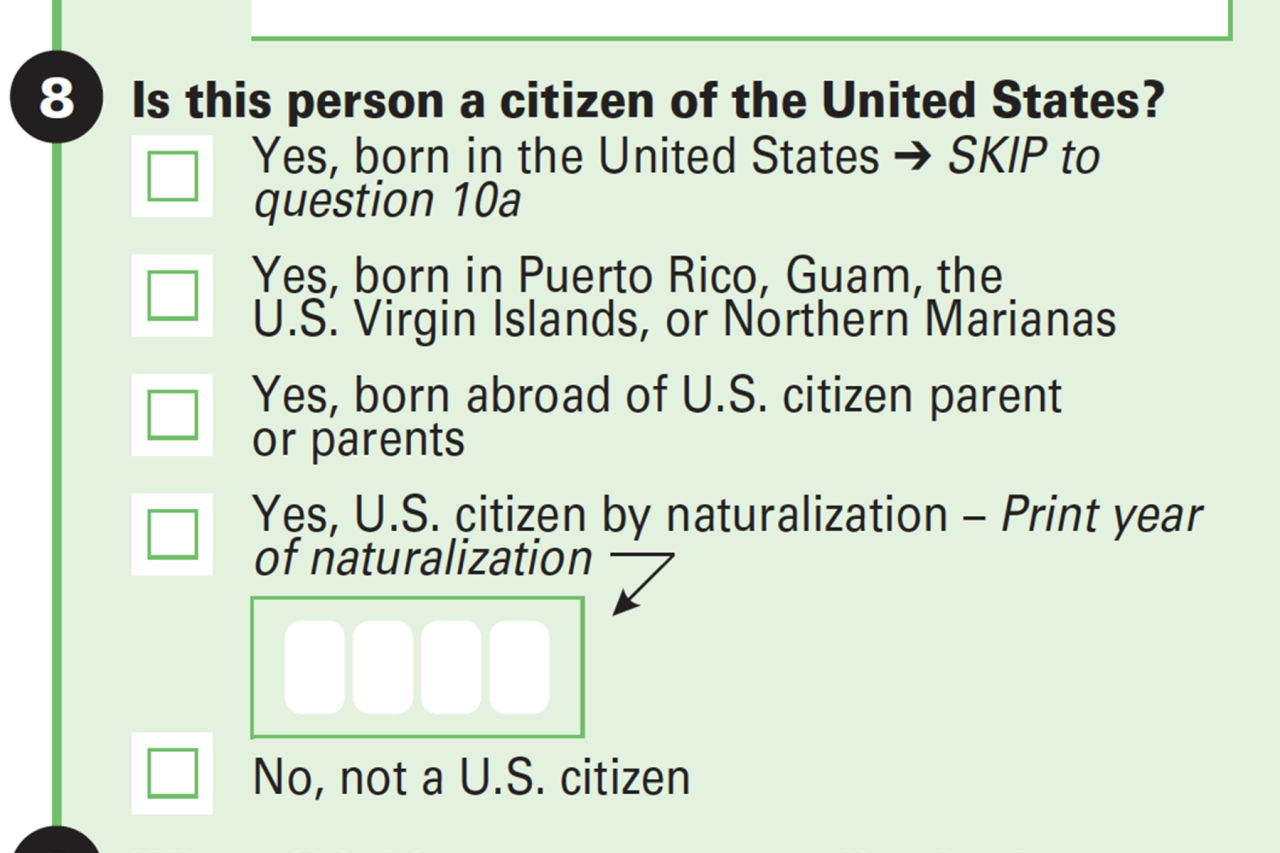
citizenship questionLast week, the Supreme Court ruled 5-4 to refuse to approve the citizenship question on the 2020 census. More accurately, SCOTUS referred the case back to a lower court. I’m glad for the outcome, but I thought the dissent was disingenuous.

“‘For the first time ever, the court invalidates an agency action solely because it questions the sincerity of the agency’s otherwise adequate rationale,’ said Justice Clarence Thomas, joined by Justices Neil M. Gorsuch and Brett M. Kavanaugh. Justice Samuel A. Alito Jr. dissented separately.”

Adequate rationale? Well, no.

“On May 30, the plaintiffs [revealed that a] central portion of the Justice Department’s rationale for the question was apparently written by Thomas Hofeller, the GOP’s longtime gerrymandering mastermind. In a 2015 study, Hofeller wrote that adding a citizenship question to the 2020 census would be ‘advantageous to Republicans and non-Hispanic Whites’ and “a disadvantage to the Democrats.’

“He also explained how Republicans could justify inserting a citizenship question by claiming, falsely, that it would aid enforcement of the Voting Rights Act. Multiple passages in Hofeller’s study appeared verbatim in the 2017 Justice Department letter that provided a legal rationale for the question’s addition.”

While the “Justice Department responded with indignant denial,” the nefarious conspiratorial linkage is quite clear, in far more detail than I can get into here. If the ruling had gone the other way, it could have dealt a grave blow to democracy.

Even those who voted correctly misrepresented the ‘pedigree’ of the citizenship question. “Never in the 230-year history of the census has the complete-count questionnaire (or its equivalent) asked for the citizenship status of everyone in the country.”

Several companies had filed a brief to the Supreme Court arguing that “The inaccuracy resulting from the Citizenship Question will harm businesses, because Census data can play a role in many decisions by large and small businesses alike.”

This is not to say the decennial Census process is now out of the woods. A report by the Urban Institute notes that “new ways of conducting the U.S. census… have not been thoroughly tested and could pose another risk to the count’s accuracy. These methods include allowing all households to complete an online form…

“The study found that new operational changes being implemented in 2020 like ‘internet self-response’… were ‘insufficiently tested in a decennial census environment’ and that “best evidence suggests they will disproportionately improve the count of those who are already easiest to count, leaving the hard-to-count population a lingering challenge.'”

The average person might think the Census folk only work on the Census in the immediate run up to the event, but not so. Particularly in the 60 months before the decennial, the Bureau is testing questions and methodologies.

“Uncertainty in funding in recent years” – blame Congress and the White House for that – “has led the Census Bureau to cancel field tests for the 2020 census, including test runs designed for rural and Spanish-speaking areas. This could still lead to the worst undercount of black and Latinx people in 30 years.

Of course, the folks at Census are aware that not everyone is online, and will offer alternatives, including mail, phone, and when necessary, in-person visits, though each of those attempts come as an added expense.

An inaccurate count affects redistricting for a decade and affect other data sources. It also guides community funding decisions. Learn more about Census data at the Census Academy.

Zeolites, whatever the heck THOSE are

Sometimes being a librarian means working on questions for which you have no feel, no particular interest. Just focus on the bottom line.

zeolitesThis is more about the librarian life than the mineral group of zeolites. The library where I used to work got this reference question to find out about this substance that’s used in various commercial products, including, I’m told, dialysis machines. Since I am usually seeking the opportunity to broaden my horizons, and the question was near the top of the queue, I took it.
I discovered that the website of the United States Geological Survey has a National Minerals Information Center. From the page I needed: “Zeolites are hydrated aluminosilicates of the alkaline and alkaline-earth metals.” Yeah, right.

“Natural and synthetic zeolites are used commercially because of their unique adsorption, ion-exchange, molecular sieve, and catalytic properties. Major markets for natural zeolites are pet litter, animal feed, horticultural applications (soil conditioners and growth media), and wastewater treatment.”

I also checked with this site, which indicated that zeolites “are built of corner-linked tetrahedra and contain exchangeable cations.” Yet, an hour and a half later, I was not only finished, I knew I had useful information.

“In 2018, six companies in the United States operated nine zeolite mines and produced an estimated 95,000 tons of natural zeolites, a 15% increase from that of 2017… New Mexico was estimated to be the leading natural zeolite-producing State in 2018, followed by California, Idaho, Texas, Oregon, and Arizona.

“The top three U.S. companies accounted for approximately 90% of total domestic production. An estimated 93,000 tons of natural zeolites were sold in the United States during 2018, an increase of 14% compared with sales in 2017.” After finishing the inquiry, I went into the office of the library director and said, “I have no real idea what I just researched, but I know it’s good stuff.”

Sometimes being a librarian means working on questions for which you have no feel, no particular interest. Just focus on the bottom line, and ignore sentences such as “The most common [zeolites] are analcime, chabazite, clinoptilolite, erionite, ferrierite, heulandite, laumontite, mordenite, and phillipsite.”

For ABC Wednesday

Unwritten rules for Canada Day

respect the queue

mercator_projection
This work is licensed under a Creative Commons Attribution-NonCommercial 2.5 License.
I was astonished. During that Team JEOPARDY! tournament, there was a question in the Dates category. “The Dominion of Canada was proclaimed on this date in 1867.”

The players at the time were Julia Collins, who had won 20 regular games; Austin Rogers, 12 regular games; and Ken Jennings, a record 74 regular games. None of them rang in, and Canadian-born Alex Trebek appeared genuinely disappointed.

But I knew. Heck, I’ve known since at least 1967, when EXPO ’67 took place.

Sometimes, Quora is useful. I have pilfered some unwritten rules in Canada. They are fairly consistent among the over 40 contributors.

Say “I’m sorry” for everything, even when the other person is wrong. Hold the door for others.

Don’t make ostentatious displays of wealth, or brag about your material success.

Never raise your voice in public. You will scare the natives.

Don’t litter. Respect the environment, National and Provincial Parks.

Take off your hat and shoes when entering the home.

Never refer to people by their physical ethnic group or by skin color. Do not make nasty or negative comments about immigrants or refugees. Respect the diversity of ALL cultures, and their relationship to Canadian culture as a whole.

Don’t talk about religion or politics unless it’s brought up in a meaningful way. Separate religion and politics altogether.

Feel free to gripe about the weather.

Queuing up is mandatory. Jumping the queue will always be met with a dirty look, snide comments, or, on occasion, worse.

The left lane is the passing lane on the highway.

Feign an enjoyment of hockey.

Americans on Quora have heard that the wait time for Canadian medical care is excessive. To a person, the feeling is exactly the opposite.

As one fellow put it, “Canadian healthcare is so much better than US healthcare it’s like comparing apples to a moldy pile of compost with something fuzzy and odoriferous growing on it.”

Happy Canada Day!

Ramblin' with Roger
Social media & sharing icons powered by UltimatelySocial