F is for Frankenstein; or, The Modern Prometheus

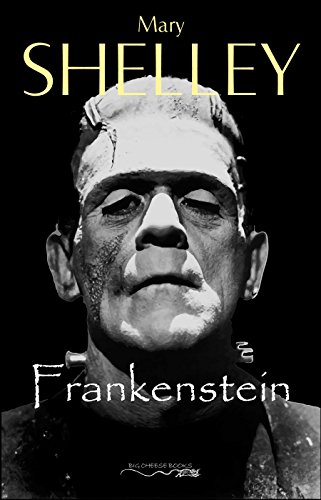
“The first sound adaptation of the story, Frankenstein (1931), was produced by Universal Pictures, directed by James Whale, and starred Boris Karloff as the monster.”

FrankensteinThe novel Frankenstein was written by English author Mary Shelley when she was but 20 years old. It was published with no author credit on 1 January 1818. Her name first appeared on the second edition, published in 1823.

It is a classic tale. Victor Frankenstein animates a creature. By the end, we’re left to wrestle with the question of whether it’s the man or the creature who is is truly the monster.

The recent bicentennial of Frankenstein might be reason enough to note the book. But it is the many appearances in popular culture that have sustained the story’s popularity.

The first film adaptation of the tale, Frankenstein, was made by Edison Studios in 1910. That short piece has been restored, and you can watch it right here.

“The first sound adaptation of the story, Frankenstein (1931), was produced by Universal Pictures, directed by James Whale, and starred Boris Karloff as the monster. The film has been selected for preservation in the United States National Film Registry…

“In Great Britain, a long-running series by Hammer Films focused on the character of Dr. Frankenstein (usually played by Peter Cushing) rather than his monster.”

It is these portrayals that have kept Frankenstein in the popular culture. When I was growing up, two sitcoms had characters who had the “look.” Lurch (Ted Cassidy) on The Addams Family (1964-1966) was a standard creature in the Karloff tradition; “You rang?”

Whereas in The Munsters (also 1964-1966), Herman Munster (Fred Gwynne) was “the patriarch of a family of kindly monsters. The rest of the family included a grandfather resembling the Universal Dracula…, a wife that resembles ‘The Bride of Frankenstein’, and a werewolf son.”

In 1971, General Mills put out the monster cereals, chocolate-flavored Count Chocula and the strawberry-flavored Franken Berry. “Since 2010, Franken Berry, Boo Berry [first released in 1973], and Count Chocula cereals have been manufactured and sold only for a few months during the autumn/Halloween season in September and October.”

My favorite iteration has to be the movie comedy Young Frankenstein (1974) by Mel Brooks and Gene Wilder. Borrowing “heavily from the first three Universal Frankenstein films… Wilder portrays Dr. Frankenstein’s American grandson, Frederick, while Peter Boyle plays the monster.” I literally fell out of my seat with laughter – it WAS an aisle seat – when I first saw this in the cinema.

Dustbury posted this recently: “Disabled Valery Spiridonov, 33, was ready to have his neck severed by Professor Sergio Canavero — dubbed ‘Dr. Frankenstein’ — and his head reattached to a new, healthy body.”

Finally, listen to Frankenstein by the Edgar Winters Group here or here or a long version here. It went to #1 in 1973 on the Billboard charts in the US.

For ABC Wednesday
Movie review: Shoplifters (Manbiki kazoku)

the movie Shoplifters (Manbiki kazoku) will be available on DVD on February 12.

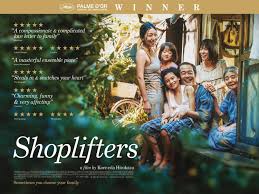
ShopliftersMy wife and I had just seen the movie Shoplifters (Manbiki kazoku) at the Spectrum Theatre in Albany. A young woman of our acquaintance said, “I don’t know why it got such positive buzz. I thought it was meh.”

I totally understood. The film was a little slow to develop, and even at the end of the two hours, we had questions about the various relationships. Yet we thought it was very much worth seeing.

The story involved a Japanese family with the folks generally underemployed. Some of them resort to… well, see the title… to survive. There’s a code that comes with such thievery, which is that while it’s still in the store, it’s not really stealing.

Their lives get complicated when they find a young girl stuck outside in the cold. They take her in, and are surprised that, at first, no one reports her missing. She begins to learn the family “trade”.

One takeaway is the notion of what constitutes family. The father discusses the boy’s adolescent urgings in a way I’ve never seen before in cinema, precise but not too complicated.

This is a film by director Hirokazu Kor-eeda, whose work I am totally unfamiliar with. He seems well-regarded, with all of the films he wrote and/or directed as least 85% positive in Rotten Tomatoes. Shoplifters is 99% positive with the critics. The performances were strong.

The predominant description of the movie in reviews is that, in many ways it feels Dickensian, like a fresh take on Oliver Twist, as one put it. I’m not sure I would have come up with that parallel myself, but it’s not inaccurate. Why else would we be rooting for, at some level, people who are regularly breaking the law?

Shoplifters will be available on DVD on February 12. I’d be interested in the opinions of others on this movie from Japan which was nominated as Best Foreign Film for this season’s Oscars.

Music throwback: Beatles Decca tapes

Coincidentally, both the Tremeloes and the Stones recorded Beatles’ songs.

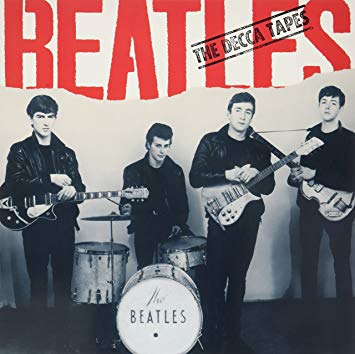
Beatles Decca tapesSomeone on Quora posted 10 of the 15 songs that appeared on the Beatles Decca tapes, an audition which took place on 1 January 1962 in London.
As you may know, Decca Records rejected the Beatles – John Lennon, Paul McCartney, George Harrison, and drummer Pete Best – with a polite “guitar groups are on the way out.”

The order of the songs at the session was:

Like Dreamers Do (A) (Lennon/McCartney)
Money* (That’s What I Want) (Gordy/Bradford)
Till There Was You* (Meredith Willson)
The Sheik of Araby (A) (Smith/Wheeler/Snyder)
To Know Her Is to Love Her* (Phil Spector)
Take Good Care of My Baby** (King/Goffin)
Memphis, Tennessee (Chuck Berry)*
Sure to Fall (In Love with You)* (Cantrell/Claunch/Perkins)
Hello Little Girl (A) (Lennon/McCartney)
Three Cool Cats (A) (Leiber/Stoller)
Crying, Waiting, Hoping* (Buddy Holly)
Love of the Loved** (Lennon/McCartney)
September in the Rain** (Warren/Dubin)
Bésame Mucho* (Consuelo Velázquez)
Searchin'(A) (Leiber/Stoller)

*unreleased version **unreleased (A) appears on Beatles Anthology #1, 1995

I had – actually have – a bootleg an unauthorized version of the Decca Tapes on vinyl from some point in the 1970s. I know that because my girlfriend at the time, who otherwise liked the collection, scowled when she heard Three Cool Cats: “save one chick for me!” It was a song, let’s say, of its time.

The decision to reject the Beatles turned out to be fortunate for three bands:

Brian Poole and the Tremeloes, “who auditioned the same day as the Beatles, as they were local and would require lower travel expenses”

The Beatles, who ended up at Parlophone under the tutelage of George Martin

The Rolling Stones: after the Beatles became popular in England, Decca snatched up the Stones

Coincidentally, both the Tremeloes and the Stones recorded Beatles’ songs.

Those five Decca recordings on the Anthology 1 collection in 1995 was a boon to Pete Best’s bank account.

10 songs
Searchin’
Three Cool Cats
The Sheik Of Araby
Like Dreamers Do
Hello Little Girl

I also own The Songs Lennon and McCartney Gave Away, a “compilation album containing the original artist recordings of songs composed by [the duo] in the 1960s that they had elected not to release as Beatles songs. The album was released in the UK in 1979.” Three covers of the Decca songs appear there.

Hello Little Girl- The Fourmost
Like Dreamers Do – The Applejacks
Love of The Loved – Cilla Black

Economic Color Blindness of the Sears Catalog

Sears’ innovative business model brought unprecedented market access to black customers

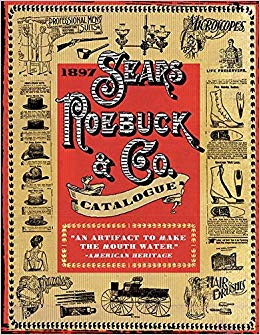
Sears catalog I already felt badly in 2017 when the local Sears store closed, even though I probably hadn’t shopped there in over a decade. I felt worse in 2018 when the company filed for bankruptcy.
Part of it was that Sears should have been the best position to become what Amazon has turned into, the category killer. It was because of the Sears catalog.

Now I’ve read this very entertaining article, The Economic Color Blindness of the Sears Catalog. The company “played an important role in circumventing the institutionalized racial discrimination of the Jim Crow South.”

I get the sense that a lot of people in America don’t understand how restrictive things could be. “For example, a black shopper would likely face greater difficulty than a white shopper in obtaining credit for a large purchase when such decisions fell to a racist store owner. The retail store could impose a higher credit price structure on black patrons as a matter of personal discretion, or deny them credit entirely.

“The Sears catalog, by contrast, would allow black patrons to buy the same item by mail on credit, with Sears having little ability to bring race into the equation.

“Black patrons could also be refused a sale in a store if they sought an item deemed dangerous to the racial hierarchies of segregated society, such as a firearm.” But Sears, in the days before more restrictions, could ship guns to any home.

“The Sears catalog circumvented the ability of local store owners to discriminate as it essentially allowed for a faceless transaction that took place entirely by mail. Combined with the expanded price competition it brought to the retail industry” – isn’t that what Amazon did more recently? -“Sears’ innovative business model brought unprecedented market access to black customers — and did so in a way that allowed them to avoid the indignities of discriminatory treatment at the cash register counter.”

What’s also interesting is the assessment by Gary Becker from back in the 1950s that “a discriminatory cultural belief such as racial prejudice also carries associated economic costs for the discriminator.” In other words, it costs bigots to be bigots, a lesson still applicable today.

“I cannot throw out these books”

I wrote 10 or 11 blog posts re Never A Dull Moment: 1971, the year that rock exploded by David Hepworth.

Jaquandor recently wrote about owning books. In part, he quotes from Life Itself by Roger Ebert, which makes more sense in its entirety, and really speaks to me. “I cannot throw out these books. Some are enchanted because I have personally turned all their pages and read every word. They’re shrines to my past hours.”

Looking at my bookshelves in the office, I realize the sheer number of books I am not going to get rid of, because. And that doesn’t even count the ones in the bookcases that are in the attic, arranged, BTW, and the relatively few in the living room.

Initially, I  was just going to pick books as they appeared on the shelves. Then I decided to put them in some sort of imperfect order

ALBANY

Six and Eleven – Ed Dague (2010). Former local news anchor I hung out with him one night and have a transcript – somewhere – of that night’s broadcast in 1994

A Day Apart: How Jews, Christians, and Muslims Find Faith, Freedom, and Joy on the Sabbath – Christopher Ringwald. (2007). Signed to me. I got to hear him speak on the topic in my church a few years before his tragic death.

Figuring Sh!t Out: Love, Laughter, Suicide, and Survival – Amy Biancolli (2015). Signed to me, my wife and our daughter. About surviving the suicides in her life, including that of her husband, the aforementioned C Ringwald

O Albany – William Kennedy (1983). The greatest writer out of the city. Both he and Biancolli worked for the local newspaper, the Times Union, and both were honored by the Albany Public Library Foundation

RACE

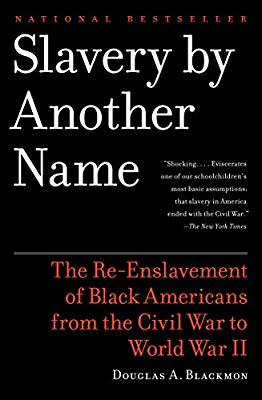
Slavery by Another Name: The Re-Enslavement of Black Americans from the Civil War to World War II – Douglas A. Blackmon (2008) – signed to me in 2009 at an event arranged by Bill Kennedy

The New Jim Crow: Mass Incarceration in the Age of Colorblindness – Michelle Alexander (revised 2011). Because it makes sense.

The Sweeter the Juice – Shirlee Taylor Haizlip. when I wrote a blog post about it, I got an email from her!

Brothers in Arms: The Epic Story of the 761st Tank Battalion, WWII’s Forgotten Heroes – Kareem Abdul Jabbar and Anthony Walton (2004). Did you know Kareem was on JEOPARDY! for the first time the same month I was?

FANTACO

The Nearly Complete Essential Hembeck Archives Omnibus – Fred Hembeck (2008). I remember helping friend Fred unload boxes of these at a comic book convention in Saratoga Springs, NY

Xerox Ferox: The Wild World of the Horror Film Fanzine – John Szpunar. It premiered at FantaCon 2013. I got it signed by the author, plus subjects such as Steve Bissette, Tom Skulan, Dennis Daniel and Jim Whiting

Saga of the Swamp Thing: Book One – Alan Moore, Stephen Bissette, John Totleben (2009), art plate signed by Steve; I met Steve at FantaCo in 1987

FantaCo book publications, almost all of which have stories; I know I was quoted in the Washington Post about Splatter Movies (1981)

Elfquest books – Wendy and Richard Pini, the original 20 issues in four volumes. Wendy and Richard came up to FantaCo for signings thrice a year

MUSIC

Blues People – LeRoi Jones (1963), before he became Amiri Baraka, he wrote about “the Negro experience in white America and the music that developed from it.”

Soulsville USA – Rob Bowman (1997). The story of STAX Records

Never A Dull Moment: 1971, the year that rock exploded – David Hepworth. I wrote 10 or 11 blog posts on this book

Across the Charts: The 1960s – Joel Whitburn (2008), This a book that shows the power of songs that cross over among the pop, soul, country, and adult contemporary charts.

Plus a slew of books on the Beatles

This post is getting LONG – more books soon.

Ramblin' with Roger
Social media & sharing icons powered by UltimatelySocial