Lydster: Apostille

certified

Thanks to my daughter, I’ve learned a new word, apostille, which I’ll describe in due course. She decided to study abroad in the second semester of this college year. There’s a database she consulted to discern where to go based on her interests in art, black studies, environmental studies, and social justice.

She found one college in Botswana and three in South Africa: one in Johannesburg and the others in Cape Town. So she picked one, and then the process began. Because her current college compiled grades in a non-conventional way, she didn’t get approved for this process until late October. This seems like a reasonable amount of time, except that one has to get a visa to be a student in South Africa.

She made an appointment and was given January 21, 2025, to appear at the South African consulate in New York City. (One has to go to NYC, LA, or DC.) After writing a letter of appeal, the time was changed to January 14, and her February 5 flight was still a tight deadline.

The extensive list

Before the consulate visit, she had to check off items on this list. One item was a Notarized copy of the birth certificate. What does THAT mean?

Since my daughter was away at college, I went to Albany City Hall to get another copy of her birth certificate. We had the original, but I correctly surmised we’d need another one. It was a good thing I went in that direction. Once I got the birth certificate ($17), I got this page from the city clerk’s office. “Once a certified record is issued by the city of Albany, that record must go to the Albany County clerk’s office. The fee is $3 per document. The record must be issued within the last six months.” Fortunately, the city and county clerks are only a short distance apart on Eagle Street.

“The documents must then go to the New York State Secretary of State,  Miscellaneous Records the country where the document is to be sent must be specified. The fee is $10 per document. ” That is at 99 Washington Avenue, not too far away. 

The word at the top of the page the city clerk’s office gave me is Apostille. It is “a document used in international law that is issued by a government in accordance with the Hague Convention, and that certifies that another document has been signed by a notary public.”

Plus

She also needed a “Machine-readable valid passport with at least two (2) unused (blank) pages labeled Visa when presented at the Embassy or Consulate; one page for affixing the visa or permit by the embassy/consulate and the other page for endorsement of entry/departure stamp by the South African Immigration Services. Passport must be valid for 30 more days after the intended return date from South Africa.”

As it turned out, I had… persuaded her to get a passport in February 2024, which allowed her to dream about going abroad.  

  • Two (2) passport photos with white or light background

She got this when she was home for Thanksgiving break. These are for the visa.

  • Medical report on prescribed form (physical). The certificate must not be older than six (6) months at the time the applicant submits an application.

It was also completed during the T-day break.

  • Original FBI certificate (full criminal background check report) and original police clearance certificate from each country where the relevant applicant resided for 12 months or longer after attaining the age of 18 years (for the last 5 years) in respect of criminal records or the character of that applicant, which certificate shall not be older than six months at the time of its submission.

Ditto. This was done in Half Moon, a small hamlet in the metro area that is not especially nearby.

What else?
  • Certified/notarized copy of bio page of the passport
  • Proof of financial means in the form of recent three months bank statements stamped by bank, and notarized letter from the parents stating the financial responsibility.
  • Proof of sufficient financial means available to the learner while in South Africa
  • Certified copy of ID of person taking financial responsibility, with three months statement and stamped letter from the bank.

Our financial institutions (banks, credit unions) handled “certified/notarized” slightly differently. 

  • Proof of itinerary/reservation of round trip air tickets. Please do not purchase air tickets until you obtain a South African visa.

How do we prove an itinerary without buying a ticket? We purchase a (more expensive) refundable ticket.

But we HAVE insurance, don’t we?
  • Proof of medical cover, renewed annually, for the period of study with a medical scheme registered under the Medical Schemes Act.

This confused me somewhat, as the entity arranging the trip provided a policy through a company that “provides a complete network of travel insurance coverage—medical insurance, 24-hour emergency assistance, trip and baggage delay, loss of baggage, and much more!” However, the company was NOT registered under the Medical Schemes Act.

On January 6, I purchased a qualifying insurance policy. I had a copy of my receipt, but we didn’t have a copy of the policy. I wrote to them again on January 10th, and they sent the policy to my daughter, saying they had sent it previously. Unfortunately, it was password-protected, and we had no idea what the password was. Luckily, my daughter wrote to them again, and they gave us a clean copy we could print.

So, on Monday, January 13, my daughter and I took a train to New York City in anticipation of the trip to the  South African consulate with what we HOPED was everything we needed, including a  US Postal Service self-addressed, pre-paid courier envelope “to facilitate return services” and a “non-refundable fee of  $36.00 money order for processing.”

More soon.
Afrofuturism: a history of black futures

technoculture and speculative fiction


Afrofuturism? What’s that?

In August 2024, my wife, daughter, and I visited the National Museum of African History & Culture in Washington, DC. My wife and I have never been to the museum, although I was a charter member for several years before its 2016 opening. Conversely, my daughter had gone twice,  once for school and once with a church group.

The primary newish exhibition was about Afrofuturism, a term I’d never heard of before planning the trip. We went to it first. The exhibit ended two weeks after we visited, so we were lucky. (It ran from March 24, 2023, to August 18, 2024, and can still be accessed, in part, online.)

However, after seeing the exhibit, I still had difficulty explaining to somebody else what Afrofuturism is. I did have a good sense of WHY there was Afrofuturism, and it was because we – black people are still here, despite it all.

What?

What does Wikipedia say? “Afrofuturism is a cultural aesthetic, philosophy of science, and history that explores the intersection of the African diaspora culture with science and technology. It addresses themes and concerns of the African diaspora through technoculture and speculative fiction, encompassing a range of media and artists with a shared interest in envisioning black futures that stem from Afro-diasporic experiences. While Afrofuturism is most commonly associated with science fiction, it can also encompass other speculative genres such as fantasy, alternate history, and magic realism, and it can also be found in music.”

So, I decided to buy Afrofuturism: A History of Black Futures in the museum shop to augment my understanding. There are four main chapters, and several essays written by different authors are included within.

Space

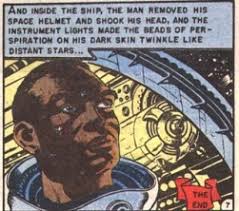
Chapter 1 is Space Is The Place. One of the first images in the museum display and also in the book’s introduction is the final panel of Judgement Day, a 1953 Al Feldstein/Joe Orlando story from EC Comics’ Weird Fantasy #18, in which Tarlton is a representative from “Earth Colonization.” He visits Cybrinia, “the planet of mechanical life,” to see if the blue and orange robots are ready for “inclusion in Earth’s great galactic republic.”
An essential character in Afrofuturism is Lieutenant Nayato Uhura from Star Trek. She was played by Nichelle Nichols, who also came up with her character’s Swahili name.  Famously, she wanted to quit after the first season, but she was convinced to stay on by MLK, Jr.  She subsequently formed the “company Women in Motion, which NASA contracted to help recruit more than 8000 people, including some of the first African American Asian Latino and female astronauts.” Many women, starting with Mae Jemison, credit Nichelle’s efforts for them entering the space program.

Futurists

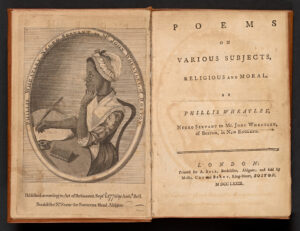
Chapter 2 is Speculative Worlds. Interestingly, the notion goes back at least to Phillis Wheatley (1753-1784)

Her Poems of Various Subjects, Religious and Moral, were released two years before her emancipation in 1773, the first book published by an African American poet. Thomas Jefferson and others underestimated her fervent imagination, capable of composing such lines as

celestial Salem blooms and endless spring

calm and serene thy moments glide along

and may the muse inspire each future

Martin R Delaney (1812-1885), a writer, “soldier abolitionist, publisher position, and advocate for black resettlement in Africa,” originally published Blake or the Huts of America as a serial in the Anglo African magazine from 1859 to 1862; the book tells the story of Henry Blake, who escaped slavery in the South, flees to Canada, then travels to Africa and Cuba. In action, Blake resembles both Denmark Vesey and Josiah Henson, two historic figures well known for efforts to achieve freedom for themselves and others.

William Edward Burghardt DuBois was a towering figure. He was asked to curate the American Negro exhibit at the 1900 Paris Exposition. “DuBois developed colorful hand-drawn charts, graphs, and maps that illustrated the social realities of African Americans. These infographics were surrounded by documentary photographs, books, and patents attributed to African Americans. By visually demonstrating the accomplishments of the post-emancipation generation, Dubois [claimed] that African Americans’ achievements deserve to be seen in the same light as other vaunted achievements of the 19th century.”

Funny books

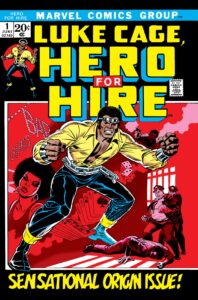
My best college friend Mark used to drive us to a store so he could pick up comic books, which I thought was a very strange thing for an adult to do. But one day in 1972, I discovered Luke Cage, Hero for Hire #1, which I purchased, which started two decades of funny book collecting.   There was also a Luke Cage live-action program in the 2010s. 
In one of the early video clips at the museum, the speaker said he didn’t know that he needed to see the movie The Black Panther and that it needed to exist until he saw it. I understood that because I had the same experience.

In a caption: for Black Panther (2018), “production designer Hannah Beachler constructed the aesthetics of Wakanda, the technologically advanced African nation where the movie takes place. Beachler traveled throughout Africa for eight months, researching the continent’s culture, architecture, clothing, food, and transportation. 

“The fictional African nation of Wakanda [is] powered by the imaginary element vibranium, concealed from the outside world and never conquered.” For a continent that had long been colonized, this was massive.

There is also a section, Dialogues in Space: Octavia Butler and Samuel Delany.

Art

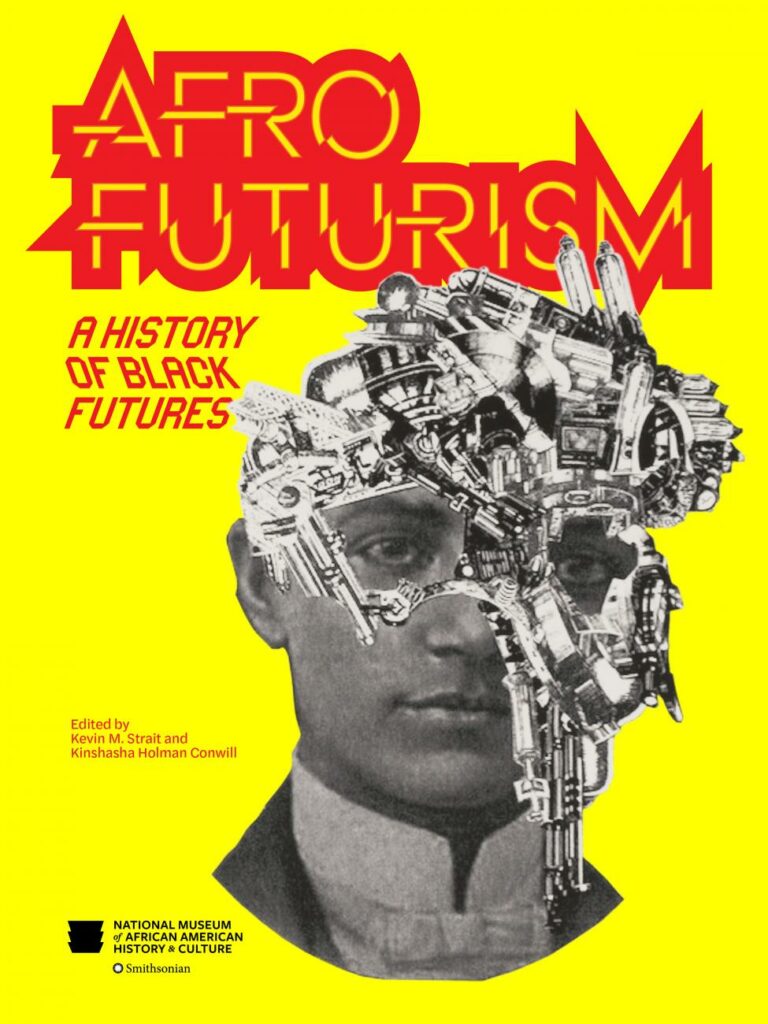
Chapter 3 is Visualizing Afrofuturism. The book cover is Android/Negroid #14 by Wayne Hodge (2015): “The series combines collage and photography by merging photographic portraits with illustrations of machinery and technology. Hodge explores the relationships between race, history, and science fiction.”

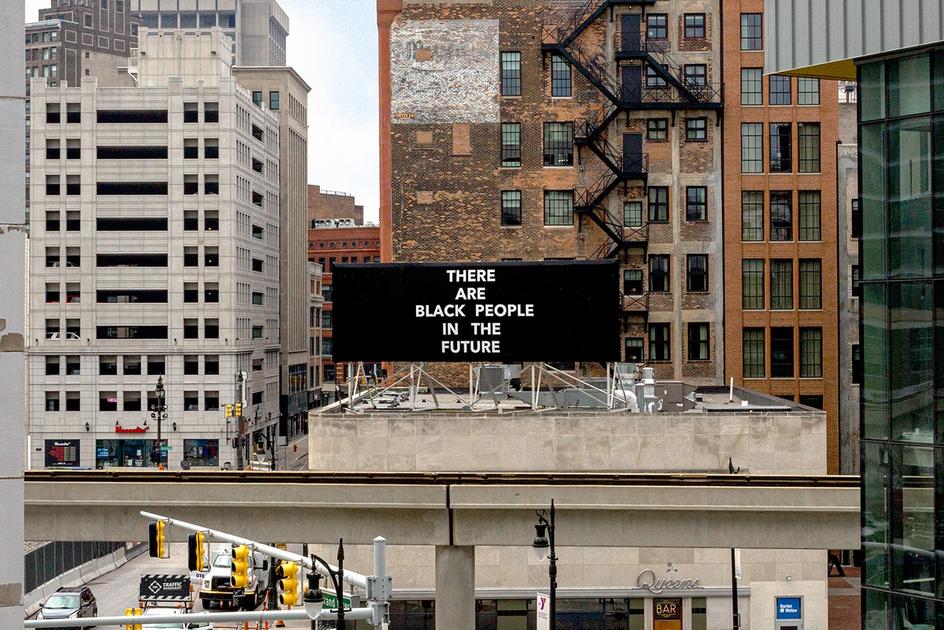
There Are Black People in the Future is a series of billboards that started in Pittsburgh and have spread worldwide.

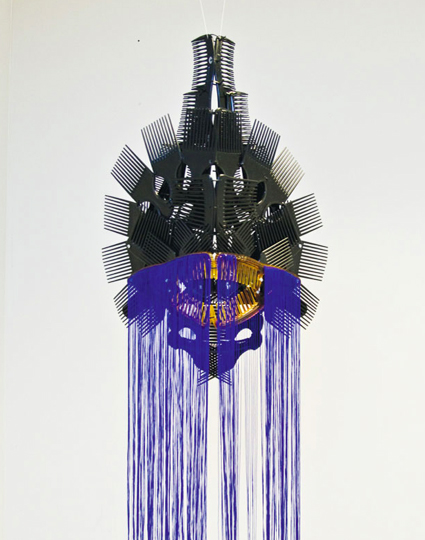
The chapter focuses on fashion and art, such as Commemorative Headdress of Her Journey Beyond Heaven by Kenya, which uses “mass-produced items to draw attention to material consumption beauty standards and black cultural identity. “

Music

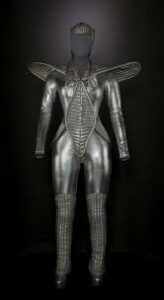
Chapter 4 is Musical Futures, which namechecks, among many others, Jimi Hendrix,  Nona Hendryx of LaBelle, Vernon Reid of Living Colour, and especially Sun Ra. Writer Stanley Nelson says without Sun Ra, it is hard to understand George Clinton, Erykah Badu, Janelle Monáe, Raz G, Kamasi Washington, Shabaka Hutchings, Black Panther, Lovecraft country, and Afrofuturism itself. Cover art and costumes (see Nona Hendryx’s outfit) are elements of Afrofuturism.

The Order Of The Pharaonic Jesters – Sun Ra

Welcome To The Terrordome – Public Enemy

One Nation Under A Groove – Funkadelic (George Clinton)

Space Children – Labelle

Metropolis – Janelle Monáe  

Cult of Personality – Living Colour

The book helped me better understand Afrofuturism. There was a certain repetition, inevitable, with a half-dozen writers covering similar territory. Nevertheless, I recommend it; the visuals in this book are tremendous. At 200 pages, it’s a relatively quick read.

HeLa

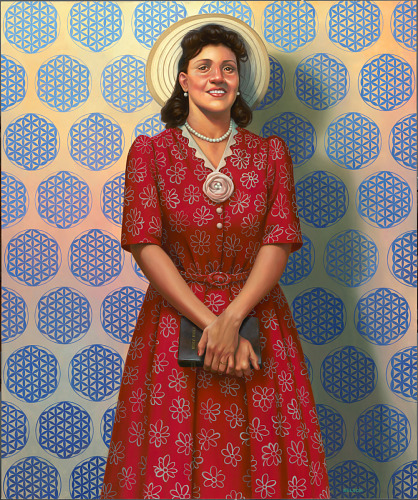
Finally, this picture of Henrietta Lacks was not in the book but in the exhibition .”She died in 1951, aged 31, of an aggressive cervical cancer. Months earlier, doctors at the Johns Hopkins Hospital in Baltimore, Maryland, had taken samples of her cancerous cells while diagnosing and treating the disease. They gave some of that tissue to a researcher without Lacks’s knowledge or consent. In the laboratory, her cells had an extraordinary capacity to survive and reproduce; they were, in essence, immortal. The researcher shared them widely with other scientists, and they became a workhorse of biological research. Today, work done with HeLa cells underpins much of modern medicine.”

I wondered how someone whose cells had been exploited for so long would be Afrofuturism. Ultimately, her immortality, a scientific miracle, was also successful in achieving the future for her family when they settled the case’s outcome.


What Albany winters used to be

no singing?

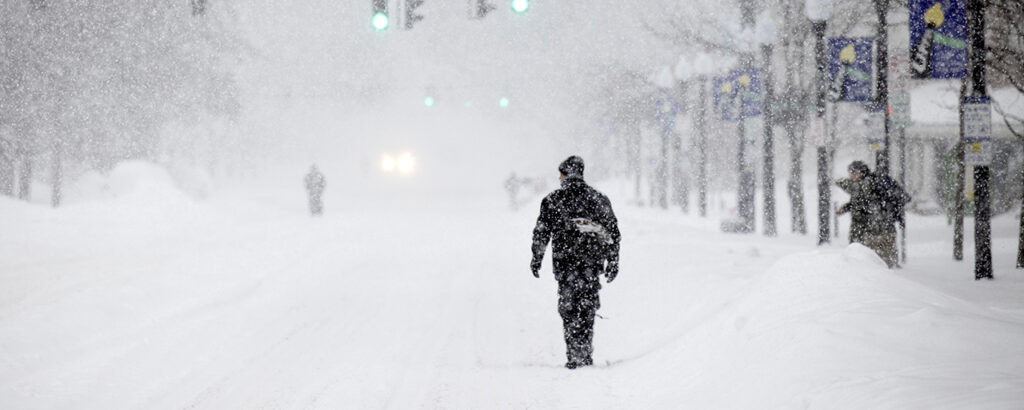
December 17, 2020 – Albany, NY – Albany digs out after an early winter storm. (Mike Groll/Office of Governor Andrew M. Cuomo)

Having lived in the New York State capital since 1979, I recall what Albany winters used to be: colder and snowier. Here’s a February 2024 news article about another mild winter.

Most of this winter wasn’t terrible, but February 2025 sucked. On February 9th at church, the education classes were canceled, and the choir didn’t sing in anticipation of a forecasted snowstorm. It wasn’t that bad in Albany. I ended up reading the prayers of people.

The following weekend, choir and education hours were canceled again, less because of the snow but the threat of ice. I ended up being an usher. Somebody said after the service, “Isn’t it nice having time off from choir?” NO! I miss the singing.

The ice continued throughout the week all over the city, with high winds and subzero wind chills. When I had to go to a drugstore, trying to climb over the intersections of solid ice was treacherous. If not for using my cane, I would surely have fallen more than once.

I take pride in keeping my sidewalk clear, but it took two days and multiple applications of deicer to get down to the pavement. It didn’t matter much since most of the rest of the walks weren’t clear for several days when it finally reached freezing.

More bus stories

The whole month was messy. Early in February, I was waiting at a bus, and this relatively short woman was terrified of stepping off the bus into water that would probably be halfway up to her shins. She was paralyzed about what to do, so this guy said, “Okay, we got you,” and, with each of us holding an arm, got her across the gap between the bus and the curb. She was so happy. The bus driver waved the guy and me onto the bus without having to pay.

A couple of days later, it wasn’t snowing, but no one had shoveled the entire walk to the curb. The bus driver wanted to put down the ramp for a person in a wheelchair, but the ramp wouldn’t lie flat. So he wheeled up the small snow bank, and two other people pushed him into the bus—think tush push.

Another time, I was waiting for a bus on Central Avenue, and I had just missed what appeared to be a three-car accident. The vehicles were sitting in the left lane heading eastbound. When the cops came, they stopped in the right lane, making it almost impossible for any vehicle to get by, even as we saw the bus on the horizon. Cleverly, the bus driver drove into the Hannaford grocery store parking lot and managed to pick up the customers anyway. The passengers were praising the CDTA driver for their ingenuity.

Icebreaker Questions for Work

Sing. Obviously.

Here are some more Icebreaker Questions for Work: Breaking the Ice and Building Connections. The concept still cracks me up.
Some of the introductory text: “Ah, icebreaker questions! They’re like little magical potions that can work wonders in breaking down barriers and helping people connect on a deeper level. Whether you find yourself in a work setting where team members may not know each other well or you simply want to foster a sense of camaraderie, icebreaker questions are here to save the day…

“Icebreaker questions are conversation starters designed to, well, break the ice! They’re a fun and lighthearted way to get people talking, connecting, and feeling more comfortable with one another. Think of them as those little sparks that can ignite powerful conversations and create memorable moments together.”

Category 2: Would You Rather?

  1. Would you rather have a rewind button or a pause button in your life?  I’m not going back, that’s for sure. Pause, I suppose. Hmm. Stop The World (And Let Me Off) by Patsy Cline, a song I remember growing up, is stuck in my head.  –
  2. Would you rather always speak in rhymes or sing instead of speaking? Here’s an admission: when I recite the Lord’s Prayer at church, I tend to sing it instead of saying it. I’m trying to remember the words “debts” and “debtors” rather than” trespass” and “trespasses.”. Debt and debtors are the Presbyterian choices, but I was a Methodist for most of my life, so it’s easy to fall into that trap, even 22 years into Presbyterianism. Here’s a version that at least starts less bombastic than most. But I giggled when the lyrics, probably an AI feature, read, “And forgive us our death As we forgive our dead earth”!
  3. Would you rather have a pet dinosaur or be best friends with a unicorn? May I ride the unicorn? Then that. 
  4. Would you rather only be able to whisper or always have to shout? Whisper.  Our choir director and others, such as directors of plays, have talked about how a whisper can still be heard in the back of the room.  
  5. Would you rather have to wear clown shoes every day or a clown wig? A clown wig because it would cover my balding head. No clown shoes unless they’re orthopedic.
  6. Would you rather have to sing every time you speak or dance while you walk? Sing. Obviously.
  7. Would you rather have a pet elephant or a pet penguin? The Penguin likely poops less. (And my spellcheck capitalized penguin.) 
  8. Would you rather always smell like onions or always have bad breath? Presumably, the bad breath would be more likely to be masked, so I’ll go with that.
  9. Would you rather have a flying car or a personal robot assistant?  I will let my robot assistant clean my office, type these blog posts, give me massages, make dinner, wash the dishes…
  10. Would you rather have a permanent funny hiccups or uncontrollable laughter? From time to time, I actually do have uncontrollable laughter after I find certain things that are astonishingly funny. But other people look around, wondering, “What is that old fool laughing about?”  

Black country music landscape

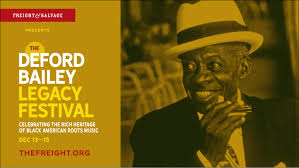
DeFord Bailey

From the Greene County, OH library page: “Black artists have been part of the country music landscape since the beginning, with elements of African-American music, like blues, rock and roll, and southern gospel music, woven in. The banjo, an essential Appalachian music instrument, was introduced to the region by black slaves in the early 19th century (source: Smithsonian Music).”

It was probably in 2005, the year he was posthumously inducted, that I first learned about Country Music Hall of Fame member DeFord Bailey (1899-1982). “An influential harmonica player in both country and blues music, … Bailey was one of the Grand Ole Opry’s most popular early performers and country music’s first African American star… He grew up in a musical family that played what he called ‘Black hillbilly music,’ a tradition of secular string band music that drew upon the same core repertoire shared by rural Black and white musicians alike.”

From Opry.com:  “Harmonica wizard DeFord Bailey wasn’t merely one of the Opry’s first stars — he was the first musician to perform the Saturday that announcer George D. Hay coined the name of the world’s longest-running radio show that would become famous – the Grand Ole Opry. Bailey, whose tunes helped popularize his instrument in the United States, boasted another first, as well: He was the first musician to hold a recording session in Nashville, setting the stage for a scene that would change the world.”

Listen to Pan American Blues and an album

Ray

The multifaceted Ray Charles released an album in 1962, Modern Sounds in Country and Western Music, which became his first album to top the Billboard 200 charts, and it did so for 14 weeks. The follow-up release, Volume Two, got to #2.

Doug Freeman of the Austin Chronicle wrote of Charles’s influence through the album, stating:

Country and soul have always had a tenuous connection, undoubtedly exacerbated by the racial identifications of their respective fanbases. Yet despite the perceived disconnect between the two genres, the populist formats of both have always been more fluid and contiguous than is traditionally recognized. Elvis‘ melding of country and R&B may even arguably be considered the genesis of rock & roll, though that middle ground has largely only served to allow soul and country to remain segregated. With his 1962 Modern Sounds in Country and Western Music, Ray Charles created the benchmark for crossing the line, highlighting the similarities in sentiment often overshadowed by sound

Ray Charles (1930-2004) was posthumously inducted into the Country Hall of Fame in 2021.

Charley Pride

The black country artist I remember best growing up was Charley Pride. “During the peak years of his recording career (1966–1987), he had 52 top-10 hits on the Billboard Hot Country Songs chart, 30 of which reached number one.

“In the late summer of 1966… he was booked for his first large show, in Detroit’s Olympia Stadium. Since no biographical information had been included with those singles, few of the 10,000 country fans who came to the show knew Pride was Black and discovered the fact only when he walked onto the stage, at which point the applause trickled off to silence. ‘I knew I’d have to get it over with sooner or later,’ Pride later remembered. ‘I told the audience: ‘Friends, I realize it’s a little unique, me coming out here – with a permanent suntan – to sing country and western to you. But that’s the way it is.'”

Charley Pride (1934-2020) was inducted into the Country Music Hall of Fame in 2000.

Listen to Greatest Hits

Others

There are many more black country artists, such as Darius Rucker, formerly of Hootie and the Blowfish. Here are 12 Black artists shaping country music’s future (2021) and 13 Black country artists you need to know (2024). There is some overlap; the latter group includes Shaboozy, whose A Bar Song (Tipsy) dominated both the pop and country charts for weeks.

Beyoncé’s album Cowboy Carter did not receive any nominations at the 58th Annual Country Music Association Awards, presented in November 2024. Still, it won Best Country Album and Album of the Year at the Grammys in February 2025.

Listen to Texas Hold ‘Em

Ramblin' with Roger
Social media & sharing icons powered by UltimatelySocial