Fridays in Lent: Mozart Requiem

Some or all the music from the Mozart Requiem appears in at least 70 movies and television episodes.

Mozart-musicI’ve sung the Mozart Requiem in D minor at least thrice, once in 1985, once or twice in the 1990s, and once on September 11, 2002. I LOVE this piece of music.

The one problem singing it is that I have to keep from crying. As was made clear in the movie Amadeus, this is as much about the composer’s own death as Jesus’.

Some or all the music from this work appears in at least 70 movies and television episodes, plus a number of commercials.

Here is a live recording.


MLK as creationist?

For Dr. King, the value of biblical stories is not diminished by their mythological nature. Rather, the myth serves to take the reader beyond the idea or thought within the mind.

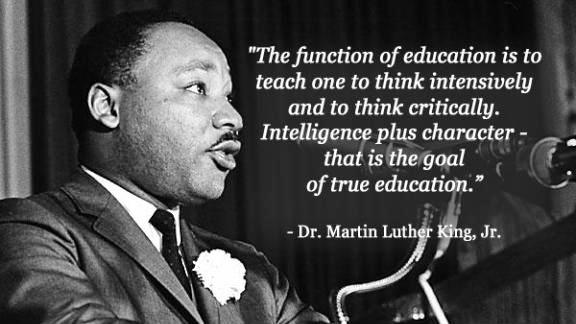
MLK-ed-quoteIn a couple of different Facebook strains around the Martin Luther King holiday, I read suggestions that Martin Luther King was a creationist. This is, as far as any evidence I’ve seen, a total fabrication.

First, a sidebar: apparently, there’s a narrative out there that suggests that philosophically – it is a Darwinian worldview that allows racism to exist, while a biblical perspective does not, evidence to the contrary notwithstanding. Implicit was the notion that King must be a creationist because he believed all people were created equal.

The problem is the only “evidence” to support this theory about King is the fact that he was a Baptist preacher, and aren’t all Baptist preachers creationists? (No.)

From HERE:

Dr. King’s understanding of the Bible is quite simple: he believed it was written in a pre-scientific world and used language that was representative of its era. He flatly rejects a literal interpretation of biblical stories, claiming such a reading would be “absurd” in a Copernican world.

For Dr. King, the value of biblical stories is not diminished by their mythological nature. Rather, the myth serves to take the reader beyond the idea or thought within the mind. In short, he accepts the standard methods for critically examining the Bible. …he explains that this modern method “sees the Bible not as a textbook written with divine hands, but as a portrayal of the experiences of men written in particular historical situations.” Textual and literary criticism, archaeology, and history revealed to King the inadequacy of a literal biblical interpretation. He claimed that this critical approach to the Bible was “the best or at least the most logical system of theology in existence.”

Also, read what he said fairly early on in his papers. No public record suggests a fundamental change from this viewpoint.

For those who have found reading the Bible confounding because it contradicts itself, or for a myriad of other reasons, King’s viewpoint may make the reading more understandable.
***
Daniel Nester on why Maple Shade, NJ is important in the MLK story.

Marvin Gaye, 1939-1984

Father stop criticizing your son
Mother please leave your daughters alone
Don’t you see that’s what wrong
With the world with world today
Everybody wants somebody
To be their own piece of clay

MarvinGayeThe absurd death of Marvin Gaye, at the hands of his father, a day shy of his 45th birthday, always saddens me in early April. He would have been 75 today, but instead was killed 30 years ago yesterday.

Here are twenty-one songs, all linked here, some multiple times, and with different spellings. My list is more or less in preference order, though I’m sure I left off something obvious. The citations refer to its Billboard pop charts zenith, and the year:

21. The Star-Spangled Banner – a controversial version performed at the 1983 NBA All-Star Game
20. Yesterday – WAY too many covers of this Beatles song, yet this is one I like
19. Let’s Get It On (1, 1973)
18. Got to Give It Up (1, 1977)
17. I’ll Be Doggone (8, 1965)
16. Pride And Joy (10, 1963)

15. You’re All I Need to Get By (with Tammi Terrell) (7, 1968)
14. Your Unchanging Love (33, 1967)
13. I Heard It Through the Grapevine (1, 1968) – this might have fared better on my list if I had not burned out on it in the Big Chill period. BTW, Yahoo! Voices wrote: “The song became so popular in fact, that numerous artists have re-recorded their own renditions, not that any of them can compare to the original.” WRONG: It was NOT the original. Smokey Robinson and the Miracles recorded it earlier, though Berry Gordy put the kibosh on its release. Then Gladys Knight and the Pips went to #2 with it the year before Marvin’s version went to #1.
12. It Takes Two (with Kim Weston) (14, 1967)
11. Mercy Mercy Me (4, 1971) – the ecology is more threatened now than it was then…

10. Sexual Healing (3, 1983) – his last big hit, after he had moved from Motown to Columbia
9. Ain’t Nothin’ Like the Real Thing (with Tammi Terrell) (8, 1968)
8. What’s Going On (2, 1971)
7. Hitch Hike (30, 1963)
6. Ain’t That Peculiar (8, 1965)

5. Stubborn Kind Of Fellow (46, 1962) – and he was, in his dealings with Berry Gordy and others
4. Ain’t No Mountain High Enough (with Tammi Terrell) (19, 1967)
3. Piece Of Clay – never heard this song until I found it on the soundtrack to the 1996 movie Phenomenon
Father stop criticizing your son
Mother please leave your daughters alone
Don’t you see that’s what wrong
With the world with world today
Everybody wants somebody
To be their own piece of clay

2. Inner City Blues (9, 1971) – STILL makes me want to holler, throw up both my hands…
1. Can I Get a Witness (22, 1963)
***
This is an interesting listen A Tribute To The Great Nat King Cole by Marvin Gaye. All links are correct, except #2, which is neither the song (On the street where you live NOT Ramblin’ Rose), or the artist (sung by someone named Eugene Butcher) listed.

Don’t cry for me, Art and Tina

It’s April 1, and, as usual, I got nuthin’. I usually find the stuff that people pull on others, such as this list from PARADE magazine, are, at best, unfunny, and at worst, really annoying. Though I rather liked this one.

I’m reminded again that I can be funny, but that it’s situational. Just yesterday, I was in a convenience store and some government agency guy wanted to take pictures of the cigarettes, which I noted to the clerk was was one of the worst pickup lines ever; she laughed, and it WAS funny (especially with the delivery and voice), but ya had to be there…

Punography

L is for Lennon: John and Yoko

Lennon’s lead guitar work on Walking on Thin Ice, which he recorded 8 December 1980, was his final creative act.

JohnandYokoJohn Lennon met Yoko Ono at an art gallery in November 1966. Very soon, the thing that would really bug Paul, George, and Ringo was that SHE was in the studio with John and them; this had been the Beatles’ nexus, but now he’s bringing in his girlfriend?

Her vocals would eventually show up on Beatles songs, notably Revolution 9 from the white album, and the very strange song What’s The New Mary Jane [LISTEN, if you want] which actually never made it onto a legitimate record until the third Beatles Anthology album, released in the 1990s.

They did a number of albums together, including two avant-garde albums called Unfinished Music. Two Virgins had the infamous nude cover; the CD release added the Yoko song Remember Love [LISTEN], the B-side to the Plastic Ono Band single, Give Peace A Chance [LISTEN].

The Life with the Lions, which corresponded with Yoko’s miscarriage, also had extra material for the CD release. This was followed by The Wedding Album, with side 1 filled with John yelling “Yoko!” and Yoko screaming, “John!”; at least side two was an informative interview.

Live Peace In Toronto was interesting, with Eric Clapton and “Revolver” cover artist Klaus Voorman playing with John. Side two was all Yoko, mostly experimental stuff. LISTEN for yourself to the whole album.

Almost saw John & Yoko at an antiwar demonstration in 1972 or 1973. We had taken a charted bus down from New Paltz, NY to NYC, but we had to get back at the appointed hour. While we were on the bus, still in Manhattan, we heard John on the radio at the rally we had just left only minutes earlier. Speaking of war: Yoko and a bunch of kids appear on Merry Xmas (War is Over) [LISTEN]. Likewise, John regularly appears as guitarist and/or producer on songs she recorded in the 1970s.

They had their famous breakup, the “Lost Weekend”, but got back together in late 1974, then had a son together, Sean, on John’s 35th birthday, October 9, 1975.

When John decided to go back into recording in 1980, Yoko was inarguably an equal musical partner, with their songs alternating on Double Fantasy and the album after John’s death, Milk and Honey. No song better reflects, for me, John’s evolution as a person than Woman, from the former album.

Perhaps my favorite Yoko song is Walking on Thin Ice:

Released in 1981. She and John Lennon concluded the recording of the song on December 8, 1980. It was upon their return from the recording studio to The Dakota (their home in New York City) that Lennon was murdered… Lennon was clutching a tape of a final mix when he was shot.

Lennon’s lead guitar work on the track, which he recorded [that day], was his final creative act.

The B-side was It Happened [LISTEN], which starts with a dialogue between John and Yoko before she sings. Here’s a list, with links, to Yoko’s best songs, including the aforementioned Walking on Thin Ice.

Yoko has continued to record, as well as keep John’s music in the public eye. Sean is a recording artist as well, and I got to see him play a few years back.


ABC Wednesday – Round 14

Ramblin' with Roger
Social media & sharing icons powered by UltimatelySocial