Civil War cards

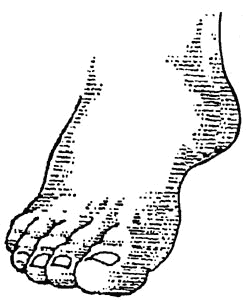
At least a plurality of the cards had someone dying by being impaled by something, and the pained eyes of the soon-to-be deceased I always found haunting.


In a discussion on the website of SamuraiFrog, I wrote: “Yeah, just the frickin’ trailer of [the Quentin Tarantino film] Kill Bill 1 put me on edge; I can only imagine how it actually plays out.” To which, somewhere, Mr. Frog asked if it was because of the violence. Well, yeah, but it’s more specific than that.

Of all the forms of fictionalized violence in movies, the type I hate the most involves people getting stabbed or, worse, run through with a bayonet or sword. And I know why.

There were these Civil War Trading Cards that came out in 1962 from Topps, the folks that made the baseball cards. I bought them because they were history, and I was interested in that, but I don’t know why – except for some bizarre sense of completeness – I KEPT buying them.

While there were soldiers shot and run over on some cards, I swear that at least a plurality of them had someone dying by being impaled by something, and the pained eyes of the soon-to-be deceased I always found haunting. The card above is a good, not great, example of this.

So even in PG-13 movie violence, I often instinctively turn away when swordplay is involved.

You know what comic book I found yucky? It was a Daredevil, somewhere in the #160s, I think, drawn and written by Frank Miller, in which Elektra stabs some guy through a seat in a movie theater; that guy, and the terrified guy next to him, had THAT look, too.

In my dorm in college, two guys were sword fighting once; I left right away because I was afraid that someone would accidentally spill blood.

Constitutional allies

2013 marks the 100th anniversaries of 16th and 17th Amendments.

It’s Constitution Day!

Earlier in the year, I was inclined to agree with Jon Stewart of The Daily Show that most of the Constitution seems to be under attack, except that the Second Amendment right to bear arms seemed to be sacrosanct. For instance, the Supreme Court has chipped away at the Fifth Amendment right to remain silent.

Worse, it felt that only a relative handful of people were concerned. That has visibly changed, and the opposition to governmental overreach is bipartisan.

Item from Newsmax:

“The American Civil Liberties Union is joining tea party activists in opposing the use of armed drones and other counterterrorism operations to kill suspected terrorists, even American citizens.

“A recently surfaced Justice Department memo revealed that drones can strike against a wider range of threats, with less evidence, than previously believed.

“Both the ACLU and tea party groups cite the Fifth Amendment, which says that Americans are guaranteed due process of law under the Constitution and that the classified program circumvents that right.

Item from Newsmax:

“Stopwatching.us has gathered more than a quarter of a million signatures, including the libertarian Competitive Enterprise Institute and the conservative FreedomWorks and Restore America’s Voice.
Most of the selected signatories on the page are from more liberal groups, such as the Daily Kos, MoveOn.org, Green Peace, and Occupy Wall Street NYC.”

Now President Obama has decided to get Congress’s input in our Syria policy, consistent with the legislative body’s Constitutional war making authority. The Tonight Show’s Jay Leno recently quipped: “And if that works there’s talk of bringing back the REST of the Constitution!”

The Constitution is not “left” or “right”, people have started to have figured out.

In a book review, Jaquandor pondered: “Do I believe in the Constitution? I suppose so, in that I believe that we have a government that is structured according to the provisions contained within the Constitution’s pages. And that’s about all that I believe about it. I don’t believe that there is anything especially sacred about the Constitution, and I don’t believe that the Constitution represents some kind of moment when we rose to greatness. In truth, the Constitution is a muddled mess of a document, and the government it creates isn’t so much a brilliantly constructed Machine of Democracy as a hodge-podge, ramshackle mess of compromises with difficulties exacerbated by some really poor writing.”

2013 marks the 100th anniversaries of the 16th and 17th Amendments. The 16th, which allowed for a federal income tax, is almost universally despised, not just because it levies taxes, but because the tax code has become so cumbersome that one needs accountants and lawyers to fully exploit the loopholes that other accountants and lawyers have inserted into it.

The 17th Amendment calls for the direct election of US Senators, which previously had been selected by state legislatures. Seems like a no-brainer, but there is a cadre that continues to call for its repeal. Here’s why.

Race in America, late summer, 1963

“We often hear it said here that while the Negro drive for equality is a justifiable movement, in the last year the Negroes have been pushing too hard and too fast….”

NBC News did a very interesting thing last month: it rebroadcast the August 25, 1963 episode of the news panel program Meet the Press, 50 years after the original broadcast. You can read the transcript at the site as well. The guests were Roy Wilkins, head of the NAACP, and Martin Luther King, Jr., head of the Southern Christian Leadership Conference. They were speaking three days before the massive March on Washington.

What I found fascinating is that there are two overriding themes in the questioning. One comes in the first question from Lawrence E. Spivak, “permanent member of the MEET THE PRESS panel,” and future moderator of the program: “Mr. Wilkins, there are a great many people, as I am sure you know, who believe it would be impossible to bring more than 100,000 militant Negroes into Washington without incidents and possibly rioting. What do you see as the effect on the just cause of the Negro if you do have incidents, if you do have any rioting?” Love the use of the word “militant.”

Of course, the march was peaceful, as Wilkins suggested would be the case, even larger than Wilkins’ upper estimation of up to 190,000 participants, and with a great number of them white people.

I found this concern particularly interesting in terms of current MTP host David Gregory’s description of the times: “The previous months of 1963 were tumultuous ones in the civil rights movement.

“King was jailed in April, images of brutality were widely publicized as police turned fire hoses and attack dogs on demonstrators in Birmingham, Alabama, and the NAACP ‘s Medgar Evers was murdered in Jackson Mississippi in June.”

The other emphasis was based on this question to Dr. King: “We often hear it said here that while the Negro drive for equality is a justifiable movement, in the last year the Negroes have been pushing too hard and too fast…. There has been concern about the sit-ins, about some of the incidents that have happened in connection with them. Do you find any substantial reaction among white people to this effect, or does it affect you in any way in the conduct of your movement ?”

I always found this notion that fairness coming “too fast” laughable, given, as Dr. King noted that black people at the time had “waited for well-now 345 years for our basic constitutional and God-given rights.” I remember that national polls into at least the 1980s suggested that white people thought the black people were moving too quickly towards equality, a view not shared by black people.

Less than a month after the “I Have a Dream” speech, four black girls were killed in their Birmingham church, as Arthur noted. I was pleased that President Obama signed legislation posthumously awarding the Congressional Gold Medal to Addie Mae Collins, Denise McNair, Carole Robertson, and Cynthia Wesley. But I was saddened to discover that the body of Addie Mae Collins had gone missing, probably in the first five years after her death.

I found it ironic that the panelists on that 1963 segment of MTP talked about violence BY blacks when violence TO blacks was so often the reality in the day.

Fortunately, we live in post-racial America in 2013, where the selection of a Miss America of Asian Indian descent was universally cheered. OK, NOT so universally cheered. At least we can be comforted (?) by the fact that if she had eligible to be competing for Miss India, she probably wouldn’t have even made it to the finals.

Talk Like a Pirate, but don’t walk the plank

The Pirates, who had not had a winning season since 1992, got to 81 wins, then had a four-game losing streak, before winning #82 last week.

It suddenly occurred to me a while back that all these deals whereby you get something, and you are required to pay for it over and over (and over and over) again through mandated leases, such as Software as a Service (SaaS), are forms of corporate piracy. As my buddy Steve Bissette ranted – I think it was regarding a policy by Adobe or Microsoft: “We can afford them once and that’s what we can afford. We want to own almost all things we buy. With few exceptions, we don’t wish to buy or support those things which do not wish to be purchased outright. We do not need more monthly bills. We do not wish to interact with you regularly for permission to be permitted to use what we purchase to use.”

Did you know you can’t buy an electronic copy of the Oxford English Dictionary? It is “only available as monthly rentals, services that come with expansive data-collecting policies and which cannot be owned.” Cory Doctorow “mentioned this to some librarians at the American Library Association conference in Chicago this spring and they all said, effectively: ‘Welcome to the club. This is what we have to put up with all the time.'”

Speaking of whom: The site for Cory Doctorow’s 2012 novel Pirate Radio, which I have not read, makes it sound intriguing. “When Trent McCauley’s obsession for making movies by reassembling footage from popular films causes his home s internet to be cut off, it nearly destroys his family. Shamed, Trent runs away to London. A new bill threatens to criminalize even harmless internet creativity. Things look bad, but the powers-that-be haven’t entirely reckoned with the power of a gripping movie to change people’s minds…”

A sensible Internet policy platform.

Author Scott Lynch responds to a critic of the character Zamira Drakasha, a black woman pirate in his fantasy book Red Seas Under Red Skies, the second novel of the Gentleman Bastard series.

Democracy ruled under the Jolly Roger?
***
We’re talking baseball here: At the All-Star break, the St. Louis Cardinals were 57-36, .613. The Pittsburgh PIRATES were 56-37, .602. Since then, these two teams, plus the Cincinnati Reds have continued to be in a heated pennant race. One of the teams will win the National League Central Division, and almost certainly, the other two will play a one-game playoff. The Pirates, who had not had a winning season since 1992, got to 81 wins, then had a four-game losing streak, before winning #82 last week, breaking that terrible string. I’m rooting for them. How could I not?

J is for Jesus

There are lots of examples how Jesus was hardly passive, thus clearly inspiring the nonviolent direct action of Martin Luther King Jr and others.

As I have noted, I’ve been reading – very slowly – a book by Shane Claiborne and Chris Haw, Jesus for President. The subtitle is Politics for Ordinary Radicals. The title had concerned me what it might be promulgated, but that turned out not to be a worry. The book is coming from a Christian POV, but not a traditional one.

Jesus for President shows the political backdrop in the early first century and how subversive Jesus was. “Jesus spoke about a throne, and Herod wasn’t on it… His campaign slogan was ‘Jubilee,'” a topic I’ve addressed recently. Here is a brief video of Claiborne [LISTEN].

The book has a lot to say about war and the environment and patriotism, and I hope you read it. Certainly, in the case of the latter, it spurned my post about the American flag. But let me give you just a taste.

I had the profoundly great opportunity to see the late author Walter Wink speak about a decade ago, and his reflection about “Jesus’ creativity in his teaching” was amazing. Claiborne and Haw write about him at length.

In turning the other cheek (Matthew 38-42), “Jesus was not suggesting that we let people sadistically step all over us. When hit on the cheek, turn and look the person in the eye. In the orderly Jewish culture a person would only hit someone only with the right hand… if you hit a person with the left hand, you could be banished for ten days…”

“When someone drags you before the court to sue you for the coat off your back, take off all your clothes, exposing the sickness of their greed… ‘You can even have my undies. But you cannot have my soul or my dignity.’

“When someone makes you walk a mile with them, go with them another mile… Roman law specified that civilians had to walk none mile but that’s all…” The soldier could get in a bit of trouble if someone literally went the extra mile for them.

There are lots of examples of how Jesus was hardly passive, thus clearly inspiring the nonviolent direct action of Martin Luther King Jr and others.

I previously discussed Zealot by Reza Aslan, who is a Muslim. I find it interesting that these two books, even though they come from very different angles, are clearly saying that one has to understand the context of Jesus’ time on earth to really understand parts of the message. From what I know, it’s clear in both books that Jesus was a troublemaker, showed antipathy for the earthly authorities that oppressed people, and was most definitely not a wuss.
***
Notes on Jesus II. Daniel Nester’s recollections of being an altar boy.


ABC Wednesday – Round 13

Ramblin' with Roger
Social media & sharing icons powered by UltimatelySocial