
Movie review: The Post (Spielberg)

Jason Robards is a better Ben Bradlee than Hanks

After the family got to see The Post at the Spectrum Theatre in Albany in January 2018, the Daughter asked, “What’s Watergate?” That’s because the end of the movie teases about yet another journalistic crusade for the Washington Post, running into federal governmental interference.

Except, the leads of the film realize, perhaps, more complicated. Editor Ben Bradlee (Tom Hanks) notes wistfully at one point that his close relationship with John F. Kennedy might have had him pulling a few punches.

Publisher Katherine Graham (Meryl Streep) is even more socially involved with the powerful. Her father, Eugene Meyer, had passed the paper down to her husband Philip Graham. When Philip committed suicide in August 1963, sordid matter only peripherally addressed in the film, Kay became titular head of the paper.

Quite telling is one scene in which the men start talking politics, and the women, including Kay, go off to chat about other things. She was good friends with former Secretary of Defense Robert McNamara (Bruce Greenwood), who supported her emotionally after Philip’s death.

The rival New York Times reported a blockbuster story about an extensive, confidential report written by Daniel Ellsberg (Matthew Rhys) about the United States’ failed policy in the war in Vietnam. Moreover, officials such as McNamara KNEW it was likely an unwinnable conflict. The federal government got a judge to enjoin the Times from publishing more stories.

When the Washington paper, thanks to some sleuthing by Ben Bagdikian (Bob Odenkirk), gets access to the reports dubbed the Pentagon Papers, is the DC paper bound by the Times’ legal constraints? And how will this affect the financial negotiations that Kay Graham is involved with?

The Post is a good solid film, directed by Steven Spielberg. It is unfair, though inevitable, to compare it with the Watergate-era film All the President’s Men, but one does. Jason Robards is a better Ben Bradlee than Hanks, which I have read Tom acknowledged. And it wasn’t as taut as Spotlight, the movie about the Catholic priest scandal in Boston.

Ultimately, the biggest arc takes place with Kay Graham, and a lot of that is Streep. I also loved Odenkirk.

Still, I got a little misty-eyed with joy when Meg Greenfield (Carrie Coon) reads Supreme Justice Hugo Black’s opinion in the case. The movie has seemed very current, hitting on both the attack on the media and the role of women in the workplace. A must-see for a political junkie like me.

Movie review: Darkest Hour (2017)

Gary Oldman delivers a tremendous performance in Dunkirk, aided by impressive makeup.

The good news is that The Daughter wanted to go see Darkest Hour, the 2017 film not to be confused with several other films with the same or similar titles. The bad news is that she kept referring to it as “the film with “that guy.” The good news is that after we saw it this month at the Spectrum Theatre in Albany, she now knows who “that guy” is.

In May 1940, when World War II had overtaken most of western Europe, Neville Chamberlain (Ronald Pickup), the Prime Minister from the ruling Conservative party lost the confidence of the opposition Labour. While Tory loyalists wanted Lord Halifax (Stephen Dillane), the only Conservative who could sway the opposition into a governing pact was an opinionated blowhard of excess named Winston Churchill (Gary Oldman).

Churchill could be quite difficult, as his secretary Elizabeth Layton (Lily James) discovered early on. Even King George VI (Ben Mendelsohn) admitted to being a little afraid of the pugnacious new Prime Minister. Only his equally strong-willed wife Clemmie (Kristin Scott Thomas) could tame him sometimes, and even she could become exasperated by his excesses.

This is a story of political intrigue. As the news from Europe worsened, how would Britain respond, especially since there were troops on the Continent? Should they negotiate with Hitler, as Chamberlain, disastrously by most accounting, had done so regarding Czechoslovakia? Should the king be whisked away to Canada? Or should the country fight, despite the incredible odds?

Gary Oldman delivers a tremendous performance, aided by impressive makeup. My favorite scenes involve him and Scott Thomas, who show that, despite it all, a great love between Winston and Clemmie. Also very good is Lily James.

Interestingly, I had received, after the fact, an invitation to see Darkest Hour at Hillsdale College in Michigan, suggesting that the conservative facility was giving its imprimatur to the film.

It DOES make me wish I had seen the 2017 movie Dunkirk, which addresses the battle from the side of the fighters, not just the politicians that put them at risk. This is no knock on Darkest Hour, which was telling the story from a different POV, some fictionalized, although a share of the criticism of Darkest Hour did draw comparisons, some unfavorable, to Dunkirk.

Movie review: Lady Bird (no LBJ)

“Ten years ago it would just be considered a cute little movie.”

Lady Bird is a charming, believable, well-acted story about a deeply opinionated teenage girl named Christine McPherson (Saoirse Ronan) who butts heads with her hard-working, deeply opinionated mom, Marion (Laurie Metcalf).

I related to the triad that takes place among mother-daughter-father Larry (Tracy Letts) where the dad tries to facilitate domestic tranquility at a time that he’s lost his job in 2002 Sacramento and is unsure of his own prospects.

My wife, daughter and I all enjoyed seeing it at the Spectrum Theatre in Albany in December 2017. Ronan was the star of Brooklyn, the very first movie I saw at the Spectrum after it had become a Landmark Theatre, and she is equally good here. Metcalf, who I still associate with the TV show Roseanne, has a loving ferociousness.

Letts, who was also in The Lovers this year, was fine, as were supporting characters such as Lady Bird’s friend Julie (Beanie Feldtein) and first potential boyfriend Danny (Lucas Hedges, the teen from Manchester by the Sea).

The movie shows kids in Catholic school without overly bashing it, and that does not happen that much.

Here’s the problem with the movie Lady Bird: not much, really. Maybe the title, which makes me think of Lyndon Baines Johnson and his wife, who was a perfectly nice First Lady who wanted to beautify America.

OK, the problem with Lady Bird has been, as Ken Levine put it, “praised to the heavens. Ten years ago it would just be considered a cute little movie.” True enough, with a 99% positive reviews in Rotten Tomatoes, and 82% among the general public.

Part of it is that it features the work of Greta Gerwig, who “reveals herself to be a bold new cinematic voice with her directorial debut.” Yikes.

My fear is that the very good movie will disappoint – “What’s the hype about? – rather than being appreciated for the very fine, small film that it is.

Movie review: A BOLD PEACE

President Óscar Arias fended off Ronald Reagan’s desire to use Costa Rica as a base for the American counter-revolutionary attack on Nicaragua.

When I was in Binghamton back on November 13, I went to the Bundy Museum to see the documentary A Bold Peace. It chronicles the nearly 70-year “history of Costa Rica’s dismantling of their military & redirecting their resources towards education, healthcare, & the environment,” earning the country the #1 spot on the Happy Planet index.
In 1948, Costa Rica dissolved its military. The country’s priorities changed from weapons of war to an ambitious social program that included free medical care and education. But it did not come easily.

Rafael Calderon was elected in in 1942 and instituted a number of progressive social measures including Social Security, a first for Central America. “He had two powerful allies in this enterprise: the Catholic Church and the Communist Party of Costa Rica.” But he was paternalistic and corrupt, and he ticked off the country’s emerging middle class.

Costa Ricans turned to Jose Figueres, “the founder of a think-tank called the ‘Center for the Study of National Problems’ in 1948. It was sharply anti-imperialist and thought that Calderon’s export-oriented model ceded too much to the United Fruit Company and other foreign companies.”

Later that year, “after Calderon lost the election to a candidate backed by Figueres, the legislature dominated by Calderon’s party overturned the results—thus leading to a civil war that cost the lives of 2,000 Costa Ricans.” Eventually, Figueres took power.

Costa Rica’s anti-military stance did not go well in the United States and its allies in the region. Several times over the years, the US tried to suck Costa Rica back into the fold, notably in the 1980s, when President Óscar Arias fended off Ronald Reagan’s desire to use the country as a base for the American counter-revolutionary attack on Nicaragua.

The enormous pressures put on Costa Rica to “get with the program” has meant agreeing to dubious free trade deals, which has meant “Walmart stores replacing locally-owned small stores and five star hotels springing up everywhere to lure tourists.”

Still, the notion of putting more money in butter rather than guns has made most of the average Costa Ricans, who seeming are inherently antipathetic to conflict, to live as the largest nation without a standing army.

A Bold Peace was a very informative film. The audience discussion afterward focused largely on whether the 102-minute film could have been trimmed. Of course, by only focusing on the positive aspects, but director Matthew Eddy wanted to show the whole complicated history, warts and all.

I recently read that Costa Rica runs 300 days on renewable energy, which shows that at least part of the progressive agenda remains.

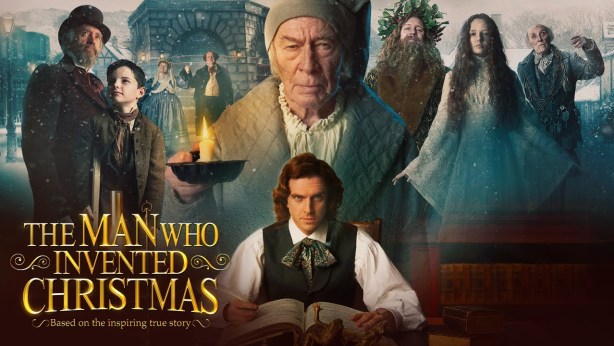
MOVIE REVIEW: The Man Who Invented Christmas

Did Charles Dickens really pluck names for his characters from people he met?


I’m a big fan of Charles Dickens’ A Christmas Carol – I’ve seen countless iterations – so it was inevitable that the family would go to the Spectrum Theatre on a Sunday afternoon to see The Man Who Invented Christmas.

The noted author (Dan Stevens) had experienced some great success with Oliver Twist. But he was reeling from three flops and a more expensive lifestyle than he could suddenly afford. Nicking an idea from Tara (Anna Murphy), one of the house staff, he decides to create a Christmas story.

But how does one write the tale, find an illustrator and self-publish it in about eight weeks? Especially with interruptions such as an unexpected visit from his estranged father (Jonathan Pryce) and mother?

Worse, the characters, notably Ebenezer Scrooge (Christopher Plummer) but eventually the others as well, fail to go in the direction the writer wants them to go, the ingrates!

Will Dickens deal with his own issues, which are testing the patience of even his most fervent supporters, his wife ( Morfydd Clark) and best friend (Ian McNeice)?

We enjoyedthe movie, unconcerned how true to the facts it might have been. So did most of the critics; 80% positive on Rotten Tomatoes. One negative review, though, seemed to miss the essence of the story, which I would tell you about, but dare not, lest it serve as spoiler.

Did Dickens really pluck names for his characters from people he met, a construct that one critic found too convenient? I have no idea. But I do recall that Ken Levine, who used to write for MASH, would come up with names for characters based on people he knew and even the players on the Los Angeles Dodgers baseball team.

If you’re a Dickens fan, or a writer of fiction, I believe you will enjoy The Man Who Invented Christmas.

Ramblin' with Roger
Social media & sharing icons powered by UltimatelySocial