
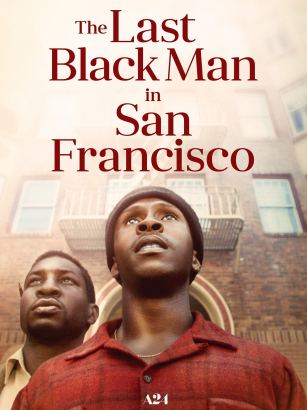
 When I was in Indiana, the youth director of my church had recommended the movie The Last Black Man in San Francisco to the teens in our charge. As it turned out, my wife and I had seen it at the Spectrum Theatre in Albany a couple of weeks earlier.
I hadn’t written about it, partly for time, but mostly because I was stuck in describing it adequately. The IMDB posting says, “A young man searches for home in the changing city that seems to have left him behind.”
Rotten Tomatoes (93% positive with critics, 84% positive with audiences) is more descriptive: “Jimmie Fails [Jimmie Fails] dreams of reclaiming the Victorian home his grandfather built in the heart of San Francisco. Joined on his quest by his best friend Mont [Jonathan Majors] Jimmie searches for belonging in a rapidly changing city that seems to have left them behind.”
Looking at the reviews, I’d agree that it is fresh, original, poetic, an aching portrayal, well-acted, “leaning into its ambiguity, humanity and a quizzical moodiness.” More than one critic notes the “complicated love/hate relationship with the place he calls home that makes [director Joe] Talbot’s love letter to the city so riveting and rewarding.”
So you get the sense of loss, a metaphor for the current housing shortage in the city by the bay. It’s perhaps confusing at first, these skateboarding buddies, one who wants to do upkeep on property not presently his.
Eventually, the story by Fails, Talbot and Rob Richert makes sense to me. There are some great performances by Danny Glover as Montgomery’s blind grandfather, plus Tichina Arnold, Rob Morgan, Mike Epps, and Finn Wittrock.
My friend David Brickman says it’s the best movie of the year so far, and he may be correct.
You probably won’t find The Last Black Man in San Francisco in theaters at this point. If you watch it on pay cable or on DVD/BluRay, you might well find it challenging but, I hope, rewarding.
 I’ve been to Georgia twice. The first time was to Atlanta in 1995. The city was/is a sprawling entity. On one particular 10-line highway, we repeatedly saw cars exiting to the right, crossing three or four lanes quickly, usually directly in front of us.
 The Library Book by Susan Orlean is initially about a fire at the main branch of the Los Angeles Public Library in April 1986 that incinerated over four hundred thousand books.
 The Woodstock