Handle with Care


In the local newspaper a couple weeks ago , the health columnist Lynda Shrager wrote Making whoopee restores body and mind — honest. “Sex twice or more per week reduced the risk of fatal heart attack by half for men. Also, men who ejaculate frequently can decrease their risk of developing prostate cancer by, as the American Medical Association says, ‘clearing out the pipes.'”

“Clearing out the pipes”?

Then I found this article, which reads: “In 2003, research on middle-aged Australian men found that those who averaged at least four ejaculations a week had a one-third lower chance of developing prostate cancer than those who had fewer. ‘When you drain the pipes, as it were, you have less clogging,’ says Irwin Goldstein, MD, head of sexual medicine at Alvarado Hospital.”

Well, OK, then. As some of you know, my father died of prostate nine and a half years ago. While the general media touts those who have survived prostate cancer, I am reminded of those who did not. Here’s a mixed list.

Unfortunately, thinking about pipes, a popular Irish tune came to mind. I can just imagine men wooing their significant others with the tune to “Danny Boy”: “My darling dear, the pipes, the pipes are calling.” You can substitute “My darling dear” with any four syllables of affection (darling, dear, dearest, lover), including the beloved’s name. Or not. (The mind will go where the mind will go.)

Ms. Shrager talks about additional benefits of sex for men and women.
***
Oh, the pictures. I was looking for a visual for the F is for February post. So I went to the LIFE magazine archive, typed in the word February, and the picture above was captured. It’s for Thayers Patent Medicine, and the picture was taken in February 1949 by George Silk. The bottom picture I found typing in the word Thayers in the LIFE photo archive.

Interestingly, the product, a slippery elm throat lozenge is still being produced, “Trusted by tenors, teachers, tour guides and other types who trill, talk and testify.” Here’s a positive review.


ROG

Underground Railroad Conference


The 9th Annual UGR History Conference: Gender, Class, Race and Ethnicity in Abolitionism, on the Underground Railroad, and in the Struggle Since will take place February 26, 27, 28, 2010
Organized by Underground Railroad History Project of the Capital Region, Inc.
Hosted by Russell Sage College, Troy, New York
In Collaboration with Rensselaer County Historical Society

February 26
“The Not So Underground Underground Railroad” Teacher Workshop
Rhonda Y. Williams, Ph.D. – evening guest speaker
“Railroads, Streets and Bridges – Black Women and Freedom Journeys”

February 27
Rosemary Sadlier–Mary Ann Shadd: Publisher, Editor, Teacher, Lawyer, Suffragette

Workshops, cultural performance, vendors, poster displays
Join with scholars, artists, historians, preservationists, educators, students, community members and others to explore how the forces of gender, class, race and ethnicity have influenced the UGR and movements for freedom that have arisen in its wake.

February 28
2-hour tour of Troy’s UGR and African American heritage sites

A complete listing of pre-conference activities, workshops, speakers,
accommodations, sponsors and directions is available

REGISTER at www.ugrworkshop.com or 518-432-4432

Previous conferences:
2009 The Underground Railroad, Its Legacies, and Our Communities
2008 The Underground Railroad – How It Worked: Two Centuries of Escape,
Resistance, and the UGR Across the Continent”.
2007 Underground Railroad: Uncovering the Voices of Women
2006 The Underground Railroad: Connecting Pathways to Liberty
2005 The Underground Railroad: Discoveries and Emerging stories
2004 The Underground Railroad: Quests for Freedom
2003 The Underground Railroad: Movement And Context
2002 Telling the Untold Story: The Underground Railroad In Albany and the
Surrounding Region

I mention this every year for only three reasons:

1. I’ve gone to these events in the past and they are always very worthwhile attending.
2. The subject matter, I believe, is important.
3. Mary Liz and Paul Stewart, the organizers of the event, and indeed the co-founders of the Underground Railroad History Project of the Capital Region, are good friends of mine.

I have a fourth reason this year: I’m doing one of the workshops on Saturday afternoon. So sign up already!

(n.b. – I took off from work Monday to finish off this presentation. Instead, I stayed home with a sick child; not nearly so productive. This to say that if the blog posts are a little terse for the next few days, that’s why.)
***
African American Newspapers: Catalysts for Social Change
Thursday,February 25th, 12:15 – 1:15 PM
Location: Librarians Room, 7th floor, Cultural Education Center, Madison Avenue, Albany (New York State Library)
Register Online

African American newspapers provided vital information to the African American community by reporting stories from a perspective often ignored by their counterparts. During the Great Migration era, many subscribers in the south depended on news reports from northern publications for an accurate picture of northern life and opportunities for African Americans. In this presentation, Cordell Reaves, Historic Preservation Program Analyst at the NYS Office of Parks, Recreation and Historic Preservation, will explore the impact of some of these publications and how they shaped African American life primarily during the early to mid-1900s. Bring your lunch.
ROG

F is for February

Amethyst, the February birthstone

Generally, when I do one of these ABC Wednesday things, I want to convey info that either I don’t think the reader knows, information *I* don’t know (or have forgotten), or possibly both. So what about February conveys that? certainly not Valentine’s Day. Black History Month is too broad. So after even more filtering, I came up with these questions.

What, or who, is February named for? I know that September-December are designated by the 7th through 10th prefixes. July and August are named for the Caesars Julius and Augustus. January, March, May and June come from various Roman and Greek gods, Janus, Mars, Maia, and Juno, respectively. April has something to do with the word open, possibly the same root as Oster/Easter, and/or for a variation on the goddess Aphrodite.

But what of February? The Wikipedia notes: February was named after the Latin term februum, which means purification, via the purification ritual Februa held on February 15 in the old Roman calendar.

OK. So why is it poor February that gets to be 28 days some years and 29 on others? This is something I used to know: February used to be the last month, and so would be the month that would be lengthened or shortened to make the calendar work out. “January and February were the last two months to be added to the Roman calendar, since the Romans originally considered winter a monthless period.”

Did you know that the year 1900 was not a leap year and that 2100, 2200 and 2300 will NOT be leap years?
“In the Gregorian calendar, the calendar used by most modern countries, the following three criteria determine which years will be leap years:
1. Every year that is evenly divisible by four is a leap year;
2. of those years, if it can be evenly divided by 100, it is NOT a leap year, unless
3. the year is evenly divisible by 400. Then it is a leap year.”
So, all of you who will be around in the year 2100, remember that. Expect many misprinted calendars and confused computers.

Why the heck is February so often mispronounced Febuary? The answer: “Although the variant pronunciation (fĕb’yū-ĕr’ē) is often censured because it doesn’t reflect the spelling of the word, it is quite common in educated speech and is generally considered acceptable. [It IS?] The loss of the first r in this pronunciation can be accounted for by the phonological process known as dissimilation, by which similar sounds in a word tend to become less similar. In the case of February, the loss of the first r is also owing to the influence of January, which has only one r.” Other examples given: “beserk” for berserk, “supprise” for surprise, “paticular” for particular, and “govenor” for governor. But they left out the most important examples: “libary” for library, and “libarian” for librarian.

A pop song about when “the music died”, of course, is American Pie, which has this lovely couplet:
“But February made me shiver With every paper I’d deliver.”

Here’s the poem February by Margaret Atwood, which ends: “Get rid of death. Celebrate increase. Make it be spring.” Amen to THAT!

ROG

February Ramblin’

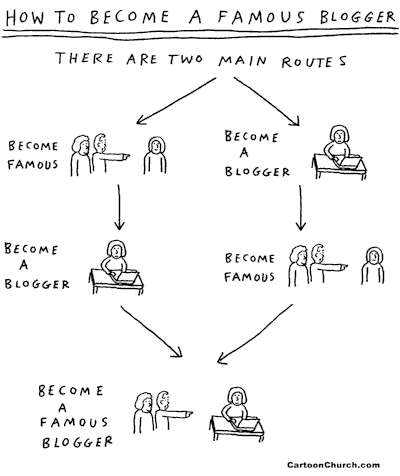
cartoon from www.weblogcartoons.com

Cartoon by Dave Walker. Find more cartoons you can freely re-use on your blog at We Blog Cartoons.

Roger Ebert’s Last Words, con’t, commenting on the Esquire article (linked) and photo of him. “Resentment is allowing someone to live rent-free in a room in your head.”

How the Somaly Mam Foundation is trying to help end human trafficking

Wayne John tells about the time when a Burger King employee threw a double cheeseburger at him. Lousy aim, too.

Gordon reveals Dymowski and DeNiro – together.

Lady Gaga or Johnny Weir? “Can you tell the difference between the pop princess’ outrageous outfits and the Olympic skating star’s flamboyant costumes without seeing their poker faces?” You Olympics watchers who see figure skating only once every four years have no idea…

Springsteen covers.

And SamuraiFrog has three recent pieces worthy of mention, about Kermit the Frog and friend,Christina Hendricks – no, I’ve never seen Mad Men, either – and a particular Super Bowl ad which also annoyed me. (Should note that, on the latter two pieces, his language is coarser than mine.)

This next section is graphic.

Western New York Legacy web site, www.wnylegacy.org, is freely available online, and contains thousands of digital images, documents, letters, maps, books, slides, and other items reflecting the rich cultural heritage of Western New York

Print & Photographs (P&P) online catalog: Some photos copyright free (and some not).

Rose DesRochers – World Outside my Window: Free Cartoons for Your Blog, two examples of which appear in this very post.


Courtesy of Past Expiry Cartoon


ROG

Movie music QUESTION

It’s no secret that my favorite movie music is from West Side Story. I’m also quite fond of Fiddler on the Roof. But it occurred to me: these are Broadway musicals adapted for the screen. What do I like the best that’s MOVIE music?

Difficult question. But, excluding the Beatles – I’ve recently seen again A Hard Day’s Night and Help! – here are some examples:

This is the famous Germans bomb Pearl Harbor speech by John Belushi from Animal House. But try to listen to it without the dramatic music of Elmer Bernstein, and I think it falls flat. In fact, throughout the film, Bernstein, who’s probably best known for the score for The Magnificent Seven (a/k/a the Marlboro theme), has all sorts of flourishes in this movie, giving the dopiest action a counterpoint.

Quality of Mercy by Michelle Shocked from Dead Man Walking. I THINK this was written for the film (though this performance is not), as opposed to what the compilers of the music of, say, Easy Rider, called “found music”, existing songs put on a soundtrack.

Forrest Gump, BTW, is the worst example of that trend; it’s not that the songs are bad, only that they’re obvious. California Dreamin’ by the Mamas & the Papas, Mrs. Robinson by Simon & Garfunkel, For What It’s worth by Buffalo Springfield, and Get Together by the Youngbloods? I mean, I already own all of those songs; not everyone does, but some Time-Life collection might have been a better venue.

Ridin’ the Rails by k.d. lang and Take 6 from Dick Tracy, a movie I never saw. I’m a sucker for trains, and songs about trains.

The Funeral from Cry Freedom. This is a bit of a cheat. The bulk of the song is the anthem Nkosi Sikeleli Africa (God Bless Africa). But it is the most stirring version I know, taking place after South African activist Stephen Biko’s death. (It starts at 2:25 on the video.)

But the movie music I have the greatest, perhaps irrational attachment for, is from the film The Night They Raided Minsky’s, which I saw with my friend Carol and her friend Judy when I was 15 in 1968. I had a mad crush, unstated, for Judy. The film was rated M, a precursor for PG. Because I have the soundtrack, I can admit that though I haven’t seen the film in 40 years, I know this song, and others in the movie, by heart:
TAKE TEN TERRIFIC GIRLS (But Only Nine Costumes)
I have a secret recipe
Concocted with much skill
And once you’ve tried my special dish
You’ll never get your fill

Take ten terrific girls
But only nine costumes
And you’re cooking up something grand

Mix in some amber lights
And elegant scenery
Then stir in a fine jazz band

Then add some funny men
And pepper with laughter
It’s tart and tasty I know

Then serve it piping hot
And what have you got?
A burlesque show!
Music: Charles Strouse Lyrics: Lee Adams

What movie music moves YOU?

ROG

Social media & sharing icons powered by UltimatelySocial