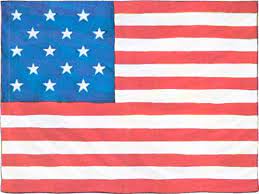
Knowing the Star-Spangled Banner lyrics

Oliver Wendell Holmes

I have heard this story multiple times over many years. But I’ve never been able to verify it to my satisfaction. I’ve been told that knowing the Star-Spangled Banner lyrics beyond the first verse could get one killed.

This is, specifically, a World War II tale. When a presumed fellow American soldier came through the terrain, the guards wanted to know if they were truly Yanks as claimed. If they knew the latter verses of the national anthem, they would be summarily shot. The theory was that NO one knows those except a spy feigning to be from the USA.

Good thing I wasn’t there because I would be dead. In fact, in our elementary school, Daniel S. Dickinson, our music teacher had us singing a panoply of patriotic songs, such as Columbia, The Gem Of The Ocean. Plus the standard fare: America, America The Beautiful, Yankee Doodle, and The Battle Hymn Of The Republic.

So I know the second and fourth verses. Yeah, that last one IS rather Manifest Destiny. “Then conquer we must, when our cause it is just, And this be our motto – ‘In God is our trust.'”

The hireling and slave?

But to the best of my recollection, our songbook did not include that third verse, so I didn’t know it, though I was aware of its existence:

And where is that band who so vauntingly swore,
That the havoc of war and the battle’s confusion
A home and a Country should leave us no more?
Their blood has wash’d out their foul footstep’s pollution.
No refuge could save the hireling and slave
From the terror of flight or the gloom of the grave,
And the star-spangled banner in triumph doth wave
O’er the land of the free and the home of the brave.

What the heck does THAT all mean? A conversation in the Washington Post may enlighten.

Scorn

“These lyrics are a clear reference to the Colonial Marines, according to Jefferson Morley, author of ‘Snow-Storm in August: Washington City, Francis Scott Key, and the Forgotten Race Riot of 1835.’ They are clearly meant to scorn and threaten the African Americans who took the British up on their offer, he wrote in a recent essay for The Washington Post. Key surely knew about the Colonial Marines, and it’s even possible he saw them among the contingent of British ships that sailed into Baltimore Harbor.

“But Mark Clague, a musicologist at the University of Michigan and an expert on the anthem, disagrees. In 2016, he told the New York Times: ‘The reference to slaves is about the use, and in some sense the manipulation, of Black Americans to fight for the British, with the promise of freedom.’ He also noted that Black people fought on the American side of the war as well.

“Whether manipulation or not, the British kept their word to Colonial Marines after the war, refusing the United States’ demand that they be returned and providing them land in Trinidad and Tobago to resettle with their families. Their descendants, called ‘Merikins,’ still live there today.”

FSK

As for the writer of the poem, “And even if these lyrics aren’t meant to be explicitly racist, Key clearly was. He descended from a wealthy plantation family and enslaved people. He spoke of Black people as ‘a distinct and inferior race’ and supported emancipating the enslaved only if they were immediately shipped to Africa, according to Morley.”

Oh, it gets worse. “During the Andrew Jackson administration, Key served as the district attorney for Washington, D.C., where he spent much of his time shoring up enslavers’ power. He strictly enforced slave laws and prosecuted abolitionists who passed out pamphlets mocking his jurisdiction as the ‘land of the free, home of the oppressed.’

“He also influenced Jackson to appoint his brother-in-law chief justice of the United States. You may have heard of him; Roger B. Taney is infamous for writing the Dred Scott decision [1857] that decreed Black people “had no rights which the White man was bound to respect.'”

Confederate victory

It’s interesting that Key’s “overt racism” prevented the famous song from becoming the national anthem during Key’s lifetime. There was no official anthem. People sang various other songs such as the ones I referenced earlier.

“Key’s anthem gained popularity over time, particularly among post-Reconstruction White Southerners and the military…
After the misery of World War I, the lyrics were again controversial for their violence. But groups like the United Daughters of the Confederacy fought back, pushing for the song to be made the official national anthem. In 1931, President Herbert Hoover made it so.

“‘The elevation of the banner from popular song to official national anthem was a neo-Confederate political victory, and it was celebrated as such,’ Morley wrote. ‘When supporters threw a victory parade in Baltimore in June 1931, the march was led by a color guard hoisting the Confederate flag.'”

Civil War reply

A little-known, unofficial fifth verse was written a half-century later by poet Oliver Wendell Holmes, clearly a response to the American Civil War. It was new to me.

When our land is illum’d with Liberty’s smile,
If a foe from within strike a blow at her glory,
Down, down, with the traitor that dares to defile
The flag of her stars and the page of her story!
By the millions unchain’d who our birthright have gained
We will keep her bright blazon forever unstained!
And the Star-Spangled Banner in triumph shall wave
While the land of the free is the home of the brave.
More a Quordle guy than a Wordle guy

duotrigordle?

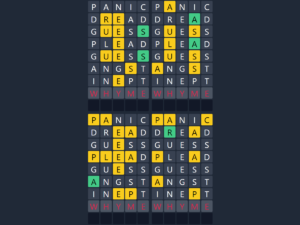
quordleLike many people, I started playing Wordle a few months ago, and I still do. Still, I’m more a Quordle guy.
In Wordle, you must guess a 5-letter word in six tries or less. Every word you enter must be in the word list. A correct guess turns that letter green. A letter in the word but in the wrong place turns yellow. An incorrect letter turns gray. Letters can be used more than once. Answers are never plurals.

The game was purchased by the New York Times a few months ago. But what I’ve discovered is that there are LOTS of imitations.  Wordle Game and  Wordle-Play and Wordleplay and Wordle.NYC and Wordle Unlimited, just to name a few. Some games have more than five letters.

There seems to be a cottage industry swirling around Wordle, with hundreds of videos and websites suggesting the best first word. ADIEU is popular because it hits four vowels.

I don’t worry about getting the word early; just trying not to miss it. Of my first 100 words, I’ve got 99. None did I get one or two turns, 15 in three turns, 19 in four turns, 24 in five turns, and 41 in six turns. I have a 57-game streak.

I think I’m an impatient player. Unlike my wife, who can start and stop over a period of hours, I like to get it completed quickly.

What I DO enjoy about Wordle is the dialogue I have with my friend David. He’ll write: “Today’s reminder to check the scale.” I’ll reply RIGHT, which was a subtle clue. All the letters in RIGHT were in the day’s word GIRTH. Or when I find the word and tell him he’s full of it; the word is PIETY and he’s studying to join the ministry.

The more (words), the merrier

There is also Dordle and its variants, such as Dordlegame, where you must find two words in seven guesses.

My favorite is Quordle, with a variant Quordle Game. This requires getting four words in nine tries. Unlike Wordle, the primary goal of most of these games is not primarily to finish in the fewest turns but to complete it at all.

To that end, I pick the same four words, which knock off 20 letters, leaving JKQVXZ. So I like to know what’s NOT there.

I use the same words for Octordle or a variant, eight words in 13 attempts. I’ve never tried sedordle (16 words in 21 attempts), and tried duotrigordle (32 words in 37 tries) but once because I can’t see all of the words at once.

My favorite recent play left me with the letters IEP showing in slots 3 to 5, but none of them were correct. I used the word PIECE, which I knew to be wrong because the C had been eliminated. Still, this gave me a PI correct in the first two slots and E correct in the fifth. I got the word, PIXIE.

Unconscious Mutterings (Sunday Stealing)

no matter what

Unconscious mutteringsThe Sunday Stealing for this week is Unconscious Mutterings. “There are no right or wrong answers. Don’t limit yourself to one-word responses; just say everything that pops into your head.

“I say … and you think …?”

Hurry!: Reflectively, it irritates me because it’s usually from someone who either 1) procrastinates until it’s almost too late or 2) tries to pack too much in.
Dumb: Usually uttered by someone arrogant.
Fudge: A perfectly good alternative for a specific vulgarity.
Sturdy: One of those Soviet women from those 1984 Apple ads.
Printing: Gutenberg. A good thing, all in all.

Itch: A craving.
Creaks: Our stairs and my knees.
Paste: That gooey stuff from grade school.
Waste of time: Some usually harmless, occasionally inspirational tasks that person B is doing that annoying person A can’t imagine doing. Also, a reference to a Marshall Crenshaw song.
Let down: Heartbreak.

Cancellation: Something one does with postage stamps.
Suspect: Still innocent until proven guilty.
Fireplace: I wish ours worked.
Spring: Stravinsky.
Commute: Something I don’t have to do.

Places: “There are places I’ll remember
All my life though some have changed
Some forever, not for better
Some have gone, and some remain”

1984

Fraud: Doublespeak. “To know and not to know, to be conscious of complete truthfulness while telling carefully constructed lies, to hold simultaneously two opinions which cancelled out, knowing them to be contradictory and believing in both of them, to use logic against logic, to repudiate morality while laying claim to it, to believe that democracy was impossible and that the Party was the guardian of democracy, to forget whatever it was necessary to forget, then to draw it back into memory again at the moment when it was needed, and then promptly to forget it again, and above all, to apply the same process to the process itself—that was the ultimate subtlety: consciously to induce unconsciousness, and then, once again, to become unconscious of the act of hypnosis you had just performed.”

Adoption: When it comes to new technology, I’m a late adopter.
Election: Something I participate in every time, no matter what, and despite the travails.
Moving day: I have written about it a few times. Helping others isn’t bad; I’ve done it about 70 times. For myself, moving sucks!

The tiny bunny

What was the meaning?

tiny bunnyOn Tuesday, there was a tiny bunny in my front yard. It was so small that when my wife and daughter left for school, they didn’t see it. It was roughly the coloring of the picture shown.
I went out to investigate. It appeared to be dead. I got my snow shovel to remove it, only to discover that the creature’s nose twitched. Ah, so it’s alive, but it’s not moving. A healthy rabbit would have quickly scampered away. I imagine that it wasn’t attacked by an animal. Most likely, it was hit by a car and either flew or hobbled over to our grass.

I let it be for a few hours, then checked out the creature again. It was still lying on its side, with a couple of flies hanging around it. Dead for sure, right? I manipulated the shovel and could stabilize the bunny enough so that it could, more or less, sit up. It started nibbling on the grass, which, oddly, gave me a bit of joy.

I never had a rodent as a pet. No hamsters or white mice. We had cats and one dog. Some short-lived goldfish, I think. So I became surprisingly fascinated by this visitor. Why did it appear on MY lawn?

The next day, it appeared to be still hanging on as I went to donate blood at Albany High School, time #176; thank you very much.

I checked on the bunny after lunch, but it had died. So I carried it to the backyard, where I buried it. It was my “pet” for about a day, and yet I felt sad about its passing. Though I knew its injuries were so severe that it wouldn’t last for long.

Judy Garland would have been 100

“Forget your troubles, c’mon get happy”

Since Judy Garland was about to turn 100, I decided to see The Wizard Of Oz at Albany’s Spectrum Theatre in early April, and my wife accompanied me. We had never seen the film in a cinema before. There were only the two Tuesday showings, at 4 and 7 pm, so I figured it would be packed; there were less than ten of us there at the latter.

My wife said more than once afterward, “She could really act,” and I concurred. Her performance was vivid on the big screen. Of course, I had seen the movie on CBS-TV annually for several years in the 1960s, though only the last two times on a color TV. I had missed the “horse of a different color” joke.

My, those ruby slippers really sparkled when she ran. I did not know that one of the iconic dresses was missing until 2021. Nor was I aware that there was a black and white dress for the Kansas scenes and a blue and white dress for Oz. Movie magic. 

It was strange, though. In the same timeframe that I’m watching the teenage Judy, I’d also see her on her eponymous show (1963-1964) or guesting on Ed Sullivan or another program. Also, I’m sure I watched the television special Judy and Liza at the Palladium (1964). Liza, of course, was her daughter Liza Minelli, about 18 at the time. (Liza’s 1972 movie Cabaret was shown at the Spectrum the week after The Wizard of Oz.)

Only two score and seven

I never paid much attention to the tabloids at the time, so I was very surprised when Judy Garland died in 1969 at the age of 47. I’ve viewed documentaries about her life since, though I never saw Judy, the 2019 biopic with Renée Zellweger.

One last thought. When I was in the play Boys In The Band in 1975, there was a specific cue for the lead character Michael to be playing the Judy Garland track Get Happy. So that song has had a soft spot in my heart ever since.

Here’s a clip of early films from when Frances Gumm was seven until Judy Garland turned 17.
Waltz With A Swing/ Americana -Every Sunday, 1936
Zing! Went The Strings Of My Heart  -Listen, Darling,  1938

Somewhere Over the Rainbow – The Wizard of Oz,  1939; plus a discussion of the isolated vocal 
Our Love Affair,  with Mickey Rooney
The Trolley Song – Meet Me In St. Louis, 1944
Have Yourself A Merry Little Christmas – Meet Me In St. Louis, 1944

Get Happy – Summer Stock,  1950
Happy Days Are Here Again/Get Happy , with Barbra Streisand, 1963?
The Judy Garland Show with Peggy Lee and Jack Carter (November 1963)
By Myself, 1964

She was accidentally slapped at the 1954 Oscars

Judy Garland would have been 100 today.

Ramblin' with Roger
Social media & sharing icons powered by UltimatelySocial