
How Do You Know What Is True?

without a soupçon of proof

“How do you know what is true?” I find this to be a fascinating question. In mid-autumn 2025, a couple of guys came onto my porch and knocked on my door. Looking through the front window, I assumed that they were from The Church of Jesus Christ of Latter-day Saints.

I could have ignored them, I suppose, but I’m always interested in conversing about issues of faith. Indeed, I’ve talked with Mormons before; I even have a Book of Mormon, which I suppose undercut one of the young men’s talking points. (I’ve TRIED to read it, but it hasn’t grabbed  me.)

One of the guys was from Utah (no surprise) and the other from Arizona. The one who did much less of the talking was the one who asked, “How do you know what is true?”

Part of it is observation. If I let go of a pencil, it falls. Some of it has been drawn from what I’ve read. When I was a kid, I absorbed the entire Encyclopedia Americana, plus its annual updates. And, as often noted, I received the World Almanac almost every year from 1963 to 2018, and devoured a lot of random statistics.

823 years!

This is why I was so quick to debunk that Internet myth that a particular calendar pattern happens only every 823 years. There’s a LOT of stuff online I don’t trust. When someone states something as fact, and I haven’t seen it, I often ask where they saw it. When they say, “On Facebook” or “the Internet,” I’ve been known to press for more information; what site on the Internet, for instance.

There’s someone I’ve known IRL, and a person I know indicated that he died. But I’ve seen nothing like a news article or an obituary, something I could use to verify. I’m loath to share faulty information. When I hear a famous person has died, I wait until I’ve seen the news in two or three historically reliable sources. It’s one of the reasons I’ve subscribed to GroundNews: to see other, diverse sources.

But I’m also willing to recognize that our understanding of information changes.

When my father painted my ceiling to reflect the planets in the Milky Way, there were no moons around Mercury and Venus, one around Earth, two around Mars, 12 around Jupiter, nine around Saturn, five around Uranus, one around Neptune, and none around Pluto. The inner  planets would be the same, but Jupiter has at least 95, Saturn has 274(!), Uranus has 28, and Neptune has 16. Pluto is no longer considered a planet, but the largest of its five moons, Charon, is half Pluto’s diameter.

This doesn’t mean science was”wrong,” but that more information has been gleaned. I get frustrated when the result of additional knowledge is presented as “they were lying to us” without a soupçon of proof.

Uh-uh

As an information specialist – my title for a time – I’m discouraged when misinformation or disinformation is readily disseminated. This is not new – I read about Bob Denver’s “recent” death in 2012 when he passed away in 2005

But the algorithm is far more robust now, and that was before the onslaught of Artificial Intelligence. I find information nearly every day that is reductive at best, summarizing other sources, often poorly. And sometimes it’s just wrong to conflate people with the same or similar names. 

When I was first online in the late 1990s, I took it upon myself  – now it sounds ridiculous – to “correct the Internet.” Now it’s nigh unto impossible, and it frightens me how resilient BS can be.  Neil deGrasse Tyson gives us pointers on what to believe on the Internet and what not to believe.

It’s not a new problem, though. “There is a cult of ignorance in the United States, and there always has been. The strain of anti-intellectualism has been a constant thread winding its way through our political and cultural life, nurtured by the false notion that democracy means that “my ignorance is just as good as your knowledge.” -Isaac Asimov, scientist and writer (2 Jan 1920-1992)


Encyclopedia Americana

married 76 years ago today

Les and TrudyIn musing about how I (eventually) became a librarian, I thought about how my parents bought us the Encyclopedia Americana when I was nine. Or twelve or at some time in between; I don’t quite remember.

I am pretty sure the purchase resulted from a door-to-door salesman visiting our home. While our parents didn’t get into the details of the household economy, my sisters and I knew that we weren’t particularly flush with cash.

My mother was a bookkeeper for McLean’s department store in downtown Binghamton, NY.  She was well-suited to the job, as I also saw in her home budgeting.

My father was probably working nights at IBM in nearby Endicott, driving a forklift, a job he hated because it was not intellectually stimulating. He had done and was still doing other jobs, notably floral arranging, sign painting, and a bit of singing, but they were not lucrative enough to support a family of five.

So the purchase of the Americana was a big deal. I’ve read the set costs somewhere between $200 and $300, depending on the binding. That would be around $2000 in 2026 dollars.

It was pitched as an educational investment for the family. But everyone knew who was most likely to read it was the kid who memorized stats from the backs of his baseball cards.

Aardwolf?

Sure enough, I read the entire set, starting with Aachen, followed by aardvark, aardwolf… I didn’t know what that was, but it isn’t an aardvark or a wolf.  It took me more than a year to finish. But I sped up the process when they purchased an annual update to the standard set, to reflect the changes, usually political.

One of my sisters commented that my father was certainly the one who used the Encyclopedia Americana more than anyone else, besides me. I was told that he wasn’t much of a student as a kid, but his innate curiosity as an adult required him to always be learning. 

Along with the World Almanac, which I received for Christmas every year, my parents boosted my geek cred. 

Les Green and Gertude (Trudy) Williams got married on March 12, 1950, and stayed together until my father died on August 10, 2000; my mom died on February 2, 2011. 

“I would eventually know everything”

Joni Mitchell and Joe Rogan

World Almanac 2016Once upon a time, as I’m sure I’ve told you, I thought that, if I kept learning, I would eventually know everything I wanted to know. I read the local newspaper and watched the local and national news, first Huntley/Brinkley on NBC, then Cronkite on CBS.
Mostly, I read reference books. A lot. The Encyclopedia Americana, which my parents bought and probably couldn’t afford, I devoured over maybe three years. There was also an annual, updating the information.

Also, from about when I was nine, and for more than a half-century, I would receive the World Almanac for Christmas, and I would read it. Early on, it was cover to cover, but even after I’d largely mastered the tallest mountains, longest rivers, and whatnot, I would read the Year In Review material of the most important stories. It was largely November to October, actually, for its publishing deadline, but it would always capture the Presidential and Congressional elections.

Of course, information exploded. Three TV networks became 373. They keep discovering more moons in the solar system, and more elements for the Periodic Table. Of course, the Internet. The World Almanac used to have a list of Celebrities and I knew who most of them were. If there’s such a list now, I have no idea how they would limit it.

Joe and Joni

All of this to say that, until a couple of months ago, I had no idea who Joe Rogan was. My daughter tells me that she has been listening to lots of podcasts to understand different points of view. This is like when I would read William F. Buckley or watch George Will on TV. So SHE knew who Joe Rogan was and, in fact, says she recommended him to me – this is possible. But she says I said, and this sounds accurate, that I didn’t have time for more podcasts.

NOW I know who he is. Recently, my daughter asked me if I knew who Joni Mitchell is. Oh dear, I have failed this child. I told her that I’d seen her twice in person and bought four of her CDs in 2021. Obviously, she brought her up over Neil Young (who she also doesn’t know) wanting to be removed from Spotify because of the info about vaccines on Rogan’s platform, and Joni following suit.

Amy

One of the interesting things I learned about Amy Schneider, 40-time JEOPARDY champion, is that she has a younger partner, which is how she knows more current popular culture references.

I’m fascinated how she missed her last Final. COUNTRIES OF THE WORLD: The only nation in the world whose name in English ends in an H, it’s also one of the 10 most populous. One of my friends deduced, “I thought about what might precede ‘h’ and could only think of ‘s’. From there, my brain ambled over to Asia and found Bangladesh.”

My process was more mundane. I mentally traveled around the globe for the most populous countries, besides the US (#3). Mexico (#10), Brazil (#6), Nigeria (#7), Indonesia (#4), Japan (actually #11 because of a declining population), China (#1), India (#2). Oh, what’s near India? Pakistan (#5). And Bangladesh (#8). (I forgot Russia, #9.)

I have to conclude that Amy did NOT read the World Almanac every year. But she learned a LOT of other info, mostly of recent vintage, that my brain just doesn’t absorb.

A is for Almanac

I’d test myself to see if I could remember which Presidents of the United States had been Secretary of State.

World Almanac 2016From the time I was about ten years old, I would get for Christmas a World Almanac almost every year. And I was happy.

When I was growing up, it was my parents making the purchase. As an adult, it would be a significant other, or else I would gift it to myself.

The almanac contained tons of statistics. Some of them were rather static: the highest mountains, the longest rivers. But other info was ever-changing, such as the largest cities, and the list of countries of the world – with a section of color maps!

There was a section on sports, with the most recent seasons in college basketball and football, the Olympics, and several professional sports.

I’d test myself to see if I could remember which Presidents of the United States had been Secretary of State, or what languages were most popular in the world. I’d check on the birthdays of celebrities or calculate the day of the week of some historic event.

In 1998, I started reading the World Almanac voraciously in anticipation of testing to get on the quiz show JEOPARDY! In truth, I don’t know that it helped glean new information, but it was nice to confirm things I already know.

My favorite editions are in the years following a Presidential election when it breaks down the voting in great detail.

The best feature in the almanac is that it cites the sources of the data it provides, so if I needed more information, I know where to look.

Odd thing, though: I realized in 2014 and 2015, I wasn’t using the almanac as much as I did in the past. And in 2016, I never got a copy at all, for only the third time in over a half-century.

But I will get the 2017 World Almanac, even if I have to buy it myself. After all, 2016 IS a Presidential election year.

ABC Wednesday – Round 19

30-Day Challenge: Day 14-Favorite Purchase Ever Made

This book has all the albums of all the group who had a Top 200 hit according to the Billboard charts, with brief bios of the artists, and a list of all the album cuts.

Favorite purchase EVER made, by me? As opposed to things purchased for me, which would an entirely different matter. Oh, dear, my library geekdom mind is showing; well, at least it has a pop culture bent.

All right, I have to pick something that has given me hours and hours of enjoyment. I first thought of the World Almanac, but I did not purchase my first half dozen almanacs, my parents did, for Christmas.

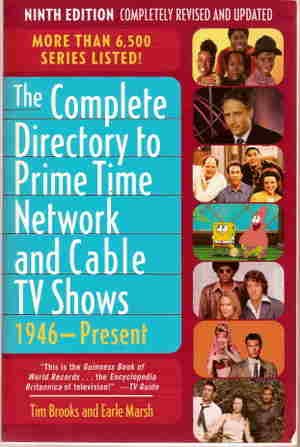
Certainly, a contender was going to be the first time I ever purchased The Complete Directory to Prime Time Network TV Shows by Tim Brooks and Earle Marsh, which allowed me to relive shows I remember, get details on shows I had forgotten, and provide useful, if trivial, information when television facts are at issue. Based on a recent blog post, I discovered that, in the Albany market in 1967, the Monkees were pre-empted by the syndicated Death Valley Days, and that I Dream of Jeannie was bumped by a local quiz show. I love that trivia stuff.

But I suppose, honestly, the correct answer to this question is the first time I got Top Pop Albums, which probably covered 1955 to 1995. I’m guessing because I’ve purchased subsequent additions. This book has all the albums of all the group who had a Top 200 hit according to the Billboard charts, with brief bios of the artists, and a list of all the album cuts, so one could find on which albums that particular song appeared. It allows me, in a visceral way, to re-experience artists I love or learn new things. I refer to it several times a week.

In fact, the newest iteration of this book, which goes up to 2009, has become so large that the album cuts now appear on a separate CD; necessary, given the number of records delineated, but I believe that the previous version, which went up to 2005, will probably be the one that I will find most useful on a day-to-day basis. 

Social media & sharing icons powered by UltimatelySocial