Being a remote business librarian

SYSOP

After I wrote about taking airplane trips, many of which were made possible by my job, I never really explained how being a remote business librarian at the New York Small Business Development Center worked.

The NY SBDC, as is true of the SBDCs around the country, offers free and confidential business advisement, from helping develop business plans to more complex operations.

Our SBDC had a part-time librarian who started in 1991. When the program received a grant to provide reference services, starting October 1, 1992, they had to gear up fast. The grad assistant, who had graduated, became librarian #2. I became librarian #3 on October 19 and the fourth person four days later.


Early on, we, designated as the Research Network, did the research and sent the information by – ready for this? – mail. The first innovation was when our databases went on a LAN or local area network. Previously, when we wanted to use a particular database, which was on compact discs, we had to wait our turn.

Eventually, we thought to try to send information via email. The trouble was, though email had existed for some years, it was slow to be introduced to some college campuses, where most SBDCs resided.

I recall specifically that some of our field advisors had come to our Central office in 1994 or 1995. My officemate sent me an email to me. One advisor said, “But why would one do that?” Noting the ten feet of distance between my office mate and me, “He’s right THERE.”


Early on, one of my responsibilities was to operate an electronic bulletin board or BBS. I was to be the SYSOP or systems operator. A couple of things: I never knew that I was in charge of it before I was hired, and I had no idea how to do it. Kevin, one of the techies in the office, trained me as best he could. Eventually, we abandoned the technology, thank goodness.

Editor

Another job was to edit a newsletter to send to the state programs in the hope that they’d, in turn, distribute it to their local offices. Some of the content was the Research Network either touting our services or offering advice.

The article I remember best was a woman who worked for the SBDC in Oklahoma City. She was severely injured from flying glass and debris following the terrorist explosion at the nearby Murrah Federal Building in April 1995. It was a very touching narrative.

When we learned the NY SBDC lost the library contract to the UT San Antonio SBDC in 1998, we were very sad, of course. We had a Christmas party in September. By that point, we had seven librarians. One took another job, and two were laid off.

Four of us remained to provide reference services for the NY SBDC, with much more significant technological growth. But that’s a story for another day.

Why I don’t eat at Cracker Barrel

Steak ‘N’ Shake

I don’t eat at Cracker Barrel. It’s not a function of its “down home” motif. The first time I remember going to one of the restaurants was during one of the Olin Family reunion weekends in Binghamton about 25 years ago. It’s possible that the number of diners overwhelmed the staff because the service was terrible.

The last time was perhaps a decade ago in East Greenbush, near Albany. (Mark Evanier noted that “the Cracker Barrels in the state of New York are in Binghamton, Cicero, Clifton Park, East Greenbush, Fishkill, Horseheads, Rochester, Watertown, and Williamsville. Again, my life has never taken me to any of these cities, and I have no idea where they are.”)

Anyway, the cooking area was arranged so the server couldn’t even suggest how my daughter, who has tree nut and peanut allergies, could have something from the griddle. We found something she could eat, but we never went back.

It was not the only time I left places that seemed incapable of taking the daughter’s allergies seriously. We ended up walking out of an Applebee’s in southern Pennsylvania. By comparison, Friendly’s restaurants—alas, no longer in Albany County—were great regarding allergens. 

Here’s a sad truth: I felt safer taking her to McDonald’s or Wendy’s than some out-of-the-way diner when she would tell them about her allergies, and they seemed unresponsive to what was being said. 

What’s it called again?

Here’s the weird thing about Cracker Barrel: until this controversy, I could never remember the place’s name. Ask my wife or daughter, and I’d say, “You know, the place with the yellow sign.” 

That said, my wife was grousing about a certain Orange man fussing about this. But I noted that it was Steak ‘n Shake that first complained. Their map suggests they are located from Ohio to Texas to Florida. They claimed “Cracker Barrel’s goal with its switch-up was to ‘delete the personality altogether’ by removing the ‘old-timer’ from the signage.”

I just discovered that the man’s name is Uncle Herschel. Perhaps people were concerned that a fictional character would be unemployed. Whew! We dodged that bullet.

So it’s a “heritage” thing, whatever that means. Except that “Cracker Barrel has always been a simulacrum of rural life, a corporate behemoth masquerading as a mom-and-pop lunch counter,” per David A. Graham in The Atlantic. “No one should confuse a bland interstate chain with a real slice of Americana.” But it wants to show its MAGA bona fides by ditching the webpage “boasting its support for the LGBTQ+ community.”

Kelly is right: the controversy shows we are becoming a stupider nation.

Pain and melancholy

Rita O’Leary, Jean Easton, John Earl Lewis, Rick Lacey

My cousin John Lewis

ITEM: Pain. On Thursday, August 21st, I went to an oral surgeon and had three teeth removed. One of them will be replaced with a device. I am less concerned about the aesthetics than that, over a week later, I’m still experiencing a great deal of discomfort.

I had been taking hydrocodone-acetamin. The maximum daily dose is six tablets, but they only gave me 12, so it took me about a week before I used them all up. Of course, the trick is that there’s no refill because they don’t want me to become addicted. I’m also taking amoxicillin three times a day for an infection.

Even when I wasn’t eating at all, a degree of discomfort would wake me up every two hours for the first four days. I would take hydrocodone right before going to bed, and then about four hours later, I’d get up and take some Advil.

This made me so tired that I was feeling very emotionally fragile. I’d see stories on the news that would make me weepy. It wasn’t just the latest mass shootings and the fruitless discussions that followed. I’d see a Note To Self about former World Champion pool player Jeanette Lee reflecting on her career journey amid a health battle and get all emotional about not just her scoliosis but the racism and sexism she endured. Usually, that story would make me feel inspired and probably a little ticked off, but no. I’m a puddle. And other stories had the same effect.

Family gathering

ITEM: On Saturday, August 23rd, my wife, daughter, and I were supposed to go to my mother-in-law’s place. My wife’s brother and his wife and their two daughters, living about an hour away, except for the one daughter in NYC, would do the same, except they got there earlier for lunch. My family arrived late, around 2 p.m., because my wife had to work in the morning.

It’s tough to get all these people in the same place simultaneously.  We brought the fixings for ice cream sundaes. But less than an hour later, my BIL’s wife got a phone call that her mother was dying, and their family rushed back. Shortly after they arrived, we got word that Rita had died.

I liked Rita O’Leary, who was 87. Until the last couple of years, I would see her a few times a year, including several Mother’s Day dinners at a local restaurant. Her obituary noted: “She leaves behind a legacy of love, acceptance, and kindness that will continue to inspire her family and community.” True enough. Rita is survived by a sister, two daughters, 15 grandchildren, 22 great-grandchildren, and two great-great-grandchildren.

Unexpected connection

ITEM: Jean Easton was a woman I was friends with during the early 1980s. She was described as a “lifelong educator, teaching poetry and writing in universities, schools, prisons, and mental health facilities.” I knew her best from the poetry scene. She was brilliant, passionate, and sometimes intense. “You could recognize her regal, determined gait.” Since I worked at a comic book store then, I sometimes talked about comic books with her daughter, Delia. As one sometimes does, I lost track of them.

It wasn’t until Susan Easton from my church choir died in 2022, and Delia attended the funeral, that I figured out that Sue and Al Easton (d. 2024), whom I met in 2000, were Delia’s grandparents and Jean’s former parents-in-law. Though I hadn’t seen Jean in a very long time, her passing made me sad.

ITEM: My father’s first cousin, Ruth Lewis, is the eldest of his first cousins. In August 2024, I saw her and her daughter, Jean, at a concert where my niece Rebecca Jade sang. Ruth’s son and Jean’s twin brother, John, whom I really didn’t know, died on August 19. The funeral was on Friday, August 29, at Trinity AME Zion in Binghamton, the church I grew up in. My condolences to my Walker family relatives.

ITEM: My friend Carla notified me of Rick Lacey’s passing. I knew and liked him at Binghamton Central High School, where he was in my sister Leslie’s graduating class. 

DOGE, AI And Tariffs

labor force is shrinking

An article in Forbes from mid-August notes that in 2025, Job Cuts Have Already Surpassed All Of 2024—DOGE, AI, And Tariffs Are the Biggest Causes.

According to a career services firm, Challenger, Gray & Christmas, “private and public employers cut 62,000 jobs in July, an almost 30% increase from the previous month and a 140% spike over the same month last year.

“More than 806,000 jobs have been cut to date in 2025, already above the 761,358 eliminated in all of 2024.

“The Challenger report says so-called ‘DOGE impact’ is the leading reason for job cut announcements so far in 2025… ” Check out layoffs. FYI, which notes that nearly a quarter of the jobs are in health and Human Services.

“In addition to the direct cuts to the federal workforce, DOGE cuts to grant funding have also led to 17,826 cuts in the non-profit sector this year, up 413% from this time in 2024, Challenger said. Non-profit organizations have cited mounting challenges from reductions in federal funding, rising operational costs, and persistent economic uncertainty.”

Tech

“Technology is the leading private sector in job cuts, with 89,251 eliminated in 2025 so far. Challenger says the advancement of artificial intelligence and ongoing uncertainty surrounding work visas have contributed to workforce reductions, which are up 36% in the sector over the same time period last year.

“The retail and automotive sectors have seen an increase in layoffs as the result of global tariffs implemented… Retail announced 80,487 job cuts in July, up 249% through this time in 2024, citing tariffs, inflation, and ongoing economic uncertainty. “

This video touches on some of these numbers, including the regional impact variations.

An example from Daily Kos and Common Dreams: John Deere has axed more than 200 employees to cut higher costs caused by tariffs. “As stated on our most recent earnings call, the struggling ag economy continues to impact orders for John Deere equipment,” the company said in a statement obtained by Illinois Public Media. 

But what does it mean?

Callie Cox, the chief market strategist at Ritholtz Wealth Management, worries in Business Insider about an under-the-radar number that raises a huge red flag for America’s job market.

“Wall Street bigwigs, major investors, stock analysts, and economists [all] agree on…  the fundamental importance of the job market….

“This is why many economists and analysts focus on the unemployment rate…  The headline jobless rate is 4.2%, up from record lows set in 2023, but hardly at a catastrophic level…

“Still, there is one number… that represents a serious cause for concern. The official US labor force, which measures the number of working-age Americans actively working or looking for work, is shrinking at a rate normally seen during the depths of economic crises. The pool of available workers has stalled for three straight months, the first such streak since 2011…

“The reasons for this shrinkage point to worrying shifts in America’s job market, and the consequences could be perilous. Over time, a smaller labor force presents pernicious challenges: lower growth, tax revenue, and productivity…

“The immigration crackdown and a rough hiring environment are only part of the story. Other long-term trends could be depressing the number of people willing to jump into the workforce. Labor force participation among women has yet to recover from pre-COVID levels, given steep childcare costs, return-to-office mandates, and the cost of childcare. The participation rate among teenagers 16 to 19 years old has also plummeted over the past few months, likely a product of fewer entry-level opportunities.”

Data
Vincent Geloso, senior fellow at AIER, is an assistant professor of economics at George Mason University, who obtained a PhD in Economic History from the London School of Economics. He shows the bogus suggestion that the BLS produced “low-quality” data or displayed “partisanship.” He adds, “Bureaucracies are usually too self-serving to get partisan. The consequences of bad data are high, and error rates are pretty low – no matter who is president.”
Also: Impact of Immigrants on Labor History
The Role of Undocumented Workers in High-Growth Occupations and Industries Across the United States


Sunday Stealing: F.A.B. Again

Run On For A Long Time

Welcome to Sunday Stealing. Here we will steal all types of questions from every corner of the blogosphere. Our promise to you is that we will work hard to find the most interesting and intelligent questions. Cheers to all of us thieves!

Since it’s Labor Day weekend, we’re going to keep this simple. We stole this from a blogger named Idzie, who called this the F.A.B. (film, audio, book) meme.

F.A.B. Again

F. Film: What movie or TV show are you watching? 

My daughter got me to buy a Roku at the local Best Buy . I must admit that if I allowed myself to be captivated by it, I could wallow in it. I watched the first episodes of Hogan’s Heroes (1965), the only one in black and white; and Northern Exposure (1990), What’s My Line (1950), and Shrinking (2023). I’d seen the former two when they were brand new.

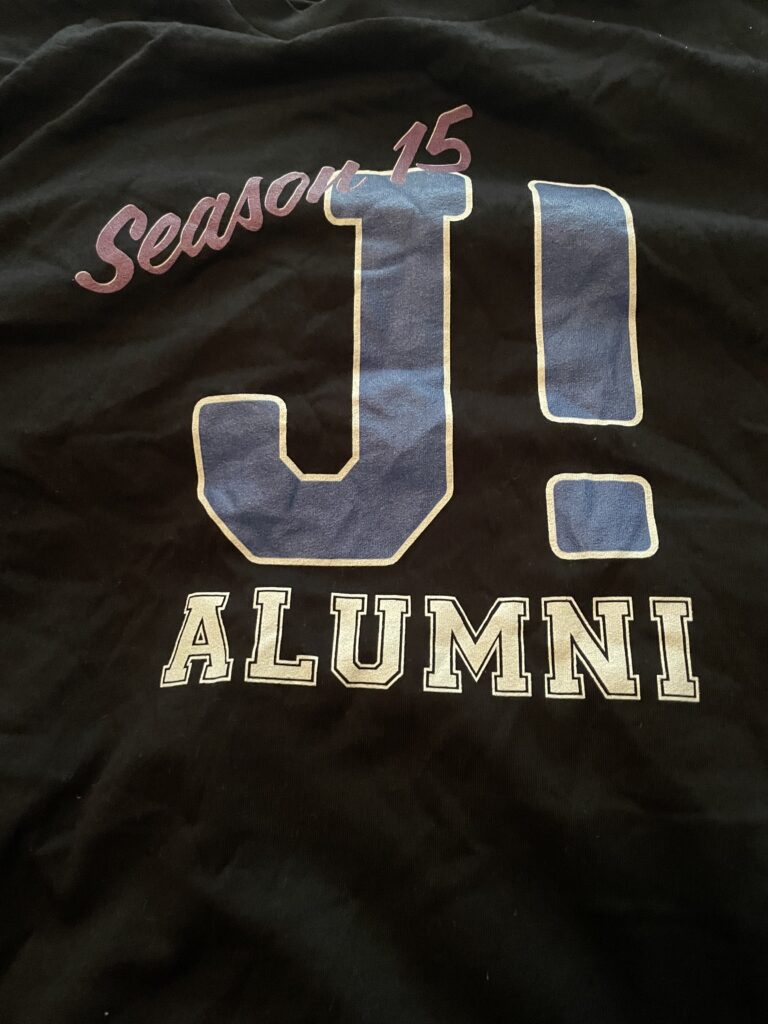
But the thing I’ve watched the most is something called Pop Culture Jeopardy (2024). It starts with 27 games with three three-person teams. I discovered that there’s a whole heck of a lot of 21st century pop culture I don’t know, so I get joy when I get a question right that they muff.

Tunes

A. Audio: What are you listening to?

September is the birthdays of Bruce Springsteen and Ray Charles who I’ve already started listened to a lot.  My father’s birthday was in September and he was a singer of folk songs, so I have been playing a lot of folk/roots/blues music. Among my favorites: Roots ‘n Blues: The Retrospective 1925–1950. Two of my favorite tracks: I’m Going to Take the Train to Charlotte, which reminds me of my last trip to see my mother before she died in 2011, and Run On For A Long Time by Bill Landford And The Landfordaires, which inspired a whole post.

I met the the folk duo Magpie a couple of years ago. I’m listening to one of their CDsS right this minute. They’re very nice people and and talented, too.

B. Book: What are you reading?

I haven’t been reading a book. We have been working on getting the daughter back to college this very weekend. I did buy John Green’s book Everything is Tuberculosis last month, and will probably be the next tome I read. The Open Door bookstore in Schenectady, a retailer I used to frequent when I was residing in the city many, many years ago, is where I purchased it. I love supporting independent bookstores.

Thank you for playing! Please come back next week.

Ramblin' with Roger
Social media & sharing icons powered by UltimatelySocial