Occupy Wall Street

A progressive version of the Tea Party could arrange a boycott against Bank of America for hiking its debit card fees (and after it took bailout money), or bring greater pressure to bear to stop the pipeline, or even run a progressive challenger to President Obama in the Democratic primaries (something I’d like to see, BTW).

I received a Facebook invitation this past weekend to attend a meeting to help organize an Occupy Wall Street organization in the Albany, NY area. Now I’m not going, not because I’m opposed to the values of the OWS group, whatever they are, but because I’m really allergic to meetings. And, based on a bunch I went to in the 1980s and early 1990s, ESPECIALLY meetings of people who are politically left of center, who are really interested in “process” such as “consensus”. I’m really happy if a group can find a consensus, but it’s maddeningly slow.

And what ARE the values of OWS? It’s “standing up for the 99%” of us who are suffering while Wall Street bankers grow richer by the day.” OK, but what does that mean, exactly? Even the OWS people will acknowledge it may mean different things to different people.

I’ve spent a lot of time at protests over the years. Sometimes, it would be a protest at a particular location, trying to change a specific behavior. But most of the time, it’s been symbolic. When I marched in front of a draft board in May of 1972, I didn’t expect that it would end the draft, though it did actually closed that particular building on that particular day.

Generally speaking, it was the repeated actions – sit-ins, demonstrations – that affected a situation to bring about change. The reason I think the OWS movement might starting to have some sort of effect already is the gross overreaction by the authorities to peaceful protest. It makes the police nervous enough to use pepper spray.

The fact is that the protesters want a panoply of different things: getting giant banks to pay their fair share of taxes, end the foreclosure crisis by the renegotiation of mortgages; some are concerned by environmental issues, such as that potentially disastrous, but big money, Tar Sands pipeline. Some, even within the movement, see this as a weakness – “what’s our mission statement?”

I think that, early on, I may have agreed with that assessment, but upon further reflection, it reminds me of that group that used to show up at Congressional town hall meetings yelling at their representatives back in 2009 and ended up getting organized (thanks in no small part to FOX News and Koch brothers money) as the Tea Party, an undeniable force in the current Republican Party. As you will recall, the participants’ agendas were manifold: some wanted fiscal responsibility, while others were more concerned with a variety of “social” issues.

Occupy Wall Street could – I’m just spitballing here – arrange a boycott against Bank of America for hiking its debit card fees (and after it took bailout money), or bring greater pressure to bear to stop the pipeline, or even run a progressive challenger to President Obama in the Democratic primaries (something I’d like to see, BTW, because I think it would focus him better; won’t happen). In any case, I’m glad to see action that belies the myth that the progressive movement is dead in the United States.

I’ve signed up for the Virtual March on Wall Street today (Wednesday), and I have even less clarity about its efficacy than I do about the in-person version. It’ll be interesting to see how it all pans out.

L is for Lyle Lovett

I got to see Lyle perform live once, as the headliner at the 1998 Saratoga Folk Festival.


There are very few times that I remember the first time I really became aware of an artist: the Beatles on Ed Sullivan, Santana in the Woodstock film. Such is the case for a guy with funny hair.

I was watching the Today show, the NBC-TV morning show, in 1989. Back when it was only two hours – it’s now four – in the 8:30 a.m. half hour. Bryant Gumbel, the co-host introduces “country” singer Lyle Lovett, at which point he, his band, and background singers performed the first two songs off his third album Lyle Lovett and His Large Band, an instrumental called The Blues Walk, and Here I Am [LISTEN]. Afterward, a perplexed Gumbel said to Lovett, “THAT was country?”

I think the IMDB post on him got it more accurately: “His albums… incorporate elements of country, Western, folk, swing, jazz, bebop, blues, and gospel music.” Soon, I went out and bought that album, which also included the Tammy Wynette classic, Stand By Your Man [LISTEN to this live version], which was later used at the end of the movie The Crying Game.

Subsequently, I purchased his first two albums, the eponymous album, which features God Will [LISTEN – and turn up the volume], and Pontiac.

Clearly, my favorite song from the Joshua Judges Ruth album, appropriately, is Church [LISTEN]. I Love Everybody, which had his then-wife Julia Roberts singing background vocals, features Record Lady [LISTEN]; Lyle and Julia had met on the set of the movie The Player.

Probably my favorite album, though, is The Road to Ensenada, with Don’t Touch My Hat, That’s Right, You’re Not from Texas [LISTEN to this live version] and an old song recorded, by, among others, the Beach Boys, Long Tall Texan [LISTEN to this version, with Randy Newman, on David Letterman’s program].

He released a number of other albums. During a less-prolific period, due to no doubt to being “caught by a bull and rammed into a fence on his uncle’s farm in Klein, Texas” in 2002, he put out Smile, a compilation of his songs from various movie soundtracks. LISTEN to I’m a Soldier in the Army of the Lord from the Robert Duvall movie, The Apostle. In addition to proving the music, he has acted in a number of films as well.

I got to see Lyle perform live once, as the headliner at the 1998 Saratoga Folk Festival; here is a wonderful review.

Lyle Lovett is an eclectic guy; I LIKE that.

ABC Wednesday – Round 9

Hardly Kosher Bacon

The notion that “private organizations can and will easily pick up any slack created by lower funding for NOAA and the [National Weather Service]” ignores the fact that much of the private research is based on public data.

One of the e-mail items I receive regularly comes from the Citizens Against Government Waste, who are vigilant against roads to nowhere and $16 muffins. CAGW regularly names a Porker of the Month, “a dubious honor given to lawmakers, government officials, and political candidates who have shown a blatant disregard for the interests of taxpayers.”

For September 2011, the designee was Sen. Claire McCaskill (D-MO) “for suggesting that the United States Postal Service (USPS) can solve its financial problems by embarking on a new advertising campaign. During a September 6, 2011, Homeland Security and Governmental Affairs Committee hearing at which Postmaster General Patrick R. Donahoe speculated that USPS could be out of business by the end of the year, Sen. McCaskill stated, ‘I really believe that if somebody would begin to market the value of sending a written letter to someone you love, you might be surprised [by] how you could stabilize first-class mail.’

With USPS facing a $10 billion loss this year and the Government Accountability Office having declared that USPS’s business model ‘is not viable,’ Sen. McCaskill later admitted that her comments were ‘corny, naïve and Pollyannaish.’ CAGW President Tom Schatz commented, ‘Sen. McCaskill’s wistful idea of a PR campaign is indicative of how out of touch Congress is with the condition of USPS’s finances.'”

I’ll admit Senator McCaskill’s observations were silly and unworkable – and so did The Daily Show’s Jon Stewart – but she herself would now admit that. I think, and it is much clearer if you saw her musings rather than just reading them, she was indulging in a little romanticism, nostalgic about an America where people actually did write handwritten letters, not just e-cards.

But I just don’t think her musings were in the same category as some previous Porkers, who were rightly called out, such as this guy and this one. Conversely, I think CAGW is flat-out wrong with regards to this fellow; the notion that “private organizations can and will easily pick up any slack created by lower funding for NOAA and the [National Weather Service]” ignores the fact that much of the private research is based on public data. And with the changeable climate we’re in, I’d hate for us to be subject to the private sector for information about the next batch of bad weather.

Getting Around and Getting Along in Canada

Most of the bicyclists were not wearing helmets, which I think is crazy, but such is the confidence he pedalists have in their drivers.

I don’t want to say that everyone we saw in Canada was nicer than the folks in the United States. A couple of the folks at the first hotel were, let’s say, indifferent. And the very first person we dealt with on the subway was clearly frustrated that we didn’t understand her incomprehensible instructions.

By and large, however, I found it a joy to be in Canada, especially Toronto. Other subway workers in the big city were quite helpful, and even complete strangers initiated contact to assist us when we looked confused.

Once we got the hang of it, we found the Toronto subway to be quite usable. Reasonably clean, mostly on time – except for that delay on the way to the zoo – and the riders were not openly hostile, as I’ve experienced in more than a few major American cities.

The bus trip to the zoo was actually fun, with people generally compliant with the signs to move back. We were near three high school girls from the suburbs who were native Chinese speakers but were studying English words for some major comprehensive test, perhaps the SATs.

Apparently driving out of Toronto in the afternoon is OK until about 3:30 pm, except on Friday afternoons in the summer, which is when we departed at 2 pm and got into a major traffic slowdown east of the city. That’s why, I suppose, the highway has all of those LED road signs imploring people to Try Mass Transit, or Use Mass Transit. And when a merged lane sign shows up, the drivers were generally quite content to let a driver in, taking turns.

In Toronto, I’ve never seen so many people riding bicycles in North America in my life. And unlike in Albany, NY, the drivers weren’t hostile to them. Most of the bicyclists were not wearing helmets, which I think is crazy, but such is the confidence the pedalists have in their drivers.

Oh, and cars yield to pedestrians – what’s THAT all about? I was practically in shock when cars stopped at the intersection and waited for the people to cross the street, even folks who were not at the intersection before the auto was. This would never happen in Albany. The one sign of impatience is when the drivers ARE making their right turns, either with the light or especially right on red, they will usually have one or two drivers turn after the light is red. So don’t step off the curb right away.

I even liked a lot of Canadian television, the little we saw, generally in the morning and evening. There was some morning show that gave a lot more of what I consider REAL news than the US equivalents do after the first half-hour. One segment was about homelessness in Canada, and the host showed real concern. Oh, and my wife got to see a performance by one of her two favorite singers, Diana Krall.

My favorite moment in Toronto: we were at the Ontario Science Centre. We bought a one-use camera for the Daughter, which was reasonably priced, BTW. She proceeded to misplace it. When I finally noticed this, I contacted the nearest employee and asked what I could do. He said, “Wait here,” walked over to the Lost and Found and in a few minutes, brought the camera to me. Usually, in such situations in the past, at best, an employee would direct me to the Lost and Found, where the camera might or might not have been returned. This outcome was, as they say, way cool.

So I was quite surprised in reading a comment to this blogpost by Arthur about the most livable cities. One of his LOCs stated: “I hope Toronto is not in the top ten! I was transferred here 6 months ago and as someone who has traveled all over and lived in South Africa, Australia, DC, LA, etc – I can tell you Toronto is not in the top ten!! Angriest people in North America, expensive, horrible weather. 6 months to go if I can make it.” (It’s #4, BTW.)

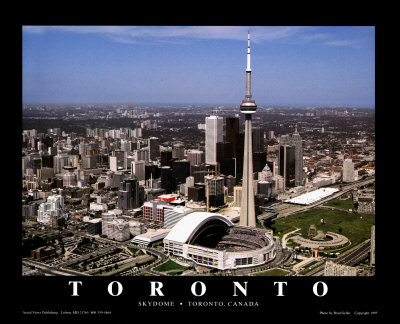
Now I did not live there. It was only four days. But there was a point, walking by the Royal Ontario Museum on our second day there when I said to my wife: “I think I could live here,” assuming that we had employment, etc. Good mass transit, bikes, educational capital, intellectual stimulation, massive multiculturalism; there were plenty of places we DIDN’T get a chance to see. And there are angrier people in lots of US cities I’ve been to, starting with Albany, NY.
***
Heather Morris’ Staples Canada Back To School Commercial. Heather Morris, from the TV show Glee, is not from Canada, BTW.

Roger Answers Your Questions, Tom, LisaF, Arthur, and Scott

In May 1980, when the semester was over, Tom nagged me to work at the store.

Lisa from peripheral perceptions, who has very nice toes, writes:
You may have already been asked and answered this one, but…How and why did you get into blogging?

The HOW question I answered, among other places, here, specifically in the fifth paragraph; curse you, Fred Hembeck! The WHY I’m sure I’ve answered, but, to reiterate, it’s mostly because I was composing things to write in my head, I didn’t have a place to put them, and the subsequent noise in my brain got too loud; I blogged to stay (relatively) sane. Now it’s so I can “meet” people like you.
***
Thomas McKinnon, with whom I worked at the comic book store FantaCo, said:
Hey Roger
Tell us the story of how you met Tom Skulan and started working at FantaCo.
I have never heard the story.

Well, those are two very different things. I’m going to go back to the old days of comic book collecting when you had to get your comics off the spinner racks at the local convenience store. I started collecting comics by early 1972 (Red Wolf #1 was cover-dated May 1972, Luke Cage, Hero for Hire June 1972). My friend and I were at college in New Paltz, NY but we had to go to some little hole-in-the-wall store on 44/55 in Highland, the next town over, to get our four-color fix.

At some point, maybe as early as 1973, a guy named Peter Maresca started a comic book store called the Crystal Cave, buying from a direct market distributor (Seagate? Bud Plant?) It was right across from a bar called Bacchus. It later moved a couple of blocks.

The chronology fails me here, but at some point, Tom Skulan, Mitch Cohn, and Raoul Vezina all worked at the Crystal Cave, so I met them all there. Tom also put bicycles together at Barker’s department store just outside the village limits.

At some point, Peter closed the store and sold the comic inventory, I believe, to Tom. In any case, I would see Tom at these little comic book shows up and down the Hudson River periodically. Then on August 28, 1978, he opened FantaCo at 21 Central Avenue in Albany, with Raoul as the front guy/graphic designer in residence, the same function he served at the Crystal Cave.

I was living in Schenectady by that time, and lost my job at the Schenectady Arts Council in January 1979; the federal funding was cut off. So I couldn’t afford to buy comics for a while. I’d take the hour-long #55 bus from Schenectady to Albany, sometimes do some work in the store, and get store credit in return so that I could feed my addiction.

I did some work on the first FantaCon in 1979. I know I helped schlep stuff into the Egg convention center, and worked the front door and/or the FantaCo table.

In August 1979, I moved to Albany, to attend grad school at UAlbany (or whatever it was called at the time) in public administration. It was a disaster, in no small part because I developed a toe infection two days before registration and literally almost died; I spent nearly a week in the college infirmary and never really caught up. But it was also very cutthroat competitive, unlike my later time at library school, which was very cooperative, and it did not suit my personality at all.

So in May 1980, when the semester was over, Tom nagged me to work at the store. I told him that I didn’t want to work at the store; I needed to go back to college in the fall. But I COULD use a summer job. So I was hired on that basis, primarily doing mail order, and didn’t end up leaving until November 1988.
***
Scott from the on-hiatus Scooter Chronicles – come back, Scott! – wonders: What is your take, if any, on the DC relaunch, with 52 new storylines and rebooted famous characters?

First, I know it’s inevitable that characters will get reimagined from time to time, in part a function of them not aging as the rest of us do. Still, the whole renumbering and reinventing the whole line smacks of both a frustrating disrespect for its own history and commercial desperation. If I hadn’t stopped buying new comics, this ploy might have motivated me to scrap the entire line. In other words, I HATE it.

That said, it appears that a couple of titles featuring female characters are specifically problematic.
***
A fellow political science major in college, Arthur@AmeriNZ, asked about a story. AP Reporter Responds To Chris Hayes Panel Debate On Racism Of Droppin’ G’s From Obama Speech
On Sunday morning’s Up with Chris Hayes, the panel discussed the contrast between the way Politico reported President Obama’s speech before the Congressional Black Caucus and the Associated Press‘ reporting. Unlike Politico, who used the official transcription to pull quotes, the AP’s article reflected the President’s folksier delivery by quotin’ him without the dropped g’s. Karen Hunter called the AP’s treatment racist, John McWhorter disagreed, and Hayes got a laugh by saying, “I can go both ways on this.”

My first instinct was to say that, if that same news organization would drop the G when quoting, say, George W. Bush (which seems to be the case), it’s a non-issue, but would be if Obama were dealt with differently. However, it is NOT because, as McWhorter argued, “Black English is becoming the lingua franca of American youth, and that ‘America, including non-black America, loves that way of speaking.'” Yuck.

Hunter says she teaches “a journalism class, and I tell my students to fix people’s grammar because you don’t want them to sound ignorant. For them to do that, it’s code, and I don’t like it.” That was an interesting point. I’ve seen literal transcripts in the newspaper, often in criminal cases, sometimes with the (sic) or “as stated” designation, and I’ve been of two minds on that, how that might color the public’s perception of the case.

I guess I agree with Hayes when he suggested, “journalistically speaking, the AP’s transcription gave a more accurate impression of the flavor of the speech.” Especially when the President clearly intended to be dropping his Gs for the particular audience to whom he was speaking. Or speakin’.
***
You have more questions? Just ask away!

Art from Sold Out #1 by John Hebert; story by Skulan, Green, and Hebert

Ramblin' with Roger
Social media & sharing icons powered by UltimatelySocial