

Movie review: Marty Supreme

Timothée Chalamet

My wife and I went to see the new movie Marty Supreme at the Spectrum Theatre in Albany in late December. It’s on many Best Picture lists. Rotten Tomatoes, which gives the film a 94% positive rating, says the director/co-writer Josh Safdie had “the uncanny gift of crafting extraordinary stories from life’s most mundane moments.”

This is a movie about “Marty Mauser, a young man with a dream no one respects, who goes to hell and back in pursuit of greatness.” His greatness lies in his skill at ping-pong or table tennis. His “hell and back” is almost entirely of his own making.

It is very loosely based on a guy named Marty Reisman. Reisman acknowledged that some elements in the movie were accurate, including the scenes with the Harlem Globetrotters.

You want to root for the underdog in a sports movie, and ultimately, this is one. Rudy should make it on the Notre Dame team. Ray should have people come to his Field of Dreams. 

Or maybe it’s not. Critic Alan Zilberman wrote: “Safdie’s film is less of a sports drama and more of an anxiety-fueled nightmare, a sustained effort to put the audience into the mental and physical space of a fast-talking operator who only tells the truth when it is convenient.” True enough. 

Unfortunately, I found I didn’t care if Marty “made it” or not because Marty is an ass who uses his friends, his family, women, and total strangers to achieve his goal.  The fact that he hates his job as a shoe salesman, which he’s pretty good at, might have made him more likable. But no. 

Shark Tank!

The character I liked the most is rich guy Milton Rockwell, played by the Shark Tank investor Kevin O’Leary, who serves a demeaning yet oddly justified punishment. There’s a New York Times article, How Kevin O’Leary Made His ‘Marty Supreme’ Character More Cutthroat, which is an interesting read.

Director Josh Safdie likes to use non-actors in his films. He’d watched a TED Talk Pico Iyer  delivered on Ping-Pong as a guide to life and “came away thinking that no one might be better suited to playing a humorless, uptight, domineering British table tennis official in 1952.” 

I will say that the table tennis play was reasonably entertaining. 

But at the end, with the seeming payoff, I didn’t care. I didn’t believe that the final event transformed Marty. Partly, the 2.5 hours were too long. The late, great Roger Ebert  noted that “no good movie is long enough and no bad movie is short enough.”

My blogging buddy J. Eric Smith wrote that he hadn’t seen Marty Supreme and won’t “Oscar voters (and the marketing shills who serve them) fall in love with certain performances/actors/musicians in ways that are absolutely inexplicable to me, often creating eye-rolling results in their awards. Currently/recently, among my film peeves, I’d say that the deeply, smugly, annoying Timothée Chalamet appearing as an Oscar contender/fave multiple years in a row is madness.” Sure, even though he spent an hour a day to get his acne-scarred face.

As someone who liked Chalamet in the Dylan film A Complete Unknown, I nevertheless get Eric’s point. The Rotten Tomatoes audience was only 83% positive about Marty Supreme. If you see it and like it, please let me know why.

Technostress

a dozen faucets

The last couple of months of the year were filled with technostress. As I noted here, I got a new router and modem from Spectrum at the end of October. But by mid-November, the Internet had become unreliable more often than not.  
I followed all the instructions the bot suggested. So they dispatched a repair guy. Early on, he decided that the particular line of modems they gave me was crap. He got a new one from his truck, and lo and behold, everything seemed to be working for about a month.

On Christmas Eve, I noticed the Internet was spotty. I tried all the usual tricks (rebooting my router/modem and my computer), which worked for a New York minute. But the landline was out, too. We couldn’t use the Roku.

And I was even having trouble utilizing my cellphone, even though I set it up NOT to use the house Internet. (The phone worked fine two houses away from our home.)

This process was making me, usually a warm and fuzzy guy, cranky. I couldn’t write much for the blog or pay bills. My wife had time-sensitive info she needed to do for her mother. 

Guy #2

Then a second repair guy arrived on December 27, after the nasty little snowstorm we had, and only 15 minutes late. He had looked over the previous tech’s records and determined that some old hardware downstairs was part of the problem.

He explained it as though it were a garden hose spliced to a dozen faucets. The Internet wasn’t dead, but it was overly worked.   This explained why I could access Gmail but couldn’t open the links within it. He even climbed the utility pole to make sure a squirrel hadn’t compromised the equipment. 

Okay, so it now works! Until the next morning! Arrgh. I rebooted the modem and router for, no exaggeration, at least the eighth time in a month. This time the fix seemed to “take,” knock wood.

Sunday Stealing Remembers the Good Old Days

Domingo Samudio

Welcome to Sunday Stealing. Here we will steal all types of questions from every corner of the blogosphere. Our promise to you is that we will work hard to find the most interesting and intelligent questions. Cheers to all of us thieves!
We’re going into the new year by looking back. Randy at GeneaMusings encourages us to reminisce. So the group remembers the Good Old Days.

When I Was Young

I used to say that I didn’t really like to wallow in nostalgia. But now it’s more of a mental exercise. Can I remember that stuff anymore? 

1. Tell us about a time when your family got a newfangled invention (your first air conditioner, color TV, VCR, microwave, computer, etc.).

Our family got a color TV in either Christmas 1969 or Christmas 1970.

The only times I remember seeing color TV before that were some summer nights c. 1962/63. My sister Leslie had a best friend, Christine, who lived next door to my maternal grandmother.

They, I, and maybe my baby sister would be at Christine’s house watching this piece of furniture. It was usually the Wonderful World of Disney and Bonanza on Sunday nights on NBC. ABC and CBS weren’t broadcasting in color until 1966.

So when we got our color TV, I remember seeing The Wizard of Oz for the first time in color. I had watched it a dozen times before that, but I never saw Oz that way before. I finally got the “horse of a different color” reference; the equine used to be different shades of gray.  

Pharaohs?

2. Is there a particular song that sparks a childhood memory?

If you have read this blog for any length of time, you know that there are HUNDREDS, maybe THOUSANDS of songs I can identify from when I was 4 to 18.  And most of them generate a memory, many of which I have written about. 

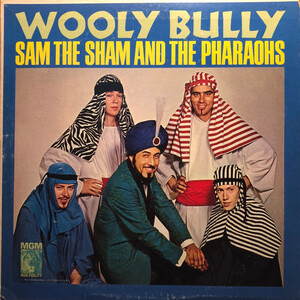
I don’t think I’ve ever written about Wooly Bully by Sam the Sham and the Pharaohs. I liked the song a lot, especially the countdown: “Uno, dos, one, two, tres, quatro.” Here’s an oddity: per Billboard magazine, it was the number one song of 1965.  However, it never reached number one on the weekly Billboard charts, though it did top Record World.

It wasn’t the song as much as the outfits I was struck by as a kid. These guys weren’t Middle Eastern/Egyptian, were they? No. 

Regarding the lead singer, “most sources refer to Domingo Samudio’s ancestry as Mexican-American. However, a 1998 Chicago Tribune article described Samudio as of Basque/Apache descent. In a 2007 conversation with music writer Joe Nick Patoski, Samudio described his grandparents fleeing the Mexican Revolution and settling in Texas, where his family supported themselves working in the cotton fields.”

Learning

3. What is something an older family member taught you to do?

My paternal grandmother taught me canasta, and my paternal grandfather taught me gin rummy. My father’s cousin Ruth described my father at her home, feverishly trying to figure out my name and initials shortly after I was born.

4. Back in the day, what name brands would we have found in your family’s kitchen?

Joy dish detergent, Kellogg’s/Nabisco/General Mills cereals (I LOVED cereal), Fro-Joy ice cream (a truly inferior product), Pyrex bowls,  General Electric (refrigerator, maybe?) Our stove/oven was ancient, and I have no idea what brand it was. Maybe my sisters recall. 

5. As a child, did you collect anything (rocks, shells, stickers, etc.)?

Stamps, baseball cards, LPs. coins. I was really put out when some kid, the child of my parents’ friends, purloined some of my half-dollars.

Thank you for playing! Please come back next week.

.

The Motown sound and the Stax sound

The Beatles at STAX?

My friend Jon wrote: If you need ideas for topics to write about, how about a piece on the difference between the Motown sound and the Stax sound?
I wrote back, glibly,  “The short answer is migration, but I’ll think about that.”

Rob Bowman wrote in Soulville, U.S.A.: The Story of Stax Records, about the differences circa 1963: “At Motown in Detroit, Berry Gordy was more than happy to put each one of his artists through an in-house charm school with the goal being that each artist could fit into middle-class white America’s image of respectable deportment, style, and grace.

Jim Stewart of STAX was not as ruthlessly ambitious as Gordy, nor did he have the vision to build the type of vertically integrated empire that Motown became.” I also think geography does have something to do with it. Stax leaned into its Mississippi Delta roots.

1964

Bowman re: 1964: “While STAX was struggling, Motown was on its ascendancy.” In retrospect, 1964 was remarkable not just for the Beatles’ invasion of America but for the string of hits by the Supremes and many others on the Detroit label. Indeed, in ’64, the Supremes put out an album, A Bit of Liverpool, which I used to own, which features five Lennon-McCartney songs among the 11 tracks.

“The sign outside Motown probably proudly proclaimed the company ‘Hitsville USA.'” I made my pilgrimage to the site in 1998.

“The marquee outside the STAX Studio, on the other hand, was adorned with the words Soulsville USA.” (STAX artists also eventually covered the Beatles, but generally sound like STAX.) The Beatles even considered recording an album at STAX in 1966, but it proved logistically impossible. 

North and South

“These slogans perfectly sum up the diametrically opposed aesthetic and operating philosophy of the two companies. Gordy was a product of the urban industrial North… and autocratic to the bone. He ran his operation very much from a master plan.

“Stewart, on the other hand, was the product of the rural fraternal South. Although he wanted to make money, he could easily be content with what seemed to be a modicum of success, not caring a wit about making further profits…

“In what had to be the greatest irony of the STAX story, Stewart was always loudly championing keeping the company sound as ‘black’ as possible while various black writers and later co-owner Al Bell were interested in crossover success, Stewart seemingly was not the least bit and interesting interested if crossing over meant compromising what he was gradually coming to understand as the Stax sound.”

Sidebar: I must note yet again the importance of Estelle Axton, Jim Stewart’s sister, and the AX in STAX, as a force in developing the sound. The fact that she’s not in the Rock and Roll Hall of Fame – Jim Stewart was inducted in 2002, and Berry Gordy in 1998 – continues to be a travesty.

1966

Bowman, 1966: “Isaac Hayes and David Porter crafted what proved to be the breakthrough record for Sam [Moore] and Dave [Prater] with You Don’t Know Like I Know. Sam and Dave charted, hitting a giddy number seven on the R and B charts while scraping the lower reaches of the pop listening to #90

“Oddly enough, Sam Moore hated the song! ‘Fifty per cent of the songs that were presented to me at STAX I didn’t like,’ exclaimed Sam. ‘I remember saying to myself…it’s hard singing. I wanted to do stuff like Sam [Cooke] and Willie [John] and Jackie [Wilson].

“Hayes and Porter wrote and initially rehearsed the song with Sam and Dave. The melodies would be set in a comfortable lower key, but when it came to recording, they would raise the key.

Porter: “I felt if you were right above where you could be comfortably, then the anxiety and the frustrations and the soul I thought needed to be captured out of those songs would come through.

“I always noticed with the Motown records the singers are so comfortable the melodies are so comfortable one is to have a little different kind of edge and I thought that that gave us that struggling for you to get there would only enhance you to get the soul even though they would be pissed at me pushing them like that they would attempt to do it and they would work I didn’t think you would really doing the record with any kind of soul unless there was some sweat.”

Breaking out

Music critic Joel Francis was asked about the validity of this opinion: “I tend to oversimplify in the following way: Motown is sweet and smooth; Marvin Gaye is Motown’s archetypal vocalist. Stax is raw and gritty; Otis Redding is its archetypal vocalist.” Of course, these things are more complicated. 

Eventually, Motown got “less comfortable.” War, initially recorded by the Temptations, but Gordy thought the song would ruin the group’s cultivated image. So he allowed Edwin Starr, lower on the roster, to record it. It went to #1. Likewise, Marvin Gaye’s music, beginning with the album What’s Going On, made Berry uncomfortable, but it was released and was a hit. Stevie Wonder’s series of albums in the 1970s falls within the same category.

So, I guess, especially in later years, the Motown “formula” was modified when the music required. 

Civics lesson

Voting Rights and the Church

LWVCivics lesson. More than once, I’ve been told that “they” ought to teach more civics. What the heck IS civics? Wikipedia suggests it is  “the study of the civil and political rights and obligations of citizens in a society.”

Maybe it was the way I was raised, but I feel as though I have almost always had a decent grasp of the importance of the concept. My parents consistently voted.  I remember when my maternal grandmother finally registered, or reregistered to vote; it might have been in 1964, for the Presidential election between President Lyndon Johnson (D-TX) and US Senator Barry Goldwater (R-AZ). Regardless, it was the first time I learned that she had been born in 1897, rather than 1898, as she had consistently said for as long as I could remember.

My father’s activism in the Civil Rights movement in the 1960s highlighted the precarious condition of the franchise for black people, how the 15th Amendment to the Constitution (1870), which allowed the right to vote regardless of color, had to be fortified by the 24th Amendment (1964), which prohibited the poll tax, and the Voting Rights Act (1965).

Polly ticks

I also used to read the political columnists in the newspapers, even as a kid. William F. Buckley’s labeling of Robert F. Kennedy as a Massachusetts carpetbagger in the 1964 US Senate race in New York led me to favor the incumbent, Kenneth Keating; RFK won. (interestingly, Buckley’s brother James, running for the very same seat in 1970, was a Connecticut carpetbagger who nevertheless won.

This, in retrospect, is likely how I ended up involved in student government in high school, becoming the president of the General Organization. It definitely made me decide to become a political science major when I went to SUNY New Paltz in the early 1970s.

Lunch and Learn

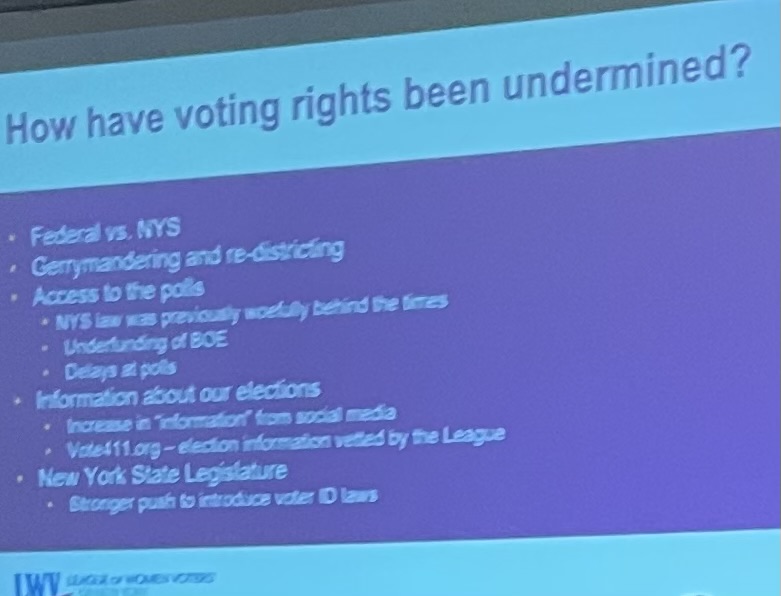
On Sunday, November 16, there was a discussion, Voting Rights and the Church, led by two women from the League of Women Voters, Erika Smitka, the state’s Executive Director, and MaryKate Owens, president of the Albany County group.

It may have been mislabeled because it surely felt like an advanced civics lesson. In April 2025, the LWV declared that our country is in a constitutional crisis. They are hardly the only ones coming to that conclusion this year. 

It is a function, Ms. Smitks noted, due to the specter of loss of due process, the rise of mis-, dis-, and malinformation, attacks on media, and the failure of civics education in the schools.

Executive orders and policies have directly attacked the traditional election process by limiting the registration of new voters at naturalization events, requiring proof of eligibility at the polls, and attacking vote-by-mail, creating fear of participation in the democratic process.

An example: Court Strikes Down Key Part of Unlawful Voting Executive Order, Blocking Show-Your Papers

Voting rights have been undermined by the current push to redistrict between decennial censuses. (Note: I’ve been appaled by what happened in Texas and elsewhere. California’s response to it, Prop 50, is likewise problematic, though, had I lived there, I might have voted for it,which is inconsistent, I know.)

Some of the solutions offered by Ms. Owens included becoming a poll worker or an observer; I worked as an election inspector in 2021. She also recommended working the 2030 Census as an enumerator; I had worked the 1990 and 2020 counts, the latter being far more difficult because COVID had delayed the process.

Links

She recommended some helpful links:

League of Women Voters of New York

League of Women Voters of Albany County

Vote 411  – committed to ensuring voters have the information they need

Albany Law School

Brennan Center for Justice; this is a great site, including an explanation of gerrymandering

ACLU of New York

In 1977, at my alma mater, I was tutoring non-political science students for the intro course, American Politics and Government. I was gobsmacked that, six weeks into the semester, many of my tutees did not know that there were three branches of the federal government. Never mind them trying to identify them.

So I’m thinking that, in some fashion, I should find a way to engage in civics education.

Ramblin' with Roger
Social media & sharing icons powered by UltimatelySocial