Favorites: Steely Dan (1988-1995)

They looked upon the promised land

Steely DanI’m doing Favorite Songs by Favorite Bands thing that J. Eric Smith did. He also picked Steely Dan, albeit at a far earlier period, 1976 to 1978. I liked them well enough then, but there were always other artists I was listening to more often.

But by the late 1980s, that was no longer the case. As I stated when Walter Becker died a few years ago, “I discovered that I owned all nine of their core albums, including that greatest hits album and Donald Fagan’s The Nightfly.”

And as Eric noted in his tribute to Becker, “The wisdom of Steely Dan was so sublime that one could get all of life’s answers from it.”

You’re at a party of people with diverse musical tastes. Yet almost everyone could at least tolerate Steely Dan, whether they were fans of grunge or pop or soul or jazz. There was a certain universality about them, that they were VERY GOOD and quite clever, to boot. As their Rock and Roll Hall of Fame page begins, “Wry. Crafty. Cerebral. Acerbic. The perfectionists of Steely Dan made deviously slick music.”

Tunes

I was loathed to come up with a list three years ago, and that hasn’t changed. But I will anyway.

Haitian Divorce (The Royal Scam) “They wrangle through the night.”
My Old School (Countdown to Ecstasy)
Aja (Aja) “Up on a hill…”
Rikki Don’t Lose That Number (Pretzel Logic) “But if you have a change of heart…”
Hey, Nineteen (Gaucho) – “That’s ‘Retha Franklin!”
Do It Again (Can’t Buy a Thrill, which was more of a band effort than the subsequent Becker/Fagan and session musicians)

Bodhisattva (Countdown)
Peg (Aja) As is true in a number of cuts, LOVE the Michael McDonald vocal.
Black Friday (Katy Lied)
Babylon Sisters (Gaucho)
Deacon Blues (Aja) “They call Alabama the Crimson Tide”
The Royal Scam (Royal Scam) – the first time I heard this song, I immediately played it again

Vaguely related, I was happy to see the Doobie Brothers were selected for the Rock and Roll Hall of Fame this year. That means original Steely Dan guitarist Jeff “Skunk” Baxter and contributing SD vocalist Michael McDonald got in.

Presidential Emergency Action Documents

National Emergencies Act (1976)

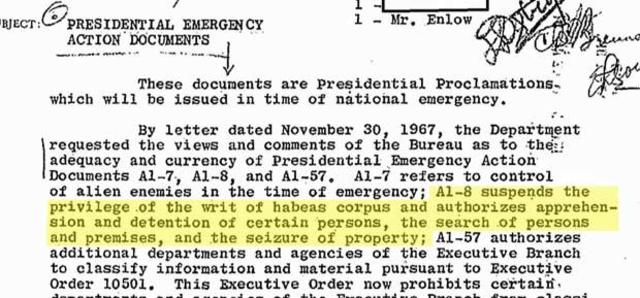
PEAD.wc-sullivan-fbi-memo-on-pads-1967-620I’m an old political science major. Yet I was only vaguely aware of a Presidential Emergency Action Documents (PEADs). The Brennan Center for Justice knows, though. They are “executive orders, proclamations, and messages to Congress that are prepared in anticipation of a range of emergency scenarios.

“PEADs are classified ‘secret,’ and no PEAD has ever been declassified or leaked. Indeed, it appears that they are not even subject to congressional oversight.”

I recommend that you check out CBS Sunday Morning from 16 August 2020, at 3:50. Better, go or here with full text, which runs a little over 10 minutes. “Ted Koppel investigates White House directives, granting vast powers to the president, that are so secret even Congress cannot see them.”

Almost without limit

“Although PEADs themselves remain a well-kept secret, over the years a number of unclassified or de-classified documents have become available that discuss PEADs. Through these documents, we know that there were 56 PEADs in effect as of 2018, up from 48 a couple of decades earlier. PEADs undergo periodic revision, these documents are mostly in PDF format, so software as Soda PDF is required to open them. Although we do not know what PEADs contain today, we know that PEADs in past years—
-authorized detention of “alien enemies” and other “dangerous persons” within the United States;
-suspended the writ of habeas corpus by presidential order;
-provided for various forms of martial law;
-issued a general warrant permitting search and seizure of persons and property;
-established military areas such as those created during World War II;
-suspended production of the Federal Register;
-declared a State of War; and
-authorized censorship of news reports.”

The CBS News piece is troubling. In part, it’s because it quotes the incumbent. In March 2020, he stated, “I have the right to do a lot of things that people don’t even know about.” The following month, “when discussing guidelines to be issued to governors about reopening states during the coronavirus pandemic,” he said something I found quite chilling. “‘When somebody is the President of the United States, the authority is total, and that’s the way it’s got to be – it’s total.'”

Alarming

Worse, in a January 2019 article in The Atlantic, Elizabeth Goitein notes The Alarming Scope of the President’s Emergency Powers.

Aiming to rein in this proliferation [of Presidential declarations], Congress passed the National Emergencies Act in 1976. Under this law, the president still has complete discretion to issue an emergency declaration. But he must specify in the declaration which powers he intends to use… The state of emergency expires after a year unless the president renews it. The Senate and the House must meet every six months while the emergency is in effect ‘to consider a vote’ on termination.

“By any objective measure, the law has failed. Thirty states of emergency are in effect… And during the 40 years that the law has been in place, Congress has not met even once, let alone every six months, to vote on whether to end them.

“As a result, the president has access to emergency powers contained in 123 statutory provisions, as recently calculated by the Brennan Center for Justice, where Goitein works.

Those of us who believe in democracy don’t want ANY President with this much power. And certainly, not one who has suggested he would use it indiscriminately.

War on the United States Postal Service

Postmaster general Louis DeJoy is an RNC megadonor.
United States Postal ServiceThere has been a war on the United States Postal Service. It did not start this year, or with this regime, or even in the past decade.

Back in 2006, the Republican Congress passed legislation to impose extraordinary new financial burdens on the USPS. It required that the entity prepay retirement health benefits 75 years in advance. According to the American Postal Workers Union, the mandate is responsible for more than 90 percent of Postal Service net losses since 2007. It is a threat to its economic viability. Check out John Oliver’s piece from May 2020.

That said, the attack on the USPS has escalated this year. As many outlets have reported, IMPOTUS has confirmed it. He’s killing the Post Office to also destroy the election.

The postmaster general, Louis DeJoy, was appointed in May 2020. He is a megadonor of the regime but has no prior expertise pertaining to the Postal Service. He has disrupted the mission of the United States Postal Service, which is to deliver mail to Americans in a timely fashion.

In the last couple of months, mail delivery has dramatically slowed down. “The efforts to sabotage the United States Postal Service are anything but subtle.” It includes mail sorting machines removed without reason, shelves detached to slow down hand sorting, and postal drop boxes being taken away.” Fortunately, in the short term, due to the outcry, these measures have been temporarily stopped. Still, the handpicked postmaster general isn’t threatening to destroy the Post Office; he’s destroying the Post Office.

Reorganization?

This month, there was a major shake-up at the Postal Service. Twenty-three executives were reassigned or displaced, taking out those who might complain. As The Washington Post reported, Postal Service employees with decades of experience have disappeared from the organizational chart. “DeJoy has created a whole new structure, with all new people, to execute his inside attack on the service.” This isn’t coincidental. Or subtle.

“The reshuffling threatens to heighten tensions between postal officials and lawmakers, who are troubled by delivery delays. The Postal Service banned employees from working overtime and making extra trips to deliver mail.” They are “wary of the administration’s influence on the Postal Service.” As well they should.

Last week, djt “made it clear that he was attacking the Post Office explicitly to destroy its ability to handle mail-in ballots. “They want $25 billion for the Post Office. Now they need that money in order to make the Post Office work so it can take all of these millions and millions of ballots. But if they don’t get those two items that means you can’t have universal mail-in voting because they’re not equipped to have it.”

In fact, the United States Postal Service has notified 46 states and the District of Columbia that they may be unable to deliver some ballots cast by mail for the November election in time to be counted. IMPOTUS is publicly opposing any effort to strengthen the Postal Service because he’s afraid it will enable more voters to vote safely by mail in November.

RNC cronies

“This isn’t just a Trump effort… Not only are Republicans meeting with DeJoy to plan the destruction of the Postal Service, but this also isn’t the first time most of these Republicans have met DeJoy.” He was a top National Republican Committee money guy who was actually in charge of fundraising before being handed the keys to one of the nation’s most vital institutions.

The NRC is engaged in a massive campaign to limit mail-in ballots. They are spending tens of millions of dollars on lawsuits to limit the franchise. They fight against states attempting to expand mail-in ballots and for ballot restrictions.

Senate Majority Leader Mitch McConnell has done nothing to defend the Postal Service, allowing the Senate to fill the board of governors with IMPOTUS appointees. By extension, he has limited Americans’ ability to vote in the most important election of our lifetimes. (Note: he’s yup for re-election in 2020.)

The post office was codified in Article 1. Section 8 of the US Constitution. Why destroy a public service? These efforts delay not only elections but the delivery of checks, bill payments, legal documents, Census forms, and vital medications in the midst of a pandemic. And yes, with millions of people planning to vote by mail, we need to ensure that our ballots arrive and are counted.

An odd sidebar: IMPOTUS Suddenly Urged Florida Voters To Use Mail Ballots. Perhaps he is afraid of losing in his newly-adopted state. He’s done so himself, with some difficulty. “It may be the tactically correct move. But it just comes at the cost of completely undermining his attempt to delegitimize the process. He began with such little credibility outside his support base that he may not care.”

This should happen

I’m happy to see the USPS inspector general is investigating changes at post offices. The story notes: “The Democrats also requested that the IG assess whether DeJoy and his wife – who ‘reportedly own assets worth tens of millions of dollars in Postal Service competitors and contractors have fully complied with ethics requirements.” This is according to a statement from Senator Elizabeth Warren’s office.

Also, Louis DeJoy has agreed to testify at a Congressional hearing on August 24.

The Senate should pass H.R.2382, the USPS Fairness Act. This legislation would specifically repeal the harmful and costly requirement that the U.S. Postal Service prepay retirement health benefits 75 years in advance. This bill would unsaddle the USPS of an immense and unnecessary financial burden.

The USPS board of governors should require the Postmaster General to permanently reverse this assault on America’s Postal Service, or else remove Louis DeJoy from the position.

The Avengers and more MCU, Phase 1

A wait of eight years

On March 13, just a couple hours before the COVID lockdown in New York State, I ran to the Pine Hills branch of the Albany Public Library and grabbed seven Marvel Comics Universe (MCU) DVDs to check out. Sure enough, the library was closed the very next day. Three months later, they remained totally unwatched.
I then decided that Alan David Doane’s very good idea of rewatching all the films in order was going out of the window. I had plenty of movies to see, and not just the seven. Fortunately, every single one that I did not have I could catch on cable.

MCU, Phase One

I saw all of these within the year of their release, except IM 2 and The Avengers. I’ve not rewatched any of them.

Iron Man (2008). I liked it quite a bit, as I noted.

The Incredible Hulk (2008). I never saw the 2003 movie directed by Ang Lee. My recollection of this film, which starred Edward Norton as the scientist Bruce Banner, was that it was murky. It looked weird, the storyline was confusing, and the behemoth was unimpressive.

Iron Man 2 (2010). It wasn’t as good as the previous one, but I saw it on video, not the big screen. Don Cheadle replaced Terrance Howard as James Rhodes.

Thor (2011). I remember liking it well enough. Yer basic god kicked out of Asgard and set straight.

Captain America: The First Avenger (2011). Now, THIS film I unabashedly liked a LOT. A great telling of the origin story. The Red Skull. Government experimentation. A man out of time. Chris Evans played Johnny Storm in those non-MCU FF movies; this is quite a step up.

Put the brakes on

But then I stopped watching the MCU films. There was a great dispute at the time over the credit that the late Jack Kirby, co-creator of almost all the Marvel characters, should receive for the films. (The general consensus: Jack was owed a LOT, including monetarily.) When the situation was finally settled in 2014, I never got back to see the ones I missed. Until now.

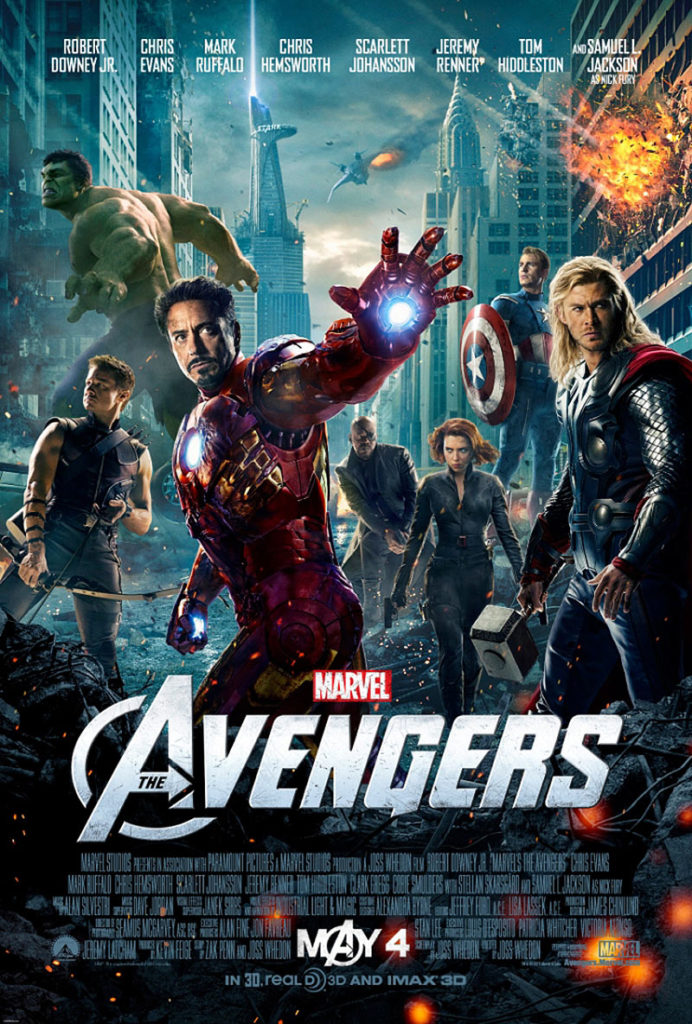
Marvel’s The Avengers (2012), which I watched in late June 2020. Having all those characters in one film could have been a recipe for disaster. It’s a bit slow as the formation of the group develops. But it turns out to be an entertaining enterprise, filled with action. And it had a REASON to get together and fight as a team, “to stop the mischievous Loki and his alien army from enslaving humanity.”

A lot of its success involves the humor among the disparate characters. It may have been the most fully realized comic book to hit the screen to that time. The action sequence, which must go on for a good half hour I allowed myself to get sucked into.

Hey 19, that’s a woman’s right to vote

19th*

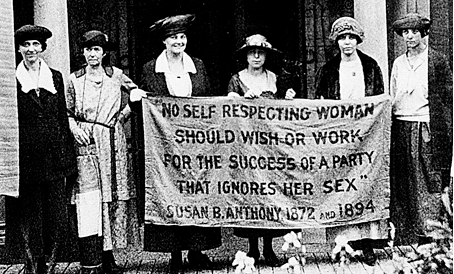
woman's right to vote“The 19th Amendment guarantees American women the right to vote. Achieving this milestone required a lengthy and difficult struggle; victory took decades of agitation.”

In fact, “opposition to woman suffrage in the US predated the Constitutional Convention (1787)… Still, there was opposition to such patriarchal views from the beginning, as when Abigail Adams, wife of John Adams, asked her husband in 1776, as he went to the Continental Congress to adopt the Declaration of Independence, to ‘remember the ladies and be more generous and favourable to them than your ancestors.’ In the scattered places where women could vote in some types of local elections, they began to lose this right in the late 18th century.”

In July 1848… the Seneca Falls Convention launched the women’s rights movement. “The Declaration of Sentiments and Grievances was ratified by the assembly. They also passed 12 resolutions that specifically necessitated equal rights for women including the resolution that proclaimed women’s right to vote.”

A constitutional amendment was first introduced in Congress in 1878. Some suffragists challenged male-only voting laws in the courts. “More public tactics included parades, silent vigils, and hunger strikes. Supporters were heckled, jailed, and sometimes physically abused.” Many Americans found the idea of a woman voting a radical change. It was generally accepted among men that women should be “protected from the evils of politics.”

Wyoming

Interestingly, the struggle was more successful in the western part of the country. It was Wyoming, in 1869, which became the first territory to grant women the right to vote. When it joined the union in 1890, it became the first state to grant female citizens the ballot. Colorado (1893), Utah (1896), Idaho (1896), Washington (1910), and Colorado (1911) followed.

“By 1914, every state west of the Rockies had granted females the right to vote. Kansas was the only state east of the Rockies to accept women’s suffrage. Why the divide? Some historians believe pioneer women were more highly regarded for their role in settling the West. Others suggest that there were fewer women in the West, therefore men valued and respected them more. Either way, New York didn’t grant women the right to vote until 1917.

“On May 21, 1919, the House of Representatives passed the amendment, and two weeks later, the Senate followed. When Tennessee became the 36th state to ratify the amendment on August 18, 1920,” the threshold was reached. The amendment was certified on 26 August.

The National Archives is having a virtual commemoration of the centennial of the 19th Amendment. The struggle for women’s suffrage, leading up to and beyond the certification of the 19th Amendment on August 26, 1920.

BTW

In recent Presidential elections, female voters outnumber male voters.

‘Ms. Jacobs! Is that you?!’ AOC’s Twitter reunion with her second-grade teacher.

The 19th*

This Poynter article recaps the 2016 presidential election.

“Hillary Clinton was running for president. Two questions followed Clinton. “Is she electable? Is she likable?

“‘That felt so unfairly narrowly tailored to women candidates,” [Emily] Ramshaw, [then editor-in-chief of The Texas Tribun] said. “That was the moment it first occurred to me that it would be incredible to have a storytelling platform that was by women for women.'”

Launching August 2, “The 19th* is a nonprofit, nonpartisan newsroom reporting on the intersection of gender, politics, and policy. It is funded by a mix of membership, philanthropy, and corporate underwriting. The name says it all, right down the asterisk.”

Ramblin' with Roger
Social media & sharing icons powered by UltimatelySocial