I’ve never read Jack London’s Call of the Wild. As far as I can remember, I’ve not seen any movie or television adaptations.
What drew me to the nearby Madison Theatre a few days before everything went into lockdown were two things: Harrison Ford’s presence and the $5 ticket price all day on Tuesdays.
An overly large pooch, a St. Bernard/Scotch Collie mix, seemed to have the run of a California home. Then he was dognapped and shipped north to Alaska.
He was purchased as part of a sled dog team operated by Perrault (Omar Sy) and Françoise (Cara Gee). Eventually, he crosses paths, for the third time, with John Thornton (Ford). Thornton protects Buck against the cruel Hal (Dan Stevens), who had stolen and beaten Buck.
Thornton and Buck go on an expedition further north practically to the Arctic Circle. In this environment, the once pampered Buck gets in touch with his primitive roots when interacting with a pack of wolves. The story was OK.
NOt a real dog
I was more curious whether I would buy the computer-generated dog in Call of the Wild as real. The answer is, “Sometimes.” The technique was less effective in the early narrative. Or maybe the storyline was just too goofy. But in his relationship with Perrault and Françoise, and later with Thornton, “he” usually resonated as a dog more believably.
I credit the fact that those performers were interacting with actor/stuntman Terry Notary, who modeled all of Buck’s actions. Those actors all expressed admiration for Notary’s work, giving them someone credible and emotive to perform with, rather than a blue screen.
There was a small audience for the 1 p.m. show. I ordered a burger, slightly overpriced but good.
It took SO long for the Madison Theatre to reopen. I hope it can withstand the current disruption. Good news is that it’s still selling food, pickup/delivery only. I’m inclined to order from them when I can.
This is different. It’s Easter Sunday. We get up, take showers, and have breakfast. Then we travel, all the way back upstairs, to the office and watch church.
On March 15, church did not happen for me. The sermon was subsequently mailed out. But on March 22, some of our fine technical experts, along with our pastors, presented service on Facebook. The pastors offered scripture, prayers, and sermons, while the service was augmented by song selections from the past four years of the Chancel Choir. There are some tracks from the Bell Choir ss well.
Like anything new, the process has evolved, with hymn texts projected on the screen so that we may sing along. The Presbyterian Church USA has indicated that it was OK to have communion at home, and we did on Palm Sunday and Maundy Thursday.
The Good Friday worship service was the scripture readings traditionally referred to as “the last seven words.” Additional readings from Psalms, the Gospels, and the epistles expanded on the message. The readings were separated by sung responses from the Taizé Community, a Christian community in France known for its contemplative, meditative music. The service concluded with music, and we were invited to ponder Jesus’ death before departing in silence.
Easter?
And now we’re in the resurrection mode. Funny thing, though. Instead of passing on chocolate for Lent, we had given up hugs and handshakes and even face-to-face contact. On the other hand, Lent isn’t all about refraining from, but taking on. We’re taking on “an abundance of caution” and handmade masks. We work from home, or in perilous conditions if we’re working at all.
And Easter doesn’t change that. Not yet.
Still, we celebrate Easter Worship Service today. The Hallelujahs may be live streaming on Facebook – my church’s service is at 10 a.m. EDT – but I hold onto hope. I must, for my own sake. Being part of a community, even one I only “see” because of the zeroes and ones on my computer screen, is still a blessing.
If you had asked me earlier this year if I had ever sung Worthy Is the Lamb That Was Slain I would have said no. This is why I don’t trust my memory.
There’s a gentleman named Don Ingram who played organ. For his 70th birthday, he conducted a 2002 performance of the entire Messiah. I found the program I recently found in MY Messiah score. Doesn’t EVERYONE have a Messiah score? It sits on the shelf right next to my Mozart Requiem score, naturally.
Messiah was composed in 1741 by George Frideric Handel, and first performed in Dublin on 13 April 1742. It received “its London premiere nearly a year later. After an initially modest public reception, the oratorio gained in popularity, eventually becoming one of the best-known and most frequently performed choral works in Western music.”
The choruses for the first part of the Messiah I’ve sung several times. It’s often performed during Advent, that period just before Christmas. That includes And the Glory of the Lord, And He Shall Purify the Sons of Levi, For Unto Us a Child is Born, and Glory to God in the Highest. The first I’ve likely sung the most.
The second section addresses the Lent to Easter period. Behold the Lamb of God, Surely He Hath Borne Our Griefs and Carried Our Sorrows, and All We Like Sheep Have Gone Astray I’ve performed a few times, but there are other pieces less familiar to me.
But THE most familiar piece in the whole work is in that section. Hallelujah I’ve sung almost every Easter morning for decades.
Part the third
Part 3 is sometimes performed in that period between Easter and Pentecost. Since by Man Came Death I’ve sung a bit. But less so for Thanks Be to God.
If it had not been for the shutdown, I would be singing Worthy Is the Lamb That Was Slain/Amen tomorrow. I find it inspirational. And the final cadence of the Amen is even emotional. I find lots of final phrases in familiar classical music make me verklempt.
Someone wondered what I thought of those churches that violate physical distancing by gathering. The folks tick me off. Not only do they put the congregants at risk, they put the greater community in peril as well.
The Pentecostal preacher in Louisiana, Tony Spell, said, “The Bible teaches us to be absent from our bodies as to be present with the Lord.” “Like any zealot or like any pure religious person, death looks to them like a welcome friend. True Christians do not mind dying. They fear living in fear.”
Conversely, the rejection of social distancing is far from mainstream among religious leaders. “‘That’s dumb, unbiblical and it doesn’t make sense,’ Rick Warren, pastor of the Saddleback Church in California, said. Warren and his wife, Kay, started the Saddleback Church about 40 years ago, and it now has 30,000 Sunday congregants around the world. They have moved their ministry online.”
Yup, I’m agreeing with Rick Warren.
“‘God gave you a brain,’ Warren said. ‘And much of what God wants to do with your life, he’s not going to write in the sky. He gave you a brain, and he expects you to use the intelligence that you were given.” These other people obviously never heard the famous God Will Save Me story, which I’ve known for a half-century.
Quoting Scripture
The fine artist Mr. Brunelle cited Leviticus 14:43-45 Modern English Version (MEV) on his Facebook page: If the disease comes again and breaks out in the house after he has taken away the stones and after he has scraped the house and after it is plastered, then the priest shall come and examine and see if the disease has spread in the house. If the disease has spread in the house, it is a persistent leprosy in the house; it is unclean. He shall break down the house, the stones and the timber, and all the plaster of the house, and he shall carry them out of the city into an unclean place.
I’m rather fond of Proverbs 6:16-19 (NIV), directed not just for those addled pastors but for certain nimrods as well: There are six things the Lord hates,
seven that are detestable to him:
haughty eyes,
a lying tongue,
hands that shed innocent blood,
a heart that devises wicked schemes,
feet that are quick to rush into evil,
a false witness who pours out lies
and a person who stirs up conflict in the community.
The Gospel lesson
When Jesus was in the wilderness, starving and parched, this from Matthew 4:5-7 (NIV) Then the devil took him to the holy city and had him stand on the highest point of the temple. “If you are the Son of God,” he said, “throw yourself down. For it is written:
“‘He will command his angels concerning you,
and they will lift you up in their hands,
so that you will not strike your foot against a stone.’”
Jesus answered him, “It is also written: ‘Do not put the Lord your God to the test.’”
It’s my opinion that Tony Spell and pastors of his ilk are trying to put God to the test. It is an arrogant thelogy that, as Rick Warren said, is unbiblical and makes no sense.
You are what you are, and you ain’t what you ain’t – Dear Abby, John Prine
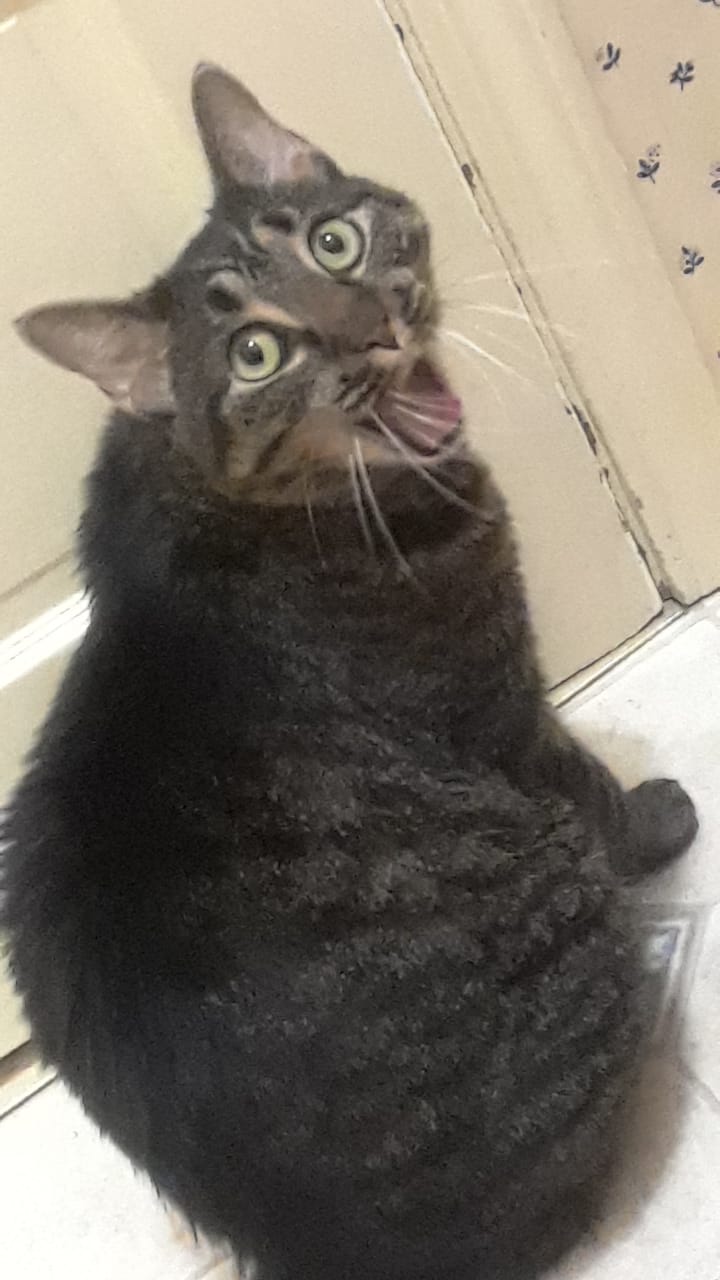
I’m told I can’t use cat pictures on my blog. The only exception is if it’s MY cat. Here’s Stormy, seeking sustenance.My household has established a new routine on most weekdays. There are variations but often it looks like this: The alarm goes off at 6 a.m. THE ALARM GOES OFF – ugh. At least it’s a half-hour later than it USED to go off when my wife traveled to work.
My wife watches CBS This Morning; increasingly, I don’t. I can’t do all COVID, all the time. But I do catch a bit when feeding the cats around 7:30 because they think it’s their right to be fed. My wife and I eat breakfast.
She goes to work in the guest bedroom. Her workload as a teacher of English as a New Language is so much greater than it was when she could actually meet with students in person. One day, she had a noon teleconference, then a 40-minute phone conversation with a parent of a student, 20 minutes to wolf down lunch, then a 2 pm teleconference. Another day, she spent about 100 minutes on the phone with two brothers.
I start writing a blog post but take a break to wake my daughter, who almost certainly has stayed up too late. Time for her to go to school too, which turns out to be on the borrowed laptop in her bedroom. Classes at 9 and 10:30, an hour for lunch, classes at 12:30 and 2. Sometimes I help her with her homework in the evening.
Old school
Time to call two people on the telephone. This has been an amazingly great exercise. Sometimes, I call people I haven’t seen in a few months, while others I haven’t been in contact with for years. (Hi, Janet!) They average about 45 minutes; some last 10 minutes, but I spoke with Bill, a grade-school friend, for about two hours. I never leave a message on answering machines because I don’t want to obligate people to have to call me back. But some see my phone ID and check back anyway.
I’ve discovered surprising simpatico with a guy whose wife also asks followup questions when he’s only reading her a news headline. A cousin of my father told me a family secret last week she had assumed I already knew. My pastors are now mailing the sermons to one of my fellow church members without a computer.
Some point, I’ll take a walk or ride my bike, take a shower, eat lunch, empty and reload the dishwasher plus washing some pots and pans, read the paper, finish the blog post, and watch the previous day’s JEOPARDY! After dinner is the daily Google hangout call of my wife’s family, ostensibly 15 minutes, but generally close to an hour. I’ll miss it because I’ll be attending church remotely on Maundy Thursday and Good Friday.
Here now the news
Watch the evening news, which is recorded, so I can zap past all those pharma medicine ads. I either help my wife and daughter, or at least stay out of their way. I’m happy to be retired.
And I was strangely mortified that an SBA program to help small business was so poorly introduced. A CBS story showed personal information showing up on the SCREENS of the next applicant in the queue. The SBDC, where I worked for nearly 27 years, is an SBA program.
And I’m terribly sad about the death of John Prine, who was not only one of America’s greatest songwriters but apparently a really nice guy. He beat cancer TWICE only to succumb to complications from COVID-19.

 I’ve never read Jack London’s Call of the Wild. As far as I can remember, I’ve not seen any movie or television adaptations.
 This is different. It’s Easter Sunday. We get up, take showers, and have breakfast. Then we travel, all the way back upstairs, to the office and watch church.
 If you had asked me earlier this year if I had ever sung Worthy Is the Lamb That Was Slain I would have said no. This is why I don’t trust my memory.
 Someone wondered what I thought of