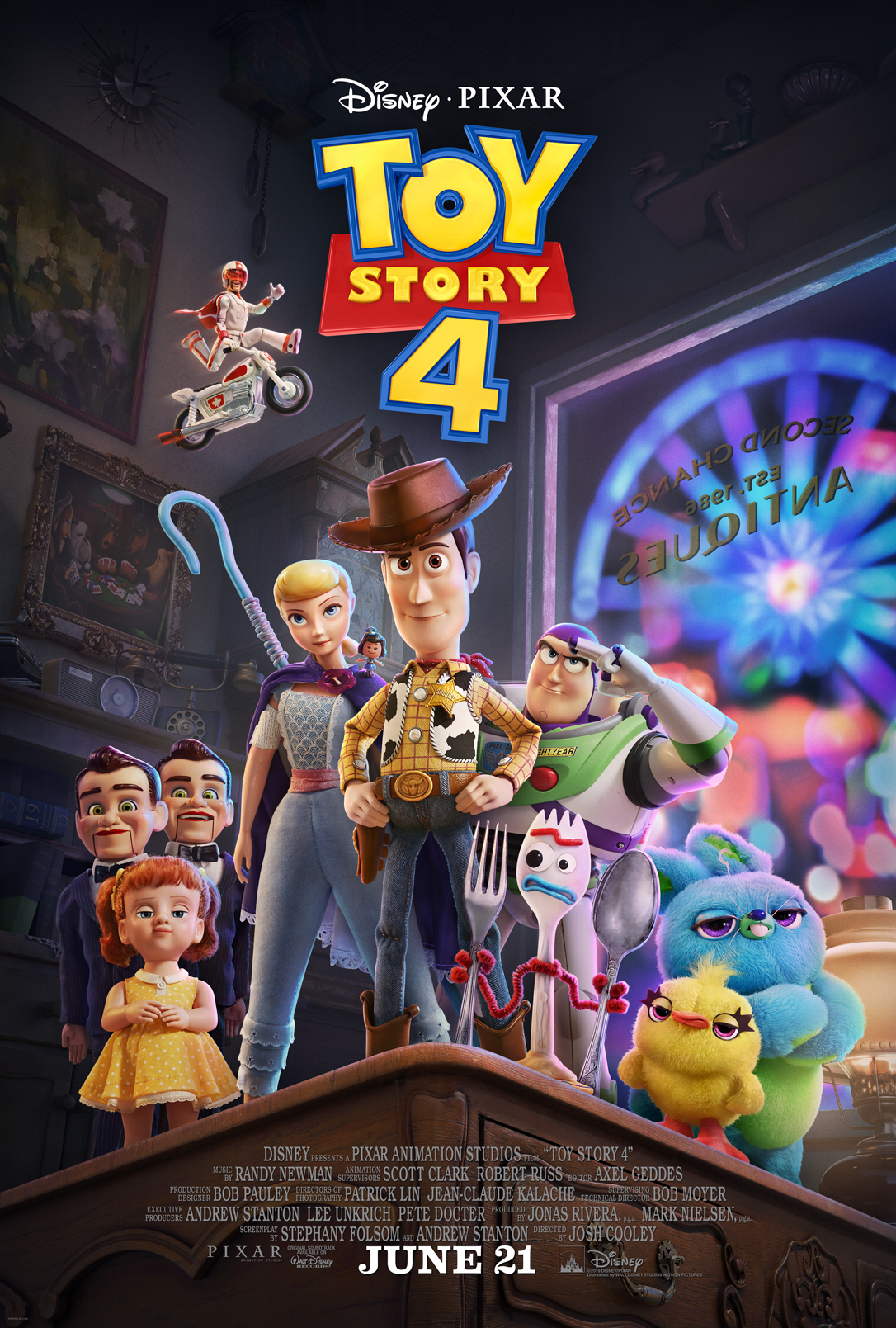
Movie review: Toy Story 4 (Pixar)

a fine coda

Toy Story 4I saw Toy Story 4 in a movie theater, the Spectrum 8 in Albany. Every Toy Story I’ve seen at a cinema. Since the first two movies came out in 1995 and 1999, respectively, pre-parenthood, it was my own volition in seeing them.

The third film I saw with my wife but without my daughter in 2010. Since my wife and daughter saw #4 without me, I saw it by myself.

Woody (Tom Hanks) and the rest of the toys are on a road trip with Bonnie (Madeleine McGraw) and her parents (Jay Hernandez, Lori Alan), just before Bonnie enters kindergarten. The toys’ primary task is keeping track of the new character named Forky (Tony Hale), who has issues.

Woody unexpectedly runs into his long-lost friend Bo Peep (Annie Potts), now a “lost” toy. They have philosophical differences when it comes to what the role of a toy should be. Bo, despite her porcelain construction, is impressive.

Ultimately, Woody, Bo, and some new friends such as Ducky (Keegan-Michael Key) and Bunny (Jordan Peele), have a mission. They have to sneak into the antique store run by Margaret (June Squibb), a place Bo knows too well. It’s not just the old-school doll Gabby Gabby (Christina Hendricks), but her friends, all of whom are creepy identical ventriloquist dummies named Benson.

There is a lot of insecurities revealed in Toy Story 4, including from daredevil Duke Caboom (Keanu Reeves). It can be difficult to find your place in the world, even if you’re a doll.

This is a fine coda to the franchise. Buzz Lightyear (Tim Allen) and Jessie (Joan Cusack) had smaller but vital roles in the narrative. I LOLed at a scene involving dependence on GPS.

Toy Story 4 received a 98% positive rating in Rotten Tomatoes. Matthew Norman of the London Evening Standard wrote: “The legislation it flouts is the law of diminishing returns which governs movies with numbers after their names.”


Disney Removes ‘Toy Story 2’ Scene That Recalled Hollywood Casting Couch Abuse.

AS as in American Samoa (USPS)

Most American Samoans are bilingual

American Samoa.Pago PagoThe United States Postal service, the oft-maligned entity, is in fact quite systematic. One of its great innovations was the two-letter state codes back in 1963. This allowed for easier mail delivery.

At some point, the Canadian postal service also created a two-letter system for its provinces and territories, using something called the ISO 3166-2:CA. Exciting!

For some reason involving the international scope of the ABCW folks, I’m going to go through the list alphabetically each week. For those weeks that have NO state/province/territories with that letter, I’ll figure out something else.

AA Armed Forces Americas (except Canada)
AB Alberta, Canadian province. The use of the first letter in the second syllable avoids the clash with Alabama. The traditional English abbreviation was Alta., the traditional French Alb. Capital: Edmonton; largest city: Calgary.
AE Armed Forces Europe, the Middle East, and Canada

AK Alaska – first letter, 1st letter of the third syllable. Apparently, the tradition abbreviation was Alas. Capital: Juneau; largest city: Anchorage.
AL Alabama – in general, in case of a tie, the states that are oldest get those first two letters. When I was a kid, I mostly saw it as Ala. Capital: Montgomery; largest city: Birmingham.
AP Armed Forces Pacific
AR Arkansas – its traditional abbreviation was Ark. Capital and largest city: Little Rock

AS American Samoa – “Samoa was not reached by European explorers until the 18th century. International rivalries in the latter half of the 19th century were settled by an 1899 treaty in which Germany and the US divided the Samoan archipelago. The US formally occupied its portion – a smaller group of eastern islands with the excellent harbor of Pago Pago [the capital and largest city]- the following year.”

As of April 2019, the population of American Samoa is approximately 55,689 people. Most of them are ‘nationals but not citizens of the United States at birth’. Most American Samoans are bilingual and can speak English and Samoan fluently. The total land area is 199 square kilometers (76.8 sq mi), slightly more than Washington, D.C.”

AZ Arizona – often previously listed as Ariz. Capital and largest city: Phoenix

Jointly developed by the Postal Service and mailing industry, standardized address information enhances the processing and delivery of mail, reduces undeliverable–as–addressed mail, and provides mutual cost reduction opportunities through improved efficiency.”

For ABC Wednesday

Discussion of reparations as history lesson

for three decades, members of Congress have introduced H.R.40
reparationsIn the current conversation about reparations, there is one thing I think we all can agree upon: we see race in America with very different lenses.

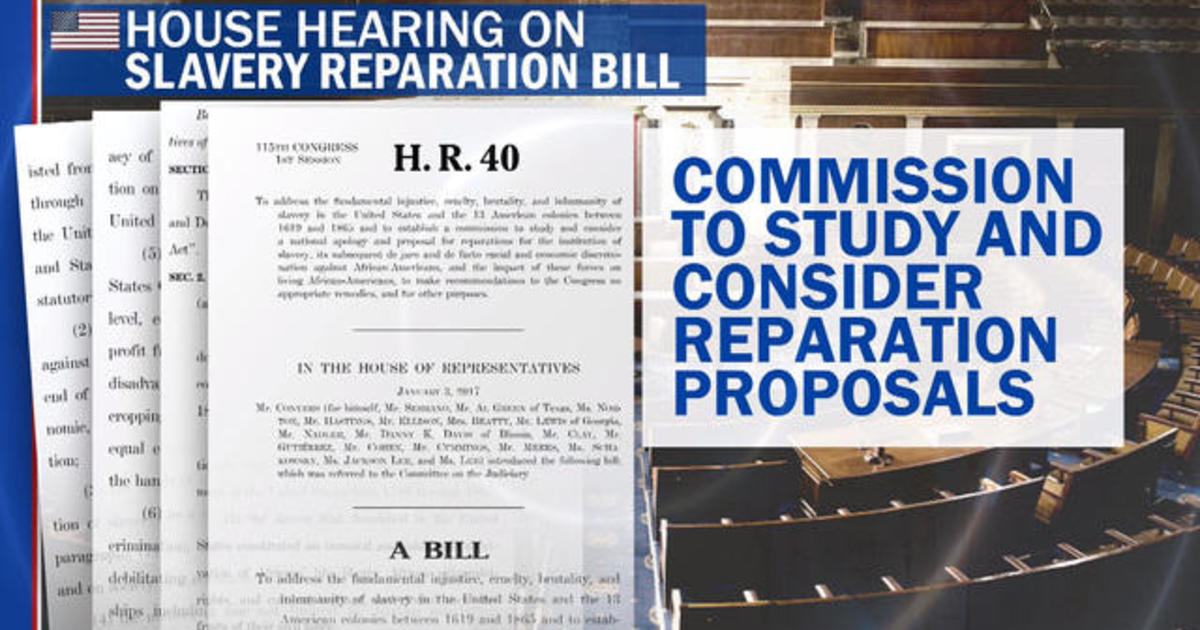
I have been skimming the House Judiciary Committee’s Subcommittee on the Constitution, Civil Rights, and Civil Liberties’ hearing on H.R. 40 and the Path to Restorative Justice, which was held Wednesday, June 19, 2019. Both the bill number and the date were significant.

H.R. 40 refers to “forty acres and a mule,” a radical post-Civil war redistribution of land “set apart for the settlement of the negroes [sic] now made free by the acts of war and the proclamation of the President of the United States.” After the assassination of Abraham Lincoln. this, of course, never took place.

June 19, or Juneteenth, was the date in 1865 “when the Union soldiers, led by Major General Gordon Granger, landed at Galveston, Texas with news that the war had ended and that the enslaved were now free.” After a period of decline, the celebration “received another strong resurgence through Poor Peoples March to Washington D.C. [in 1968]. Rev. Ralph Abernathy’s call for people of all races, creeds, economic levels and professions to come to Washington to show support for the poor.”

The specific ask in the legislation is to establish “the Commission to Study and Develop Reparation Proposals for African-Americans to examine slavery and discrimination in the colonies and the United States from 1619 to the present and recommend appropriate remedies.” In other words, have a bunch of meetings.

TESTIMONY

“Reparations is not a new idea—and for three decades, members of Congress have introduced H.R.40, a bill to establish a commission that would study reparations. But only once before, in 2007, has Congress even held a hearing on the bill.”

You may have heard the riveting testimony of prominent black author Ta-Nehisi Coates. “It is tempting to divorce this modern campaign of terror, of plunder, from enslavement, but the logic of enslavement, of white supremacy, respects no such borders. And the god of bondage was lustful and begat many heirs: coup d’etats and convict leasing, vagrancy laws and debt peonage, redlining and racist G.I. bills, poll taxes and state-sponsored terrorism.”

However, another author, Burgess Owens, whose great-great-grandfather was a slave, testified: “At the core of the reparation movement is a divisive and demeaning view of both races. It grants to the white race a wicked superiority, treating them as an oppressive people too powerful for black Americans to overcome. It brands blacks as hapless victims devoid of the ability, which every other culture possesses, to assimilate and progress. Neither label is earned.”

So you have some asking to cut the check and others who point out the statistical errors of “the reparations agenda.”

THE BIGGER PROBLEM

Like me, the Weekly Sift is “of two minds about this subject. On the one hand, enslaved Africans and their descendants built a large chunk of America’s wealth and wound up owning none of it. That long-ago injustice (plus Jim Crow plus ongoing racism) still has repercussions, and even those whites whose families never owned slaves have benefited in ways we don’t always appreciate…

“But in addition to the inadequacy of monetary settlement, there’s a bigger problem: For reparations to bring this chapter to a close, our society needs to reach some kind of consensus about what the payment is for and what it means. We’re nowhere close to that.

“If reparations for slavery were paid tomorrow, the white-nationalist types would believe blacks had used their political power to extort something, and they would want to get it back. A lot of other whites would feel like racism was a dead topic now: ‘Don’t ever talk to me about racism again. I paid my bill for that.'”

That appears to be an accurate assessment, based on the comments of Senate Majority Leader Mitch McConnell, who suggested that electing Barack Obama as President made up for hundreds of years of racism. As if.

The rationale for the Supreme Court gutting the heart of the Voting Rights Act in the 5-4 Shelby County ruling of 2013 was more voter equality. Yet, even before that ruling, states have passed discriminatory laws making it HARDER for people to vote.

My inclination, in this current retrograde period, is to have the conversation about what “reparations” mean go forward. But I need to continue musing on this, with perhaps more personal observations next time. Meanwhile, listen to Let Your Voice Be Heard radio for the episode 40 Acres and Barack Obama.

The Good Fight and other Sunday TV

no CBS All Access for me

Good FightBefore The Good Fight aired in 2017, I was a huge fan of the TV seriesThe Good Wife (2009-2016). Maybe it was the premise. In real life, the US was experiencing a series of sex scandals, involving high profile male politicians.
Often, but not always, there was a wife standing by her husband. It happened in New York State, with Eliot Spitzer, the crime-fighting attorney general who became governor. But it as revealed that Spitzer, in his former role, was also prostitute-facilitating Client 9.

Likewise “Alicia [Julianna Margulies] has been a good wife to her husband, a former state’s attorney [Chris Noth]. After a very humiliating sex and corruption scandal, he is behind bars. She must now provide for her family and returns to work as a litigator in a law firm.”

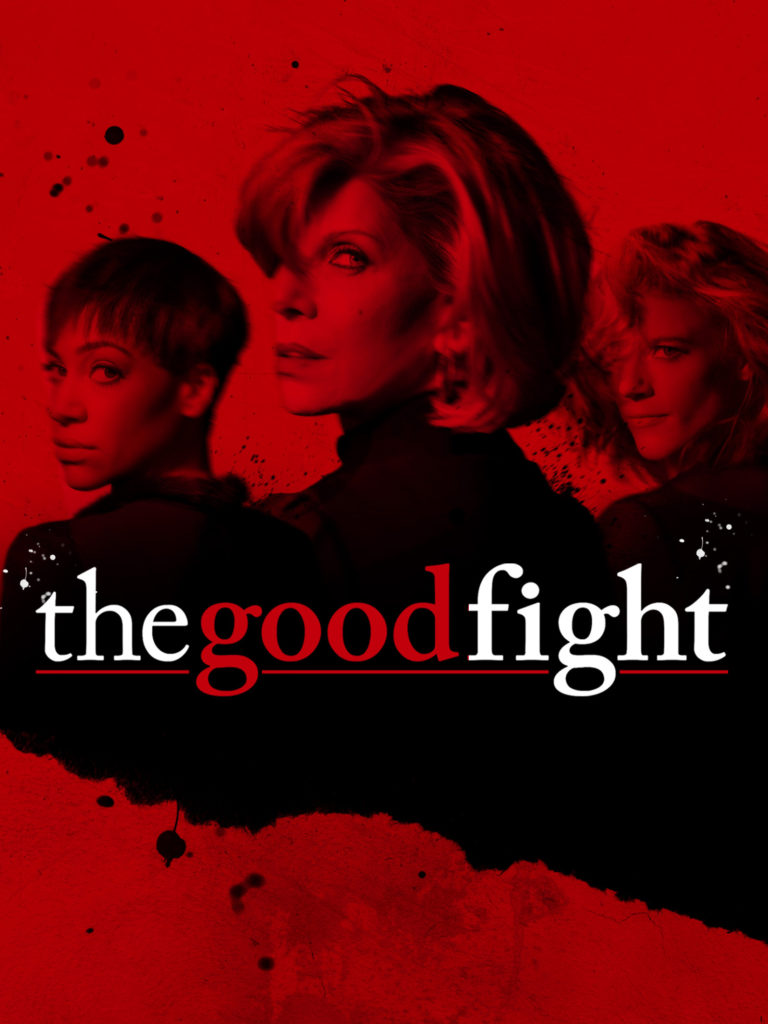
After the run ended, there was a spinoff called The Good Fight, starring Christine Baranski as Diane Lockhart, Alicia’s former boss/partner/frenemy. CBS showed the first episode. To see others, though, one had to sign onto something called CBS All Access. No thanks. The new Star Trek is on the same platform.

Now, after the third season of The Good Fight, with another one scheduled, Season 1 is being shown on CBS broadcast TV, each Sunday night. I’m excited, but not enough to have watched any of the five episodes I’ve recorded. I know lots of folks like to binge on these things, but it’s not me.

That means the DVR records a lot Sunday nights. In addition to The Good Fight, there are also one or two episodes of 60 Minutes episodes. Of course, most of them I’ve already seen unless some NFL football game, NCAA basketball contest or golf tournament ran long.

The other hour is The $100,000 Pyramid. It’s a game show that initially aired in 1973 as the $10,000 Pyramid, hosted by the late Dick Clark. Former NFL linebacker Michael Strahan is the current host. The game plays the same as it did decades ago. The clues in the first round may be more explicit – “horny” was a word a contestant had to convey recently.

Whereas I specifically dislike some of the other shows ABC has brought back, such as To Tell The Truth and Match Game, though I had watched them in earlier incarnations. I have no interest in seeing Press Your Luck or Card Sharks then or now.

A song you’d sing a duet in Karaoke

Joan Baez. Bill WoodThe prompt was: A song you’d sing a duet with in Karaoke. Hmm, I do sing, but I’ve NEVER sung Karaoke; never been that drunk, I suppose.

The answer would be anything for which I can sing harmony. I love singing harmony far more than the melody. I tend to hear it instinctively, the bass line for sure, but also some alto parts.

As noted, I want to sing the Jermaine parts for the Jackson Five.

Midnight Train to Georgia – Gladys Knight and the Pips. I always wanted to be a Pip. I mentioned this five years ago:
“In 1977, the Pips (minus Gladys) appeared on comedian Richard Pryor’s TV special that aired on NBC. They sang their normal backup verses for [the song]; during the parts where Gladys would sing, the camera panned on a lone-standing microphone.”
This routine slayed me. I haven’t seen it in decades, yet it still makes me laugh, and I cannot explain why.

You Can Make It If You Try – Sly and the Family Stone. The Larry Graham part is low in my range, but I’d sing it anyway. There’s a whole family of shared vocals, including by the Temptations and Prince that would make the list.

Shredding the Documents – John Hiatt. That Beach Boyesque part
Long May You Run – Neil Young. Especially that Beach Boys reference
In My Room – the Beach Boys

Help – the Beatles. This is something I have actually sung with my daughter. She in turn taught it to a friend of hers. I was VERY proud; inculcation completed!

Shower the People – James Taylor – the standard harmony, but also the lower vocal near the end
Church – Lyle Lovett
The Boxer – Simon and Garfunkel, excluding that verse added for the live album (“after changes upon changes, we are more or less the same”

I should throw in a couple songs I actually HAVE dueted on, primarily with my sister Leslie, lo those many years ago:

So Soon in the Morning – Joan Baez and Bill Wood
Go Where You Want To Go – the Mamas and the Papas

Ramblin' with Roger
Social media & sharing icons powered by UltimatelySocial