Florida: race, murder, self-defense

“The most damning element here is not that George Zimmerman was found not guilty: it’s the bitter knowledge that Trayvon Martin was found guilty.”

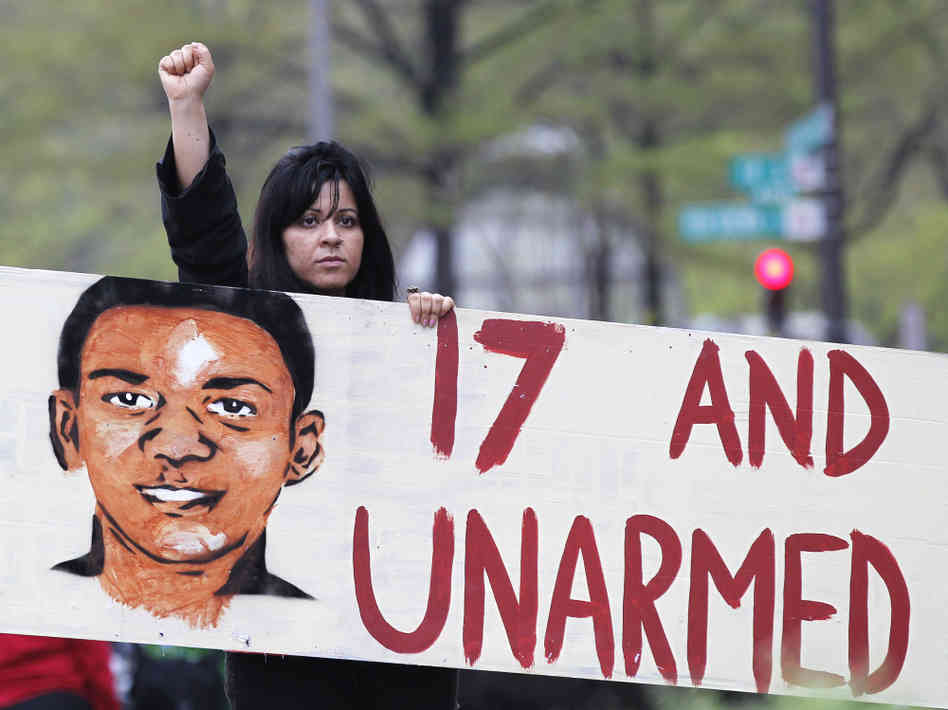
After George Zimmerman’s acquittal in the shooting death of Trayvon Martin death in Florida, the New York Daily News did a piece When will it end? Deadly racial targeting of black men and teens is hardly ancient history.

So I find it difficult to look at the case as a singular event but in the context of a social pattern. Black-on-black murder doesn’t make headlines, unless it hits an epic proportion, as it has in Chicago recently. Black-on-white murders statistically draw tougher sentences. So there is always uneasiness when a white-on-black killing takes place.

In the “good old days”, there were often no consequences, and in these days, laws such as Stand Your Ground can justify the same result.

Jelani Cobb has covered the Zimmerman trial for the New Yorker. Her stories are all worth reading. George Zimmerman, Not Guilty: Blood on the Leaves has some quotable pieces.
“The most damning element here is not that George Zimmerman was found not guilty: it’s the bitter knowledge that Trayvon Martin was found guilty.”
“Yet the problem is not that this case marks a low point in this country’s racial history—it’s that, after two centuries of common history, we’re still obligated to chart high points and low ones. To be black at times like this is to see current events on a real-time ticker, a Dow Jones average measuring the quality of one’s citizenship… That [Trayvon’s shooting] occurred in a country that elected and reëlected a black President doesn’t diminish the despair this verdict inspires, it intensifies it.”
*”Perhaps history does not repeat itself exactly, but it is certainly prone to extended paraphrases. Long before the jury announced its decision, many people had seen what the outcome would be, had known that it would be a strange echo of the words Zimmerman uttered that rainy night in central Florida: they always get away.”

Of course, the case may have hinged on the judge’s jury instruction, which was appallingly incomplete.

Perhaps not coincidentally, the review of the newly-released movie Fruitvale Station,- the true story of Oscar Julius Grant III, a young black man unjustly killed in California in 2009, notes how that story echoes the Martin case. “The film’s portrayal of a young black man as a complex human being– [not that] you’re either a thug or a saint, good or bad, black or white (sometimes literally), with no shades of grey between…. [T]he eagerness with which the pro-Zimmerman faction of the populace and media leapt breathlessly upon any scrap of negative information about his 17-year-old victim–he smoked pot! He talked like a thug on Twitter! He flipped off the camera in pictures! He may have stolen jewelry!… But even if every vile posthumous rumor that attached itself to Martin was true, even if he was a pot-dealing, thugged-out thief, what then? Is tweeting like Tupac a death-penalty offense?” Supporters of Trayvon have suggested he was a good son, someone who did well in school, who went to church, who did community service; assuming that’s true, that’s fine, but it’s just the “saint” side of the portrayal, and, for me, doesn’t materially affect the tragedy of the situation.

Another Florida case in which Stand Your Ground may be invoked is the first-degree murder case in which Michael Dunn, who is white, is charged with shooting into a car, killing 17-year old Jordan Davis, who was black, after an argument over loud music. (Sidebar: someone on Facebook complained about a person mentioning this case on FB, because the original story came out back in November 2012, as though it were old news, or resolved. Just this month, 2nd judge leaves the Michael Dunn/Jordan Davis case.)

Meanwhile, I came across this bizarre story from May 2013: Fla. mom gets 20 years for firing warning shots. “Marissa Alexander of Jacksonville had said the state’s ‘Stand Your Ground’ law should apply to her because she was defending herself against her allegedly abusive husband when she fired warning shots inside her home in August 2010. She told police it was to escape a brutal beating by her husband, against whom she had already taken out a protective order.” One is left wondering if she had instead killed her husband, she would be walking the streets, or whether her race (she’s black) or gender would have played into the case.
***
Related: this week is the 150th anniversary of the New York City Draft Riots. “With the ludicrous Newt Gingrich (who claims to be a historian) insisting the peaceful Trayvon Martin protesters were ‘prepared to be a lynch mob,’ it’s worth remembering that devastating eruption of white mob violence 150 years earlier when at least 11 black men were actually lynched.”

Lester Chambers of the Chambers Brothers Assaulted on Stage Dedicating Set to Trayvon Martin, with link to “Time has Come Today.”
Kids Who Die by Langston Hughes.

Blog site down; I’m so annoyed

What happens to the blog when I die?

For some reason, the company that has provided service for this blog since May 2, 2010, stopped working on July 10, 2013, at 11 a.m., EDT. I went to the web guy’s website and found it (and his wife’s site) was also down. I have had pretty good luck with the company to date; I never was offline more than 10 minutes in the past.

What’s bugging me, though, is not just that the site was offline for over six hours, but the fact that I had not set up a current backup system. Oh, the first five years of this blog are available at my old Blogger blog site. And I DID create an echo site, rogerowengreen.wordpress.com four years ago; I just never actually followed up on this.

The service being down has prompted me to finally post there as a backup site going forward, and, as time permits, back four years to May 2, 2010.

This actually also addresses another issue I’ve thought about, which I may have mentioned here: what happens to the blog when I die? Assuming – a big assumption – that WordPress will continue to provide a free blog service AND that they don’t start deleting blogs that have become defunct, then the backup site will be my blog beyond the grave. Or something like that.
***
Sad that Cory Monteith, 31, of the TV show Glee died from an overdose of heroin and alcohol. His character Finn Hudson will have to die as well, but will it be in some noble fashion, when the show starts shooting later this month? Or will they let Finn’s death be an object lesson to the fans?

A is for Acronym plurals

“The argument that acronyms should have no different plural form (for example, ‘If D can stand for disc, it can also stand for discs’) is in general disregarded because of the practicality in distinguishing singulars and plurals.”

Jaquandor, that fine Buffalo blogger, wrote about the acronym FUBAR, and how a writer had used it as FUBARed. FUBAR, in case you don’t know, means Fouled Up Beyond All Recognition, where F really represents some OTHER word.

“Here’s my thing: Isn’t FUBAR already past-tense? Can something really be FUBARed, when the -ed suffix has already been used in the F part of the FUBAR acronym? Seems to me that FUBAR covers all bases, in terms of tense.”

And I replied: “As fussy as I can be, the absence of the -ed SOUNDS wrong… As I think more on this, I HAVE heard FUBAR NOT as a past tense. ‘You really know how to FUBAR.” So the -ed isn’t always already present anyway, in my experience.”

This inevitably got me thinking about how an acronym, “an abbreviation formed from the initial components in a phrase or a word,” is made plural. From the Wikipedia: “it has become common among many writers to inflect acronyms as ordinary words, using simple s, without an apostrophe, for the plural. In this case, compact discs becomes CDs…

“The argument that acronyms should have no different plural form (for example, ‘If D can stand for disc, it can also stand for discs’) is in general disregarded because of the practicality in distinguishing singulars and plurals.”

Further: “A particularly rich source of options arises when the plural of an acronym would normally be indicated in a word other than the final word if spelled out in full. A classic example is Member of Parliament, which in plural is Members of Parliament. It is possible then to abbreviate this as M’s P… This usage is less common than forms with s at the end, such as MPs, and may appear dated or pedantic. In common usage, therefore, weapons of mass destruction becomes WMDs, prisoners of war becomes POWs, and runs batted in becomes RBIs — generally, if the abbreviation ends with a tensed back vowel syllable. The plural of RBI is ‘RBIs’ because acronyms become bona fide words as language evolves, and as with other words attract a plural suffix at the end to be made plural, even if the first word is the main noun in the spelled-out form. ” A call to make multiple runs batted in as RBI I think is just silly.

Some acronyms, BTW, have become lower-case words. FUBAR’s linguistic cousin, snafu – Situation Normal, All Fouled Up – easily takes the s as a plural.

For me, in dealing with acronyms, clarity is the key, not propriety. Which, incidentally, is why FUBARed doesn’t both me either.


ABC Wednesday – Round 13

File under: Carol is…a year older

It’s usually the little stuff that drives people crazy.

One of the admirable things about The Wife is that she has this filing system for papers. Sometimes she can even find things in it; OK, I jest, because usually, she can. But her categories are not my categories, so I can almost NEVER find anything in her system.

She keeps receipts of almost everything she buys. If she needs it, she’ll pull out the folder for the year that purchased the item. This is of absolutely no use to me because, unless it was very recent, I can’t REMEMBER what year we bought something. Was it 2010 or 2009?  Occasionally she can’t remember either.

Moreover, I get impatient wading through a year’s worth of random receipts. MY system, when I was single – still used for things that are mine, rather than hers or ours – is by type of items – appliances, pharmacy, food, and the like. She’s willing to rifle through her files, but I find it too arcane.

I do see one advantage of her system, though. When the contents of a folder are eight years old, she can toss it; not that she does, necessarily, but she could.

With my folders, I put the tabs in the back, while she puts them in the front, something that, for some reason, totally flummoxes me when looking in her files.

It’s usually the little stuff that drives people crazy. As long as I don’t actually have to FIND something in her files, it’s all good.

Happy birthday, honey.

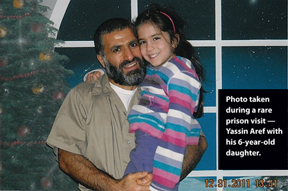
Yassin Aref: a matter of (in)justice

The evidence shows that as early as December 2002, the FBI thought Yassin Aref was really an Al Queda agent named Mohammed Yasin, using a pseudonym. The real Yassin, who was missing two finger, was killed in Gaza in 2010.

picture from the projectsalam.org webpage

It was local front-page news, of course, back in 2006: two Muslims convicted of material support for TERRORISM, in Albany, New York! But even a casual reading of the news reports running up to the conviction of Yassin Aref, an Albany iman, and Mohammed Hossain, a pizzeria owner, didn’t add up. The clips of them with the FBI “informant” did NOT indicate the hate-filled speech I was told to expect.

Read about Yassin Aref’s arrest, conviction, and incarceration in this 2011 article for New York magazine. It discusses the government’s “controversial policy of preemptive prosecution—taking down those thought to possibly become terrorists in the future.”

Now Aref’s lawyers will file papers this month (July 2013) asking that the conviction be overturned or for a new trial, in something called a 2255 motion.

From the press release from Project Salam: “Aref discovered significant new evidence about his case as a result of an FOIA (Freedom of Information Act) request he made in 2011.” The prosecution had it, the trial judge and appeals judge saw it, but the defense team did not. Incidentally, the defense tried and failed, to get this information earlier.

“The evidence shows that as early as December 2002, the FBI thought Aref was really an Al Queda agent named Mohammed Yasin,” using a pseudonym. The real Yassin, who was missing two-finger, was killed in Gaza in 2010. Aref writes, “I am still alive and have all my fingers so I cannot be Mohammed Yassin.”

The FOIA documents were heavily redacted, but it’s reasonable to believe that the trial judge was given classified information that misidentified Aref as Al Queda member Yasin.

So my friend Lynne Jackson is on a walk from Albany to Binghamton, a distance of 133 miles (214 km), to bring attention to this case, as she brings petitions to Judge Thomas McAvoy, as I noted here; I attended the kickoff event on July 12. She can still get more names on the online petition until July 23. If, after reading the materials, you are so moved, please sign it.

Ultimately, though, the case is about more than Yassin Aref and Mohammed Hossain, who likely just got caught up in the FBI’s zeal. It’s about: “In all criminal prosecutions, the accused shall enjoy the right to a speedy and public trial, by an impartial jury of the state and district wherein the crime shall have been committed, which district shall have been previously ascertained by law, and to be informed of the nature and cause of the accusation; to be confronted with the witnesses against him; to have compulsory process for obtaining witnesses in his favor, and to have the assistance of counsel for his defense.” In other words, it’s about the 6th Amendment to the Constitution. The withholding of these documents that hold secret, and evidently false, information, is unconstitutional. THAT is the crime here.


Ramblin' with Roger
Social media & sharing icons powered by UltimatelySocial