O is for Oceans

I never heard of the Southern Ocean! It wasn’t in my fourth grade geography book.


This post was inspired by an episode of the TV show JEOPARDY! Specifically, April 4, 2011 final. The category was WORLD GEOGRAPHY: “These 3 nations each border the world’s largest & smallest oceans.”

I must admit that I sussed out the answer immediately. From the responses, however, it was clear that none of the contestants knew a key element of the clue. One response was India and Sri Lanka; another Australia, Papua New Guinea, and Borneo; and the third, Australia, Indonesia, and Malaysia.

So, what ARE the largest and smallest oceans in the world?

The largest, by a considerable margin, is the Pacific Ocean, with 64,186,000 square miles (166.241 million sq km). But you all knew that, didn’t you?
The second-largest, of course, is the Atlantic Ocean, with 33,420,000 square miles (86.557 million sq km); I wasn’t aware of such a disparity of size between the Pacific and Atlantic.
The third-largest is the Indian Ocean, at 28,350,000 square miles (73.426 million sq km). This, clearly, is the ocean that the contestants thought was the smallest; not so.
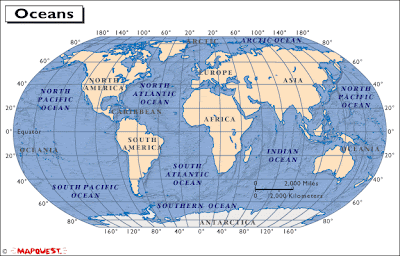
The fourth-largest is the Southern Ocean at 7,848,300 square miles (20.327 million sq km). WHAT? I never heard of it! It wasn’t in my fourth-grade geography book. “Until the year 2000, there were four recognized oceans: the Pacific, Atlantic, Indian, and Arctic. In the Spring of 2000, the International Hydrographic Organization delimited a new ocean, the Southern Ocean (it surrounds Antarctica and extends to 60 degrees latitude).”
The smallest ocean, then, has to be the Arctic Ocean at 5,106,000 square miles (13.224 million sq km).

So, if the largest ocean is the Pacific, and the smallest the Arctic, what three countries border both?

While you think about it, a bit about oceans: The ocean covers 71 percent of the Earth’s surface and contains 97 percent of the planet’s water, yet more than 95 percent of the underwater world remains unexplored.

Obviously, the bordering nations have to be large, northern countries. Two immediately came to mind: Russia and Canada. What’s the third? The United States! Specifically Alaska. (The Pacific is at the top of this map, with North America to the left and Asia to the right.)

Interestingly, the first contestant started writing the US, Canada and Mexico, bailed and went with the answer shown. Even though I knew the answer to the question, I learned something too from this exercise!

ABC Wednesday – Round 9

F is for Former Names

Perhaps, the greatest area of change involves place names.


The item pictured above used to be called a guitar. Then this item-

-came along. And now the first item is now called an acoustic guitar, to differentiate it from the second item, an electric guitar.

This used to be known as a clock


– until this –

– came along. Now an analog clock describes a clock with an actual face, compared with a digital clock.

There’s a whole bunch of these, called retronyms, a term the late New York Times wordsmith William Safire believed had been around for 30 years, but in the dictionaries for far less time. Here is a list of retronyms.

This used to be known as a stewardess, but now is a flight attendant.

This used to be known as a fireman, but is now a firefighter.

The language has become more gender-neutral.

Perhaps, the greatest area of change involves place names. A lot of this took place in Africa in my lifetime, where locations that used to be colonies are now independent countries. Also, in the Western Hemisphere, British Honduras became Belize, British Guiana became Guyana and Dutch Guiana became Suriname.

Sometimes the local politics or internal struggles affect the nomenclature. Ceylon is now Sri Lanka, e.g. and the Democratic Republic of the Congo used to be Zaire. Cambodia has had a couple of other names.

Some formerly divided countries re-merged, such as Germany and Vietnam. In Africa, Tanganyika and Zanzibar joined to create Tanzania. Conversely, other countries broke into two or more parts. Bangladesh was once East Pakistan. Czechoslovakia, Yugoslavia, and especially the Soviet Union are no more. Egypt and Syria merged to form the United Arab Republic in 1958 but got a divorce in 1961. Here is a list of some countries that have had name changes.

One of the name changes I remember most, though, was a city; Peking became Beijing, explained here; likewise, a description of the change from Bombay to Mumbai, something I admit I occasionally forget. Of course, St. Petersburg, Russia has been Petrograd and Leningrad.

Three of the four schools I’ve attended in my life have changed names. Binghamton Central High School merged with Binghamton North to become Binghamton High School in 1982. Both my State University of New York undergrad school, New Paltz, and my grad school, Albany, have undergone a number of name changes; the former in 1828 as the New Paltz Classic Academy, and the latter as the New York State Normal School in 1844. My first school, Daniel S. Dickinson, has long ago been razed.

Finally, THE song of a name change, first a hit by The Four Lads, way back in 1953. Listen to Istanbul (not Constantinople) by They Might Be Giants.

Feel free to share your favorite name changes.

ABC Wednesday – Round 7


Ramblin' with Roger
Social media & sharing icons powered by UltimatelySocial