John Thompson, Tom Seaver

Mets and Hoyas

Tom SeaverI’ve been pondering something since the deaths of basketball Hall of Fame coach John Thompson and baseball Hall of Fame pitcher Tom Seaver. It is that being a sports fan was hugely significant to me for a chunk of my life. But it has waned in recent years.

I could tell you, without looking it up, who won the World Series every year in the 1960s. For the 2010s, I could recall only four. And two of them, the 2017 Houston Astros and the 2018 Boston Red Sox were arguably tarnished.

Tom Terrific

After the decline of my New York Yankees after their 1964 Series loss to the St. Louis Cardinals, I started following their crosstown rivals, the Mets. But they were pretty terrible. They put this young pitcher, Tom Seaver, into the rotation in 1967, and he went 16-13, with a 2.76 ERA. Pretty good on a team that went 61-101. In 1968, the Mets were 73-89, their most wins ever. Seaver was 16-12 but lowered his ERA to 2.20.

By 1969, the leagues divided into East and West divisions. Shockingly, the Mets amazed sports fans with a 100-62 record. They swept the West’s Atlanta Braves in three games. They were widely assumed to be the underdogs to the Baltimore Orioles with the Robinsons Franks and Brooks, among other stars. Yet the Mets won the World Series four games to one. Tom Seaver in 1969 went 25-7, with a 2.21 ERA.

A letter writer in the Boston Globe remembers this. “That year, Seaver had made a statement that ‘if the Mets can win the World Series, then we can get out of Vietnam,’ an extraordinary act in those days for a professional athlete.”

I followed Seaver through his career with the Cincinnati Reds and Chicago White Sox. I forgot he pitched for the Red Sox in 1986, but he was injured during the 1986 Series, so didn’t play against the winners, NYM. It was just as well for the legacy of the greatest Met. He died in late August in his sleep of complications of Lewy body dementia and Covid-19.

Big John

John ThompsonFor a couple years in the mid-1960s, John Thompson was a backup center for Bill Russell of the Boston Celtics. It was probably before I saw the Celtics in an exhibition game at the IBM Country Club in Endicott, NY. The NBA’s Celtics and the New York Knicks were my teams then.

I didn’t become a follower of the men’s college game until the late 1970s. I tended to root for the teams in the Big East, which was formed in 1979 and featured Syracuse, the premiere team in upstate New York. But I’d root for any BE team, including Georgetown, against non-conference opponents.

John Thompson inherited a Georgetown Hoyas team which had been 3–23 the year before. He led them to a .500 record in season two. “By his third season in 1974–75, Georgetown qualified for the NCAA Tournament for the first time since 1943.”

So when North Carolina beat Georgetown in the March Madness finals in 1982, I was disappointed. And when the Hoyas beat Houston in 1984, making John Thompson the first black coach to win the Final Four, I was quite thrilled. And when underdog Villanova, from the Big East, beat Georgetown in the championship game in 1985, it was actually OK. “Over 27 years, Thompson’s Hoyas went 596–239 (.714), running off a streak of 24 postseason appearances – 20 in the NCAA tournament and 4 in the NIT.”

Thompson’s coaching legacy includes the recruitment and development of four players in the Naismith Memorial Basketball Hall of Fame: Patrick Ewing, Alonzo Mourning, Dikembe Mutombo, and Allen Iverson.” Iverson thanked Thompson for “saving my life” in an Instagram post.

Sean Gregory wrote in an appreciation for Time, “No coach of his generation, in any sport, was more influential.” John Thompson died in late August.

Chadwick Boseman – Wakanda forever

learned to T’Challa

Chadwick BosemanI’ve been musing on why I found the death of Chadwick Boseman so affecting. Only recently I noted three films he starred in. “MARSHALL (2017) a biopic starring Chadwick Boseman as Supreme Court Justice Thurgood Marshall I had intended to see.” Ditto for the film GET ON UP (2014), about the Godfather of Soul James Brown that I had coincidentally recorded to the DVR last month.
I had started watching 42 (2013) the movie about Jackie Robinson. It was the day I was being discharged from the hospital after a health scare. I think I tried to stall my release time to finish watching it.

Cancer. As the Chicago Tribune noted, “The cancer was there when his character T’Challa visited the ancestors’ ‘astral plane’ in poignant scenes from the Oscar-nominated ‘Black Panther,’ there when he first became a producer on the action-thriller ’21 Bridges,’ and there last summer when he shot an adaptation of a play by his hero August Wilson…”

The South Carolinian died at the age of 43 of colon cancer, only a couple years older than my brother-in-law John when he died of the same damn disease in 2002. And while I knew of John’s struggle, most of us didn’t know Chadwick had been diagnosed at stage 3 in 2016. It was none of our business, but I’m always surprised when something can remain a secret in Hollywood.

A bit of Killmonger

I totally get this quote. Boseman said he “more easily identified with” Black Panther’s “antagonist, played by Michael B. Jordan, who had been cut off from his ancestral roots: ‘I was born with some Killmonger in me, and I have learned to T’Challa throughout my studies.'”

“‘It’s the place where you start. All African Americans, unless they have some direct connection, have been severed from that past. There are things that cannot be tracked. You were a product, sold. So it’s very difficult as an African American to connect at some points directly to Africa. I have made that part of my search in my life. So those things were already there when I got into the role.'”

In my review of Black Panther, which I LOVED, that Chadwick Boseman had the less showy part. That’s not meant as a knock on the actor. The “villain” often gets the juicier role.

Incidentally, the Howard University graduate noted on Stephen Colbert’s show his roots. DNA testing indicated that his ancestors were Krio people and Limba people from Sierra Leone, and the Yoruba people from Nigeria.

His unexpected death brought out tons of tributes. “Marvel Studios president and CCO Kevin Feige called Boseman’s death ‘absolutely devastating,'” and I would agree. “‘Each time he stepped on set, he radiated charisma and joy, and each time he appeared on screen, he created something truly indelible.'” As a good friend of mine and I said when we departed last month, “Wakanda forever.”

“Get in good trouble” – John Lewis

“necessary trouble”

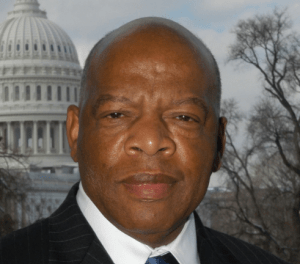
“Do not get lost in a sea of despair. Be hopeful, be optimistic. Our struggle is not the struggle of a day, a week, a month, or a year, it is the struggle of a lifetime. Never, ever be afraid to make some noise and get in good trouble, necessary trouble.”

John Lewis, who died July 17, tweeted that in 2018. But he used the term “good trouble” a lot. I heard him recite it on The Daily Show with Jon Stewart back in 2015. In fact, there’s a new documentary, John Lewis: Good Trouble. It has been streaming since July 3, though I’ve not seen it yet.

I HAVE read March, Books 1-3, a series of graphic novels with Lewis as a co-author. It covers his life up to the twin victories of the Civil Rights Act of 1964 and the Voting Rights Act (VRA) of 1965. Then it fast-forwards to the inauguration of one Barack Obama.

A casual reading would suggest that Rosa Park refused to stand, Martin Luther King gave a speech, Obama was elected, and voila! We HAVE overcome. Of course, this was not true for a variety of reasons, including the mass incarceration fueled by the drug wars.

The war on voting

Worse, there has been a real retrenchment of voting rights. In 2013, the Supreme Court eviscerated a key provision of the VRA. Section 5 of the law required jurisdictions with a history of discrimination to obtain approval before changing voting rules.

The Court held in Shelby County v. Holder “since the coverage formula was last modified in 1975, the country ‘has changed, and while any racial discrimination in voting is too much, Congress must ensure that the legislation it passes to remedy that problem speaks to current conditions.'” In other words, IMO, the Court decided that America was post-racial.

Just this week, SCOTUS allowed limits on felon voting in Florida. This action was taken in spite of the wishes of a majority of Sunshine State voters.

Google voter suppression 2020. In Rolling Stone, read The Plot Against America: The GOP’s Plan to Suppress the Vote and Sabotage the Election. The Minnesota Daily reminds us that in 2018, “gubernatorial candidate Brian Kemp, then Georgia’s Secretary of State, was blocking 53,000 voter registrations in Georgia,” and essentially stole the election.

Wisconsin voters in 2020 were forced to cast their ballots in the midst of a pandemic. Long voter lines, often in communities of color, are the result of selectively closing polling booths. It’s critical to continue to fight for the right to vote and run for office.

I just sent some money to FairFight.com. Also, I’m supporting the HEROES Act to safeguard our elections regardless of the pandemic. This will allow millions of voters to vote safely this November. Related, support the United States Postal Service from someone’s personal animosity.

As someone once said, “If voting weren’t important, they wouldn’t spend so much time keeping us from doing so.”

Fortunately…

Right now, there are groups of people recognizing the systemic injustices that continue to take place in the United States. Many are young, though there are a few gray hairs among them. They are every racial and ethnic grouping you can imagine. The timing couldn’t be better. I’m sure they’ll easily be able to find their own issues to address.

As friend Arthur wrote: “To really honour the man, the country should rededicate itself to finishing Lewis’ life’s work. That’s not just the good and right thing to do, but a moral imperative, too.”

In his 2017 memoir, Across That Bridge: A Vision for Change and the Future of America, John Lewis wrote something we need to remember about the struggle. “Freedom is not a state; it is an act. It is not some enchanted garden perched high on a distant plateau where we can finally sit down and rest. Freedom is the continuous action we all must take, and each generation must do its part to create an even more fair, more just society.”

The “good death” of Carl Reiner

Denny O’Neil, David Mazzucchelli, and me

It appears that Carl Reiner had a good death on June 29. The 98-year-old was productive and vital until the very end.

This is very clear as I was watching If You’re Not In the Obit, Eat Breakfast, the 2017 documentary for which Reiner was nominated for an Emmy. I caught it on July 3.

He “tracks down several nonagenarians [and older] to show how the twilight years can be rewarding.” The participants included Fyvush Finkel, who died before the release; the recently deceased Kirk Douglas; Betty White; Dick Van Dyke, with his much younger wife Arlene; Norman Lear; and naturally, his friend of 70 years, Mel Brooks. Here’s the preview.

I’m pleased to note that my daughter has watched all five seasons of The Dick Van Dyke Show, which Carl Reiner created, and which I love. Of course, he played the irritable TV star, Alan Brady, as well as the budding English anti-existentialist Yale Sampson, and several other annoying characters.

Not like his characters

But as Mark Evanier noted: “Carl Reiner was the friendliest, most talented person in show business… He was a guy I admired not just for his fine work as a writer, producer, director, and performer but for just the way he was as a person. Every time I was around him, he was an absolute delight – funny, engaging, willing to talk with anyone about anything. He was just what you’d want an idol to be. He was a role model for how to be truly successful and sane in show business.”

Yes, Carl Reiner was an actor (Ocean’s 11 franchise, Hot in Cleveland) and director (Oh, God; The Jerk; All of Me). But mostly he was a writer, going back to 1950s television, with Sid Caesar and Dinah Shore. He co-wrote and directed Dead Men Don’t Wear Plaid (1982) and The Man with Two Brains (1983).

I had wished he would have been selected for the Kennedy Center Honors, like his friends Mel Brooks had been in 2009 and Norman Lear in 2017. It may be that he was underappreciated as the straight man, such as the interviewer of Brooks’ 2000 Year Old Man.

Other recent deaths of note

Dennis O’Neil, who died June 11, was a comic writer who I admired greatly. His Green Lantern/Green Arrow with Neal Adams made the book relevant. He also did work on Iron Man and The Amazing Spider-Man.

Somewhere in my possession is a photo of O’Neil, David Mazzucchelli, Augustus Manly (Matt at the time), me, and a fifth person at the comic book store FantaCo in Albany. Denny and David were working on Daredevil at the time, so this had to be 1984 or 1985. He was quite pleasant, but I might have been a bit awestruck.

Hugh Downs, who passed away on July 1, was a constant presence in my television watching the last third of the 20th century. He hosted the game show Concentration (1958-1968), which BTW I was very bad at. Downs also co-hosted The Today Show (1962-1971).

With Barbara Walters, he co-hosted the news show 20/20 from 1978 until his retirement in 1999. In 1984, “he was certified by the Guinness World Records as holding the record for the greatest number of hours on network commercial television (15,188 hours).”

The reference to the “good death”, incidentally, comes from Paul McCartney explaining the song The End of the End from his 2007 album Memory Almost Full.

Margaret Lia and Freda Gardner

Normandy invasion

Margaret LiaThe mom of my childhood friend Ray, Margaret Lia died recently at the age of 95. She was the Den Mother of our short-lived Cub Scout troop. I was terrible at the craft-driven things I was supposed to do, but she was very patient with me.

I always liked her light British accent. When Ray got married in October 1976 to Pam, I got to escort Mrs. Lia to her seat, and I was quite pleased by that.

I didn’t know this romantic story until I read it in the obituary: “Margaret worked as a stenographer when her company was moved from London to the countryside for the duration of World War II. It was there that she met and fell in love with Albert Lia, a US Army serviceman, whose troops were preparing for the Invasion of Normandy. During Albert’s time in Europe, they corresponded by mail and after the war, he proposed in a letter. Soon she was emigrating to America to become his war bride and their loving marriage lasted 60 years.”

Like most funerals in this period, “a memorial mass will be celebrated at SS Cyril and Methodius Church at a later date.” St. Cyril’s on Clinton Street in Binghamton was very close to my now-razed school, Daniel Dickinson.

“Please consider a donation to the American Civic Association, 131 Front Street, Binghamton, NY, 13905.” The ACA is “an organization committed to helping immigrants and refugees start a new life in our community while preserving their ethnic and cultural diversity.”

My late father, Les Green, was involved with the place. He, sister Leslie and I performed there at least once as the Green Family Singers. In March of 1969, I had my 16th birthday party there. And unfortunately, it was one of those mass shooting sites back in 2009.

A pioneer

Freda Gardner Freda Gardner was a member of my church. We served on a couple of committees together, including Education. We were part of the group working with Pastor Glenn Leupold when he was getting his doctorate c 2012-2015. She was wise, intelligent, compassionate, and always an advocate for equality and justice.

A fellow church member took her to a local presbytery meeting a few years back. He introduced her, at which point everyone laughed. “Oh, WE know Freda!”

Until relatively recently, neither he nor I knew she had been elected Moderator of the 211th General Assembly of the Presbyterian Church (USA) in 1999 and was the first female full-time faculty member at Princeton Theological Seminary. She was a force in the PCUSA, but never boasted about it.

As Pastor Glenn noted, “Freda was a life-long learner, possessing a masterful use of language. She could explain just about any theological concept with clarity and precision, enabling many to understand.” She was 91. As is often the case recently, “A memorial service will be held at First Presbyterian Church in Albany, New York, at a date to be determined.”

Ramblin' with Roger
Social media & sharing icons powered by UltimatelySocial