
Generations of mothers

Oneonta is a lot closer than Charlotte

I’ve long been aware of how different my mother, my daughter, and I were raised. My mother grew up with her mother, Gertrude Williams, but also her grandmother Lillian (and her second husband, Maurice Holland), and her mother’s siblings Adina and Edward Yates at 13 Maple Street in Binghamton, NY. She had generations of mothers.

My sisters and I grew up with my parents, Les and Trudy Green, at 5 Gaines Street. But my parental grandparents, Agatha and McKinley resided just upstairs. My maternal grandmother, Gertrude, and her sister Adina lived just six short blocks away from us. In fact, my sisters and I went to 13 Maple Street at lunchtime during the school year and spent much of the summer there as well. It was a fair approximation of having generations of mothers.

The daughter of my wife and me saw her maternal grandparents maybe every six weeks or so. But they were over an hour away. Her maternal aunts and uncles weren’t close by either, though she at least has had a decent chance to know them and their kids, my daughter’s first cousins.

But my birth family was more geographically scattered. My parents moved to Charlotte, NC in 1974. Since my father died in 2000, my father and my father never got to meet each other. My mother and my sisters and niece Alex (daughter of Marcia) came up from Charlotte and San Diego a few times, and I went down to Charlotte with my daughter in 2009, when she was five. She doesn’t really remember my mom, who died in 2011.

So no local familial babysitters on either side except when we dropped her off in Oneonta for a few days.

Jade

The first time my daughter saw her cousin Rebecca (daughter of Leslie) was on television. Rebecca and Rico were on some show called Wipeout. My niece actually came in second. The first time my daughter saw her oldest cousin in person was at my mother’s funeral.

The next time was in 2013 when my cousin  Anne invited Rebecca, Rico, and my family to Thanksgiving dinner. (That was also the last time I saw my mother’s first cousins Robert and Donald Yates before they died.) My family did see Rebecca perform in NYC in 2017, but we spent five minutes with RJ afterward. At least we all had dinner together in Syracuse in 2019; thanks to Shela E. for both of these opportunities.

This explained why my daughter was so annoyed with me, after the fact, that I didn’t take her to the Dave Koz Christmas show on Long Island featuring Rebecca. And it’s why she and I are going to see Leslie singing in New York City in June. Leslie’s coming to my daughter’s high school graduation, and maybe Alex can too.

My daughter recognizes that I want her – maybe she also wants for herself – to better know my (tiny) side of the family.
1942: Casablanca and White Christmas

THAT’S R and B?

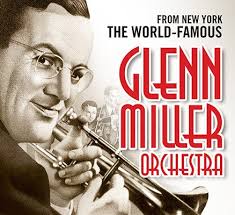
Glenn MillerIn Joel Whitburn’s A Century of Pop Music, an interesting note. “The recording industry enjoyed booming success during the early 1940s until the era’s dominant big bands were stilled on August 1, 1942, when the American Federation of Musicians joined in a ban on recording due to a dispute over musicians’ royalties.

“By the time all the record companies entered into an agreement to end the ban in late 1944, vocalists had assumed predominance over bands in popularity.”

This is also the year of one of my favorite movies, Casablanca. I’ve mentioned it at least a dozen times in this blog. I saw this film, outdoors in a park, maybe in Rochester (?) with my friend Debi. I’ve lost track of the friend ever since. Nor have I seen the film again, and it was at least thirty years ago, so I should fix that. It’s certainly one of the oldest films that I’ve ever viewed, aside from The Wizard Of Oz and a handful of others.

White Christmas – Bing Crosby (Decca), 11 weeks at #1, gold record. In 2016, I wrote a whole post about the song here. I noted that the recording ALSO led the rhythm and blues tally for three weeks that year, and continued to appear on some charts for several years. It is the best-selling single worldwide with an estimated 50 million copies sold.

Bronze Star

Moonlight Cocktail– Glenn Miller with Ray Eberle and the Modernaires (Bluebird), 10 weeks at #1, gold record. From Wikipedia: “In 1942, Miller volunteered to join the U.S. military to entertain troops during World War II, ending up with the U.S. Army Air Forces. On December 15, 1944, while flying to Paris, Miller’s aircraft disappeared in bad weather over the English Channel. He was posthumously awarded the Bronze Star Medal.”

Jingle Jangle Jingle– Kay Kyser with Henry Babbitt and Julie Conway (Columbia), 8 weeks at #1, gold record.

(I’ve Got A Gal In) Kalamazoo – Glenn Miller with Tex Bereke, Marion Hutton, and the Modernaires (Victor), 7 weeks at #1, gold record. Apparently, Kalamazoo was a funny-sounding city name, like Walla Walla and Schenectady.

Tangerine – Jimmy Dorsey with Bob Eberle and Helen O’Connell (Decca), 6 weeks at #1. A familiar tune, though I don’t remember specifically why.

Sleepy Lagoon – Harry James (Columbia), 4 weeks at #1. Instrumental.

A String Of Pearls – Glenn Miller (Bluebird), 2 weeks at #1. Instrumental. All of the Miller cuts are well known to me.

Blues In The Night (My Mama Done Tol’ Me) – Woody Herman (Decca)

Post-Roe worse than pre-Roe?

Employing the logic of Plessy v. Ferguson

Being old enough to remember the pre-Roe v. Wade days, it was a time when people with means were able to get a safe abortion by going somewhere else. Some people went as far as Sweden if memory serves.

Others would utilize back-alley ‘practitioners” who utilized “alternative” methodologies, which would often leave women infected, permanently incapable of bearing children, or occasionally dead.

In a post-Roe country, it will be a time when people with the means will be able to get a safe abortion by going somewhere else. I saw on the news that a clinic in Mississippi was working on a way to get people to New Mexico to receive services.

From the LA Times: “Defiant California leaders stood ready… to protect residents and non-residents alike from any federal rollbacks of abortion rights, though they could face significant challenges in expanding the state’s capacity to serve as a haven for those arriving from outside its borders.”

And those who choose to flaunt the state laws in Texas and Oklahoma? The populace has been deputized and monetarily incentivized to report alleged perpetrators. (What happened to the right to privacy?)

Check out these maps from Axios and the New York Times, though I’ve noticed these maps vary a bit, especially regarding Pennsylvania.

Being the masochist that I am, I actually read Justice Samuel Alito’s draft opinion in  Dobbs v. Jackson Women’s Health Organization. OK, not the last 30 pages, which cataloged all the historical opposition laws to abortion in the states and pre-state territories. One could research similar opposition to contraception, interracial marriage, same-gender marriage, and other rights that were once considered controversial.

Tribe response

Here are some responses that resonate with me.

The new Supreme Court’s iron fist by Laurence H. Tribe, who, not incidentally, is cited in the opinion on page 46.

“If the right of a woman to decide whether to have a baby — a right that arises from the simple idea that everyone owns their own bodies — won’t qualify, then neither will most of the rights you have long assumed are yours. And not a word of the draft would prevent women who have abortions, or who miscarry in circumstances the state deems suspect, from being imprisoned as criminals.

“And this might not be a two-sided coin: A court capable of doing what the Alito opinion would do is equally capable of saying that a nationwide abortion ban would represent a legitimate exercise of Congress’s power to treat abortions as commerce and accordingly ban them all, while a nationwide attempt to codify Roe and Casey to protect the liberty of women would be a constitutional overreach…”

Tribe trashes Alto’s “tortured” reasoning. “Indeed, the most relevant text, the Ninth Amendment, instructs that the failure of the Constitution to ‘enumerate’ a right cannot be taken to ‘deny or disparage’ its existence.”

Also, check out the Boston Globe piece, The Supreme Court is coming after democracy itself by Adrian Walker.

The Atlantic

In The Atlantic, Alito’s Plan to Repeal the 20th Century by Adam Serwer. If the conservative justice’s draft opinion is adopted by the Court, key advances of the past hundred years could be rolled back.

“Alito’s writing reflects the current tone of right-wing discourse: grandiose and contemptuous, disingenuous and self-contradictory, with the necessary undertone of self-pity as justification…

“Alito claims to be sweeping away one of the great unjust Supreme Court precedents, such as… Plessy v. Ferguson, which upheld racial segregation. But in truth, Alito is employing the logic of Plessy, allowing the states to violate the individual rights of their residents in any way their legislatures deem ‘reasonable,’ as the opinion in Plessy put it.

“Aside from rights specifically mentioned in the text of the Constitution, Alito argues, only those rights “deeply rooted in the nation’s history in tradition” deserve its protections. This is as arbitrary as it is lawless. Alito is saying there is no freedom from state coercion that conservatives cannot strip away if conservatives find that freedom personally distasteful…

“This is total gaslighting; he knows as well as anyone that these other rights are like Roe, rooted in the right to privacy. If Roe is imperiled because it is unenumerated and not ‘rooted in our history and tradition,’ then these other rights are also subject to challenge,’ Melissa Murray, a law professor at NYU, said of Alito’s disclaimer. ‘Conservative lawyers are going to eat this up like catnip, and of course, they are going to challenge these other precedents.'”

Delegitimized

I know I’m having a difficult time accepting the legitimacy of this Supreme Court because of the chicanery of its composition manipulated by Senate Republicans. When Antonin Scalia died in February 2016, they said Obama couldn’t select Merrick Garland to replace him because of “precedent” involving picking a justice in the President’s final term in office.

Yet the Senate ran over such “precedent” when Ruth Bader Ginsburg died in September 2020 and Trump appointee Amy Coney Barrett was confirmed in near-record time.

Speaking of the upper chamber, Susan Collins (R-ME) is shocked, SHOCKED that Gorsuch and Kavanaugh, who suggested to her that Roe was “settled law” during their confirmation hearings would lie to her.

Interesting times. Ugh.

Sunday Stealing: Firsts

Twilight Zone

firstsI’m been feeling blog unfocused. Maybe it’s after hitting my 17th anniversary of blogging, doing it every day another year felt a bit daunting.

I’ve missed doing ABC Wednesday, which I participated in for over a decade. It helped create my weekly blogging structure. So I’m going to do a bit of Sunday Stealing, which I’ve done as early as 2011 and as recently as 2021.

I may do it every week if the prompt strikes my fancy. Perhaps I’ll even do it on a Sunday!

This week are things that are firsts.

First Job: Newspaper delivery of the Evening and Sunday Press (Binghamton, NY) or library page (Binghamton Public Library)

First Favorite Politician: CLean Gene McCarthy

First Record/CD: Beatles VI (US album from Capitol Record Club

First Sport Played: kickball in the backyard, softball at school

First Concert: lots of local concerts that I don’t specifically recall. Seals and Crofts my first year of college

First Foreign Country Visited: Canada (Niagara Falls, ON)

First Favorite TV Show: Twilight Zone

First Favorite Actor: Bill Bixby of My Favorite Martian

First Favorite Actress: Annette Funicello of the Mickey Mouse Club

First Girlfriend/Boyfriend: probably Martha

First Encounter with a Famous Person: Nelson Rockefeller (briefly), or Rod Serling 

First House/Condo Owned: my current one

First Film Seen: 101 Dalmatians

First Favorite Radio Station: WEWNE, Endicott, NY

First Book I Remember Reading: Play The Game, a sports anthology book from the 1930s that I STILL OWN, and in fact, is in the room I’m sitting in

Rote memorization

87 years ago…

I’ve been musing on rote memorization. One reason is a column in the Boston Globe, The blessing of ‘rote’ memory by Jeff Jacoby. The subtitle: “Memorization for its own sake has long been unfashionable. It shouldn’t be.”

Jacoby notes: “There was a time when memorization was a standard feature of American schooling. In 1927, New York City’s board of education directed grade school teachers to teach poetry to pupils, with particular emphasis on the use of rhythm, diction, and imagery.”

Of course, “it isn’t only literature that can be memorized. The elements of the periodic table, the names and locations of the 50 states, the 46 US presidents, the first 100 digits of pi, the Seven Wonders of the Ancient World, all the best picture Oscar winners — the list is literally endless…

“Everyone memorizes some things — the multiplication tables, their Social Security number, song lyrics, the Wi-Fi password, family members’ birthdays — but memorization for its own sake has long since gone out of favor.” I was not specifically aware of that trend.

Lowest form?

“Writing in The American Scholar more than 40 years ago, the late Clara Claiborne Park, a professor of English at Williams College, commented on the disdain with which professional educators dismissed learning material by heart as mere ‘rote memory.’ She quoted one college president who sneeringly called memorization ‘the lowest form of human intellectual activity.'”

Jacoby pushes back. “But there is nothing ‘low’ about mastering a block of information so effectively that you can surface it at will… You don’t have to be a ‘Jeopardy!’ contestant to relish having instant recall of thick slices of knowledge. Memorization takes work, but there is joy in the accumulation of knowledge that requires no googling.”

I’ve actually gotten pushback in this blog about this in the past. Why remember it when you can just look it up? To which I’ve indicated the joy – yes, that’s the word – of knowing stuff.

The Word

When I used to attend a Friday Night Bible Club for several years, roughly from fourth through tenth grade, Pat, the woman running it, suggested that we should try to memorize Bible verses. To this day, I still remember Psalm 119:11, in the King James Version, of course. “Thy word have I hid in mine heart, that I might not sin against thee.”

Memorization was also the recommendation at her church, Primitive Methodist in Johnson City, coincidentally very close to where my parents would move after I went to college. I remember one of the PM teens selected John 11:35, “Jesus wept.” It wasn’t explicitly stated, but I have long thought that this process was suggested in case the Communists took over the country and took all of our Bibles.

Music allowed me to cheat somewhat. Because I know the anthem God So Loved the World, I can cite John 3:17. “For God sent not his Son into the world to condemn the world; but that the world through him might be saved.”

A college friend of mine surprisingly got into a brief but intense Christian phase. They recommended that I memorize all of the books of the Bible, and I dutifully did so.

Now? Well, I can get through the Pentateuch, then Joshua Judges Ruth, which, not incidentally, is the title of a Lyle Lovett CD that I own. Then the twofer history books, which are in reverse alpha order: 1st and 2nd Samuel, Kings, Chronicles. The history section ends with EastNortheast; I mean Ezra, Nehemiah, Esther. Job, Psalms, Proverbs, and… a couple more. The five major prophets, then I totally fall apart over the 12 minor prophets. I’m better with the New Testament, but some of the epistles – where IS Philemon? -are a bit shaky.

Lousy memory

I did really well with math tables. I know the Social Security numbers of my wife and daughter. And I used to remember all the area codes, and the geography they represented when the codes had a zero or one in the middle. Also, I’m rather good with birthdays.

But rote memorization of words was/is tougher. I struggled with the Emancipation Proclamation, which is only two minutes long. I could never be a leading actor because I couldn’t absorb the lines. In high school, I was the Fire Chief in Eugene Ionesco’s The Bald Soprano. I couldn’t remember some soliloquy, so someone put it on a scroll, which I took out and read, then flung towards the audience.

Yet I DO know the Presidents, which helped on JEOPARDY; the order of Beatles album releases (US AND UK), and most of the MLB players who hit more than 500 home runs.

The one thing I actively tried to instill into my child’s brain was the names of the states. Not exactly in alphabetical order, but the four A states, the three C states et al.

Recently, Kelly thanked his 7th grade English teacher for forcing his class to memorize a particular poem that he learned to hate, but since…

Social media & sharing icons powered by UltimatelySocial