The Battle at Lake Changjin

The movie market in China

The Battle at Lake ChangjinI was falling down a rabbit hole, looking at 2021 box office grosses for movies. I knew Spider-Man: No Way Home had the largest gross sales.
DOMESTIC (45.3%) $627,428,198
INTERNATIONAL (54.7%) $759,000,000
WORLDWIDE $1,386,428,198

It’s interesting how well the film did in so many countries: $44.7M in France, $61.4M in the UK, and almost $41M in South Korea. But not in China.

Whereas for The Battle at Lake Changjin, almost all of the revenue is from China.
DOMESTIC (–) (Released Nov 19, 2021) $342,390
INTERNATIONAL (100%) $902,198,524
United Kingdom (Nov 19, 2021) $63,392
Australia (Dec 2, 2021) $138,739
Hong Kong (Nov 11, 2021) $2,596,393
China (Oct 1, 2021) $899,400,000
WORLDWIDE $902,540,914

And what IS this film? “Set in the Second Phase Offensive of the Korean War, ‘The Battle at Lake Changjin’ tells an epic historical tale: 71 years ago, the People’s Volunteer Army (PVA) entered North Korea for battle. Under extreme freezing conditions, the troops on the Eastern Front pursued with fearless spirit and iron will, as they courageously fought the enemy at Lake Changjin (also known as Chosin Reservoir). The battle was a turning point in the Korean War and demonstrated the courage and resolve of the PVA.”

In fact, 108 of the 200 top-grossing films have 0% sales in the United States. Another five got 0.1% of its box office from the US. Six of the eight critics in Rotten Tomatoes panned it.

Time travel

Number 3 on the list is Hi, Mom: “A woman travels back in time to befriend her own mother in an attempt to make her life better.” Though it had a limited box office in Australia, New Zealand, and Hong Kong, $821M of the $822M in sales were in China, with none from the US. The four critics in RT liked it a lot.

The fourth film was No Time To Die, the most recent James Bond film
DOMESTIC (20.8%) $160,772,007
INTERNATIONAL (79.2%) $613,262,000
WORLDWIDE $774,034,007
The list of countries is lengthy and broad.

F9: The Fast Saga ranks number 5.
DOMESTIC (23.8%) $173,005,945
INTERNATIONAL (76.2%) $553,223,556
WORLDWIDE $726,229,501
Lots of countries are represented as well, though China is quite important with almost $217M in ticket sales.

Movies into musicals

I started thinking about this when I read what Mark Evanier wrote about movie musicals. “There are 27 (!) stage musicals which are ‘in development’ as movies.” Given the lackluster box office of In the Heights and West Side Story, most of these films probably won’t be made.”

West Side Story
DOMESTIC (54.4%) $30,271,174
INTERNATIONAL (45.6%) $25,331,328
WORLDWIDE $55,602,502
Nothing from China

In the Heights
DOMESTIC (68.1%) $29,879,041
INTERNATIONAL (31.9%) $14,000,000
WORLDWIDE $43,879,041
Ditto

China

I read that This Year, Hollywood’s China Relationship Finally Unraveled. It doesn’t matter how accommodating the industry may be — the next phase of the Xi Jinping era may be defined by less space for Western content.

“Despite attempts to make it past China’s censors, Space Jam: A New Legacy never received a release in China this summer and scored just $162.8 million worldwide… — Disney received the same cold shoulder when it came to its Marvel tentpoles Shang-Chi and the Legend of the Ten Rings and The Eternals, films that were built around Chinese talent in order to make a giant showing in the market. But to no avail.

“Neither film was given a release in the country that continues to take heat for reported human rights abuses. Hollywood’s silence on those abuses has become deafening as other industries and entities have begun to confront China. In fact, 2021 — with its diminishing economic returns in the country — might mark the year that finally cooled the Hollywood-China romance.

“The reversal of fortunes in China has begun to accelerate in the past year. In 2021, just 25 U.S. movies were released theatrically in the country, many of which were minor indie titles instead of studio tentpoles. By contrast, some 45 Hollywood movies were shown on Chinese screens in 2019. That is forcing the major studios to pivot on their China ambitions, mostly because there is little to no growth to be attained in the country in the current climate… “
Movie review: West Side Story

There’s a place for us

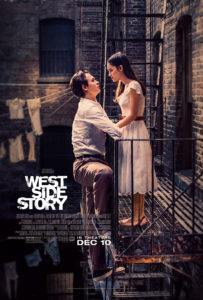
West Side StoryOf course, my wife my daughter, and I HAD to go see the new movie West Side Story. Not only have we all seen the original film a number of times, but we’ve all attended at least three stage productions of the musical.
First, we loved the physical setup of the opening. The signage suggests the future location of Lincoln Center. It makes sense. “April 21, 1955: The Mayor’s Slum Clearance Committee chaired by Robert Moses is approved by the New York City Board of Estimate to designate Lincoln Square for urban renewal.” Nine years later, buildings began opening. The rubble in the new film was more believable.

Thus, this iteration is in keeping with the timeframe of the original musical (1957) and movie (1961). Of course, the vintage cars would tip one off as well.

This Tony (Ansel Elgort) has a rap sheet, less the dewy-eyed kid from film #1. So his Something’s Coming is less a certainty than a need. But he has the support of Valentina (executive producer Rita Moreno), who is the widow of Doc, who had run the store in the first movie. Valentina is a more substantial character and gets the most affecting song late in the story.

Fancy colors

My daughter noted the color schemes of the Jets (blues, greys) and Sharks (reds, browns). Though I wasn’t consciously aware of this, I must have subliminally picked up on the motif.

This Anita (Ariana DeBose) is at least as feisty as her predecessor, as Bernardo (David Alvarez) finds out. The “eyes lock across the room” between Tony and Maria (Rachel Zegler) isn’t as dramatically corny as in the first film.

What I loved about Tony singing the song Maria afterward is that other people notice, some with admiration, others with disdain, which was occasionally funny.

America was enhanced by dancing in the streets, with passersby occasionally getting a line. Gee, Officer Krupke really works in the new setting, with the ultimate musical payoff. One Hand, One Heart is lovely.

I always found Cool to be the weakest song in the show. In the musical, it’s before The Rumble, but afterward in the original film. It’s before here, but serving a very different purpose, showing a rift between Tony and Riff (Mike Faist).

The Tonight Quintet is the piece that first made me fall in love with West Side Story. The set of The Rumble, with the long shadows, worked well. So did the Gimbels, an old competitor of Macy’s in the day, for I Feel Pretty.

Opera?

My nutritionist said that WSS is an opera. No more so than A Boy Like That/I Have A Love. The scene at Doc’s with Anita and the Jets was stronger this time.

It seems that from where Chino (Josh Andrés Rivera) shoots Tony, he could have also wounded Maria as well. This Chino was better developed. So was Anybodys (Iris Menas). This is a very talented cast.

If not every note feels as it did when I saw the original nearly six decades ago, it’s OK. Some folks complained that there was some dialogue in Spanish that was not translated. Given the fact that people throughout – the cops, and even Bernardo – were insisting people “speak English”, it was no big deal to me. But I will allow there was occasionally a bit too much talking altogether, IMO.

Still, we’re glad we saw the new film. The critics mostly agree. The box office was rather anemic. Did that have anything to do with allegations against Elgort?

A more fundamental question is whether there should be a remake at all. Did we NEED another version of A Star Is Born a couple of years ago? I dunno, but I don’t spend much time thinking about it.

I’m glad that WSS lyricist Stephen Sondheim got to see this film before he died. He said that he loved it. My family saw it at the Spectrum Theatre in Albany on December 30.

MLK: Where Do We Go from Here?

seeking the highest good

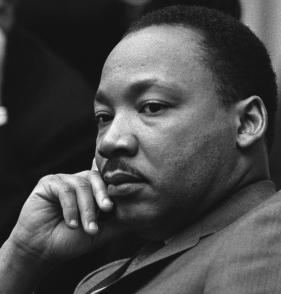
martin-luther-king-jr-photo
Jan 15, 1929- Apr 4, 1968

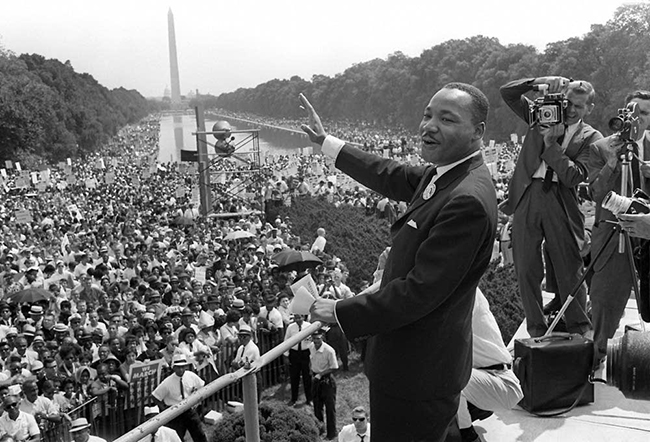
Dr. Martin Luther King, Jr. delivered his “Where Do We Go from Here” sermon at the annual convention of the Southern Christian Leadership Conference in Atlanta, Georgia on August 16, 1967. You can read the sermon in full in the book The Radical King, edited by Cornel West.

West wrote in the book introduction. “The radical King was a democratic socialist who sided with poor and working people in the class struggle taking place in capitalist societies. . . . The response of the radical King to our catastrophic moment can be put in one word: revolution—a revolution in our priorities, a reevaluation of our values, a reinvigoration of our public life, and a fundamental transformation of our way of thinking and living that promotes a transfer of power from oligarchs and plutocrats to everyday people and ordinary citizens. . . . Could it be that we know so little of the radical King because such courage defies our market-driven world?”

MLK’s Concerns

“I’m concerned about a better world. I’m concerned about justice; I’m concerned about brotherhood; I’m concerned about truth. And when one is concerned about that, he can never advocate violence. For through violence you may murder a murderer, but you can’t murder murder. Through violence, you may murder a liar, but you can’t establish truth. Through violence, you may murder a hater, but you can’t murder hate through violence. Darkness cannot put out darkness; only light can do that.

“And I say to you, I have also decided to stick with love, for I know that love is ultimately the only answer to mankind’s problems. And I’m going to talk about it everywhere I go. I know it isn’t popular to talk about it in some circles today.

“And I’m not talking about emotional bosh when I talk about love; I’m talking about a strong, demanding love. For I have seen too much hate. I’ve seen too much hate on the faces of sheriffs in the South. I’ve seen hate on the faces of too many Klansmen and too many White Citizens’ Councilors in the South to want to hate, myself, because every time I see it, I know that it does something to their faces and their personalities, and I say to myself that hate is too great a burden to bear.

“I have decided to love. If you are seeking the highest good, I think you can find it through love. And the beautiful thing is that we aren’t moving wrong when we do it because John was right, God is love. He who hates does not know God, but he who loves has the key that unlocks the door to the meaning of ultimate reality.”

Echoes of 1 Corinthians 13  

“And so I say to you today, my friends, that you may be able to speak with the tongues of men and angels, you may have the eloquence of articulate speech; but if you have not love, it means nothing.

“Yes, you may have the gift of prophecy, you may have the gift of scientific prediction and understand the behavior of molecules, you may break into the storehouse of nature and bring forth many new insights. Yes, you may ascend to the heights of academic achievement so that you have all knowledge, and you may boast of your great institutions of learning and the boundless extent of your degrees; but if you have not love, all of these mean absolutely nothing.

“You may even give your goods to feed the poor, you may bestow great gifts to charity, and you may tower high in philanthropy; but if you have not love, your charity means nothing.

“You may even give your body to be burned and die the death of a martyr, and your spilt blood may be a symbol of honor for generations yet unborn, and thousands may praise you as one of history’s greatest heroes; but if you have not love, your blood was spilt in vain.

“What I’m trying to get you to see this morning is that a man may be self-centered in his self-denial and self-righteous in his self-sacrifice. His generosity may feed his ego, and his piety may feed his pride. So without love, benevolence becomes egotism, and martyrdom becomes spiritual pride.”

In conclusion

“I want to say to you as I move to my conclusion, as we talk about ‘Where do we go from here?’ that we must honestly face the fact that the movement must address itself to the question of restructuring the whole of American society. There are forty million poor people here, and one day we must ask the question, ‘Why are there forty million poor people in America?’

“And when you begin to ask that question, you are raising a question about the economic system, about a broader distribution of wealth. When you ask that question, you begin to question the capitalistic economy. And I’m simply saying that more and more, we’ve got to begin to ask questions about the whole society.

“We are called upon to help the discouraged beggars in life’s marketplace. But one day we must come to see that an edifice which produces beggars needs restructuring. It means that questions must be raised. And you see, my friends, when you deal with this you begin to ask the question, ‘Who owns the oil?’ You begin to ask the question, ‘Who owns the iron ore?’ You begin to ask the question, ‘Why is it that people have to pay water bills in a world that’s two-thirds water?’ These are words that must be said.”

And much earlier: Give Us The Ballot

Per Alan Singer: “‘On May 17, 1957, Reverend Dr. Martin Luther King, Jr. was one of the speakers at a Prayer Pilgrimage held at the Lincoln Memorial in Washington DC. King demanded that Congress pass legislation ensuring the right of African Americans to vote.

“He condemned Democrats for ‘capitulating to the prejudices and undemocratic practices of the southern Dixiecrats’ and Republicans for ‘capitulating to the blatant hypocrisy of right-wing, reactionary northerners.’ In typical King linguistic poetry, he charged ‘These men so often have a high blood pressure of words and an anemia of deeds.'”

Also, from Jeffrey Cass: The Absurdity of Racists Co-opting MLK’s Legacy. Stop using King’s words to support oppressive systems

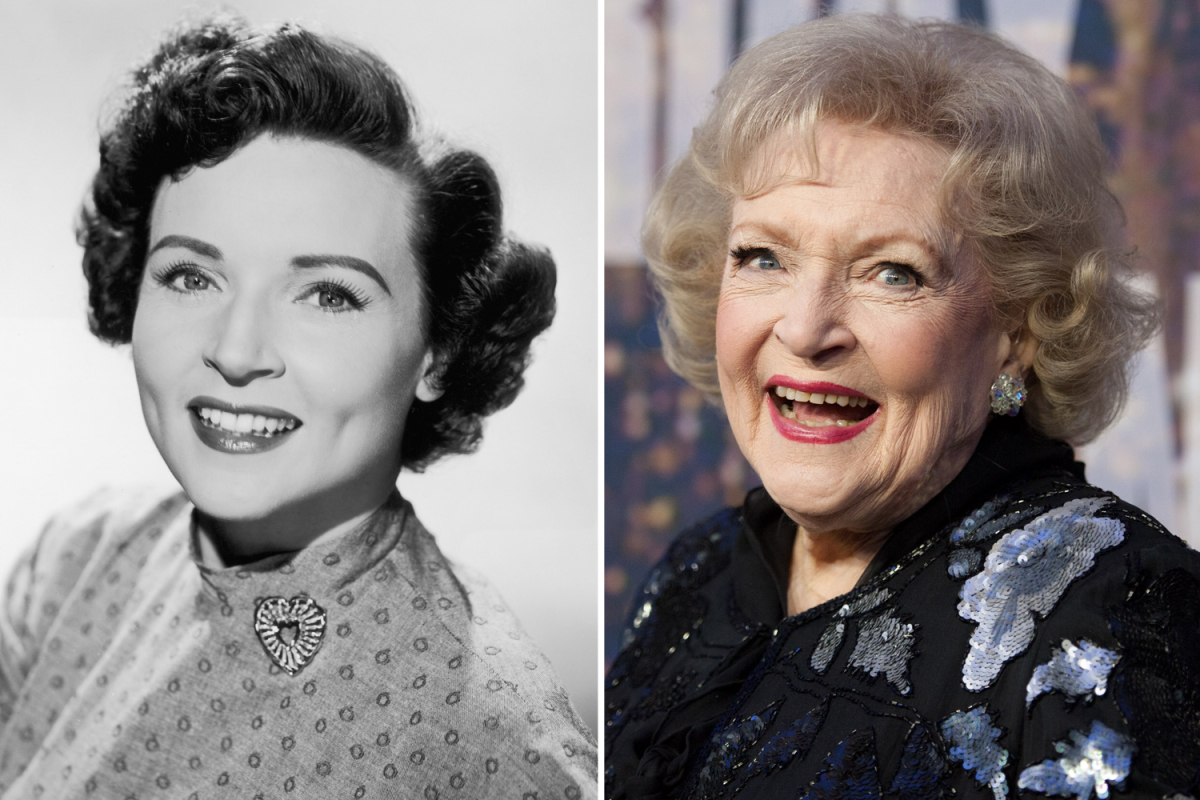
Betty White would have been 100

six Emmys

Betty White

On New Year’s Eve, my daughter yelled down the stairs to me. “Betty White died.” Major bummer. Betty White would have been 100 tomorrow. If you read what I wrote when she turned 90, you know I’ve thought she’d been very cool for a long time.

From the Boston Globe: “White began her television career as $50-a-week sidekick to a local Los Angeles TV personality [Al Jarvis] in 1949… ‘I did that show 5½ hours a day, six days a week, for 4½ years… Jarvis was replaced by actor Eddie Albert, and when he went to Europe for the film ‘Roman Holiday,’ she headed the show.”

She starred and more remarkably produced the sitcom Life with Elizabeth in 1952, based on a sketch she had done with Jarvis.

From All That’s Interesting: “It was a minor coup when Betty White got her own [variety] show in 1954 with full creative control. Not one to waste an opportunity, White immediately set about hiring [black tap dancer Arthur Duncan to perform]  on her show…

“But even in California, Duncan’s regular presence on the show drew criticism. And it only escalated after NBC rolled out the show nationally, with Southern viewers threatening to boycott the network if White didn’t remove Duncan from the lineup. Although NBC eventually canceled White’s show,” Duncan became a star on The Lawrence Welk Show from 1964 to 1982.

She met her great love, Allen Ludden, in 1961 when she was a contestant on Password, the game show he hosted. she turned down his proposals for a year, in part because of her two, brief failed marriages. They were married from 1963 until he died from stomach cancer in 1981.

Always game

Betty was a GREAT game show contestant. She was a regular panelist on Match Game, Tattletales, To Tell the Truth, The Hollywood Squares, and The $25,000 Pyramid. No wonder she had been dubbed “the first lady of game shows.” As recently as 2008, she was a stellar contestant on an iteration of Password. She snagged a Daytime Emmy for hosting the game show Just Men! in 1983, the first woman to do so.

She had over 300 credits as herself, from hosting holiday parades to appearing on talk shows. As host of Saturday Night Live in 2010, she won her most recent Emmy.

Betty has also won Emmys for Mary Tyler Moore Show twice, Golden Girls, and for a guest appearance on The John Larroquette Show (1993). She has over 100 acting credits, from soap operas to My Name Is Earl.

People magazine has a piece about her secrets for long life. CNN has array of photos throughout her career. There’s still scheduled a special movie event called “Betty White: 100 Years Young — A Birthday Celebration” on the date, January 17. It was to cover her lengthy career and her animal advocacy.

Linkage

Of course, after she died, there were tons of tribute pieces. Here are some I found particularly interesting.

Hollywood Reporter: She was as important as she was beloved

Parade: Quotes. You REALLY should read the first one, at least

Variety: Funniest Moments, including feuding With Ryan Reynolds

Mark Evanier: “Actors… we’re all like feral cats.”

Songs of freedom, for MLK

One day when the glory comes
It will be ours, it will be ours

mlkIn honor of MLK’s birthday, here are some songs of freedom. All but the last four were sung by participants of the march from Selma to Montgomery in March 1965. Of course, they were also shared at other rallies and marches. Many of these songs are from the church tradition.

There are a LOT of tunes that could be labeled civil rights songs. Here is a recent compilation.

God Will Take Care Of You – Aretha Franklin. This is from her great Amazing Grace album. The movie about making that album is also quite worthwhile.
We Are Climbing Jacob’s Ladder – Bernice Johnson Reagon and Vocal Group. She was a member of the wonderful group Sweet Honey in the Rock, which I saw perform decades ago.
Steal Away – Mahalia Jackson and Nat King Cole. Mahalia was Martin’s favorite singer, by all accounts. This was on Nat’s short-lived television show on NBC in the mid-1950s, a pioneering effort in its own right.

Nobody Knows The Trouble I’ve Seen – Paul Robeson. Actor and activist, as well as a tremendous singer.
We Shall Not Be Moved – The Freedom Singers. Performed at the March on Washington on August 28, 1963
Oh, Freedom – The Golden Gospel Singers
If You Miss Me In The Back Of The Bus  – Kim and Reggie Harris, who I saw sing in person twice some years back

Keep Your Eyes On The Prize  · Robert Parris Moses
Ain’t Gonna Let Nobody Turn Me Around – The Roots. From the soundtrack to the film Soundtrack For a Revolution (2012)
We Shall Overcome  – Joan Baez. She performed at the march on Washington and elsewhere. This performance was in London in 1965

Mavis

I Wish I Knew How It Would Feel To Be Free – Nina Simone. An anthem.
When Will We Be Paid – Staple Singers
99 and 1/2 (Won’t Do) – Mavis Staples. I most highly recommend the album We’ll Never Turn Back.
Glory – Common and John Legend from the 2014 movie Selma. This was performed by the youth of our church a few years back.

Ramblin' with Roger
Social media & sharing icons powered by UltimatelySocial