S is for Statues of Robert E. Lee

The Confederate memorials were an attempt to erase history.

The conversation about Confederate statues in the United States is highly charged, as recent events in Charlottesville, VA have shown.

I absolutely agree with The Hill:
“Please don’t direct the discussion towards the ownership of slaves. Then we just get into the argument that people like George Washington and Thomas Jefferson owned slaves. That’s not the point! Washington and Jefferson are well known in history from the beginnings of our country. [General] Robert E. Lee was a traitor to his country. These monuments were constructed well before African-Americans were permitted to vote, and they are only a reminder that racism still exists.”

But, as The Week notes in How America forgot the true history of the Civil War: “Ex-Confederates and associated sympathizers began to think up alternative histories that sounded better [than slavery], starting right after the war ended. The major plank of this was the ‘Lost Cause,’ which argued that the war was not actually about slavery — instead, it was about ‘states’ rights.’

“The antebellum South was cast as a sepia-toned paradise of noble gentlemen, virtuous ladies, and happy slaves.” John Oliver reveals The Ugly Reality Behind The ‘Lost Cause’ Cult.

In other words, the Confederate memorials were an attempt to erase history, as this southern white male and this one note.

Most of those statues were erected during the Jim Crow era before and after World War I, after the re-imposition of white supremacy. As Smithsonian magazine makes clear, We Legitimize the ‘So-Called’ Confederacy With Our Vocabulary, and That’s a Problem. “Tearing down monuments is only the beginning to understanding the false narrative of Jim Crow.

More than 4,000 black people were lynched in the South — where are their monuments?

To understand how toxic the period was, read Before its subversion in the Jim Crow era, the fruit symbolized black self-sufficiency. So, what changed? And Lynching and Antilynching: Art and Politics in the 1930s.

Robert E. Lee was NOT “invariably kind and humane” to the people he enslaved, despite scuttlebutt of his benevolence. Here’s W.E.B. DuBois on Robert E. Lee. My fellow TU blogger Rob Hoffman noted:”The last thing we need in our divided nation is to excuse the behavior of a man, even one as talented as Robert E. Lee, for betraying his country at a time when it really needed him most.”

Moreover, Lee himself said: “I think it wiser …not to keep open the sores of war but to follow the examples of those nations who endeavored to obliterate the marks of civil strife, to commit to oblivion the feelings engendered.”

I’d like to see some of those statues in museums, where context can be explained. Listen to the semi-comedic The Ballad Of General Robert E. Lee’s Statue.

Movie review: Victoria and Abdul

Someone can indeed show an old queen new tricks

In my busyness, I neglected to write a review of the movie Victoria and Abdul, which my wife and I saw at the Spectrum Theatre in Albany in October 2017. It’s a mostly true story of a couple guys from India sent to England to present Her Royal Highness, Empress of India, Queen Victoria with a coin for her golden jubilee.
Victoria (Judy Dench) is, by her own description, old and fat and very much a curmudgeon, bored with the pomp of the affairs of state. It’s worse because her beloved husband Albert died, and her good friend John Brown is gone as well. (I saw the movie Mrs Brown, also starring Dame Judi, back in February 1998; V&A is is a sequel of sorts.)

As Abdul Karim (Ali Fazal) and Adeel Akhtar (Mohammed) make their brief presentation, the former violates protocol by actually making eye contact with the queen. The handsome Abdul finds favor with the monarch and they develop a most unexpected friendship.

Her household and inner circle, notably Sir Henry Ponsonby (Tim Pigott-Smith) and her increasingly impatient heir apparent Bertie, Prince of Wales (Eddie Izzard) are NOT pleased with the queen’s fascination with the Indian interloper.

Victoria and Abdul, in a mostly humorously cheeky way, shows that someone can indeed show an old queen new tricks. It addresses Britain’s colonial past, making it clear that Victoria could actually learn from even her far-away subjects. And while her Mr. Brown was not well-regarded by those around the queen, the elevation of this brown-skinned man made them apoplectic.

I will admit that I liked Victoria and Abdul it more than some of the critics (only 66% positive on Rotten Tomatoes). One complained that “the film’s attempt to portray the Queen as more politically enlightened than her courtiers is kindly but unconvincing.” Well, my wife and I were convinced.

The leads plus Eddie Izzard were especially good. I may have now seen Judi Dench in more movies than any other actor, save perhaps Meryl Streep, and she always makes the trip to the cinema worthwhile.

The Vietnam War by Ken Burns and Lynn Novick

The real value of the documentary was the story telling

There are over 6.6 million living veterans in the United States from the Vietnam war era. That constitutes about 36% of all US vets, according to the 2016 American Community Survey, the largest contingent in the country.

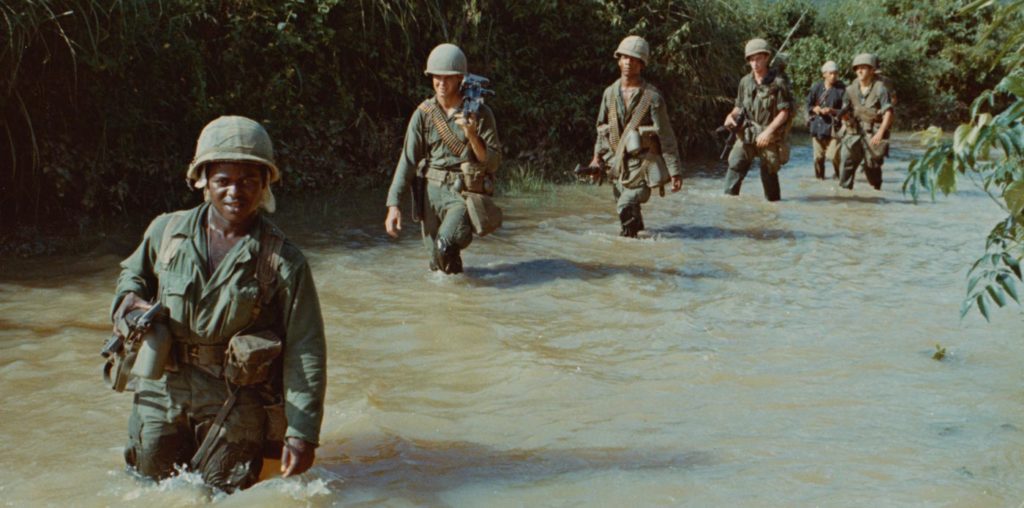
And of course, it was the war I grew up with. So I just HAD to watch the series The Vietnam War by Ken Burns and Lynn Novick, all 10 segments, all 18 hours of it, though it took almost a month. It did not lend itself to binge-watching.

I knew quite a bit about the war from my time protesting it. Names, dates. 1954: the French fall at Dien Bien Phu. But I never felt how brutal the battle was. How the the United States, first little by little, then in a big way after the Tonkin Gulf resolution, expanded the war, were facts I knew.

Of course I had not been privy to the thoughts of the American Presidents and their administrations as they struggled with their decisions as events on the ground did not go as planned.

The real value of the documentary, though, was the story telling: the soldiers that were there taking this hill or that, only to abandon it a few days later. The sister of one soldier killed in Vietnam who became an antiwar activist.

And while the segments prior to my political awareness were interesting, seeing the parts I lived through had the greater impact. It managed to reflect all sides of the war: Vietcong soldier to disillusioned American vet.

The evolution of the antiwar movement was of particular interest to me. The killings of four students at Kent State in 1970, for instance, which I was well aware of, nevertheless became deeply personal.

One of the odd takeaways I got was that Hillary Clinton was Lyndon Johnson were the policy wonks who arguably the most qualified in 2016/1960, but that the more TV/media-savvy candidate got the nomination (John Kennedy) or won the election, even though Trump had claimed his sex life was his personal Vietnam.

I saw the criticism of the Burns/Novick work, that “Vietnam was not a ‘tragic misunderstanding’ but a campaign of ‘imperial aggression.'” Surely it was the latter, but I leave room for the possibility that it was the former as well.

Songs of war and the protest of same

When I watched The Vietnam War, the PBS series by Ken Burns and Lynn Novick, in October 2017, I was naturally drawn to the music. Here is the list of the 120+ songs that were included in the 18-hour program, which you can listen to at Spotify, or find on YouTube.

Some were very familiar, others not, but I was fascinated that there were at least five Beatles songs – Tomorrow Never Knows, Revolution 1, While My Guitar Gently Weeps, Blackbird, and Let It Be, which can be expensive to license. (I swear I also heard Piggies, but maybe I was just hallucinating.)

Coincidentally or not, Robert S. Hoffman posted Protest music: Music you can resist to, which include three of the songs on the Burns/Novick roster: Eve of Destruction by Barry McGuire, For What it’s Worth by Buffalo Springfield, and Ohio by Crosby, Stills, Nash, and Young, the powerful outro for episode eight.

As Dustbury pointed out: “For about as long as there have been protests, there have been protests of protests. This 1966 wonder, on the real-life Are You Kidding Me? label, lays out its agenda before the very first verse… The Beach Bums were Doug Brown and the Omens, plus a different frontman than usual: Bob Seger, who probably wrote this under the ‘D. Dodger’ pseudonym.”

But The Ballad of the Yellow Berets was WAY too close of a ripoff of the tune that was #1 for five weeks on the Billboard pop charts in 1966, longer than any song that year.

The Ballad of the Green Berets [listen] was co-written and performed by Staff Sergeant Barry Sadler, From the Billboard Book of Number One Hits by Fred Bronson: “He was sent to Vietnam, where his fellow soldiers showed little interest in his songs…

“His Vietnam duty was cut short when he fell into a booby trap while on patrol….Lapsing in and out of consciousness, he treated the [leg] wound himself.”

Robin Moore, author of the book The Green Berets, got hold of Sadler’s 12-verse song about the army combat unit and edited it down. Initially released to the military, it was so popular, Moore took the track to RCA, which “agreed to finance a full recording session, complete with orchestra.”

Thank you for your service?

Dr. Sherman describes ‘thank you for your service’ as a ‘token of gratitude or something that is meant to break the ice, although it often doesn’t accomplish that goal.’

“Thank you for your service,” says golf pro Michael Allen to Major William McGarry, Bioenvironmental Equipment Engineer, 944th Aeromedical Staging Squadron during the last day of the Charles Schwab Cup Championship at Desert Mountain Club in Scottsdale, Ariz., Saturday. (U.S. Air Force Photo by Tech. Sgt. Meredith Mingledorff)

The family was listening, again, to the original cast album for the Broadway sensation Hamilton, when this dialogue from the song Helpless came on:
[ELIZA]
Thank you for all your service
[HAMILTON]
If it takes fighting a war for us to meet, it will have been worth it

And I laughed. The Wife wondered why, and I said that “Thank you for your service” is such a 21st century trope, used there as a deliberate anachronism. And by trope, I mean “a common or overused theme or device.”

This got me to wondering how vets feel about it. In Why Saying “Thank You for Your Service” Offends Some Veterans, James Kelly wrote: “As active-duty USMC, I have to admit that when people thank me for my service, I feel awkward and a little uncomfortable. But why? Where do veterans’ uneasiness come from?

“The first issue is that literally everyone says it. In fact, it is said so much that it has become, to many vets, an empty platitude, something you just say because it is politically correct.

“Some veterans believe that saying ‘thank you for your service’ is almost a way for civilians to massage away some of the guilt at not participating themselves.”

Rich (only name given), suggests “Thank You for Your Service” Can Actually Do More Harm Than Good.

“In her book Afterwar: Healing the Moral Wounds of Our Soldiers (2015), Dr. Nancy Sherman discusses this conflicted relationship veterans have with the phrase and the people who casually offer it. As University Professor of Philosophy at Georgetown University and the Inaugural Distinguished Chair of Ethics at the United States Naval Academy, she is a philosopher who lectures worldwide on moral injury and military ethics.

“Dr. Sherman relates this to a greater problem that she describes as the ‘gaping disconnect between those who wear the uniform and those who don’t.’ She describes thank you for your service as a ‘token of gratitude or something that is meant to break the ice, although it often doesn’t accomplish that goal.’ Instead, it can at times come across as ‘glib,’ or just a ‘one-stop remark [a person] can dispense with’ to avoid any meaningful communication.”

See also Please Don’t Thank Me for My Service.

So what should you do instead?

The first article notes:

“When I asked veterans how civilians should thank them for their service, one answer proved to be the most common: ‘VOTE!’ Volunteer in your community, try and make a difference, and vote for what you believe is right. Honor the actions of veterans by ensuring that your voice is heard at the ballot box. Educate yourself on veterans’ issues. There are a number of fantastic organizations that help veterans with real issues but the most impactful is to use your right to make your voice heard.”

The second:

“If you want to thank a veteran, be considerate, be genuine, and be willing to listen or have a conversation. Dr. Sherman suggests simple alternatives that may actually contribute to repairing the military-civilian gap. If the service member appears to be willing and able to talk with you, you should invite a respectful conversation.

“‘I am grateful for your service. Where were you deployed? What was it like?’

“You might also ask: How is your transition back home so far? What is/was your job in the military? How is your family doing with your service? What do you want to do now that you’re back?”

I must say that I would personally be very uncomfortable with doing this latter thing, for reasons stated in the article. “It’s also true that many [vets] do have physical and emotional scars or moral wounds as a result of their service and are dealing (or not) with lingering feelings of guilt, shame, or helplessness, among others.”

So I’ll probably do what I’ve been doing all along, which is giving the knowing head nod, hoping that’s it’s adequate, at least for the moment.

Ramblin' with Roger
Social media & sharing icons powered by UltimatelySocial