
Why W and K for US radio and TV stations?

“It was only in late January, 1923 that the K/W boundary was shifted east to the current boundary of the Mississippi River.”

One of those mundane questions I’ve long wondered about, but never bothered to look up, is why virtually all the radio and television stations in the US start with either the letter W or K.

From Primer Magazine: “In 1912, several countries attended a conference centered on the subject of ‘International Radiotelegraphs.’ One of the biggest things to come out of this gathering was the assignment of certain letters to certain countries, to identify their radio signals – America was given W, K, N, and A (fun fact: Canada got ‘C’ and Mexico got ‘X’).”

But why those particular letters in the US has seemingly been lost. (A for America?)

“While N and A were chosen for American military radio stations, W and K were designated specifically for commercial use. Stations were allowed to choose the letters that followed the K or the W, and the combination was allowed to be three or four letters in length.”

Initially, the K stations were to the east and the W stations were to the west. Thus one can find early radio stations such as KDKA out of Pittsburgh, PA, established in 1920. By 1926, the Federal Communications Commission codified the idea of having four letters, but stations with three didn’t need to change.

From Early Radio History:

“The original K/W boundary ran north from the Texas-New Mexico border, so at first stations along the Gulf of Mexico and northward were assigned W calls. It was only in late January, 1923 that the K/W boundary was shifted east to the current boundary of the Mississippi River. With this change, K’s were assigned to most new stations west of the Mississippi; however, existing W stations located west of the Mississippi were allowed to keep their now non-standard calls.”

This page has more information on the topic than most mortals would want to know, such as the K/W exceptions and other trivia. For instance, some break the rules by owner requests -examples: WACO in Waco, Texas; WMT (Waterloo [Iowa] Morning Tribune). The page was compiled on 1 January 2017, so it’s quite recent.

For ABC Wednesday

Trivial metadata surrounding music

I’ll bet some of them used to read the side panels of cereal boxes.

A friend of mine wrote this about his wife: “[She] likes music but isn’t obsessed with the trivial metadata surrounding it — you know, she knows a song when she hears it but might not know the title or artist, or underlying themes, or what studio it was recorded in, or if the band’s usual drummer was replaced by someone else for some reason on that particular song — that sort of thing doesn’t interest her.”
My wife is like that. And so are many folks who read my blog who DON’T know who Holland-Dozier-Holland are, or Barry and Greenwich, or Doc Pomus, or even George Martin when I mention them here, all of whom are in the Rock and Roll Hall of Fame. They do know Carole King from the album Tapestry, but Gerry Goffin, or Mann and Weil, not so much unless they happened to have seen Beautiful: The Carole King Musical.

What I realized is that my friend, and much of the crew who worked at FantaCo, and the director of my library, and Dustbury, and Chuck Miller, and I are the anomalies. We’re the geeky outliers who used to read the liner notes of albums to find out who wrote each song, who produced the tracks, even each song’s running time. We discovered that the person who wrote X also both wrote AND produced Y.

I’ll bet some of them used to read the side panels of cereal boxes. I know I did: thiamine, niacin…

I tended to surround myself with like-minded people and fooled myself into believing that almost everyone is like that. Then I post something on, say ABC Wednesday, and folks know the tunes but not the names.

I get the comeuppance I need. I’m the weirdo who knows Classical Gas by Mason Williams is exactly three minutes, designed to accompany some video on The Smothers Brothers TV show, without looking it up. But not everyone’s brain is filled with such musical trivia. And that, I suppose, is a good thing.

MOVIE REVIEW: The Man Who Invented Christmas

Did Charles Dickens really pluck names for his characters from people he met?


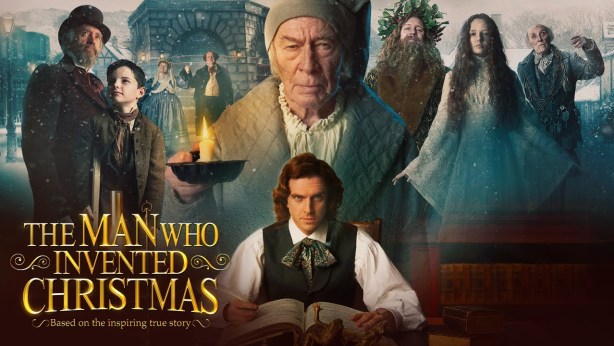
I’m a big fan of Charles Dickens’ A Christmas Carol – I’ve seen countless iterations – so it was inevitable that the family would go to the Spectrum Theatre on a Sunday afternoon to see The Man Who Invented Christmas.

The noted author (Dan Stevens) had experienced some great success with Oliver Twist. But he was reeling from three flops and a more expensive lifestyle than he could suddenly afford. Nicking an idea from Tara (Anna Murphy), one of the house staff, he decides to create a Christmas story.

But how does one write the tale, find an illustrator and self-publish it in about eight weeks? Especially with interruptions such as an unexpected visit from his estranged father (Jonathan Pryce) and mother?

Worse, the characters, notably Ebenezer Scrooge (Christopher Plummer) but eventually the others as well, fail to go in the direction the writer wants them to go, the ingrates!

Will Dickens deal with his own issues, which are testing the patience of even his most fervent supporters, his wife ( Morfydd Clark) and best friend (Ian McNeice)?

We enjoyedthe movie, unconcerned how true to the facts it might have been. So did most of the critics; 80% positive on Rotten Tomatoes. One negative review, though, seemed to miss the essence of the story, which I would tell you about, but dare not, lest it serve as spoiler.

Did Dickens really pluck names for his characters from people he met, a construct that one critic found too convenient? I have no idea. But I do recall that Ken Levine, who used to write for MASH, would come up with names for characters based on people he knew and even the players on the Los Angeles Dodgers baseball team.

If you’re a Dickens fan, or a writer of fiction, I believe you will enjoy The Man Who Invented Christmas.

Music throwback: Baby, It’s Cold Outside

“The tension in the song comes from her own desire to stay and society’s expectations that she’ll go.”

Somehow I missed the controversy over the song Baby, It’s Cold Outside that was apparently raging on social media last Advent. It’s back in full force this year, having shown up in at least two Facebook threads, and I wasn’t even looking.

More than one person I’ve seen refer to it as the “Christmas rape song.” First off, it’s not about Christmas at all. The weather is obviously unpleasant, but it has no more to do with the holiday than “Let It Snow! Let It Snow! Let It Snow!”

The song was written by Frank Loesser in 1944 and performed in the 1949 movie Neptune’s Daughter by Ricardo Montalbán and Esther Williams, with the guy in pursuit, two people who are IN LOVE, not contending for dominance. In the same film, Betty Garrett is wooing Red Skelton.

Some of the defenders of the song suggest considering the time period. Is it about sex? Possibly, but not necessarily. Perhaps he was being a gentleman by offering his place for her to stay warm into the morning. Her concerns may have been about what people would think about a single woman staying at his place.

But if the original is sweet and consenting, can the many cover versions be seen in the same light?

The specific lyric “what’s in this drink” is also a current concern, given the fact that there have been numerous cases of men (usually) lacing the drinks of women (most often), for the purposes of sex. Many women have reported that Bill Cosby was notorious for doing that sort of thing. But the phrase was, and arguably is, a common joke, justifying one’s goofy behavior, even when one is consuming nothing stronger than grape juice.

In the 2010 Listening While Feminist post, In Defense of “Baby, It’s Cold Outside”, “The tension in the song comes from her own desire to stay and society’s expectations that she’ll go.”

As for the drink: “The phrase generally referred to someone saying or doing something they thought they wouldn’t in normal circumstances; it’s a nod to the idea that alcohol is ‘making’ them do something unusual. But the joke is almost always that there is nothing in the drink. The drink is the excuse. The drink is the shield someone gets to hold up in front of them to protect from criticism.”

See also the 2016 Vox article: Why “Baby, It’s Cold Outside” became an annual controversy about date rape and consent.

Listen to Baby, It’s Cold Outside, from Neptune’s Daughter.

Here today – “I am holding back the tears no more”

You’d probably laugh and say
That we were worlds apart
If you were here today

December 1963
The relationship among the Beatles is a very popular topic on the Quora website. Someone asked: If John Lennon were still alive, would he and Paul McCartney have patched up their differences?

It’s a reasonable question, given the number of post-breakup fight songs that were released by all four of the ex-Fabs, none quite as nasty as Lennon’s How Do You Sleep?, “an answer to Paul McCartney’s ‘Too Many People’ and a direct attack on his old friend.” It even features a slide guitar part played by George Harrison.

As all the respondents noted in one way or another, before he died, John had already resolved his relationship with Paul.

To a similar question, a writer notes: “It’s easy to see how Paul feels about John. Every time he sings “Here Today”, he wells up with tears. There was a lot of love between those two. Brothers always.”

Well, not every time; I’ve seen McCartney get through the song dry-eyed. But in this 2015 interview, around the time of what would have been John’s 75th birthday, Paul notes how he is surprised how affected he can sometimes become, singing the song he wrote back in 1981 about his late friend.

I remember that shortly after Lennon was murdered in 1980, someone put a microphone in front of McCartney’s face and asked him how he was feeling. Paul uttered something like, “It’s a real drag, man.” And he was criticized in some circles.

Stick a mic in front of any grieving person and one is like to find a lack of eloquence. That’s something I’ve been sharply aware of when reporters stalk out people after tragedy.

Listen to Here Today

Only tangentially related:

Coverville 1194: The 14th Annual All-Beatles Thanksgiving Cover Show

Ringo Starr does NOT support Roy Moore’s campaign – reference to “You’re Sixteen”

Labor woes: How it all began in America

Social media & sharing icons powered by UltimatelySocial