The Right to Die and other topics

My mom was not the greatest cook, by her own admission.

rip.euthanasia1More from Chris:

– what’s your take on right to die and why?

Literally, I could spend a week’s worth of posts on this topic. This is the very abbreviated version.

In 1998, I watched Dr. Jack Kevorkian make the case for assisted suicide for the terminally ill on 60 Minutes. “From 1990 to 1998, he claimed to have helped end the lives of some 130 willing subjects.” I thought he made a compelling case.

After he “videotaped himself injecting Thomas Youk, who suffered from Lou Gehrig’s disease, with a dose of lethal drugs,” he ended up in jail and ended up serving eight years in prison. I’m convinced his gaunt look allowed the moniker Dr. Death to stick.

Meanwhile, there was that circus of the Terri Schiavo case (1998-2005), which I needn’t rehash, except to say that the grandstanding about protecting life from Jeb Bush and congressional Republicans I found repugnant because it was so clearly a quality of life issue, the nuance about which they clearly did not recognize. This 2015 TIME magazine article suggests that overreach has set the stage for the current right-to-die movement.

But I had been thinking about this for decades. Long before health care proxies became the norm, I had a pact with a friend of mine in college. We agreed that if either of us were seriously injured so that the quality of life had been severely diminished, the other would sneak into the hospital, if necessary, and literally pull the plug. Glad we never had to test this out.

Of course, we make right-to-die decisions all the time these days, such as Do Not Resuscitate in hospitals, applicable when my mom died nearly five years ago. I thought the whole characterization of the Obamacare “death panels” was fascinating because surely, there ARE limits of what services any medical system can/will provide.

Guess I’ll pass on the my general philosophy of the American way of death and how it is related to mummification, and the afterlife, and the rational evolution towards cremation.

– do you ever carry on elaborate imagined conversations with people? If you do, has Facebook changed these conversations, like picturing posting something and the imagining the responses?

To the first point, sure, now and then. This is usually some wish fulfillment. I wish I had said THIS rather than THAT.

To the second, not at all. FB is such artifice to me. I can have a decent “conversation” now and then, but I find too often certain tropes that for me are conversation enders, involving the false comparable designed to change the topic, or the “that’s unimportant”, designed to do the same.

About 10% of the time, maybe more, I write responses, and then delete them before publishing. I’m just not as invested as I am with a REAL, face-to-face chat most of the time UNLESS it’s someone I know in real life, or have gotten to know well enough from their previous online interactions.

-if you could pick any writer living or dead to tell your story, who would it be?

James Michener, who would turn my life into the epic that it is in my mind.

– what do you consider the most creative time in your life, when you were the best at imagining things?

I could make the case for right now. I’m writing a blog post seven days a week. Three or four or five of them might be substantial. Moreover, I see the whole arc of the blog as somewhat creative. If I write X and you’re not interested, hey, maybe you’ll be interested in Y, which I’ll tackle tomorrow.

And blogging helps my thought process.

Other times: the second through sixth years of the current job, when I had to find ways to interact with SBDC state directors when they had to be sold on the efficacy of that. Or some period at FantaCo, not the first year and surely not the last, when I was editing magazines, doing the mail order, balancing the checkbook, and managing the staff.

– what simple device would improve your life that isn’t on the market?

All my thoughts and dreams going right to the computer in comprehensible English.

– what were your favorite meals when you were a kid?

My mom was not the greatest cook, by her own admission. So I don’t have this great pool of favorites. I liked Kraft macaroni and cheese, chicken cooked any number of ways, corn on the cob. We used to go out most Fridays and get fish from W.T. Grant’s department store; I remember liking that.

My father spent hours making spaghetti sauce, and so that was good. He also had the capacity to throw leftovers into some delicious concoction he called gouly-goup; only later did I realize he stole the name from goulash. He also made waffles with such panache that it was always enjoyable.

We had eggs a lot. Fried, scrambled, deviled, omelet. We all became competent making those.

Music Throwback Saturday: Weird Al, Part 2

The illustrious Illinois blogger SamuraiFrog decided to rank all of “Weird Al” Yankovic’s songs, 165 of them, an impressive undertaking. So, I decided to come up with a list of my 33 favorite Weird Al songs. Why 33? Because LPs play at 33 revolutions per minute. And I’m going to break them up into three posts of 11 songs each, mostly because posting 11 posts of three songs each would be weird.

Part 1 is HERE, and part 3 will show up in a little more than a month.


22. Buy Me a Condo
(Parody of Bob Marley; from “Weird Al” Yankovic in 3-D, 1984)
Will the Rastafarian falls into the trap of American consumerism. This is, as Mr. Frog noted, subversive.

21. Money for Nothing/Beverly Hillbillies
(Parody of “Money for Nothing” by Dire Straits; from UHF, 1989)
SamuraiFrog notes: “The theme song to The Beverly Hillbillies, adapted to the Dire Straits classic. Mark Knopfler and keyboardist Guy Fletcher actually play their parts on the track. The video is brilliant. One piece of neat trivia: Simpsons director David Silverman designed the computer-generated characters.”

The Dire Straits song was ubiquitous on MTV in its first decade. The Beverly Hillbillies was, for two seasons (1962-1964) the #1 most-watched program in the US, and individual episodes are STILL among the 60 most viewed along with Super Bowls, Roots, and final episodes of MASH, Cheers, The Fugitive, et al.

20. I Love Rocky Road; #106 in US, 1983
(Parody of Joan Jett & the Blackhearts’ cover of “I Love Rock and Roll” by Arrows; from “Weird Al” Yankovic, 1983)
I love the Al swagger in the video over a type of ice cream, which, now that I think of it, I’ve never tried. The Joan Jett song was all over MTV in the early ’80s, and I grew to like it quite a bit.

19. Canadian Idiot; #82 in US, 2006
(Parody of “American Idiot” by Green Day; from Straight Outta Lynwood, 2006)
I’m rather fond of “American Idiot” and the idea that would be a song about the “nicer” folks from north of the border struck a funny bone.

18. Ricky; #63 in US, 1983
(Parody of “Mickey” by Toni Basil; from “Weird Al” Yankovic, 1983)
Before I finally OD’ed on I Love Lucy reruns, I used to watch them all the time. I was impressed by the love Al obviously had watching them too. Toni Basil’s “Mickey” was just the perfect song for this.

17. Eat It; #1 in Australia, #5 in Canada, #6 in New Zealand, #12 in US, #36 in UK in 1984
(Parody of “Beat It” by Michael Jackson; from “Weird Al” Yankovic in 3-D, 1984)
I have some friends in the music business, and one mentioned at the time that this was a particularly stupid song; I totally disagreed. I thought it was a variation on the remarkable Michael Jackson video, and I appreciated that MJ, who was a massive star, had enough of a sense of humor to allow this, and later, Fat, the parody of Bad.

This was Al’s first Top 40 hit in the US, and would be his highest-charting single until 2006.

16. Yoda
(Parody of “Lola” by The Kinks; from Dare to Be Stupid, 1985)
The mix of familiar Kinks chords with Star Wars. Back in my FantaCo days, we used to sell some masks, including Yoda, which I might have bought if it had fit over my big head.

15. Stop Forwarding This Crap To Me
(Style parody of Jim Steinman, who wrote a lot for Meat Loaf; from Alpocalypse, 2011)
Yes, now people Facebook and tweet that crap to us, instead of email; we’ve so evolved. I love the sweet tone of the fairly angry message.

14. Tacky
(Parody of “Happy” by Pharrell Williams; from Mandatory Fun, 2014)
Yes, I eventually tired of the original, but it took an amazingly long time. And just at that point, this parody, with great guest stars shows up, including Aisha Tyler, Margaret Cho, Eric Stonestreet, Kristen Schaal, and Jack Black. I’m impressed that this was all one shot, with Al changing clothes to be in the first and last segments. And the examples of tacky – selfie at a funeral – are totally believable.

13. Living with a Hernia
(Parody of “Living in America” by James Brown; from Polka Party!, 1986)
It’s a great video and a surprisingly strong recreation of the JB style. I’m not crazy about the original song; it’s VERY ’80s, in a bad way. Getting a hernia helped this position, I suppose.

12. King of Suede; #62 in US, 1984
(a parody of “King of Pain” by the Police; from “Weird Al” Yankovic In 3-D, 1984)
A song about a proud clothier next to an arcade. Love the reference to Blue Suede Shoes. The original song is about depression and rejection, so it’s a great diversion.

Imagination of compassion, or something like that

I’m told that group referred to as ISIS, or ISIL, HATE to be referred to as “DEASH”.

The night after the shootings and bombing in Paris that killed over 125 people on Friday the 13th of November, the Albany Public Library Foundation held its second annual Literary Legends gala to honor two writers. One, Gregory Maguire, author of Wicked, who was born in Albany, ended his brief remark with a quote, which I failed to write down. I thought it contained the phrase “the imagination of compassion.”

this is what people say

Instead of finding what’s wrong with someone’s response to a situation, try to imagine the scenario with some compassion. The idea of imagination compassion is far more uplifting and far less destructive. “You remake the world when you imagine it compassionate.”

So while I didn’t change my status on Facebook to the French tricolor – in part because it feels, to me, that it gives the bombings in Beirut the day before the short shrift. And indeed, there are tragedies every day around the world that warrant our response, so one could argue Eurocentrism. Yet I’m opposed to criticizing those who did post the blue, white, and red because they are expressing their own compassion.

I note Arthur’s lovely tale, which I suppose would be characterized as an imagination of compassion, though I can see it taking place in Lebanon as well as France.

Hey, I understand the bias towards Paris. France is the US’s oldest ally. More to the point, there were three households I knew personally that night in Paris. One was a woman from Albany passing through. Dartmouth professor and writer Jeff Sharlet, who I knew when he was a child, was interviewed by MSNBC that night.

That Literary Gala’s other awardee was Barbara Smith, who has written a bunch of black feminist literature. I asked her if she knew my mother’s first cousin Fran, a noted writer in those circles, and she had indeed met her. Fran’s two daughters were born in Paris, and daughter Anne and her family are living there currently.
***
And then I get the real quote from Maguire: “The consolation of imaginary things is not imaginary consolation.” – Roger Scruton. Memory can be so faulty.

“Compassion: a source of comfort to somebody who is upset or disappointed.” So the above still holds.

Still, I’m told that group referred to as ISIS, or ISIL, HATE to be referred to as “DEASH”. Daesh (or Da’esh pronounced dɑʃ). It’s a term used to describe the terrorist organization, introduced by French Foreign Minister Laurent Fabius. (Is this why they’ve been so focused on France?)

Fabius argued that since the IS is not Islamic and absolutely not recognized as a state, he said “…the Arabs call it Daesh…” (from Arabic “to tread upon”, “to trample or crush underfoot”). I’ve decided to refer to them only as Daesh going forward. My compassion can go only so far.

My pal Amy Biancolli, who has dealt with suicides in her life, is uncomfortable with the term suicide bomber. A reader suggested kamikaze, and I’m thinking that it’s more correct, perhaps with a qualifier of some sort.

Smoking and transportation

She thought she was finally being booted off for her transgression.

break-cigarettesSome months ago, Mark Evanier wrote about the bad old days, when smoking allowed on most airplanes. He linked to a New York Times article, What Flying Was Like Before the Smoke Cleared, which was terrible, especially for the flight attendants.

I wrote in this blog some years ago: “Airplanes used to have smoking and non-smoking sections. I remember sitting in row 22, the last non-smoking row. Wouldn’t you know that the smoke did not have the courtesy to go back from row 23, but instead wafted forward?”

Still, here’s a story about a smoker I did feel just a little sorry for:

It was in the early 1990s. My then-Significant Other and I took the bus from Albany to New York City for the day. The 7:30 departure back to Albany, then on to Montreal, was so busy that the bus company needed a second bus, which we got on.

About 20 miles north of New York City, the bus driver, while continuing to operate the vehicle, yelled back to the passengers, “Is someone in the bathroom?” The SO and I were sitting three rows from the back, and I hollered back, “Yes.”

“Is someone SMOKING in the bathroom?” My ultra-sensitive nose knew that someone had lit up somewhere near me. I didn’t want to rat out anybody, yet he was clearly seeking confirmation of what he already expected. “Yes,” I replied.

The bus driver pulled over on the side of the New York State Thruway, and walked towards the back. By this point, the woman in the loo had come out and returned to her seat.

He walked up to her and said, “There’s no smoking on this bus!” She said nothing.

“Do you want me to let you out here?” She replied, in a distinct French Canadian accent, “Oh, no, no!”

We get to Albany without further incident. But then everyone was supposed to get off our bus, with those traveling north of Albany getting on that first bus that left NYC.

The smoker did not understand; she thought she was finally being booted off for her transgression from a couple of hours earlier. No, they just needed one busload to go from Albany to Montreal. I’m not sure HOW she finally figured out to get on the other bus.

THAT smoker I ALMOST felt sorry for.
***
The Great American Smokeout is today. Tobacco undoubtedly contributed to the deaths this year alone of our friend Bonnie, actor Leonard Nimoy, and many others. Chewing tobacco killed baseball Hall of Famer Tony Gwynn last year. The sooner one quits, the better.

Aspirational America

“we spent the next century plus– up to and including now, today– addressing the problems created by the country’s economic dependence on chattel slavery in an incomplete and unsatisfactory manner.”

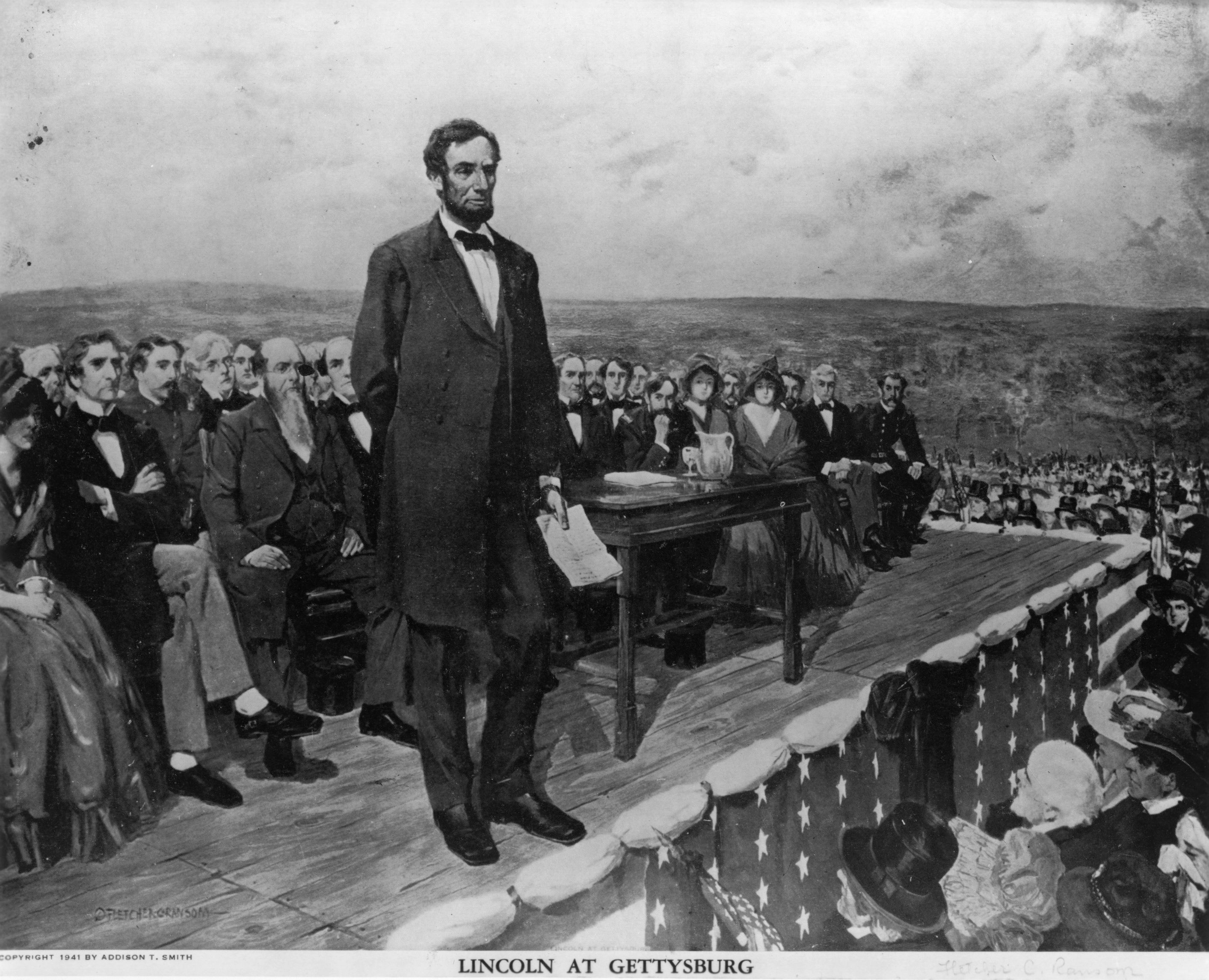
19th November 1863: Abraham Lincoln, the 16th President of the United States of America, making his famous 'Gettysburg Address' speech at the dedication of the Gettysburg National Cemetery during the American Civil War. Original Artwork: Painting by Fletcher C Ransom (Photo by Library Of Congress/Getty Images)
19th November 1863: Abraham Lincoln, the 16th President of the United States of America, making his famous ‘Gettysburg Address’ speech at the dedication of the Gettysburg National Cemetery during the American Civil War. Original Artwork: Painting by Fletcher C Ransom (Photo by Library Of Congress/Getty Images)

There’s this post that Jaquandor linked to, by a person who had visited Gettysburg, PA in July 2015. That was the site, of course, of one of the bloodiest battles of the Civil War, a site that President Lincoln would visit in November 1863, and mistakenly proclaim: “The world will little note, nor long remember, what we say here.”

This Outside The Law person wrote:

I believe the United States has as its chief value in the world its aspirational qualities, and I believe that those qualities are best expressed in the Constitution and its supporting documents, particularly the Federalist Papers. The Constitution, a living document, is, like all scripture, flawed.

The 3/5ths Rule, for starters was the seed for the horrors of the war I’ve spent the weekend thinking about, but we spent the next century plus– up to and including now, today– addressing the problems created by the country’s economic dependence on chattel slavery in an incomplete and unsatisfactory manner. It’s great that we have the 14th Amendment, but it would be a far better thing if we had more Supreme Court Justices that believed that the 14th Amendment means what it says.

It occurred to me that both the strength and weakness of the United States is that some of its people believe that ideals are achievement.

So this is an overly broad, open-ended question: How can America achieve its stated ideals? What does that look like?

Ramblin' with Roger
Social media & sharing icons powered by UltimatelySocial