
Things I learned from visiting France

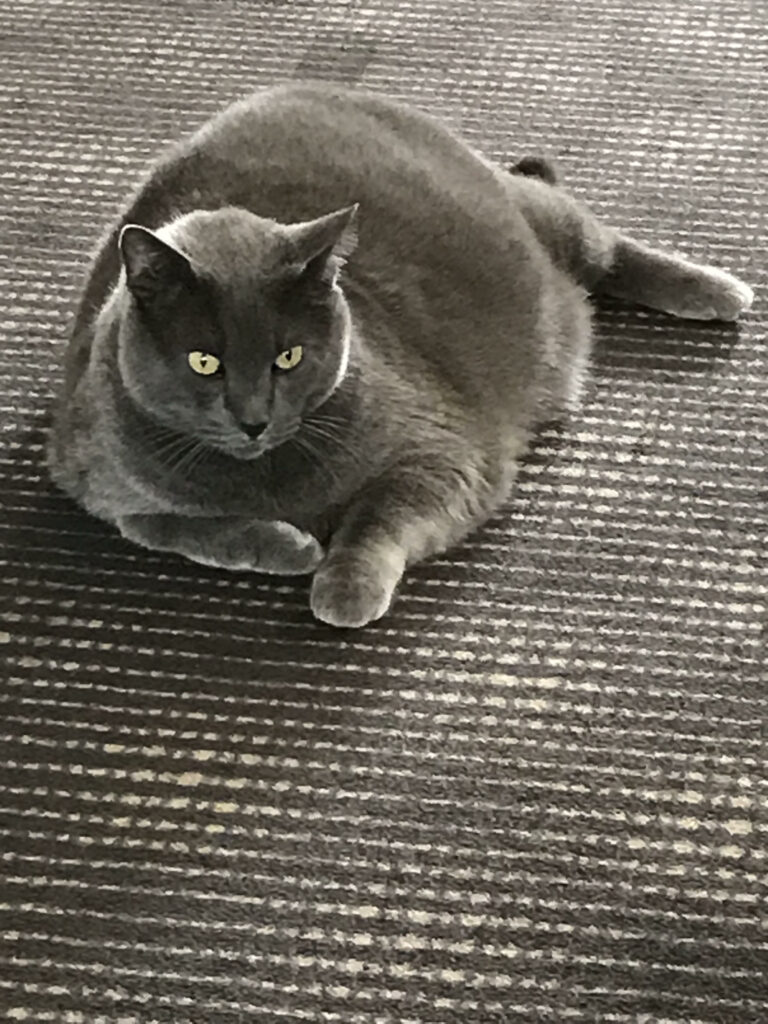
très grand chat domestique

Here are some things I learned from visiting France in May 2023. You world travelers likely already know some of these things.

Let me lay out the four places we stayed. We spent two nights at (#1) the Hotel Paris – Andre Latin Hotel, then two more at (#2) the Hotel Kyriad Auray (2), one night at (#3) Les Chtis Bretons, near Le Temple in Trédion (3), and the final night at (#4) Millennium CDG in Roissy en France. These were very different experiences.

Power

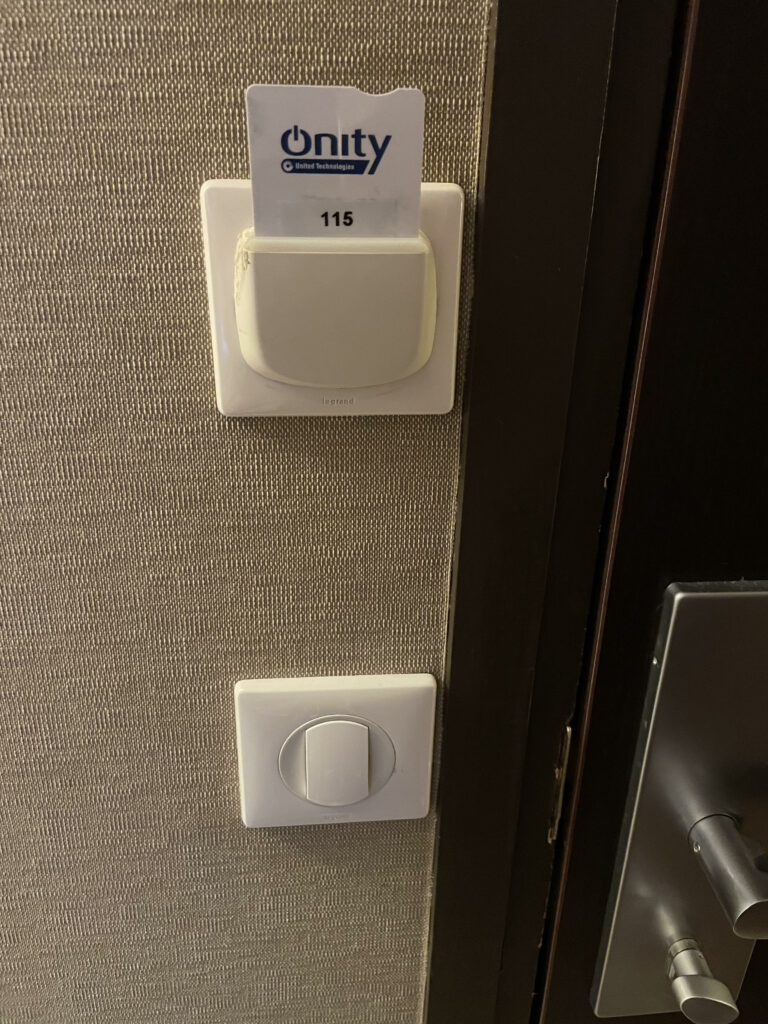
When we got into room #1, I couldn’t get the lights to work. I asked the person at the front desk, and they asked if I had put the key card in the slot; of course, that’s how we got in.

No, the slot INSIDE the room. When the key is in that slot, the lights work. It’s a measure to keep people from wasting electricity. We also had to give the key to the front desk when we went out, then get it back upon our return.

It was good that we had three adapter plugs for European sockets.  Ours were called Travel Smart by Conair. We used all three. One was to charge my laptop, and another was for the white noise machine; we didn’t use it the first night, and we slept poorly even though I’d been up over 36 hours.

The third plug was to charge our phones and my watch. On May 9, days before our May 14 departure, I bought a SooPii 60W 6-Port Charging Station for Multiple Devices. It was advantageous.

I changed my phone carrier from Boost Mobile to TMobile nine days before departure. My phone worked everywhere we went in France except place #3, only five kilometers from the chateau, where we DID have connectivity.

I also got a Glocal Me hotspot and a 5G SIM card. This was not successful. So my wife could only use her phone when we were on Amtrak, the planes, three hotels, and the TGV TRAIN. Fortunately, our Wordle streaks remained intact.

Media

I briefly checked out the television at hotels #1 and #2. Hotel #1 in Paris had a variety of channels, some in English, primarily BBC 4 and its spinoffs. There were also channels from Tunisia and, I believe, Iran.

The TV at Hotel #2 in Auray was all in French. The only English I heard was from Cannes. Michael Douglas was accepting an award, which was translated. But some offerings were American programs dubbed into English, including Grey’s Anatomy, Friends, and The A-Team. 

Radio was quite eclectic throughout the country. On the tour bus in Paris, between descriptions of the sites, the music ranged from Middle Eastern to the Parisian dance halls to hip hop lite. 

Breakfast
Food was abundant at Hotels #1, #2, and #4. They all served croissants and had machines dispensing coffee, tea, and hot chocolate. Mainly #2 and #4 seemed heated toward their perception of the American palate. Carrot cake and brownies for breakfast? I LOVE carrot cake but wasn’t ready for it at 8:30 a.m.

In the lobby of Hotel #2 was perhaps the largest domesticated cat I’ve ever seen. It would wander among the diners, walking under the chairs. When it was petted, it would linger for a time. 

Driving

Driving in the countryside, from Auray to Erdeven to  Trédion, wasn’t too demanding for my wife. However, there were a LOT of traffic circles, and the signage was not sufficiently large to know which way to go.

We were dependent on the GPS. I would navigate because it was hard for my wife to drive and figure out where to go. “In 500 meters, take the 12 o’clock, ” I’d say. (Or “nine o’clock” or “three o’clock.”) 

In particular, when we went from Erdeven, where the wedding took place, to  Trédion, where the reception was 45 minutes away, was held, we would have never found the place. We were directed to caravan with other vehicles, but by the third circle, we’d lost the car we were supposed to follow.

Conversely, driving in Paris appeared to be insane, with bicycles and motorcycles cutting in between lanes. The fact that we never saw an accident was remarkable. The motorcycles rode on the lines between lanes. My wife was happy not to be behind the wheel there.

Condolences to David Kaczynski

NYADP

In my news feed, I read that the guy identified as the Unabomber, who conducted a bombing spree that spanned nearly two decades, killing three people and injuring 23. had died, apparently by suicide. I immediately thought about his very decent brother, David Kaczynski.

The first time I saw David was about a quarter-century ago at my current church. He was the person who turned in his brother Ted to the authorities.

This 2003 article in the Cornell Daily Sun captured a similar gathering that David had brought together. “Gary Wright… was hit with 200 pieces of shrapnel in February of 1997 by one of [Ted] Kaczynski’s bombs…”

“Bill Babbitt talked about his brother, Manny Babbitt, [the Vietnam vet] who was executed in 1999 for the murder of Leah Schendel” after Bill turned in HIS brother. He believed Manny would be “spared a death sentence — a promise the police” couldn’t keep.

For me, the most compelling speaker was Bud Welch. His “23-year-old daughter, Julie… was killed on April 19, 1995, in the Oklahoma City Bombing… In the days following the crime, Welch said he saw no need for a trial at all. Now, he says he was ‘temporarily insane’ for eight or nine months… He said his views changed slowly, and he realized that [executing] Timothy McVeigh and Terry Nichols would be an act of vengeance.”

Moreover, Bud Welch became friends with Timothy McVeigh’s father and realized the elder McVeigh, too, was a victim of the heinous crime. I wrote about Bud a few years ago.

Tragedies united these seemingly disparate gentlemen in a common cause: to fight the death penalty. It was a remarkable evening.

Radio silence

From The Business Insider: “In 1995, The Washington Post published a 35,000-word manifesto written by the Unabomber, whose real identity at the time remained unknown, about how technology was destroying humanity.

“The time following the manifesto’s publication was emotionally taxing for David. ‘We never found anything conclusive,’ he stated, ‘for me, it was like a roller coaster. I thought, ‘Am I crazy? A suspicion does not make him the Unabomber.'”

David “remembered Ted as a loving, caring, older brother figure, not a terrorist. He recalled telling himself, ‘I grew up with this man; is it possible I grew up with evil in my own family but was too blind to see who he truly was?'” Ultimately, David made the agonizing decision to turn Ted over to the FBI.

Wikipedia: His brother’s confrontation with the death penalty later motivated David Kaczynski to become an anti-death-penalty activist. In 2001, Kaczynski was named executive director of New Yorkers Against the Death Penalty [now, New Yorkers for Alternatives to the Death Penalty].

“While the mission of NYADP originally focused only on ending the death penalty, under Kaczynski’s guidance in 2008, it broadened its mission to address the unmet needs of all those affected by violence, including victims and their families.”

David’s “decision prompted Ted to cease all communication with his family, including rejecting all of David’s attempted correspondence during his imprisonment.” So I can imagine that David is mourning Ted’s passing because Ted was his big brother, not just the Unabomber.

Unexpected stuff, plus ARA

Deep Throat

One of the vagueries of blogging involves unexpected stuff, like this image from NASA.
I received this email on May 28: “As you may know, our Community Guidelines describe the boundaries for what we allow– and don’t allow– on Blogger. Your post titled “Antoinette” was flagged to us for review. This post was put behind a warning for readers because it contains sensitive content; the post is visible at
http://rogerowengreen.blogspot.com/2005/06/antoinette.html. Your blog
readers must acknowledge the warning before being able to read the
post/blog.” We apply warning messages to posts that contain sensitive content.
“If you are interested in having the status reviewed, please update the content to adhere to Blogger’s Community Guidelines. Once the content is updated, you may republish it at [URL]. This will trigger a review of the post.” For more information, please review the following resources: Terms of Service: https://www.blogger.com/go/terms
Blogger Community Guidelines: https://blogger.com/go/contentpolicy

Sincerely,The Blogger Team”

So I looked at the article, which was about the Tony Awards.  I assume the offending part is:  “My buddy Fred Hembeck has been extolling the wonderfulness of one Mark Evanier for some time, and Mark has a lot to say about the Tonys that I found interesting… He also writes about medical marijuana (6/6) and Deep Throat (6/3), topics covered recently on this page, and how the rich get richer, and the myth of the “death tax” (6/6), which I would have written about had I had something cogent to say.”
Could it be a passing reference to Deep Throat, which was not about the 1972 movie but about the guy who fed information to Woodward and Bernstein about Watergate?
Resolution
After musing about this for three days, I decided to submit the piece for approval, unaltered. The response?
“Hello.
We have re-evaluated the post titled “Antoinette” against Community
Guidelines https://blogger.com/go/contentpolicy. Upon review, the post has been reinstated. You may access the post at
http://rogerowengreen.blogspot.com/2005/06/antoinette.html.

Sincerely,The Blogger Team”

At some level, the situation is comical. There’s no THERE there. And it did not prevent you from seeing a blog post I wrote EIGHTEEN YEARS AGO.
Conversely, I’m troubled by the kneejerk reaction of some anonymous person, or bot, who decided that something I wrote was salacious/pornographic without even understanding the context of Deep Throat. It’s the dumbing down of America.
Another matter: A guy wrote, “I’m working on cleaning my website, and I need your help in removing a link from your site. Your site is probably perfectly legitimate, but I’m just trying to eliminate as many links as possible.

Here’s the page on your site with the link: https://www.rogerogreen.com/2022/04/27/april-rambling-shadow-docket/

“Once you’ve removed the link(s), please send me a quick note so I can create a record of it. Thanks in advance! I hope to hear from you soon.”

This was one of my linkage posts, so sure. Whatever. It’s good to know my blog is “probably legitimate.”

I almost forgot: Ask Roger Anything!

The initial motivation for this post was to get you to Ask Roger Anything. I’m particularly looking for musically thematic pieces to write.

Now when I say Anything, maybe you should make sure that the questions don’t use the words ass (an animal) or bitch (an animal) or Uranus (a planet). God knows, I mean Allah knows, not that, I mean heaven knows SOMEONE will misconstrue my intent.

I’ll answer your questions in the next month or so. And I have received a few questions already. Please pose your questions in the blog’s comments section, email me at rogerogreen (AT) Gmail (DOT) com, or contact me on Facebook. Always look for the duck.  

Roissy en France

Notre histoire en couleurs

May 20: I may have said we were returning to Paris, but we were actually going to Roissy en France.
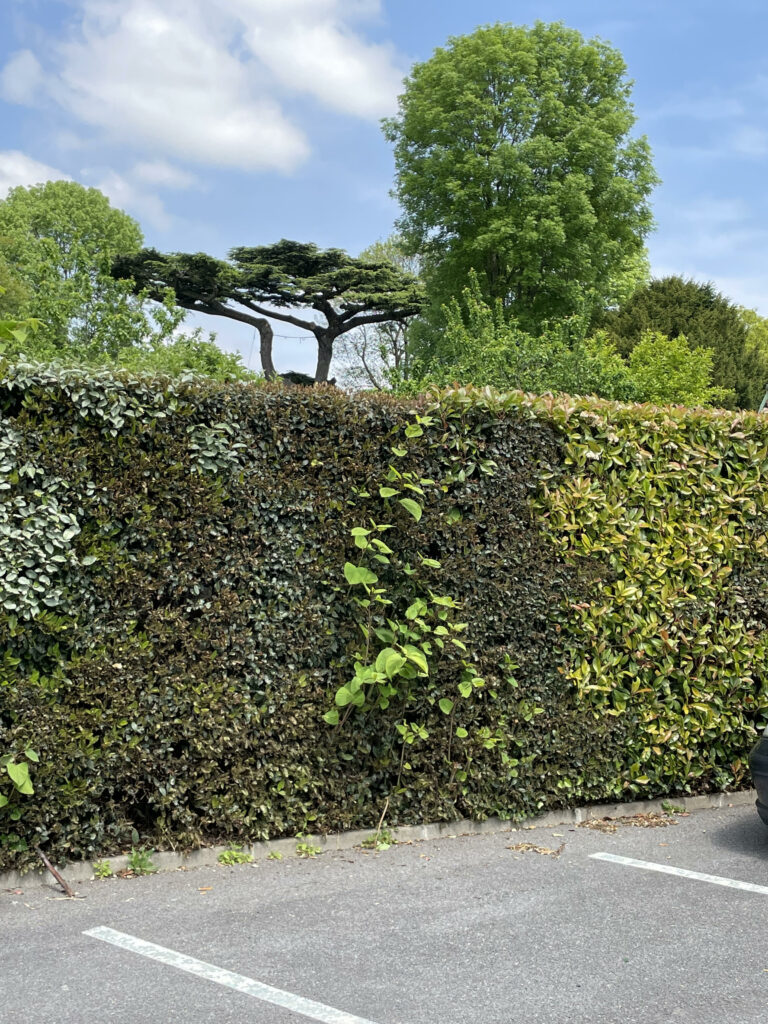
We eat breakfast at the B&B. There was a giant jukebox in the dining area with dozens of 45s. We talked to a couple from the wedding. The dancing didn’t start until 1 a.m.!

We saw Father Thomas, who was also staying at the locale. My wife drove from Tredion back to Auray, which took about an hour. We returned the rental car and stopped at the cafe we visited three days ago.

Our travel documents suggested we might take a TERTRAIN from Auray to Redon, leave at 13:05, and arrive at 14:30. Because they were doing track work, we took a bus. It was rather uncomfortable, as I couldn’t put my feet under the seat in front of me.

The TGVTRAIN from Redon to PARIS MONTPARNASSE was nice, but it took a while, from 14:50 to 18:07.

I should have used the loo on the train. The bathroom at the train station cost 50 Euro cents, but it didn’t work! Finally, we went to another level and spent another Euro in a locale with an attendant.

We still needed to get to our hotel in Roissy en France, near the airport. My wife decided we’d take a taxi. With the stop-and-go traffic, it took at least an hour, which made it a pricey choice.

After we dropped off our stuff, we went to eat. We opted against the dining choices at the hotel. Wandering into town, we found a Chinese/Thai restaurant with one of the broadest menus I’ve ever seen.

Our last day in France

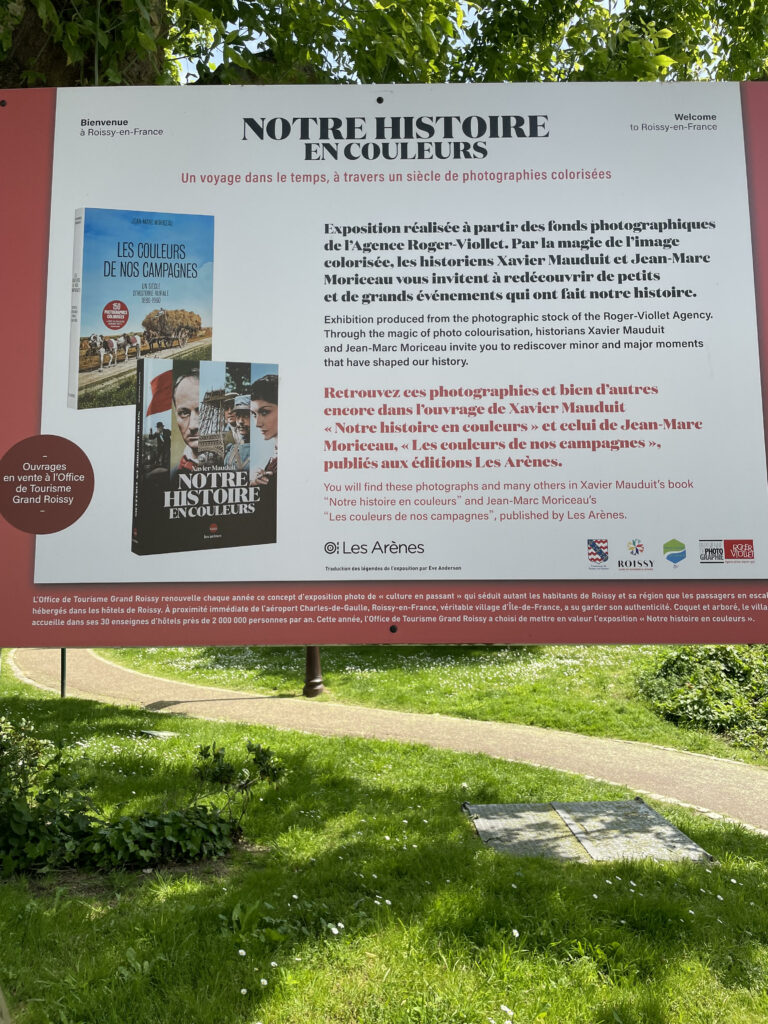
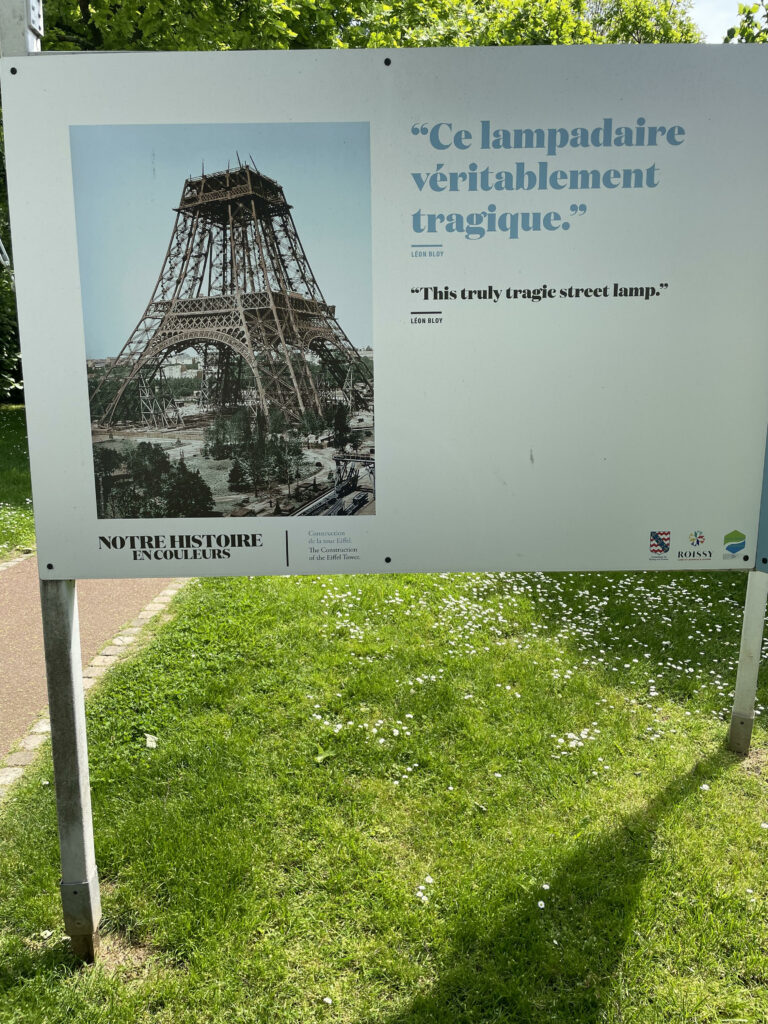
After breakfast, we wandered into the charming town. We came across a series of about 40 placards describing France’s history. They were from the book  Notre histoire en couleurs, OUR STORY IN COLORS, by Xavier Mauduit.

“This book is a walk through time, a stroll through yesterday’s world where everything is suddenly in color. A unique experience for all generations!

“Let’s find our poets and our novelists, Baudelaire, Hugo, Proust or even Colette, without forgetting all the anonymous people, students, workers, peasants. Let’s walk the streets of our cities and the roads of our countryside.” This was an unexpected joy.

My wife got a hotel employee to get us to the airport. We were delivered to the right terminal, 2, but the wrong section. Fortunately, Charles De Gaulle Airport has a train system like the AirTrain to JFK.

Unlike the chaos at Delta at JFK, getting the boarding pass at Air France was simple and uncrowded. After checking through various checkpoints, we got to our gate quickly. We got some excellent airport food, which is not an oxymoron.

Our eight-hour flight – leaving at 19:30 Paris time and arriving at 21:45 NYC time, was mainly uneventful. However, I was surprised how far back the guy in front of me could push back his seat, further than anyone around him.

We deboarded the plane. I was trying my new Mobile Passport Control app, which I couldn’t send until I determined what terminal we were at. I don’t know if it helped or not. We got through two Customs checkpoints far faster than the debacle we experienced in 1999 after returning from Barbados.

One of the folks from my church choir had agreed to pick us up. Now the terminal at JFK WAS a zoo, but we found each other. Carol and I rode home in about 3.5 hours. Our daughter had waited up until 2 a.m. for us, which was very sweet.

My forebearers

In search of Margaret Collins


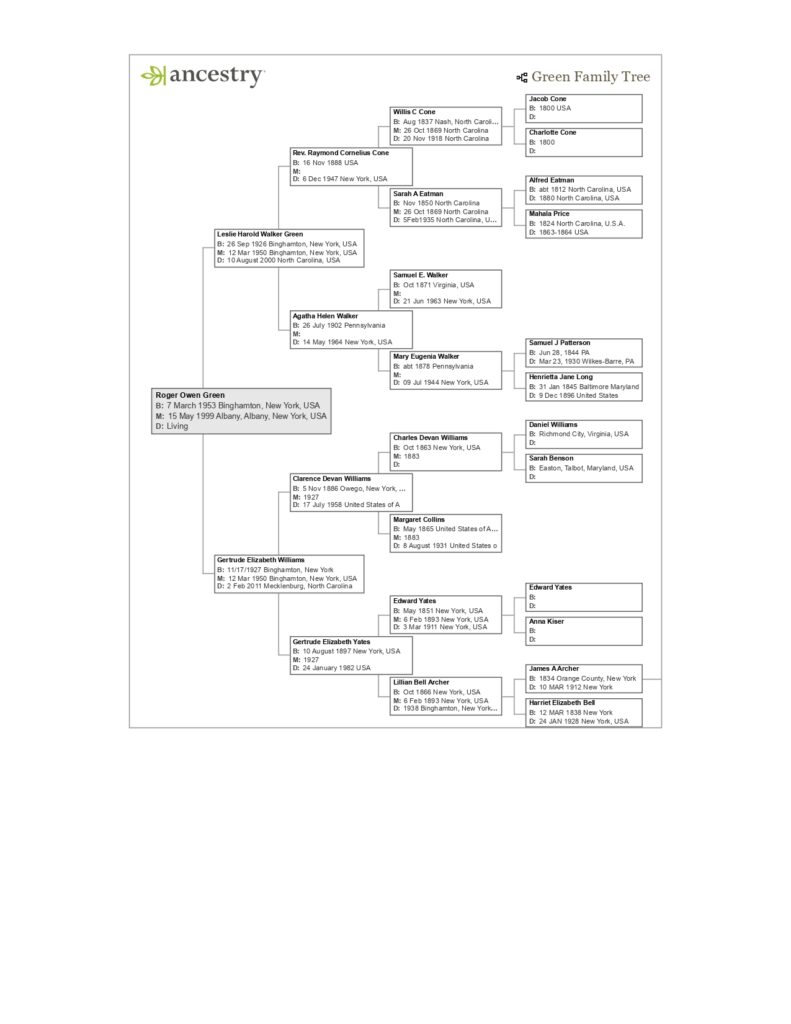
Here is a graphic of my current forebearers up to my great-grandparents. Click on it to biggify; many thanks to Arthur. You’ll note that I have identified 12 of the 16. I don’t have the parents of Samuel Walker, my father’s mother’s father. I’ve gotten hints from Ancestry, but they do not direct me to the correct person.
Also, I haven’t located Margaret Collins’ parents, though I went to a genealogist specializing in Irish lineage for that particular purpose. Margaret is my mother’s father’s mother. A town historian found her death certificate, but it only mentions her father’s surname and doesn’t identify her mother.

However, much to my surprise, I DID find the parents of Charles Williams, and I wasn’t even looking for them. Charles remarried in 1921 to Margaret Greenleaf; he married ANOTHER Margaret, presumably so he wouldn’t have to worry about saying his previous wife’s name in error. Charles’ parents were mentioned on the marriage license. Daniel Williams and Sarah Benson have a compelling story I will tell later this year.

I’ve also been aided in pursuing Margaret Collins Williams by my buddy Melanie, who cracked the case of my biological grandfather Raymond Cone.

Extend the parameters

Both Melanie and the Irish genealogist recommended that I pay attention to the people, not just in my direct line.

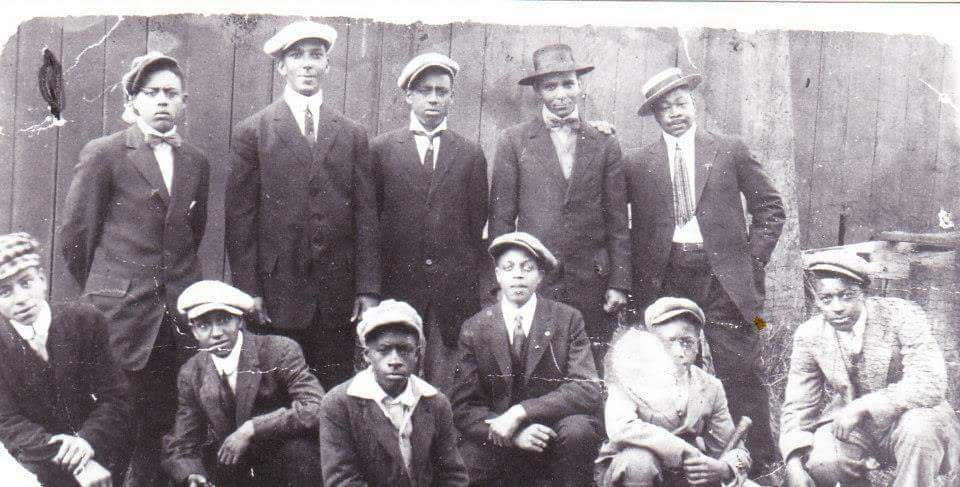
Here’s a picture of who I believe are baseball players. One of them is very likely to be Charles Williams (b. 1884 or 1885), the older son of Charles and  Margaret Williams, my great-grandparents, and the brother of my grandfather Clarence Williams. In the 1910 US Census, the younger Charles’ occupation was listed as “ball player.”

Some lines go back much further than others. If I go back, two and three generations from Sarah Eatman were Thomas Eatman Sr and Jr, enslavers from North Carolina. Two generations earlier, I can find my British roots. Likewise, Mahala Price leads back to Brits, Price, and Hackney.

I’ve long known the identity of Harriet Bell’s parents, Phillis Wagner and Edward Bell. Edward, I suspect, was enslaved in New York north of NYC but manumitted before 1810.

Ramblin' with Roger
Social media & sharing icons powered by UltimatelySocial