
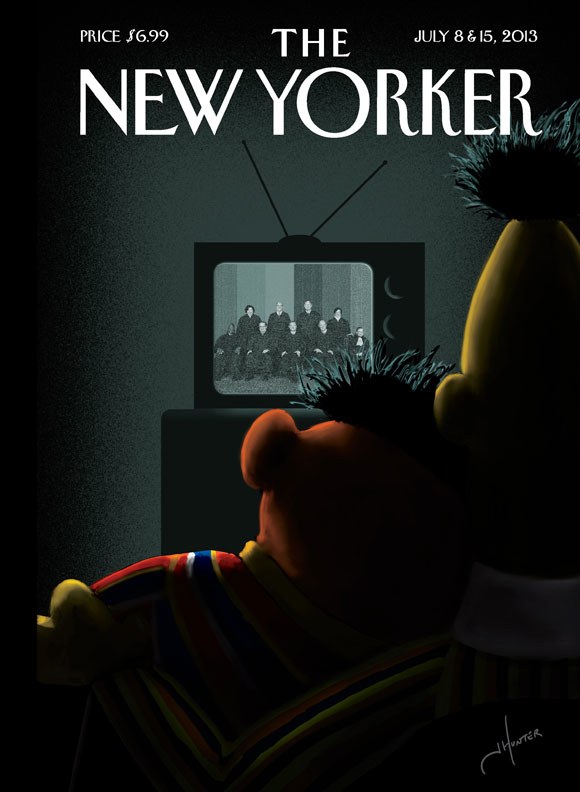
Artistic intent versus audience interpretation

Ray Liotta is a working actor, but we’re not paying his bills.

new-yorker-cover-bert-ernieOne of my favorite Pete Townsend solo tracks is Let My Love Open the Door from his 1980 album Empty Glass. I recall that there was some conversation about whether the song was religious in nature, as Townsend occasionally hinted. or a romantic song.

Here’s the thing, though: it doesn’t matter. Whatever the artist’s vision of the work, how the audience perceives it will usually carry the day.

So I found the whole rather vigorous discussion of whether Bert and Ernie of Sesame Street were gay – it made several mainstream news stories – as rather beside the point. As Muppeteers Frank Oz and the late Jim Henson came up with them, the characters reflected their friendship.

When Sesame Street scriptwriter Mark Saltzman noted in an interview that he wrote Bert and Ernie with his longterm relationship with film editor Arnold Glassman, that was his process. He clarified to the New York Times, “As a writer, you just bring what you know into your work. Somehow, in the uproar, that turned into Bert and Ernie being gay. There is a difference.”

The Sesame Street folk responded, initially awkwardly. Ultimately, the audience decides what it chooses to believe.

Another showbiz buzz this month involved Cosby Show actor Geoffrey Owens found working at a Trader Joe’s market. Beyond the pushback against some trying to shame him is a more basic reality; you don’t always get that next job in the entertainment world.

It’s not for me to judge if GoodFellas costar Ray Liotta does a commercial for Chantix, an anti-smoking drug. He’s a working actor, but we’re not paying his bills. If he needs the money or loves the product or both, so be it.

Working actress Blythe Danner is still in those ads for Prolia, an injection to fight osteoporosis. Ditto for her.

That said, I STILL wish the flood of pharmaceutical ads would end in the US. But we’re quite unlikely to see that genie put back into the bottle.

Enjoying Aussie interaction: sports edition

The Blue Jays lead grew to 8-1 in the top of the 7th when Tommy Kahnle from Albany County, NY, the fourth of seven Yankee pitchers, gave up three runs in only 2/3 of an inning.

Making only my second trip to the new Yankee Stadium, Marconi and I took Metro North from Poughkeepsie (halfway between Albany and NYC) to see the New York Yankees take on the Toronto Blue Jays on Saturday, September 15, 2018. I’ve only known him since September 12, 1971, so not very long.

In the bottom of the 2nd, the two empty seats on the aisle nearest us were filled by this young couple from Australia, in the City for a couple weeks. She was wearing a borrowed Blue Jays top, while he was nominally a Yankees fan.

Soon after they arrived, the Yankees starting pitcher, the usually reliable CC Sabathia, had given up five runs in only 2 1/3 innings, including two solo home runs by right fielder Randal Grichuk. CC was taken out of the game.

Meanwhile, the Yankees had opportunities to score, twice with the bases loaded, and once with runs on second and third base, but failed to do so. This really deflated the home team crowd.

We, mostly I, since I was closer, answered some of the idiosyncrasies of the game, such as the foul ball rule and how the defensive positions are numbered.

Yankee shortstop Didi Gregorius hit a solo homer in the bottom of the 6th, and the female Aussie frowned. “You still have a big lead.” I also coaxed her into acknowledging that he had made a great basket catch over second base.

The Blue Jays lead grew to 8-1 in the top of the 7th when Tommy Kahnle from Albany County, NY, the fourth of seven Yankee pitchers, gave up three runs in only 2/3 of an inning. Toronto had the bases loaded and no outs, and the Aussie guy was savvy enough to know that the situation was still perilous for the Yankees even when the lead runner was thrown out at the plate.

In in the bottom of the 7th, designated hitter Giancarlo Stanton (I explained the DH) and Gregorious hit solo homers, and pinch hitter Miguel Andújar hit a grand slam. Suddenly Toronto was up by only 8-7, and the Aussie woman fretted. But that’s the way the game turned out.

The scoreboard displayed narratives of what the batters had done earlier in the game. But in the latter stages, it showed scorecard shorthand. F7 meant flying out to the left fielder. The Aussie guy was bemused to know that a forward K meant struck out swinging while a backward K meant struck out looking.

“How do you KNOW these things?” he asked. “I’ve been only going to games since I was eight.” “So 20 years.” HA! A splendid time was had by Aussies and at least these two Americans.

Oh, I was in Washington, DC at the beginning of September. I was starving one muggy evening, and I ended up at a tavern/restaurant. I sat at the bar, got a burger and a drink, and had a nice conversation with an Aussie woman currently working in the US. She mostly bemoaned the leadership of her home country and her current one as we watched the US Open tennis on TV.

Lydster: Cursive writing, analog clocks

Even thirty years ago, I realized some ten-year-old children could not read an analog clock.

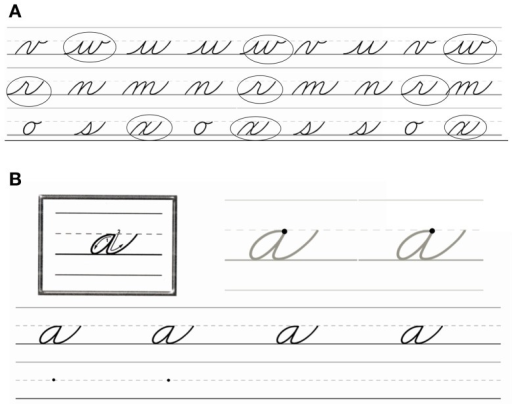
The Daughter was practicing her signature, using cursive writing, earlier this year. A couple generations ago, this wouldn’t have even warranted a mention.
Now there’s a great debate regarding the necessity and efficacy of cursive writing. In some circles, it is now considered a form of creativity, art, if you will, and I think the Daughter was attracted to it at that level.

It is also true that, for some time, she was having difficulty READING cursive, notes from her grandparents, for instance. To the degree that she can, it’s like learning a foreign language. I imagine the folks who design logos are cognizant of that trend.

One of the “cons” of cursive listed: “It’s gone the way of the typewriter.” Of course, the typewriter is making a comeback.

Is the loss of cursive a “dumbing-down of our education system” or is teaching it time wasted? As one who thinks that quicker is not necessarily better, I believe that since it appears to be good for the brain, it should be taught.

“Since it engages both the right and left hemispheres of the brain, it can actually aid in reading comprehension, idea generation, spelling, brain development and memory.”

Even thirty years ago, I realized some ten-year-old children could not read an analog clock. The Daughter was learning in second or third grade, but I know I understood it before I left kindergarten, and I might have known it earlier.

The announcement that analog clocks are disappearing from UK schools caused similar conflict, with some bemoaning it, others suggesting that we can’t read a sundial either, times change, etc.

I suppose I like the analog clock – a retronym, BTW – precisely because it’s imprecise. A quarter to three might be 2:44 or 2:46, and unless you’re trying to catch a train or something, it matters little.

If I had to keep one or the other, it would be cursive writing. Yes, toddlers might have computers to type on, but there’s value to the hands-on craft.

Virginia Eubanks on Automating Inequality October 2

Automating Inequality systematically investigates the impacts of data mining, policy algorithms, and predictive risk models on poor and working-class people in America.

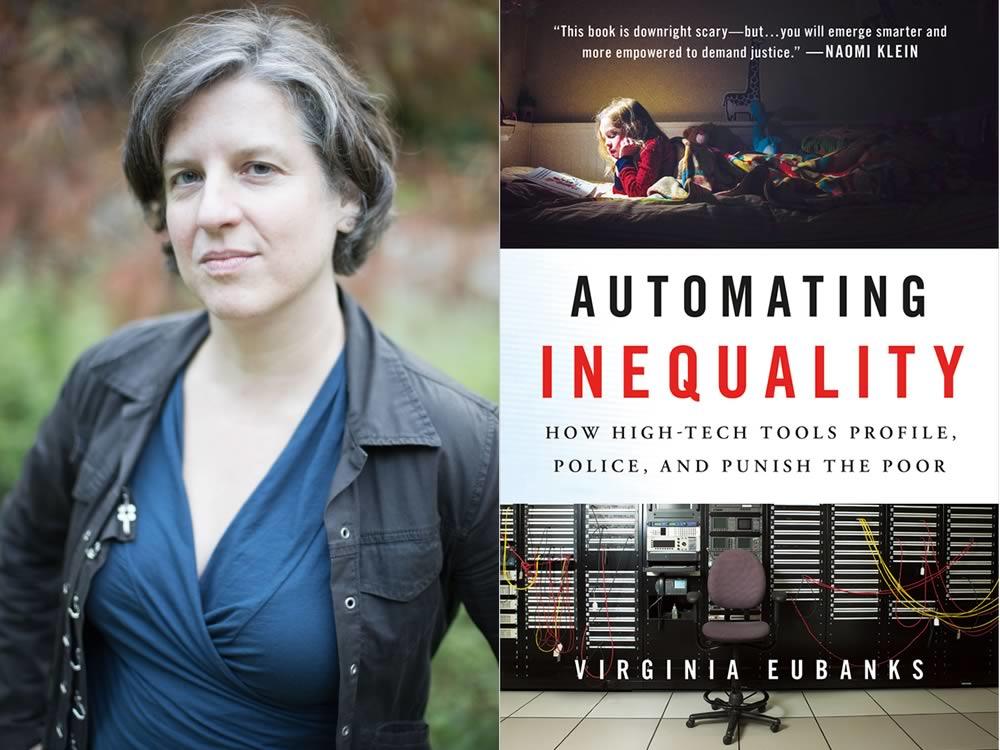
The Author Talk for Tuesday, October 2 at the Albany Public Library will be by Virginia Eubanks. She will be talking about In Automating Inequality: How High-Tech Tools Profile, Police, and Punish the Poor. Eubanks “ably demonstrates why everyone should be very, very worried about the present and future of poverty management,” according to NY Daily News.
Here’s the book blurb:
Since the dawn of the digital age, decision-making in finance, employment, politics, health and human services has undergone revolutionary change. Today, automated systems–rather than humans–control which neighborhoods get policed, which families attain needed resources, and who is investigated for fraud. While we all live under this new regime of data, the most invasive and punitive systems are aimed at the poor.

Automating Inequality systematically investigates the impacts of data mining, policy algorithms, and predictive risk models on poor and working-class people in America. The book is full of heart-wrenching and eye-opening stories, from a woman in Indiana whose benefits are literally cut off as she lays dying to a family in Pennsylvania in daily fear of losing their daughter because they fit a certain statistical profile.

Check out the New York Times Review of the book; a story about the book on NPR All Things Considered; an interview with Virginia on PBS’s “The Open Mind”; and the All Over Albany story from book launch in Troy.

Virginia Eubanks is an associate professor of political science at the University at Albany who has worked in community technology and economic justice for 20 years. She is also the author of Digital Dead End: Fighting for Social Justice in the Information Age; and co-editor, with Alethia Jones, of Ain’t Gonna Let Nobody Turn Me Around: Forty Years of Movement Building with Barbara Smith.

Her writing about technology and social justice has appeared in The American Prospect, The Nation, Harper’s and Wired. For two decades, Eubanks has worked in community technology and economic justice movements. Today, she is a founding member of the Our Data Bodies Project and a Fellow at New America. She lives in Troy, NY.

Author talks and book reviews are sponsored by the Friends of the Albany Public Library every Tuesday that the library is open at the Washington Avenue branch of the APL, 162 Washington Avenue, in the main auditorium at noon.

Les Green, Pop, ancestry, DNA, anger

It would be Les Green’s 92nd birthday tomorrow

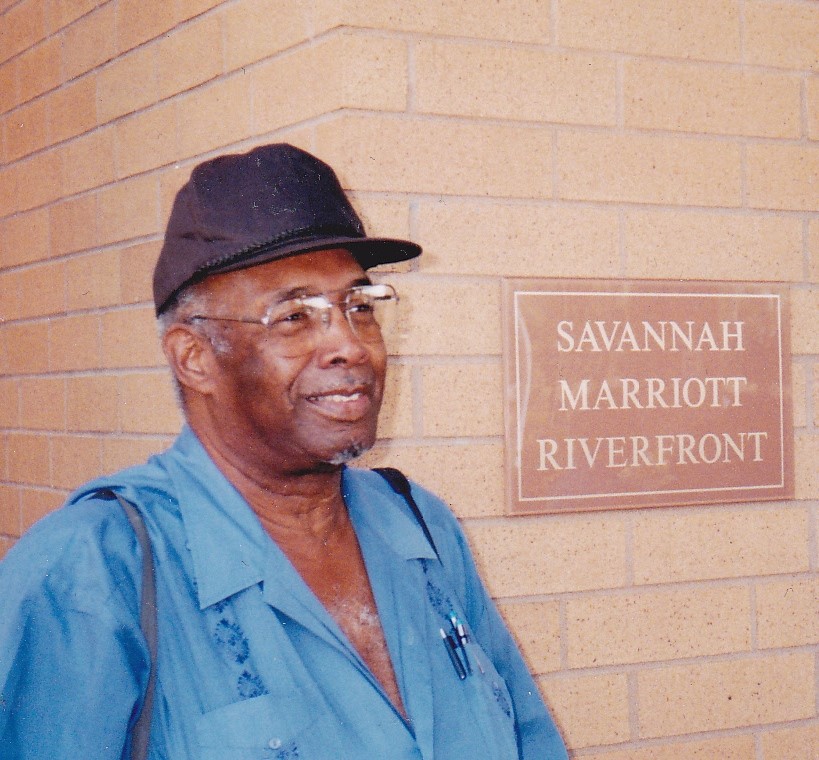
Les Green.Savannah GA.1998
On the same day this month, I read two oddly similar stores. One was in the Boston Globe: “DNA test tells man the bittersweet truth: His father was a Catholic priest.” The other was a piece by Times Union blogger Robert S. Hoffman When your dad is not your father.

And it got me to thinking, again, about the parents of my father, Les Green. Something in the Globe story stuck out: “For decades, James C. Graham was tormented by a simple, but profound question: Why did his father seem to dislike him so much? The South Carolina man confirmed the bittersweet truth: The man who raised him wasn’t his father at all.”

My father seemed to have at least a mild antipathy his stepfather, for the man we all called Pop, McKinley Green. Clearly, he knew Pop wasn’t his biological father, and that might have been the source of his distress. Or maybe it was Pop’s family, who, even after Mac died in 1980, said disparaging things – “bastard son” – about my father within his earshot.

Regardless, I’m still hoping that DNA will someday help me to identify the identity of my biological grandfather. There are at least five people in Ancestry that are noted as my second or third cousins. One is cousin Lisa, a second cousin on my maternal grandmother’s side. And just recently, there’s a guy named Charles with a very distinct surname, clearly a third cousin on my paternal grandmother’s side.

But what of the other three, two of which are closely related to each other as well as to me? One has a genealogy with 125 names and 10 distinct surnames, none of which are familiar. He’s very African, with lineage almost exclusively from Ivory Coast/Ghana, Nigeria, and Mali.

I should address a question from my friend Carol about Ancestry.com: “I’m concerned about the data storage and privacy issues. Have you researched that at all?” Well, yes, they do, though participants can contribute either pseudonymously or with real names. It is the open sharing of information that the best information will arise.

This is a picture of my dad at the ASBDC conference in Savannah, possibly the best time I ever had with him. It would be Les Green’s 92nd birthday tomorrow. I’ll figure this genealogy stuff out eventually.

Father and Son – Cat Stevens

Ramblin' with Roger
Social media & sharing icons powered by UltimatelySocial