
Annie Lennox: ‘Now I Let You Go…’

Who will remember us — and for how long?

mass moca.annie lennoxThe family, including all of my immediate in-laws, spent nearly a week in the Berkshires in western Massachusetts There’s a lot of cultural landmarks there, including the Norman Rockwell Museum, which I’ve been to at least thrice.

This year, my wife and I attended three other museums/galleries. First up, the Massachusetts Museum of Contemporary Art in North Adams, generally referred to as MASS MoCA.

One of the first things we saw was Annie Lennox’s ‘Now I Let You Go…’. This link will tell you most of what you need to know. A docent pointed out one thing I DIDN’T notice, that a piano on top of the pile shows up in shadow on a far wall, and it’s quite affecting. The musician had a vision for the piece, and contacted MASS MoCA, according to a radio interview. She writes:

We interact with an infinity of objects from birth to the grave.

Over time our ‘belongings’ become more steeped and resonant with memory and nostalgia.
In many ways, personal objects express aspects of who we are — our identity: our values: our statements and choices.

The passages of time through which we exist become defined by the objects with which we interact.

The artifacts contained within the earthen mound — partially buried — partially excavated — have all played a part in my life.

I have had a special connection to each item presented — a connection that has been hard to relinquish.

In time, we will all disappear from this earth.

This is our destiny.

What will we leave behind? Who will remember us — and for how long?

I heard music in the background that sounded like Eurhythmics’ Sweet Dreams Are Made of This, yet not exactly. It was the song played backward, it turns out.

Coincidentally, two other female musicians also had displays at the museum, but I saw neither. Unfortunately, the paintings of Chrissie Hynde of the Pretenders leave at the end of August 2019. The work of Laurie Anderson will be there through 2020, but one has to make an appointment in advance.

Things we did see included Still I Rise (through May 2020), the ceiling lights of Spencer Finch’s Cosmic Latte, and the most impressive Hello America: 40 Hits from the 50 States, a new wall drawing by Joe Caldwell (the latter two through 2020 at least).

Admission is $20, but you can come back the next day for free. If our schedule had permitted, we would most certainly have done that. Since the last time we went – could it have been in 2007? – it had taken over far more repurposed old factory buildings than the handful where the museum once existed.
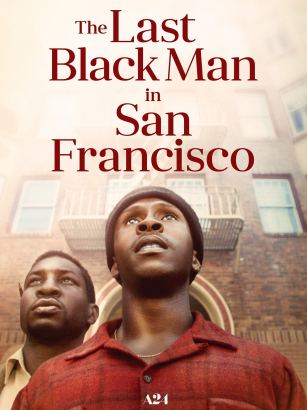
The Last Black Man in San Francisco

complicated love/hate relationship with the place

last black man in San FranciscoWhen I was in Indiana, the youth director of my church had recommended the movie The Last Black Man in San Francisco to the teens in our charge. As it turned out, my wife and I had seen it at the Spectrum Theatre in Albany a couple of weeks earlier.

I hadn’t written about it, partly for time, but mostly because I was stuck in describing it adequately. The IMDB posting says, “A young man searches for home in the changing city that seems to have left him behind.”

Rotten Tomatoes (93% positive with critics, 84% positive with audiences) is more descriptive: “Jimmie Fails [Jimmie Fails] dreams of reclaiming the Victorian home his grandfather built in the heart of San Francisco. Joined on his quest by his best friend Mont [Jonathan Majors] Jimmie searches for belonging in a rapidly changing city that seems to have left them behind.”

Looking at the reviews, I’d agree that it is fresh, original, poetic, an aching portrayal, well-acted, “leaning into its ambiguity, humanity and a quizzical moodiness.” More than one critic notes the “complicated love/hate relationship with the place he calls home that makes [director Joe] Talbot’s love letter to the city so riveting and rewarding.”

So you get the sense of loss, a metaphor for the current housing shortage in the city by the bay. It’s perhaps confusing at first, these skateboarding buddies, one who wants to do upkeep on property not presently his.

Eventually, the story by Fails, Talbot and Rob Richert makes sense to me. There are some great performances by Danny Glover as Montgomery’s blind grandfather, plus Tichina Arnold, Rob Morgan, Mike Epps, and Finn Wittrock.

My friend David Brickman says it’s the best movie of the year so far, and he may be correct.

You probably won’t find The Last Black Man in San Francisco in theaters at this point. If you watch it on pay cable or on DVD/BluRay, you might well find it challenging but, I hope, rewarding.

Georgia on my mind

key lime pie

midnight in the garden of good and evilI’ve been to Georgia twice. The first time was to Atlanta in 1995. The city was/is a sprawling entity. On one particular 10-line highway, we repeatedly saw cars exiting to the right, crossing three or four lanes quickly, usually directly in front of us.

What made it worse was that it was the year before the Summer Olympics, so there was plenty of construction everywhere.

I was there with my girlfriend, now my wife, visiting friends of hers. We also got to see part of the Martin Luther King Museum. Our visit to CNN involved sitting in on some program we have on a VHS tape, and nothing to play it on!

My second Georgia was to the coastal city of Savannah, in 1998, for a work conference. It’s the oldest city in the state and had some interesting historic structures. It was particularly proud of its connection to the book and then-recent film Midnight in the Garden of Good and Evil.

But the best part is that my father drove down from Charlotte, NC to hang out with me. We both arrived on Saturday night, and the conference didn’t formally start until Monday morning, so we walked around the city with some of my friends, eating key lime pie or recalling tales of my growing up.

He LOVED the city by the Atlantic Ocean and said he’d like to move there someday. Unfortunately, he died less than two years later.

Songs about Georgia:

Oh, Atlanta – Alison Krauss
Midnight Train to Georgia – Gladys Knight and the Pips
Georgia on My Mind – Ray Charles
The Night the Lights Went Out in Georgia – Vicki Lawrence
Jug Band Music – the Lovin’ Spoonful

GA Georgia. Historic abbreviation: Geo. Capital and largest city: Atlanta.

GU Guam, an unincorporated organized territory of the US, Capital: Hagatna (Agana); largest city: Dededo. How the United States Ended Up With Guam

For ABC Wednesday

Book review: The Library Book

“The people of Los Angeles formed a living library.”

Library Book.Susan OrleanThe Library Book by Susan Orlean is initially about a fire at the main branch of the Los Angeles Public Library in April 1986 that incinerated over four hundred thousand books.

Why was I not familiar with this story? Maybe because it took place around the time of the Chernobyl nuclear accident.

The book is about the development of the LAPL, which, invariably, reflected the growth of the city itself. Orlean describes the various characters who have been the city Librarian, some of them quite colorful. This discussion inevitably gets into gender roles in employment.

The Library Book gets into the history of libraries generally, how and why they developed, and for whom. We see the value of books and other things libraries collect, and the awful power of book burnings.

But it is mostly about the 1986 fire. Was it set by Harry Peak, a struggling actor, whose ever-contradictory stories frustrated the investigators? Was he even at the scene of the the fire, or not?

The book delves into the investigation of arson. Was the library fire set? Breakthroughs in technology makes clear that some of the fires that investigators thought were deliberately set may not have been.

It is so much about recovery, how, after the librarians there mourned the losses, the community came together fire, forming “a human chain, passing the books hand over hand from one person to the next, through the smoky building and out the door.

“It was as if, in this urgent moment, people, the people of Los Angeles formed a living library. They created for a short time, a system to protect and pass along shared knowledge, to save what we know for each other, which is what libraries do every day.”

Ultimately, The Library Book is a love letter to Susan Orlean’s mother, who taught her the wonder of libraries. That joy is contagious.

As one Goodreads writer noted, “It is in many ways a tribute to libraries and librarians and what they stand for and the importance of the library now and in the future.’

If you like your books linear, the structure of The Library Book may be a little frustrating, as it bounces among the themes. But it did not bother me at all. In fact, I rather enjoyed it. The Library Book is a lot of things, just like a library.

Jesus Sought Me: Luke 19

Come down from that tree!

Zacchaeus tree.Palestine_Jericho
Zacchaeus tree in Jericho, Palestine
Now it’s the second day of Triennium, so it’s Tuesday. No, wait, it’s Wednesday. We left on Monday, got here on Tuesday. It WAS Wednesday.

The scripture of the day was Luke 19, specifically the first ten verses, and the theme of the day is Jesus Sought Me. After breakfast, there are discussions with our group of 18. We were joined by a couple of women from Connecticut, who were their entire delegation.

Jerry, the pastor, led the discussion about Zacchaeus, the tax collector. It was a despised profession because they only made a real profit when they overcharged those who owed money. And he was the chief tax collector in the area, so he was particularly loathed

Verse 3: He wanted to see who Jesus was, but because he was short he could not see over the crowd. The first “he” was Zacchaeus. But Jerry opined that the second he was NOT Zaccheus but Jesus and that Jesus was short.

Ha! That dovetails with my working theory that Jesus was not only height-challenged but homely as well, which I shared with one of our visitors afterward.

The broader message was that Jesus picked that unlikely guy, deciding he needed to stay at Zacchaeus’ house that night. The crowd grumbled, “Why is Jesus hanging out with THAT dude?” Zacchaeus declared he’d give up half of his possessions to the poor, and if he cheated anybody, he’d pay them back four times the amount.

The message continued later that morning in the small group discussions. I was probably older than the instructor and there was only one other person over 40. The rest appeared to be older teens or in their early twenties. I enjoyed the intergenerational interaction.

I should explain the worship services. It’s in a hall that holds most of the 5000 people attending the conference.

The session started, always, with what they called “The Energizer”, doing various exercises to pop music from a variety of artists, including Taylor Swift and BTS, the latter which thrilled my daughter. I thought it was, in the words of Frank Zappa, “enforced recreation,” but I was clearly in the minority.

Our group showed up closer to the start time of the worship services, but the Energizers started slightly before the scheduled time. The kids in our group would try to get there early.

There was a band who sang and played a folk/gospel/rock amalgam. They were quite good. The lyrics to the songs, all but one of which were unfamiliar to me, were shown on a couple of screens. It’s usually not my cuppa, but most of the songs were pretty good.

The sermons during the week, from five diverse speakers, were good across the board. They spoke of an inclusive, rather than exclusionary God, a God that would welcome even a tax collector.

While no specific political statements were made, it was clear that the speakers were cognizant of a certain rhetorical disconnect out of the District of Columbia.

Social media & sharing icons powered by UltimatelySocial