The second Obama term

The Republicans decided to go to clown school.

That first Barack Obama Presidential campaign had that whole “HOPE” thing going. The impression that most impressed me from four years ago was that even before he was actually inaugurated, how busy he was dealing with an economic disaster far greater than he possibly could have anticipated.

I should have known, though, that the honeymoon would be short-lived. Less than a week after he had officially become President, he was criticized, on FOX News, of course, that he hadn’t done enough for the economy. Then when he came out with the “bailout”, it was considered too large. (I remain convinced that it wasn’t large enough.) The Republicans, for the most part, became intractable in coming up with any solution that didn’t harm the poor and middle class.

I began to tire of the term “job creators.” The “job creators” can’t create jobs because the taxes are too high. But jobs were created in the US for generations with far high rates.

These “spontaneous” tea party folks started coming out of the woodwork fairly early on, screaming at their Congresspeople at public meetings, and having rallies, covered as though they were news events, rather than staged propaganda, by FOX News.

It took almost no effort to find references to the President as a Muslim – “his name is Barack HUSSEIN Obama!” Or a socialist/communist/fascist, by people who seem to have zero grasp of what those words mean. Here is almost every Obama conspiracy theory ever.

The term was an uphill climb. A lot of political capital was used on Obamacare, a term that was initially used derisively, but which is now the recognized nomenclature. Worse, the health care bill didn’t pass until 2010, with no GOP support. If it was a triumph, far less than the universal coverage some of us were seeking – that got thrown under the bus quite early in the negotiations – it was a muted win.

After the Democratic “shellacking” (Obama’s word) in the midterm elections, it was often suggested that Obama would be a one-term President.

The killing of Osama bin Laden muted some critics of the President for about five, maybe even ten minutes. Still, with an anemic economic recovery, it seemed that the Republicans should be in the White House this week.

Fortunately for Obama, the Republicans decided to go to clown school. There was actual talk about whether birther darling Donald Trump would enter the race. Buffoons such as Congresswoman Michele Bachmann, Texas Governor Rick “what agencies WOULD I cut” Perry, and pizza man Herman “9-9-9” Cain all were frontrunners in the race at some point. Near the end, former senator Rick “don’t Google his last name” Santorum became a credible threat to what the Republican establishment thought was the inevitable nomination of Willard Mitt Romney.

While the administration was already the most progressive in terms of gay rights through 2011, after a hint by VP Joe Biden on a Sunday morning, President Obama came out in support of marriage equality. (It was 2012 was a very good year, in general.) I appreciated that the President took a principled stand on something.

In his first Presidential race, Barack Obama was dubbed as “no-drama Obama.” I believe that he spent his early years figuring out that he didn’t want to be perceived as an “Angry Black Man.” I remain convinced that his perceived anemic performance in the first debate with Romney was a function of that. His more aggressive demeanor in debate #2 generated the ABM charge in some circle.

Frankly, I was unsurprised about the difficulty of agreeing on federal tax rates and expenditures, and the debt ceiling, variations on the so-called “fiscal cliff.” Will the next four years be as frustrating as the last four? Will there be legislation passed on immigration, gun control, or any number of other issues?

Book Review: After All by Mary Tyler Moore

Mary Tyler Moore’s her second marriage, to television producer Grant Tinker, seemed to epitomize the emotional distance both of them operated on when things were less than optimal.


As a television personality, there is probably no one I enjoyed more than Mary Tyler Moore. She appears on my Top Five favorite TV shows of all time, The Dick Van Dyke Show; her eponymous show is on my Top 20 list.

Looking forward to reading her autobiography, I was mystified by the fact that, for much of her professional life, she was a bundle of insecurities. Her success on her own show and Van Dyke’s she attributed to the talented performers, writers, and producers around her. Her failures, on other shows and on stage, are her fault. Such insecurity is odd, and not particularly appealing.

There is a certain arm’s length in her retelling of her growing up with a distant father and alcoholic mother, told in short chapters. A neighbor briefly molests her when she was six, and her mother refused to believe her; it’s told, as much of the book is, in this matter-of-fact manner. Later, the deaths of her younger sister and her son are likewise relayed.

Interestingly, her second marriage, to television producer Grant Tinker, who ran her production company, MTM, seemed to epitomize the emotional distance both of them operated on when things were less than optimal, though they appeared fine when things went well.

The book became so frustrating that, halfway through reading it, I actually blogged about it. Chris Honeywell nailed it: tanha, “a Buddhist idea which seems to correspond to ‘cravings, lusts, and focusing on self without introspection.'”

Then I started having second thoughts. I spoke to a friend of mine who has gone through therapy. The therapist has said to my friend, “Why aren’t you screaming” about the painful events being shared? Maybe when one has experienced enough emotional venting, one may come off as cavalier about the tough issues.

The most interesting chapter, and, at 12 pages, one of the longest, is when Mary finally gets sober. She went to the Betty Ford Clinic and was incensed by the tough treatment. “Then leave,” one nurse said.

After All, by the end, was a rather honest book. Not always pleasant, not what we might have expected from “our Mair,” but thorough.
***
Mary Tyler Moore nearly skipped the audition for “The Dick Van Dyke Show”.

Dick Van Dyke: “I’d go to work with terrible hangovers. Which if you’re dancing is hard.”

52 minutes of Carl Reiner talking about writing. He created The Dick Van Dyke Show.

Signed, Dear Abby

The name Abigail Van Buren came from a Biblical woman and a one-term President.

Even as a child in Binghamton, NY, I religiously read Ann Landers in the morning paper, the Sun-Bulletin, and Dear Abby in the Evening Press. When the papers merged, both columns appeared.

Someone of a younger vintage might not appreciate the impact of the social significance of these columns written for many years by twin sisters, born July 4, 1918. Ask Ann Landers was originally the pen name created by Chicago Sun-Times columnist Ruth Crowley in 1943, but it was taken over by Eppie Lederer in 1955, and used until her death in 2002 when the name was retired; it was Eppie with whom the pseudonym was most identified.

A few months after Eppie became Ann, Pauline Phillips started the similar Dear Abby; the name Abigail Van Buren came from a Biblical woman and a one-term President. The sisters feuded for years. Pauline’s daughter Jeanne Phillips, took over Dear Abby in 2002, officially, when Pauline’s Alzheimer’s became known, though, in fact, Jeanne’s participation went back to her time as a teenager.

I long preferred Ann to Abby. I thought she was more tolerant, especially after her 1975 announcement about the end of her 32-year marriage.

Yet it was Dear Abby, by the structural simplicity of the pen name, which was the better known of the two. “Dear Abby” generated many more references in popular culture, such as this piece by the Bitchy Waiter. My favorite is the song Dear Abby by John Prine [LISTEN].

Pauline Phillips, the original Dear Abby, died on January 16.
***
Conrad Bain died this week. I must note that I wasn’t a big fan of Diff’rent Strokes, which was about this rich white man, who had a young daughter, adopting two black kids. Arnold often said to his brother, “What’chu talkin’ ’bout, Willis?” I think it was supposed to be funny.

I did watch and enjoy Bain on Maude as Dr. Arthur Harmon, her neighbor, and Republican foil to her liberal views.

Are you an optimist or a pessimist? Bewitched and Ben Franklin

“Defensive pessimism” – that sounds about the right description of my philosophy.

I know some people who appear to be unrelentingly positive, seeing the 3/4s empty glass as 1/4 full. I appreciate those people, as long as they don’t seem to be wearing rose-colored glasses.

I was commenting on someone’s blog – more on that anon – and I was reminded of one of those peculiar childhood memories that, I believe, color my view of the world to this day.

It was an episode of the 1960s television program Bewitched, starring Elizabeth Montgomery.

I recall very little about the particulars, actually. Couldn’t tell you which Darrin was in it, Dick York or Dick Sargent. We had a black and white TV, so I couldn’t tell you if it was broadcast in color. Don’t even particularly remember the plot.

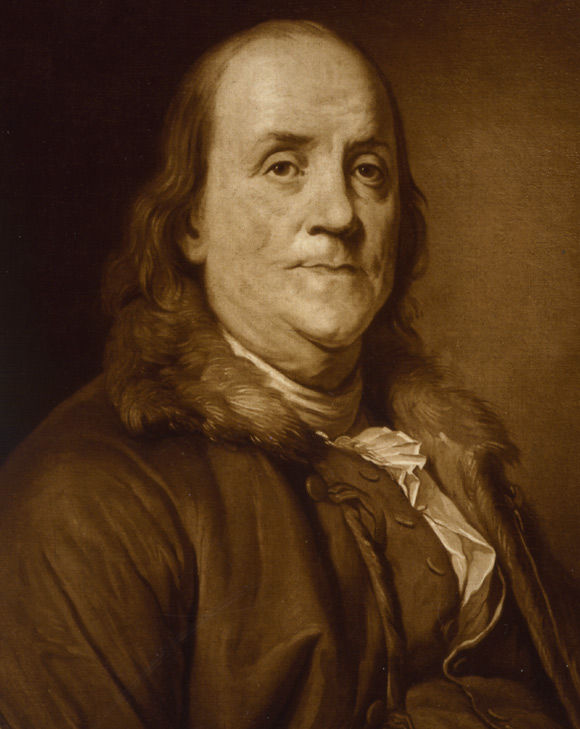
I DO know, though, that Benjamin Franklin appeared, for some reason. His character was offering up all sorts of aphorisms. One was that he always going through life expecting negative outcomes so that when something positive happened, he would be pleasantly surprised. It was a punchline that was supposed to be funny – the canned laughter told me that – but, to me, it made SENSE. (The exact quote from the show, according to here: “I’m more optimistic than pessimistic. Or perhaps I’m an optimistic pessimist — prepare for the worst, but when the very worst doesn’t happen, I’m pleasantly surprised.”)

Last month, in her V is for Visualization post, Meryl at Departing the Text wrote:

Studies suggest…that optimistic affirmations designed to lift one’s mood, often achieve the opposite effect.

…The Power of Negative Thinking essayist, Oliver Burkeman suggests that there is an alternative approach to help us find that sometimes elusive (holiday) cheer: “…both ancient philosophy and modern psychology suggest that darker thoughts can make us happier.”

According to Burkeman, Albert Ellis (a New York psychotherapist) rediscovered this key insight of the Stoic philosophers of ancient Greece and Rome: “the best way to address an uncertain future is to focus not on the best-case scenario but on the worst.”

Stoics called this worst-case scenario therapy “the premeditation of evils” and they believed that doing this would remove the anxiety “THE FUTURE” relayed. According to Burkeman, modern psychologist Julie Norem estimates that about one-third of Americans instinctively use this strategy which she terms “defensive pessimism.”

Burkeman further posits that: “The ultimate value of the ‘negative path’ may not be its role in facilitating upbeat emotions or even success. It is simply realism. The future really is uncertain, after all, and things really do go wrong as well as right. We are too often motivated by the craving to put an end to the inevitable surprises in our lives.”

“Defensive pessimism” – that sounds about the right description of my philosophy. On the other hand, I think that worrying is highly overrated.

This begs the question: was Ben Franklin portrayed accurately in a sitcom a half-century ago? This quote is attributed to him, according to several sources: “I’d rather be a pessimist because then I can only be pleasantly surprised.” So, kinda sorta, yeah.

Movie Review: Silver Linings Playbook

Silver Lings Playbook tells an ultimately orthodox story in such an unorthodox manner.

It’s a rom dramedy! It’s a sports movie! It’s about anger management! It’s a floor wax! It’s a dessert topping!

I read all sorts of things about the new movie Silver Linings Playbook (except those last two, which are from an old Saturday Night Live skit). Still, I didn’t get much of a clear sense of the film beforehand, except who starred in it.

The Wife and I went to see the movie at the Spectrum 8 in Albany, our favorite cinematic haunt, Saturday past. Pat, Jr. (Bradley Cooper, who I had previously seen in absolutely nothing; never caught The Hangover movies) is getting out of a mental institution, after eight and a half months, following a violent incident. He moves back in with his parents (Jacki Weaver, previously nominated for Animal Kingdom; I hadn’t seen her in anything; and Robert DiNiro – HAVE seen him a few times, most recently in New Year’s Eve on TV). Pat wants to woo back his estranged wife, which is complicated by a restraining order.

He seems to have found an ally in his endeavor the friend of a friend (Jennifer Lawrence, who I didn’t see in Hunger Games or anything else) who has issues of her own.

The Wife and I liked the film, though it traveled from this character study – Pat dealing with a Stevie Wonder song that triggers untoward behavior – to an almost conventional film about winning the big game, of a sort.

Sidebar: we spent much of the conversation on the way home talking about what is “crazy” in this society and what is not. Pat Jr. may have been a bit disconnected from reality. But was it much worse than Pat Sr. being banned from the Philadelphia Eagles’ stadium, or his various superstitions concerning sports?

I think it’s getting so many positive reviews and so many Oscar nominations (Best Picture, Best Director, four acting categories, screenplay, plus) because it tells an ultimately orthodox story in such an unorthodox manner. Cooper is better than expected, and Lawrence has more range. Weaver and DeNiro may have gotten their nominations in no small part for one scene, which I won’t describe except that the Led Zeppelin song What Is And What Should Never Be was playing.

I liked the film, but I was surprised by the change in tone. Still, I think it is that turn that made it work for me. Yet, I’m not sure yet whether it was Best Picture material; I’ll have to see some more movies this winter.

Ramblin' with Roger
Social media & sharing icons powered by UltimatelySocial