S is for Sesame Street

Do I watch Sesame Street on TV? Not really. But I DO watch the videos.

Back in the early 1970s, I used to watch Sesame Street. I don’t think I really have to explain Sesame Street, do I? It’s this kids’ show that started in 1969, broadcast on public television in the United States, ostensibly to educate children, with the extensive use of puppets, or, specifically, Muppet characters designed by the late Jim Henson. The program has spread to a couple of dozens of countries, in a number of languages.

The “trouble” was that I didn’t have any children to give me cover; I just liked watching it, even though I was in my early twenties. I wished that there was a show so cool when I was growing up. and I liked the songs, such as Rubber Duckie, and, naturally, Bein’ Green. I even own the 10th-anniversary album from 1979, though I had pretty much stopped watching by then.

Skip ahead a few decades, and I have a child of my own. Over the years, the show has tackled issues such as language differences, disabilities, hunger, and, notably bullying. Do I watch Sesame Street on TV? Not really. But I DO watch the videos.
Sesame Street has always been cool, offering famous grown-ups the chance to participate. The video by Feist may be the one that reminded me that Sesame Street was still doing the celebrity thing.

Here are some videos I’ve watched recently, now that the site is no longer being hacked.

Issues
Change the World, featuring the same Muppet who loves her hair
Hunger

Celebrity
Adrian Grenier: Season
Jon Stewart: Practice
Liev Schrieber and Naomi Watts: exchange things
Mark Ruffalo: Empathy
Michelle Monaghan: Fascinating
Mila Kunis: Include
Neil Patrick Harris: Curly
Seth Rogen: Embarrassed
Terrence Howard: Incognito

Parody
30 Rocks
G – a parody of Glee
(And a parody OF Sesame Street: Occupy Sesame Street Gets Violent

Music
Monster Went and Ate My Red 2 with Elvis Costello, which makes more sense if you’ve heard his original. I love this.
Arrested Development: Pride
B.B. King: The Letter B
The banned Katy Perry video – too risque for some
Jaquandor also put together some singing videos

BTW, there’s a new movie documentary featuring the puppeteer of Elmo, Kevin Clash.

There are a couple of videos that made me more than a little sad:
The late Chris Reeve to the library
Goodbye, Mr Hooper. When actor Will Lee died back in 1983, so did his character. Watch especially starting at the 7-minute mark.


ABC Wednesday – Round 9

R is for Recycling

It cost the city tens of thousands of dollars to upgrade the system, but for alleviating my guilt at throwing away a yogurt cup, it was worth every penny.

When we were away this past summer, we had our mail held. And I swear that my favorite item that I saw once we retrieved it was a flier from the city of Albany about its new recycling policy. No longer did the city only take plastic items with the #1 or #2 in the triangle; it’s now taking #1-7!

This was hugely important for us, as we are very active recyclers. So those yogurt and cottage cheese containers, which tend to be #5 or #6, we just hated to throw out.

My wife would sometimes put leftovers in them, but unless they were well-labeled, I’d mistake them for their original packaging info until it was too late. Some were saved for school arts and crafts, but there are just so many craft projects one can do. It cost the city tens of thousands of dollars to upgrade the system, according to the newspaper story at the time, but for alleviating my guilt at throwing away a yogurt cup, it was worth every penny.

I hate going to the returnable center at the local supermarket. A lot of recyclable, but not returnable, items that people bring end up in the trash. I’ve noticed over the years that a lot of people around here just don’t spend the few minutes to separate out the recyclables and it makes me…peevish.

One element of the new city regulations that I ignore is the “Single Stream Curbside Recycling Collection”. I still segregate my paper products from the bottles and cans because of the bottle entrepreneurs who rifle through the recycling bins. I figure when they open up the green bin and see that’s it’s all paper and cardboard, they’ll leave it alone, and only go through the blue bin that has the recyclable – but not returnable – bottles and cans.


ABC Wednesday – Round 9

Q is for…

In other words, expecting rationality in the development of English is…irrational!

The last time ABC Wednesday was on the letter Q, someone asked, “Why does U usually follow Q in English-language words?” And the answer was simple to find but mighty difficult to explain.

As is noted here, it’s because modern English evolved from the Phoenicians to the Greeks to the Etruscans to the Romans.

Like the Greeks, Latin had only the one k sound. As a result, over time kappa was dropped, koppa evolved into q, and gamma into c (these changes explain why Greek words spelled with k have their Latin equivalents spelled with c). The Romans used q only before u, though the combination was actually written as qv, since v was a vowel in classical Latin, to represent the kw sound that was so common in the language.

If we move on about a thousand years, we find that Old English had the same sound, but represented it by cw, since q had been left out of their version of the alphabet (so queen in Old English was spelled cwen, for example). French, however, continued the Latin qv, though by now written as qu. After the Norman Conquest, French spelling gradually took over in England, eventually replacing the Old English cw by Latinate qu, though this change took about 300 years to complete.

In other words, it’s because English is an evolving, bastardized language. Or, blame the French.

I like the answer here as well: “As for why q is always written with a u in Latin itself… The ‘u’ part is actually the easiest to understand, as its pronunciation approximates the glide sound that ‘w’ represents in the ‘kw’ cluster. What’s harder to understand is why Latin chose to have 2 separate symbols for the ‘k’ sound (the other is c; they never used ‘k’). It’s also amusing that English adopted all 3 symbols (q, c, and k). One of those accidents of history, I guess.”

Helping the Daughter with her spelling reminded me that, linguistically, the letter C has no function that isn’t being rendered by the K or the S.

In other words, expecting rationality in the development of the English language is…totally irrational!

There is even debate as to whether, typographically, there should be a qu glyph – i.e., the letters joined as if they were one. I’ve sometimes seen them written as though aligned.

Here’s a video that will enlighten the issue not at all.

ABC Wednesday – Round 9

P is for Peeved Parent

*to take care of someone’s baby or child while that person is out, usually by going to their home
*a person engaged to care for one or more children in the temporary absence of parents or guardians

I was reading the May 2011 Parenting: School Years magazine that had been abandoned in the common lunchroom, when I came across this advertisement.

Now I’ve been a parent for a while now. And, at least since the latter part of the 20th Century, I’ve noticed that there has been a concerted effort, at least in the United States, for fathers to be treated like parents too. Just this semester, there was an event in Albany, NY for fathers to walk their children to school, and in some schools, to stay for breakfast. This was also a message that had been spread in the Daughter’s preschool.

So messages like the one above, in my opinion, undercut the message. I’ve also been peevish with General Mills for quite a while, with their tag for KIX cereal – “Kid tested, Mother approved,” which you can see in this commercial and this one, among many others. And in these examples, not an adult, of either gender, in sight.
How about “kid tested, parent approved”? Doesn’t even change the scansion.

In that same magazine, an article naming moms in the title, but in the actual article, visits from either or both parents are cited.

Early on in this blog, I noted another pet peeve: when I took off from work to watch my daughter, someone said, “Oh, you’re going to babysit Lydia.” Can you babysit your own child? It didn’t resonate correctly with me. To the dictionaries to look up babysitting/babysitter:

to take care of someone’s baby or child while that person is out, usually by going to their home
a person engaged to care for one or more children in the temporary absence of parents or guardians
*a person who cares for or watches over someone or something that needs attention or guidance
OK, so there’s some wiggle room in the third definition.

But I asked my wife “Has ANYONE EVER said to you, ‘Oh, you need to babysit Lydia [because she’s sick, etc.]?” And the answer, as I suspected, was “No.” SHE watches, SHE tends to, SHE cares for. And I babysit? Nah, I watch, I tend to, I care for. I really believe the linguistic distinction matters. When she’s ready to be in a relationship and have children HUNDREDS of years now, I want her to have a partner who is a caregiver, not a babysitter.

Finally, a song: Be Kind To Your Parents. I had a different recording of this song, on pink vinyl. My sister Leslie and I used to sing it, though we changed the lyrics somewhat…
Be kind to your parents. You know they deserve it. Remember that grownup’s a difficult stage of life… They’re apt to be nervous and overexcited, confused from the daily storm and strife. Just keep in mind, though it sounds odd I know, most parents once were children long ago. INCREDIBLE!!! So treat them with patience and sweet understanding in spite of the foolish things they do. Someday you may wake and find YOU’RE A PARENT, TOO!
[So is THAT how it happens…]

ABC Wednesday – Round 9

O is for Oceans

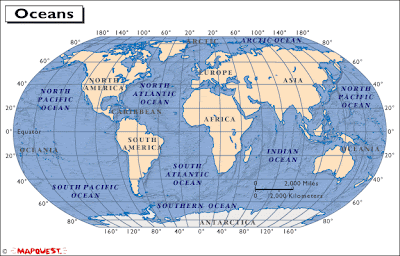
I never heard of the Southern Ocean! It wasn’t in my fourth grade geography book.


This post was inspired by an episode of the TV show JEOPARDY! Specifically, April 4, 2011 final. The category was WORLD GEOGRAPHY: “These 3 nations each border the world’s largest & smallest oceans.”

I must admit that I sussed out the answer immediately. From the responses, however, it was clear that none of the contestants knew a key element of the clue. One response was India and Sri Lanka; another Australia, Papua New Guinea, and Borneo; and the third, Australia, Indonesia, and Malaysia.

So, what ARE the largest and smallest oceans in the world?

The largest, by a considerable margin, is the Pacific Ocean, with 64,186,000 square miles (166.241 million sq km). But you all knew that, didn’t you?
The second-largest, of course, is the Atlantic Ocean, with 33,420,000 square miles (86.557 million sq km); I wasn’t aware of such a disparity of size between the Pacific and Atlantic.
The third-largest is the Indian Ocean, at 28,350,000 square miles (73.426 million sq km). This, clearly, is the ocean that the contestants thought was the smallest; not so.

The fourth-largest is the Southern Ocean at 7,848,300 square miles (20.327 million sq km). WHAT? I never heard of it! It wasn’t in my fourth-grade geography book. “Until the year 2000, there were four recognized oceans: the Pacific, Atlantic, Indian, and Arctic. In the Spring of 2000, the International Hydrographic Organization delimited a new ocean, the Southern Ocean (it surrounds Antarctica and extends to 60 degrees latitude).”
The smallest ocean, then, has to be the Arctic Ocean at 5,106,000 square miles (13.224 million sq km).

So, if the largest ocean is the Pacific, and the smallest the Arctic, what three countries border both?

While you think about it, a bit about oceans: The ocean covers 71 percent of the Earth’s surface and contains 97 percent of the planet’s water, yet more than 95 percent of the underwater world remains unexplored.

Obviously, the bordering nations have to be large, northern countries. Two immediately came to mind: Russia and Canada. What’s the third? The United States! Specifically Alaska. (The Pacific is at the top of this map, with North America to the left and Asia to the right.)

Interestingly, the first contestant started writing the US, Canada and Mexico, bailed and went with the answer shown. Even though I knew the answer to the question, I learned something too from this exercise!

ABC Wednesday – Round 9

Social media & sharing icons powered by UltimatelySocial