PAIN Question

I’ve withstood root canal. I’ve broken a rib. I’ve gotten rabies shots…


My wife managed to roll up the power windows of the car on three of my fingers last Sunday; I was pulling the door closed. Yes, I used invectives that I tend not to use around The Daughter. Later, The Daughter asked me if this was the worst pain that I had ever experienced. The answer was clearly no, and in fact, I was glad that it was the middle three fingers, because I suspect that catching any one finger would have hurt worse and possibly would have suffered real damage.

I’ve definitely experienced much greater discomfort. I’ve withstood root canal. I’ve broken a rib. I’ve gotten rabies shots, which are pretty nasty because they’re big needles and they have to stay in for 10 seconds.

But probably the worst pain involved stepping on a nail, not the initial activity, which certainly hurt enough, but rather the removal of pieces of my sneaker from my foot by the doctor. That was in May 2000; just got a tetanus booster this spring.

So:
1) What was the worst pain you’ve endured? I know for my wife it was oral surgery, which made childbirth seem like a walk in the park.
2) What activity that you do regularly causes you the most pain? Clearly for me, this is donating blood. I have done it 136 times – that’s 17 gallons – and when the nurse says, “You’ll feel a little pinch,” I know that’s a lie. It passes, but it hurts. P.S., I never look. Ever.

Macca Is 68

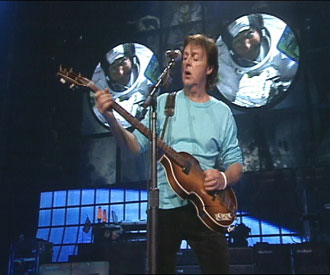
Paul McCartney hadn’t been that controversial since he recorded Give Ireland Back to the Irish back in 1972.


I figure that I should mention Paul McCartney on his birthday every year, as long as he’s still around. Fortunately, this year, there’s the big news to talk about.

That, of course, would be him being named the third Library of Congress Gershwin Prize winner, after Paul Simon and Stevie Wonder. At an event with President Obama, McCartney created a bit of bluster with the right-wing bloggers when he made a joke at the expense of Obama’s precessor, GW Bush. Horrors! Paul hadn’t been that controversial since he recorded Give Ireland Back to the Irish back in 1972.

The event will be televised on PBS on July 28.

Here’s a live recording of Cosmically Conscious, written back when Paul was in India in 1968. A snippet of this song appeared at the end of his 1993 Off the Ground album

Check the June 17, 2010 episode of Coverville, #683; Brian Ibbott has promised a McCartney cover story.
***
It’s also Roger Ebert’s 68th birthday. He just won a Webby award, indeed was named person of the year; he needed just three words in a dead language to express his appreciation of the honor. While he’s still writing his fine movie reviews, it is his journal about American flag T-shirts, racism, alcoholism, death, and how Twitter has empowered him now that he cannot speak that has been the truly amazing part of his narrative.

John C. Reilly Would Really Understand Me

The Muppet Rowlf was a regular on the Jimmy Dean Show, sometime during its 1963-1966 run on ABC-TV


I’m watching The Daily Show with Jon Stewart recently, miraculously only a couple days after the show aired. John C. Reilly, who I know best from the movie Chicago, was on, ostensibly to plug his new movie, Cyrus. But it is what he said about music, at about 4:20 of this clip, that really struck me. Seems that when he was a kid, when his mom or dad would say a word or a phrase, he would come up with a song to go along with it. I did/do the same damn thing!

And while we both realized it could be really annoying, it was not done for that purpose. It happened because that’s the way we connect the dots in the world. I was reading a cereal box recently, FCOL, and the first sentence was “Life is complicated.” IMMEDIATELY, I thought, “Why is life SO COM-pli-cated?” That’s a line from which uses the Stevie Wonder-penned song, because I haven’t yet SEEN that yet.
***
I wanted to write about the singer Jimmy Dean, but needed an angle, and didn’t find one until I read this article. Of COURSE! The Muppet Rowlf was a regular on the Jimmy Dean Show, sometime during its 1963-1966 run on ABC-TV, which I would occasionally watch. So Dean hired Jim Henson early on. Here’s a dated bit between country singer and dog, a Rowlf ad for the Dean show, and an ad for a Rowlf doll; note the early version of Kermit the Frog.

The other thing about Jimmy Dean is his big hit, Big Bad John, and how near the end, when the line reads, “At the bottom of this mine lies a big, big man.” Yet I always hear something coarser, such as “a helluva man.”

If I ever had his sausage, I have no recollection.
***
Crispian St. Peters died, best known for song called Pied Piper. But he also had a minor hit with Evanier gives details of the great artist’s life.

The Daughter’s First Gay Pride Parade

This experience reminded me of the years my father used to drag me to civil rights events when I was a kid. I didn’t always understand the nuance of the activity…

We almost didn’t make it.

I have participated in the Gay Pride Parade in Albany at least a half dozen times. And since this was the 40th anniversary of the Capital District Gay and Lesbian Community Council (CDGLCC), reportedly the longest continuously-running group of its type in the nation, this was a particularly significant event this year.

This past Sunday just seemed too complicated, though. The Daughter was having a dance recital later that afternoon, and the weather was looking threatening to boot. But The Wife had volunteered to serve coffee after church, and that involved cleanup afterward.

So I suggested that The Daughter and I at least watch the parade. The Sunday school assignment of the junior high kids at our church that morning was to work on the float with some parishioners and one of our pastors, so The Daughter was at least aware of our congregation’s involvement. And she watched it being finished after Sunday school.

As we waited for the noon start time, I decided that we could find the More Light Presbyterian contingent and at least walk with them from the park to the church a couple of blocks. I see State Senator Neil Breslin with probably the most well-known gay rights activist in the area, Times Union blogger Libby Post who wrote, before the parade, about unusual acceptance at a local high school. (I agree with someone’s assertion that “tolerance” of gay people seems akin to “tolerating” root canal or “tolerating” veggies you don’t like but eat anyway; not an adequate word at all.) There were other local pols there as well; US Senator Kirsten Gillibrand was not there, but there was a float representing her.

So, The Daughter and I start walking with the Presbys. At an entrance to the park was the small, but apparently vocal “God can cure homosexuals” band. While most people along the parade line cheered our group, I heard at least one guy from the Westboro-like cabal refer to us as “an abomination”; I think this was supposed to hurt our feelings.

Picture courtesy of Kevin Marshall

We’re about back to our church when I see our car. The Wife had parked it right along the parade route, so we wouldn’t be going anywhere for a while anyway; might as well keep walking.

In the car that was part of our contingent was a cardboard Jesus wearing a rainbow lei, bobbing up and down in the moon roof; it was a big hit.

Later, she watched the event coverage on TV (I taped four stations, and caught three reports), and she was only slightly disappointed that she didn’t get any air time.

This experience reminded me of the years my father used to drag me to civil rights events when I was a kid. I didn’t always understand the nuance of the activity, but I DID know that it was Important. And occasionally, fun.
***
From Salon: Polygamy vs. gay marriage; An exclusive clip from “8: The Mormon Proposition” explores the historical irony behind the LDS anti-gay campaign.

V is for Veteran

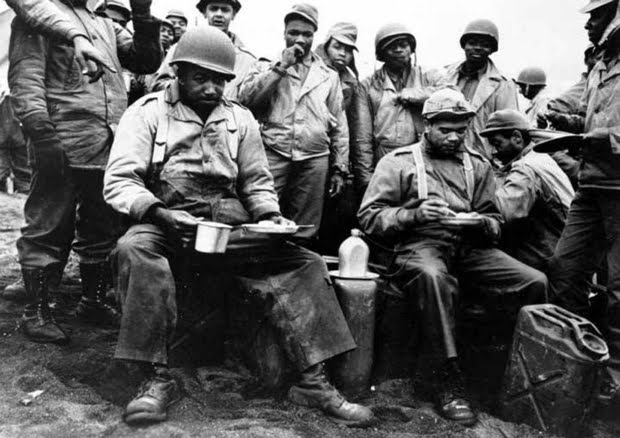
Most of the wars fought by the United States, starting with the Revolutionary War, included a subtext, even the promise, of justice for, and fair treatment of African-Americans.

Back at the end of February 2010, I did a presentation for the Underground Railroad conference about Black Soldiers in Post WW II Germany. I’m certainly not to replicate it here, but a few points I’ll mention.

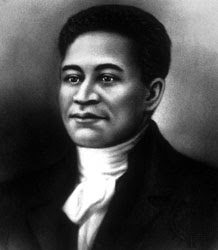
Even though the first casualty of what would become the American Revolution was Crispus Attucks at the Boston Massacre of 1770, the American colonial powers fighting Great Britain were resistant to allowing black soldiers to serve. It wasn’t until the British offered freedom to black fighters that ultimately got George Washington’s attention. Ultimately, blacks fought on both sides of the conflict, but their reason was singular: freedom.

Again, in the American Civil War, many black men felt that serving in the military was a way they might gain freedom and full citizenship. As Frederick Douglass asserted that if blacks fought, “no power on earth can deny that he has earned the right” to freedom.

General David Staunch took it upon himself to free slaves, not just on islands controlled by Union forces, but in south Florida, where he recruited men capable of bearing arms to form the first black regiment. This was ultimately opposed to, and disbanded by President Lincoln, fearing moving more quickly than “public opinion would bear.”

There was a modicum of freedom for the newly emancipated but this was negated by the Jim Crow laws and other restrictions. During World War I, WEB DuBois wrote in The Crisis magazine, “First your Country, then your Rights”. A by-then familiar refrain.

So, most of the wars fought by the United States, starting with the Revolutionary War, included a subtext, even the promise, of justice for, and fair treatment of African-Americans. World War I and especially the Civil War brought the issue to the fore.

But it was with World War II, with large numbers of black soldiers in uniform, that the contradiction between fighting for freedom for others and a lack of freedom back at home reached a tipping point.

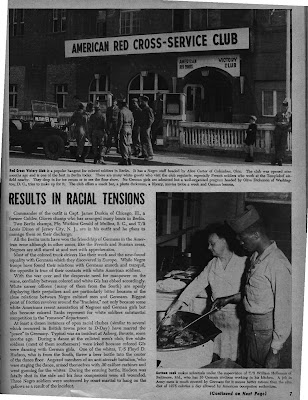
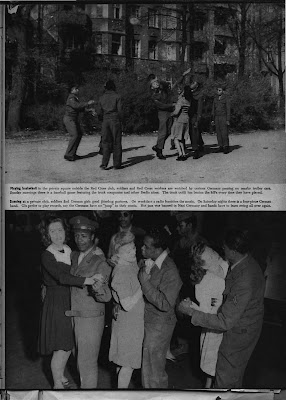
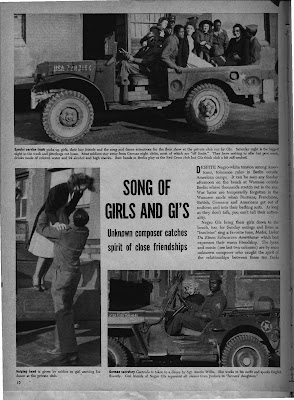
Germany in post World War II was occupied by thousands of American soldiers, many of them black. While Hitler’s mantra of racial superiority might suggest that the black soldier might have a difficult time in the former Nazi-led country, the experiences were far more mixed. A huge part of this involved the black GI and the German fraulein, something that clashed with the norms of two countries. What took place during that period changed both the condition of African-Americans back in the United States and the occupied German people as well.

Due, in part to the pressure by the black press, reporting on the superior conditions for the black troops in what was Hitler’s country, the armed services were integrated in 1948.
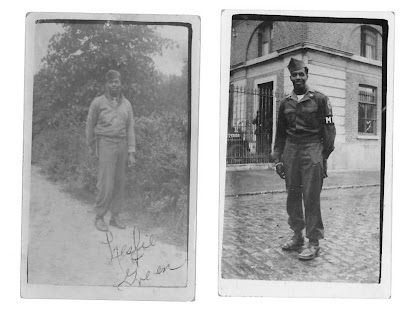

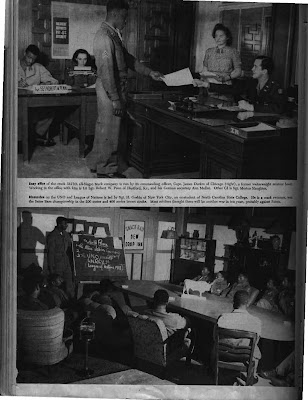
So, was it a sense of history or a more personal connection that my father to keep a Newsweek article delineating this phenomenon for 54 years, from 1946 until his death in 2000, or was there something more? My father was in the European Theater of operations from February to November 1946, but we never really talked to him about the war.
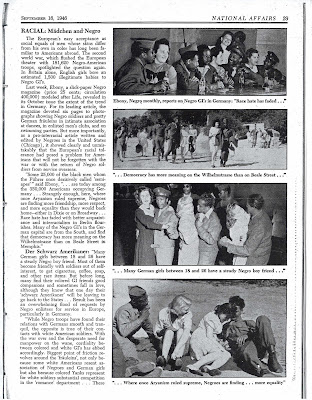
There is a surprisingly large bit of literature on this topic of race and Germany after the war. It doesn’t cite the Newsweek article, but rather an article from a then- relatively new magazine called Ebony (October 1946).

I would particularly recommend The Civil Rights Struggle, African-American GIs, and Germany, a research project and digital archive. The creators received a prestigious award from the storied civil rights organization, the NAACP.
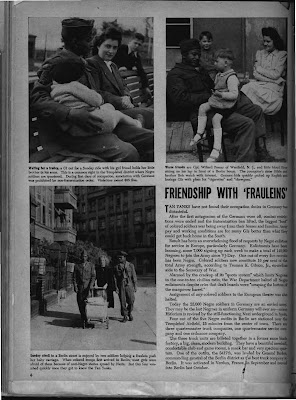
I’d also note Historians study black vets’ role in civil rights for the very first paragraph: In the words of retired Gen. Colin Powell, postwar Germany was “a breath of freedom” for black soldiers, especially those out of the South: “[They could] go where they wanted, eat where they wanted, and date, whom they wanted, just like other people.” Or, as it notes in the Ebony article, Berlin was freer than Birmingham (Alabama) or Broadway (New York City).
Additional bibliography:
Blacks during the Holocaust.
An unexpected freedom: Black U.S. soldiers found acceptance and tolerance in post-war Germany – and sometimes even the love of their lives. By Peter H. Koepf
Democratization in Germany after 1945 (video).
Post War “German Brown Babies” enter the U.S.A.

Race after Hitler: Black Occupation Children in Postwar Germany and America by Heide Fehrenbach (chapter)

Should They Be Allowed? What happens when German historians research racism in America?


ABC Wednesday

Ramblin' with Roger
Social media & sharing icons powered by UltimatelySocial