L is for Lyle Lovett

I got to see Lyle perform live once, as the headliner at the 1998 Saratoga Folk Festival.


There are very few times that I remember the first time I really became aware of an artist: the Beatles on Ed Sullivan, Santana in the Woodstock film. Such is the case for a guy with funny hair.

I was watching the Today show, the NBC-TV morning show, in 1989. Back when it was only two hours – it’s now four – in the 8:30 a.m. half hour. Bryant Gumbel, the co-host introduces “country” singer Lyle Lovett, at which point he, his band, and background singers performed the first two songs off his third album Lyle Lovett and His Large Band, an instrumental called The Blues Walk, and Here I Am [LISTEN]. Afterward, a perplexed Gumbel said to Lovett, “THAT was country?”

I think the IMDB post on him got it more accurately: “His albums… incorporate elements of country, Western, folk, swing, jazz, bebop, blues, and gospel music.” Soon, I went out and bought that album, which also included the Tammy Wynette classic, Stand By Your Man [LISTEN to this live version], which was later used at the end of the movie The Crying Game.

Subsequently, I purchased his first two albums, the eponymous album, which features God Will [LISTEN – and turn up the volume], and Pontiac.

Clearly, my favorite song from the Joshua Judges Ruth album, appropriately, is Church [LISTEN]. I Love Everybody, which had his then-wife Julia Roberts singing background vocals, features Record Lady [LISTEN]; Lyle and Julia had met on the set of the movie The Player.

Probably my favorite album, though, is The Road to Ensenada, with Don’t Touch My Hat, That’s Right, You’re Not from Texas [LISTEN to this live version] and an old song recorded, by, among others, the Beach Boys, Long Tall Texan [LISTEN to this version, with Randy Newman, on David Letterman’s program].

He released a number of other albums. During a less-prolific period, due to no doubt to being “caught by a bull and rammed into a fence on his uncle’s farm in Klein, Texas” in 2002, he put out Smile, a compilation of his songs from various movie soundtracks. LISTEN to I’m a Soldier in the Army of the Lord from the Robert Duvall movie, The Apostle. In addition to proving the music, he has acted in a number of films as well.

I got to see Lyle perform live once, as the headliner at the 1998 Saratoga Folk Festival; here is a wonderful review.

Lyle Lovett is an eclectic guy; I LIKE that.

ABC Wednesday – Round 9

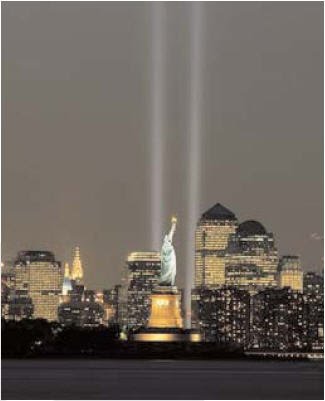
What have I learned from 9/11?

The blending of Christianity and patriotism, as though they were the very same thing, made/makes me extremely uncomfortable.

I’m not going to get into where I was ten years ago today, mostly because I did that at some point. Rather, I just wanted to muse about stuff.

I’ve still not heard a credible explanation of why WTC 7 fell. One does not need to be a conspiracy theorist to wonder about some things that happened that day.

I remember that playing the “real American” card started very early on after the attacks. There were some guys collecting money for the victims’ families that very week. Well, I didn’t know what organization they were representing. But one guy’s demeanor, in particular, gave me pause. He suggested that not contributing to the cause was tantamount to treason. Maybe those who failed to contribute were unAmerican, even terrorists.

The American Red Cross had initiated blood drives in order to treat the many survivors of the multiple attacks in 2001. Of course, there weren’t that many survivors, but they moved forward anyway. I was scheduled to donate the week following, but they called me to NOT donate. They knew they had a bunch of one-off donors, and they figured I’d come back, but that these folks likely would not. I recall there was some criticism of the organization at the time, especially directed at the director at the time, the late Bernadine Healy. From the Red Cross section on Myths and Legends:
After 9/11, the Red Cross collected so much blood that it had to throw much of it out.
Blood is a perishable commodity, with a shelf life of about 42 days. Typically, between 1 percent and 3 percent of units collected reach their expiration date before they are used. That rate was only slightly higher (5 percent) for blood units collected from people anxious to help after 9/11, including more than a quarter-million people who gave blood for the first time.
In the uncertain days following the terrorist attacks, having a robust supply of blood available seemed prudent. It takes two to three days for blood to be collected, tested, and processed, and only blood already on the shelf can be used in the immediate aftermath of an emergency.

Have I mentioned lately that, purely from an aesthetic point of view, that I really disliked the Twin Towers? Someone said it looked like the boxes the Chrysler Building and the Empire State Building were wrapped in. As a result, I had irrational guilt over their destruction.

I was surprised/confused/appalled to see how quickly the so-called USA PATRIOT Act was passed, less than two months after 9/11. One might have concluded that such extensive legislation was in the hopper even before 9/11.

As the article in Truthout, “What a Difference a Decade Makes”, points out, surveillance has swelled to the point that all of us are targeted: “Over the decade, the government’s powers of surveillance have expanded dramatically. They are directed not just at people suspected of wrongdoing, but at all of us. Our phone calls, our emails and website visits, our financial records, our travel itineraries and our digital images captured on powerful surveillance cameras are swelling the mountain of data that is being mined for suspicious patterns and associations.”

The blending of Christianity and patriotism, as though they were the very same thing, made/makes me extremely uncomfortable.

I crashed Albany Pro Musica to sing the Mozart Requiem on a very windy 11 September 2002; that was the only day ever that I wore a tuxedo to work. Exactly two weeks later, I began my weekly vigil, with a number of people who had been there weeks and months before, in my opposition to the war in Iraq. What the heck did Iraq have to do with 9/11? Took a bit of grief over that. And it would have been one thing if it were only “regular people” who jumped all over France for failing to support the curiously illogical war in Iraq; it was US Congress that opted for the jingoistic ‘freedom fries’. How embarrassing.

Someone famously wrote that, after 9/11, irony was dead. Not so. One example is some conservative “humor” book with this goody:
Start a rumor:
Janet Napolitano’s Department of Homeland Security has decided to revise its color-code warning system.
If a small-scale terrorist attack—fewer than 100 expected dead—is imminent, Ms. Napolitano will describe the situation as “calm”—Color Code: Turquoise
If a larger-scale terrorist attack—in the league of 9/11—is imminent, Ms. Napolitano will describe the situation as “relaxed”—Color Code: Ecru.
If Al Qaeda is about to destroy New York and Los Angeles simultaneously with a selection of strategically positioned nuclear devices, like in 24 only way worse柚s. Napolitano will describe the situation as “vibrant”—Color Code: Taupe.
All of this is intended to show the Muslim world that the Obama administration will not “overreact” to terrorism the way the bad old Bush administration did.

Big yucks. Islamophobia is alive and well. But I think we’re better than that.

Despite it all, I think I need to try to follow the advice of the International Institute For Human Empowerment, a representative of which wrote:

The events of 9/11 crystallized for me, the belief that we must unite as peoples of the United States, and indeed of the world, against those who seek to destroy our freedoms. The beautiful diversity that we share was challenged, making us fearful, and causing us to begin to close our hearts to those whom we might have trusted.

We have a choice. We can be afraid of anyone different from ourselves, look out only for ourselves, and live so that only the fittest survive. We can allow terrorism to win by shutting ourselves down.

Or, we can decide in our hearts and minds that humanity is one family with many beautiful expressions of color, language, and customs. We can say that we will honor all those lost and those who mourn, by declaring that we will unite toward a True Democracy–where all are equal, and all are free!

The choice is one we each will make.
***
The MAD magazine 9/11 cover – the untold story.

Summer Songs: Summertime

The summer songs are over, as the season begins to fade…

I’ve long been a sucker for those Red, Hot, and Blue albums. Not only are they generally great compilations, but they aid AIDS research.

At some point, I purchased By George & Ira: Red Hot on Gershwin, which I was quite fond of. Some critics complained about the multiple versions of a few songs, but I love the way Nina Simone’s version of I Loves You Porgy segues into Bill Evans’ instrumental take, e.g.

There are four versions of Summertime. The first is by an unlikely participant on this mostly jazz album: Janis Joplin [listen], who, according to one reviewer, “will certainly get the listener’s attention as she twists and turns the lyrics in a raspy interpretation.” Of course, as it’s probably the first version of the song I owned, from Cheap Thrills, the Big Brother and the Holding Company album, I have a particular fondness for it. Of course, she died in 1970 at the age of 27 from a drug overdose.

Though a quite different take, I also loved the Billy Stewart version [listen]. I realize it’s the trilling of the tongue bit that I found so entrancing (and one of my former co-workers found it so irritating; she wouldn’t allow me to play it if she were around). His “Summertime” was a Top 10 hit on both the pop and R&B charts in 1966. He died in a car crash in 1969 at the age of 32.

A more traditional jazz version came from The Stan Getz Quartet [listen]. Getz died in 1991 at the age of 64 from liver cancer.

Charlie “Bird” Parker [listen] performs the final version of the song. He too died young, at the age of 34. “The official causes of death were lobar pneumonia and a bleeding ulcer but Parker also had an advanced case of cirrhosis and had had a heart attack.”

The summer songs are over, as the season begins to fade…

Put Billy Preston in the Rock and Roll Hall of Fame!

on what would have been Billy Preston’s 65th birthday, I’m making a pitch for him to make it into the rock hall as a session musician.

Billy Preston, George Harrison, President Gerald Ford, all deceased.

While I’m less and less caring about who gets selected for the Rock and Roll Hall of Fame in the Performer category, I’ve become more and more interested in categories such as early influences and non-performers. I’m especially intrigued by the sideman category since Leon Russell was inducted in 2011. After all, he was a performer of some commercial success, but not enough to make it as a performer. But he played on a lot of albums for other artists and was inducted based on that.

The late Billy Preston is similarly situated. He had greater singles success than Russell, with songs such as Outa-Space, Will It Go Round in Circles, Space Race, and Nothing from Nothing, though less so with his albums. But he was well known as a session musician. “Preston collaborated with some of the greatest names in the music industry, including The Beatles, The Rolling Stones, The Band, Nat King Cole, Little Richard, Eric Burdon, Ray Charles, Joe Cocker, George Harrison, Elton John, Eric Clapton, Bob Dylan, Sam Cooke, King Curtis, Sammy Davis Jr., Aretha Franklin, the Jackson 5, Quincy Jones, Mick Jagger, Peter Frampton, Phyllis Hyman, Richie Sambora, Sly Stone, Johnny Cash, Neil Diamond, the Red Hot Chili Peppers, Norah Jones, and Ringo Starr.” Not to mention gospel great Mahalia Jackson. Both Russell and Preston played on the legendary Concert for Bangladesh.

The label on the “Get Back” single credits “The Beatles with Billy Preston”. Here’s the famed Beatles doing Get Back, live on the rooftop.

More Preston appearances:

Ray Charles & Norah Jones-Here We Go Again. Billy on organ.

John Lennon-God. Billy on piano.

Johnny Cash-Personal Jesus. Billy on piano.

Ringo Starr-I’m the Greatest. Billy on organ.

But probably my favorite piece is Billy at the organ on The Rolling Stones-I Got The Blues from the album Sticky Fingers.

So, on what would have been Billy Preston’s 65th birthday, I’m making a pitch for him to make it into the rock hall as a session musician.

Oh, and here’s the first song from Billy’s first Apple album, That’s The Way God Planned It, a song called Do What You Want To.


August Rambling

GayProf noted Perry when he wrote: “Numerous songs en vogue right now celebrate women consuming alcohol to the point of blacking out, hooking up, or hurling (not always in that order). ”

Because I was out of town, I managed to miss a couple of significant cultural anniversaries. One was the 50th anniversary of the first real Marvel superhero comic, the Fantastic Four, by Stan Lee and Jack “King” Kirby. Mark Evanier explains why it had a November cover date. Check out this hour-long Kirby documentary. And here’s a link to the intro to the FF TV show.


The other was the 100th anniversary of the birth of Lucille Ball. I watched most, if not all, of the episodes of every single one of her ongoing series, from the seminal I Love Lucy (1951-1957; 8.9 out of 10 on the IMDB scale), which started before even TV Guide and I were born but lives through the clever concept known as the rerun; to the star-studded (and too long, in my recollection) episodes of The Lucy-Desi Comedy Hour (1957-1960; 8.6); to The Lucy Show (1962–1968; 7.3), which was the one with Lucy as Lucy Carmichael, Vivian Vance (Ethel Mertz in the earlier shows) as Viv, and Gale Gordon as Lucy’s testy boss, Mr. Mooney.

Then there was Here’s Lucy (1968–1974, 6.8), where “Lucy Carter, a widow with two teen children [played her real kids with Desi Arnaz, Lucie and Desi Jr.] takes a job as a secretary for her stuffy brother-in-law [Gale Gordon, again.] Finally, there was Life with Lucy (1986; 6.0) “Lucy Barker, now a grandmother living with her daughter’s family” Gale Gordon also appeared in this show.

They declined in quality somewhat – Life with Lucy was particularly bad, as I recall – but if I didn’t quite LOVE Lucy, I liked the woman from upstate New York (Jamestown) quite a bit.

I believe this was Lucy’s favorite scene from her first series.

As you may have noticed, Katy Perry becomes the second artist, following Michael Jackson, to send five songs from an album to No. 1 on the Billboard charts, and during his birth month, no less. An accomplishment to be sure, though the charts don’t reflect the same level of sales they used to. (Similarly true of top-rated TV shows: the numbers are far less than they used to be.) Not incidentally, GayProf noted Perry when he wrote: “Numerous songs en vogue right now celebrate women consuming alcohol to the point of blacking out, hooking up, or hurling (not always in that order). “

In pictures of models, “there are women (and occasionally men) contorted into positions that, were you to see actual people in them, you’d find curious or peculiar or perhaps even alarming.”

Natalie Cole with the Allman Brothers. Check out the sidebar for David Crosby, Graham Nash, and others.

On Star Trek: The Next Generation, Data could reproduce the voices of humans with perfect fidelity. Brent Spiner can do the same with the voice of Patrick Stewart.

My new Kickstarter fave: Stripped is a documentary love letter to cartoonists and comic writers who’ve delighted newspaper readers for decades. Since 2008, 166 newspapers have shut down, leaving the future uncertain for many syndicated cartoonists. Amidst this industry upheaval, Stripped follows 60 cartoonists, including luminaries like Jim Davis, Scott McCloud, and Jeff Keane, as they navigate the uncharted waters of a new digital world.

Having seen the trailer for the Spider-Man movie reboot, I have no reason to actually see the movie. The first two movies with Tobey Maguire were great; even own them on DVD.
***

Two music legends died this month. Jerry Leiber of the songwriting duo Leiber & Stoller wrote more songs than just about any pop composer. Here’s a list of most of them. Listen to Big Mama Thornton singing “Hound Dog”, some four years before Elvis Presley. Also, hear Charlie Brown by the Coasters; coincidentally, Carl Gardner, leader of the Coasters, died a couple of months ago.

Nickolas Ashford, who died August 22, was the songwriting partner and husband of Valerie Simpson. Ashford & Simpson wrote songs for Motown artists, Aretha Franklin, and others, as well as performing themselves. Hear Marvin Gaye & Tammi Terrell do You’re All I Need To Get By. Also, here’s a song originally performed by Ray Charles, I Don’t Need No Doctor (live) by Humble Pie.

The Jerry Leiber Cover Story on Coverville.

The Salon story about Leiber and Ashford.

GOOGLE ALERTS

Roger with the hula hoop

Rollie Roger Green T-Shirt

Roger Green, the proprietor of Hair by Roger, said noise and vibrations from the work were spoiling the salon’s ‘peaceful environment’. A spokesperson from United Utilities said: “We are fully aware of the impact this scheme has had on the community…”

“The Black Boardwalk Cat is a distinctive animal that has acquired an unusual place in the hearts of many university employees and students,” said Roger Green, associate professor of political science and public administration.

Forgotten Book: THE THROTTLEPENNY MURDER, Roger J. Green. My contribution this week to Pattinase’s Friday’s Forgotten Books is a book I read in 1993.

“Former Wisbech Mayor and Wisbech Standard editor, Roger Green who died in a road traffic collision on the A47 Wisbech bypass…. This particular Roger Green got a LOT of coverage.

Social media & sharing icons powered by UltimatelySocial